Visiting Paris’s top museums with mobility challenges is not about finding ramps, but mastering a system of logistical shortcuts that minimize walking and maximize enjoyment.
- Strategic use of lesser-known entrances and internal elevators can bypass the biggest crowds and staircases.
- Planning your day around a network of accessible facilities in nearby museums provides crucial “comfort pit stops.”
Recommendation: Shift your mindset from simply seeing art to strategically managing your physical energy—what we call an “effort economy”—for a more sustainable and pleasant experience.
The dream of Paris often involves strolling through grand museum halls, gazing at masterpieces, and soaking in centuries of culture. But for travelers with knee pain, arthritis, or reduced mobility, that dream can quickly become a nightmare of endless corridors, daunting staircases, and overwhelming crowds. The physical toll of navigating these vast institutions can overshadow the beauty you came to see, leaving you exhausted rather than enriched.
Many guides offer generic advice like “wear comfortable shoes” or “book tickets online.” While helpful, this barely scratches the surface of the real challenge. These tips don’t tell you how to bypass the Louvre’s infamous spiral staircase, where to find a clean, accessible restroom near the Eiffel Tower without a long trek, or how to see the Mona Lisa without being swallowed by a sea of people. The issue isn’t a lack of will, but a lack of a strategic, logistical blueprint for a comfortable visit.
But what if the key wasn’t just endurance, but intelligence? What if you could navigate these cultural giants using a system of hidden infrastructure and comfort-first strategies? This guide moves beyond the obvious to provide a detailed logistical plan. We will focus on concrete, actionable tactics—an “effort economy”—that allow you to budget your energy, avoid physical strain, and truly connect with the art. We’ll reveal the specific entrances, elevators, quiet zones, and tools that transform a potentially painful ordeal into a deeply rewarding cultural journey.
This article provides a detailed, location-specific blueprint for navigating Paris’s most iconic cultural sites with comfort and ease. Each section addresses a common logistical challenge, offering a practical solution you can implement immediately.
Summary: A Strategic Guide to Visiting Paris Museums with Knee Pain and Minimal Walking
- The Hidden Elevator at the Louvre: How to Avoid the Spiral Staircase?
- Wheelchair Loan: Do You Need to Reserve One at the Centre Pompidou?
- The Best Clean and Free Toilets Near the Eiffel Tower?
- Smartphone vs Rental Guide: Which is Louder and Clearer for Seniors?
- The “Quiet Hours”: When is the Rodin Museum Most Peaceful?
- The “One Era per Hour” Rule: How to Prevent Museum Burnout in Children?
- How to Cross Montmartre Without Climbing More Than 50 Stairs?
- How to See the Mona Lisa in Under 30 Minutes After Entering the Louvre?
The Hidden Elevator at the Louvre: How to Avoid the Spiral Staircase?
The main Pyramid entrance at the Louvre is an architectural marvel, but it funnels visitors towards a large, intimidating spiral staircase. For anyone with mobility concerns, this is a significant barrier right at the start. The solution is not to power through it, but to bypass it entirely using a piece of hidden infrastructure known to savvy visitors: the Carrousel du Louvre entrance.
This underground shopping center entrance at 99 rue de Rivoli is your gateway to a stress-free entry. It offers a flat, indoor walk to a secondary security check with typically shorter lines. More importantly, it provides direct access to elevators that take you past the main spiral staircase and into the central reception hall under the Pyramid. This isn’t just an alternative entrance; it’s a completely different system for accessing the museum that prioritizes comfort over spectacle.
To execute this comfort-first navigation, follow this simple plan:
- Enter the Carrousel du Louvre shopping center at 99 rue de Rivoli. The entrance is clearly marked and accessible from street level.
- Follow the indoor signs pointing towards the inverted pyramid (Pyramide Inversée). This is a flat, smooth pathway of about 50 meters.
- Before the main security area, locate the two dedicated lifts. Museum staff are usually positioned here to guide priority access visitors.
- Once through the dedicated security check, you will take the central ‘tube’ lift, which ascends directly into the main reception hall, completely avoiding the spiral staircase.
By using this logistical blueprint, you start your visit calmly and with your energy preserved for the art itself, not wasted on navigating architectural obstacles.
Wheelchair Loan: Do You Need to Reserve One at the Centre Pompidou?
The short answer is no, you generally do not need to make an advance reservation to borrow a wheelchair at the Centre Pompidou or most other major Paris museums. This is a crucial piece of logistical information that can significantly simplify your planning. Instead of worrying about booking weeks ahead, you can make the decision on the day based on how you feel.
A wheelchair should not be seen as a last resort, but as a strategic tool in your effort economy. The Centre Pompidou, with its vast, open-plan galleries, is particularly taxing to cross on foot. Using a complimentary wheelchair allows you to conserve energy for appreciating the modern art collections, rather than spending it on traversing long distances. According to a recent visitor who documented their experience, wheelchairs were readily available at the cloakroom of five major Paris museums, including the Pompidou, simply by presenting a photo ID. No prior booking was necessary, making it a flexible and invaluable service.
Upon arrival at the Centre Pompidou, simply head to the ground floor cloakroom or accessibility desk. The staff are accustomed to these requests and will provide a wheelchair for the duration of your visit, allowing you to navigate the iconic building and its impressive exhibitions in comfort.
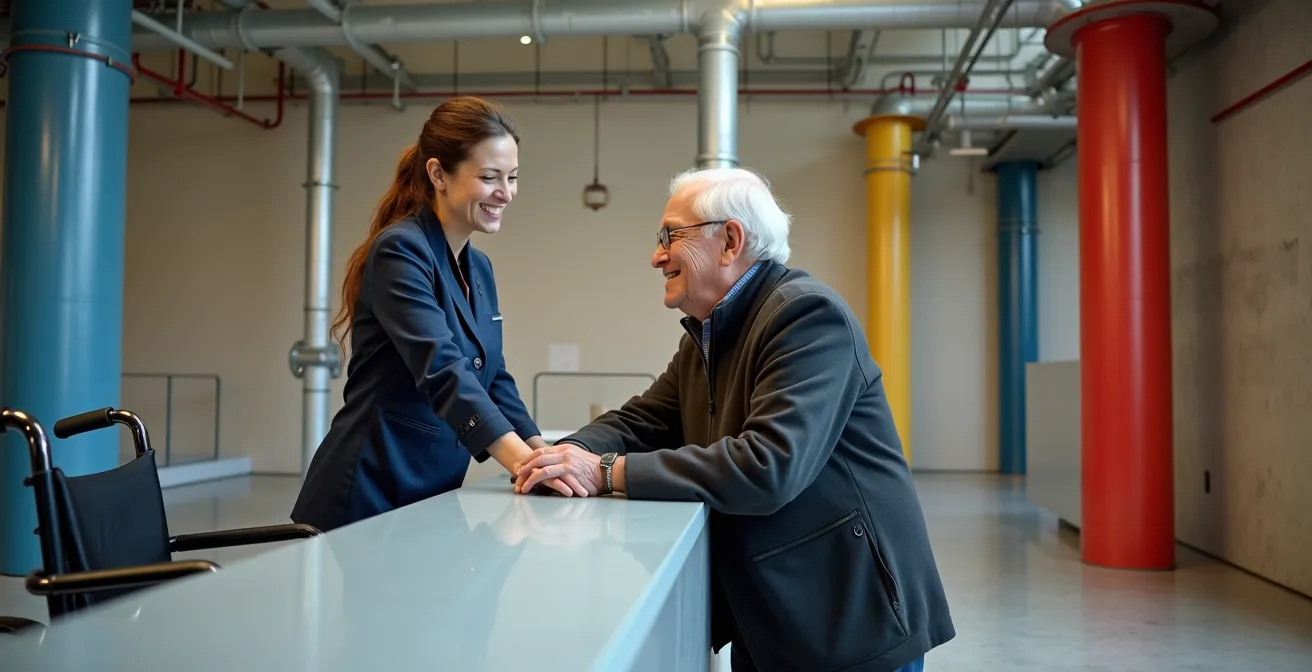
As you can see, the process is designed to be straightforward and welcoming. Embracing these available tools is a key part of a successful comfort-first navigation strategy, turning a potentially exhausting visit into an enjoyable exploration.
The Best Clean and Free Toilets Near the Eiffel Tower?
While the Eiffel Tower itself has facilities, the queues can be long and the journey to reach them arduous. A more strategic approach is to think of accessible restrooms not as a single destination, but as a network of comfort pit stops integrated into your itinerary. The most reliable, clean, and accessible toilets are often found within nearby museums, which offer free entry to visitors with disabilities and their companions.
Instead of searching for a public sanisette, plan a brief stop at a nearby cultural institution. This strategy allows for a moment of strategic decompression in a calm and secure environment. For instance, the Musée Rodin and its beautiful gardens are just a 15-minute walk from the Champ de Mars and offer perfectly accessible facilities. This turns a functional necessity into a pleasant pause in your day.
To help you build your own comfort network, this table compares the key accessibility features of several museums located within a reasonable distance of the Eiffel Tower. These institutions can serve as invaluable strategic stops during your day of exploration. As a report from the official Paris Musées network shows, these locations are well-equipped.
| Museum | Distance from Eiffel Tower | Accessible Toilets | Free Entry for Disabled |
|---|---|---|---|
| Musée Rodin | 1.5 km | Yes, all floors | Yes + companion |
| Musée d’Orsay | 2 km | Yes, multiple locations | Yes + companion |
| Musée de l’Orangerie | 2.5 km | Yes, ground floor | Yes + companion |
By viewing these museums as part of your support infrastructure, you transform the challenge of finding a restroom into an opportunity for a restful and civilized break.
Smartphone vs Rental Guide: Which is Louder and Clearer for Seniors?
Choosing an audio guide is a critical decision for an enriching museum experience, especially for visitors with hearing challenges. The choice between using your own smartphone with a museum app or renting a dedicated device involves a trade-off between convenience and specialized features. While a smartphone is familiar, the museum’s rental device often provides superior audio support.
The key advantage of the dedicated device, particularly at a world-class institution like the Musée d’Orsay, is its integration with accessibility technology. As the official accessibility services confirm, these devices are designed to work with a crucial piece of hidden infrastructure: magnetic induction loops. This technology dramatically improves sound clarity for anyone with a compatible hearing aid.
The museum auditorium is equipped with a magnetic induction loop (MIL) – remember to set your hearing aid to the T position. Audio guides can be equipped with magnetic induction neck loops, available free of charge on request at the audio guide counter.
– Musée d’Orsay Accessibility Services, Official Musée d’Orsay Accessibility Guidelines
This feature alone often makes the rental device the superior choice for clarity. Furthermore, dedicated devices have physical buttons, which can be easier to operate than a touchscreen, and a guaranteed full-day battery life, eliminating any anxiety about your phone dying. The following table breaks down the differences based on the options available at the Musée d’Orsay.
| Feature | Museum Device | Smartphone App |
|---|---|---|
| Weight | Light handheld device | Varies by phone model |
| Audio Enhancement | Magnetic induction loops available (free) | Phone’s accessibility settings |
| Physical Controls | Physical buttons | Touchscreen only |
| Battery Life | Full day guaranteed | Depends on phone usage |
| Cost | €5 rental fee | Free app download |
| Special Features | Sign language videos included | Requires stable WiFi |
Ultimately, while the smartphone app is free, the small rental fee for the museum’s device is an investment in a clearer, more accessible, and less stressful auditory experience.
The “Quiet Hours”: When is the Rodin Museum Most Peaceful?
Finding a moment of peace in a popular Paris museum can feel impossible. While many visitors focus on “quiet hours,” a more effective strategy for tranquility is to seek out “quiet zones.” The Musée Rodin is a perfect example of this principle. Due to its unique layout, combining an indoor mansion with a vast three-hectare garden, it offers built-in areas for strategic decompression, even during peak times.
The museum’s own analysis reveals that while crowds congregate in the main building (the Hôtel Biron) to see iconic works like ‘The Kiss’, the expansive gardens offer natural pockets of serenity. The key is to move beyond the central basin and explore the southern wooded areas of the park. These sections have smooth, accessible pathways but attract far fewer visitors, allowing you to enjoy sculptures like ‘The Gates of Hell’ in relative solitude. This is a prime example of using spatial planning, rather than just timing, to manage your environment.
This approach transforms your visit. Instead of rushing through galleries, you can alternate between viewing the art indoors and taking restful breaks in the garden’s peaceful corners. This rhythm is essential for managing your effort economy and preventing sensory overload.

As this image suggests, the garden provides a completely different atmosphere. By intentionally seeking out these quiet zones, you create your own peaceful experience, independent of the museum’s overall crowd levels. It’s a powerful strategy for anyone who finds the hustle and bustle of popular museums overwhelming.
The “One Era per Hour” Rule: How to Prevent Museum Burnout in Children?
While often recommended for managing children’s attention spans, the “One Era per Hour” rule is a powerful logistical blueprint for anyone looking to practice good effort economy. For seniors or visitors with mobility issues, museum burnout is a very real physical and mental exhaustion. The Louvre is a prime offender; museum officials calculate that seeing all its exhibits would require walking a staggering 12 kilometers. Attempting too much is the fastest way to an unpleasant experience.
The “One Era per Hour” rule provides a simple, elegant solution. Instead of aimlessly wandering, you commit to exploring just one wing or historical period (e.g., Egyptian Antiquities in the Denon wing, Italian Renaissance in the Richelieu wing) for a focused 45-60 minute period. This is followed by a mandatory break for rest and strategic decompression. This approach replaces an overwhelming marathon with a series of manageable, rewarding sprints.
Here is a practical, comfort-first route through the Louvre applying this principle:
- Start Smart: Use the Carrousel entrance to bypass the main crowds and stairs, saving energy from the very beginning.
- Focus on One Wing: Choose the Denon wing for its relatively compact layout and world-famous Egyptian antiquities. Commit to this area only.
- Utilize Support: Borrow one of the museum’s free multifunctional rolling chairs from the Assistance desk. They can be used as a seat when you need a brief rest in front of a work of art.
- Mandatory Break: After 45-60 minutes, head to a museum café for a seated rest. This is a non-negotiable part of the plan.
- Easy Exit: Exit back through the Carrousel shopping center for a flat, easy route to the Tuileries Garden, where you can find benches for a final rest.
By adopting this disciplined approach, you trade the illusion of “seeing everything” for the reality of truly enjoying a few things in comfort.
How to Cross Montmartre Without Climbing More Than 50 Stairs?
Montmartre, with its charming but steep cobblestone streets, represents the ultimate accessibility challenge in Paris. The iconic butte is crowned by the Sacré-Cœur basilica, which sits atop a hill involving nearly 300 steps from the base. However, reaching the top with minimal climbing is entirely possible by using a multi-modal system of public transport—a perfect example of a logistical blueprint in action.
The key is to avoid a direct uphill walk from a low-lying Metro station like Anvers or Pigalle. Instead, you can leverage a combination of an accessible Metro line, a dedicated bus, and a funicular to do the heavy lifting for you. According to accessibility experts and visitor reports, a journey using Bus Line 40 (formerly the Montmartrobus) can get you from the Pigalle station area to the artist’s square of Place du Tertre—steps from the Sacré-Cœur—with fewer than 10 stairs required for the entire trip. This is a transformative strategy.
For a completely stair-free journey, the Montmartre Funicular acts as a diagonal elevator, whisking you up the steepest part of the hill in under two minutes for the price of a standard Metro ticket. It’s the most direct and effortless solution.
Your Zero-Stair Montmartre Navigation Guide
- Accessible Metro Start: Take Metro Line 12 to the Abbesses station. It is one of the few deep stations in Paris equipped with large elevators to bring you to street level.
- Board the Right Bus: From Abbesses or Pigalle, board Bus 40. As confirmed by specialist guides at Wheelchair Travel, all Paris city buses are equipped with ramps for wheelchair access.
- Get Off at the Top: Ride the bus to the ‘Place du Tertre – Norvins’ stop. This drops you on the flattest part of the hilltop, a short roll or stroll from the basilica.
- The Funicular Alternative: If you arrive via Metro Line 2 at Anvers, follow the signs to the Funiculaire de Montmartre at the base of the hill. It will take you directly to the top.
- Gentle Descent: For your journey down, take the picturesque Rue Lepic, famous from the film ‘Amélie’, which offers one of the gentlest gradients on the butte.
By using this combination of hidden infrastructure, you can conquer Montmartre’s hill and enjoy its breathtaking views without the physical strain.
Key Takeaways
- Accessibility is a system, not a feature. Success lies in combining hidden entrances, accessible transport, and strategically located facilities.
- An “effort economy” mindset is crucial. Proactively manage your physical energy by using tools like wheelchairs and taking planned rests.
- The best solutions are often logistical “hacks,” like using museum facilities as pit stops or understanding special access rules for specific artworks.
How to See the Mona Lisa in Under 30 Minutes After Entering the Louvre?
Seeing the Mona Lisa is a bucket-list item for many, but the reality often involves battling an immense, slow-moving crowd for a fleeting glimpse. For a visitor with mobility issues, this scrum is not just unpleasant; it’s a significant physical challenge. The secret to a better experience is not to fight the crowd, but to be granted permission to bypass it entirely.
The Louvre has a specific, though not widely advertised, policy that provides priority access to the Mona Lisa for visitors in wheelchairs. This is the single most effective strategy for a quick and comfortable viewing. As a leading accessibility guide confirms, this isn’t just about skipping a line; it’s about a qualitatively different experience.
Visitors in wheelchairs are allowed to cut the line to see the Mona Lisa, and are given preferred access directly in front of the painting. When you reach the room that hosts the Mona Lisa, you will be ushered to a special viewing area – in FRONT of the crowd.
– Ataxia Scotland Accessibility Guide, Accessible Louvre Museum Paris Guide
This “front of the line” access transforms the experience from a stressful battle into a privileged, unobstructed moment with the masterpiece. To achieve this, your choice of entrance matters, as it affects your travel time within the museum to reach the Denon wing where the Mona Lisa resides. The table below compares the main accessible entrances and their estimated time to reach your goal.
| Entrance | Accessibility Features | Time to Mona Lisa | Best For |
|---|---|---|---|
| Pyramid (Main) | Central tube lift available | 15-20 minutes | First-time visitors |
| Carrousel (99 rue de Rivoli) | Two lifts, flat pathway | 20-25 minutes | Wheelchair users |
| Porte des Lions | Ground level, irregular hours | 25-30 minutes | Quiet entry (check schedule) |
For the fastest path, the main Pyramid entrance (using the central lift) is often the most direct. Upon reaching the crowded room, simply make your way to the side where security staff are managing the ropes, and they will guide you to the designated viewing area.
By applying this logistical blueprint—from choosing the right entrance to leveraging priority access rules—you can turn what is often the most stressful part of a Paris museum visit into one of the most memorable and comfortable moments of your trip. Begin planning your journey today by mapping out these comfort-first strategies for each museum on your list.