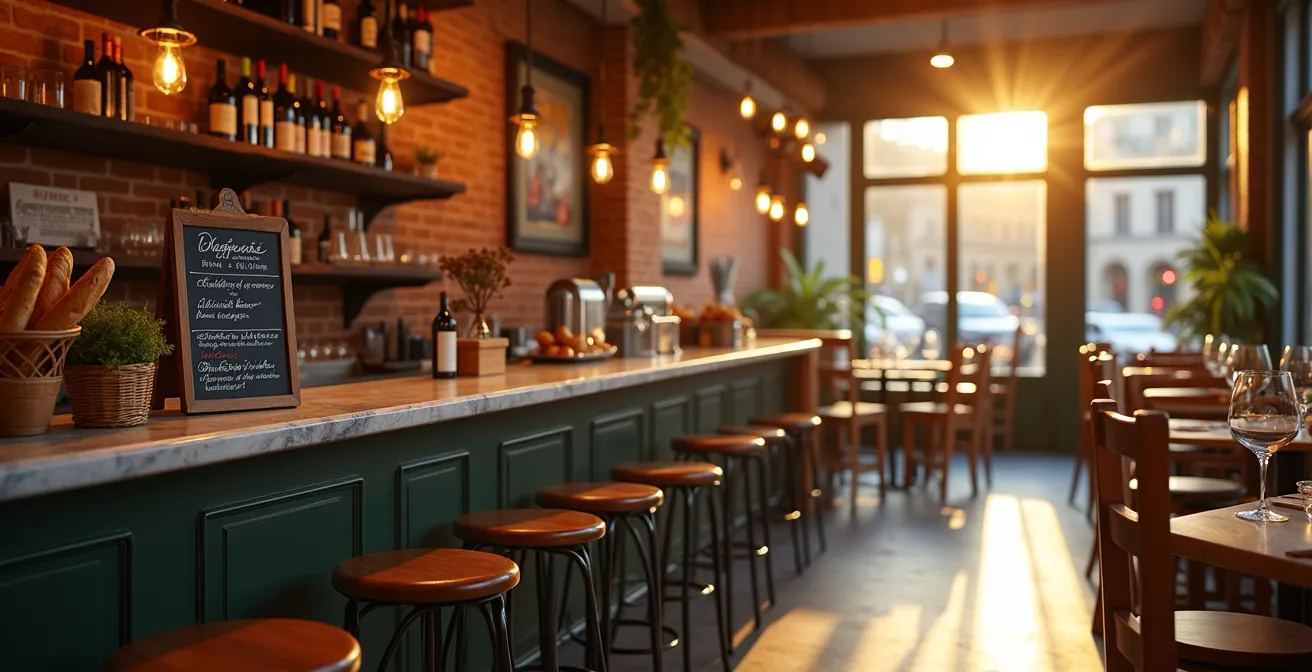
Bistronomy isn’t a watered-down version of fine dining; it’s a high-stakes game of value-driven creativity with its own secret rules and codes.
- Success means mastering booking apps and knowing the strategic moments to call a restaurant directly.
- It requires embracing the thrill of “carte blanche” menus and decoding the often-intimidating world of natural wines.
Recommendation: Master these unwritten rules, and you’ll unlock culinary experiences that rival Michelin-starred restaurants for a fraction of the price, dining like a true Parisian insider.
Paris. The very name conjures images of culinary perfection: towering soufflés, opulent dining rooms, and wine lists as thick as novels. For any serious foodie, it’s the ultimate pilgrimage. But this dream often collides with a daunting reality—the choice between overpriced tourist traps and the intimidating, wallet-draining world of three-star gastronomy. The common advice is to hunt for a ‘menu du jour’ or settle for a casual café, but that means missing out on the electric creativity that defines modern Parisian dining.
But what if the key to unlocking Michelin-quality food for under 50€ wasn’t about finding a discount, but about understanding a completely different system? Welcome to the world of bistronomy. This isn’t just “casual fine dining”; it’s a revolutionary philosophy built on technique, seasonality, and smart economics. It’s a scene with its own unwritten rules, strategic moves, and secret handshakes. Forget what you think you know about dining in Paris. To truly conquer bistronomy, you need the insider’s playbook.
This guide is that playbook. We will move beyond simple recommendations to decode the strategies that power this movement. From digital booking hacks and the psychology of the blind tasting menu to the unspoken etiquette of laptop use and the controversial “second service” rule, you’ll learn to navigate the Parisian food scene with the confidence of a local critic. Get ready to break the culinary codes and discover how to eat like royalty on a revolutionary’s budget.
For those who prefer a visual introduction, the following video offers a fantastic immersion into the atmosphere of the city’s best local-approved bistros, perfectly complementing the strategic advice in this guide.
To help you navigate this culinary landscape, this article is structured as a strategic playbook. Each section tackles a key element of the bistronomy experience, providing the tactics you need to master it. Use this summary to jump directly to the challenges you want to conquer first.
Summary: Your Playbook for Conquering Parisian Bistronomy
- TheFork or Zenchef: Which App Offers the Best Last-Minute Bistronomy Tables?
- The Blind Tasting Menu: Are You Brave Enough for a “Carte Blanche” Dinner?
- Natural Wine Lists: How to Order Something That Doesn’t Taste Like Cider?
- The “Second Service” Rule: Why You Might Be Asked to Leave Your Table by 9:PM?
- Top Chef Alumni: Which Restaurants Are Run by TV Show Contestants?
- Chinatown 13th vs Belleville: Which District Has the Best Pho?
- Coworking Friendly: Which Bistros Allow Laptops During Lunch Rush?
- How to Select a Natural Wine in a Parisian Cave Without Tasting Like Cider?
TheFork or Zenchef: Which App Offers the Best Last-Minute Bistronomy Tables?
In the fast-paced world of Parisian dining, your smartphone is your first weapon. Booking platforms are essential, as data shows that digital reservations are the new norm. In fact, a study reveals that over half of bookings are made outside restaurant opening hours, making app mastery non-negotiable. The two dominant players are TheFork (LaFourchette) and Zenchef, but they operate on fundamentally different models. TheFork is a consumer-facing app offering discounts, while Zenchef is a B2B tool that powers the direct booking widgets on many restaurant websites.
Thinking one app is enough is a rookie mistake. The true insider strategy is to play them against each other. A “fully booked” status on TheFork often doesn’t tell the whole story, as restaurateurs are reluctant to list all their tables on a platform that takes a commission for every cover. This is where the savvy diner gains an edge, using a multi-channel approach to find tables that others miss. Mastering this digital dance is the first step in your bistronomy playbook.
Your Playbook: Last-Minute Booking Tactics
- Cross-Reference Channels: Always check both TheFork and the restaurant’s own website. Many desirable bistros use a discreet Zenchef widget for direct, commission-free bookings.
- Go Analogue When Blocked: If a restaurant shows as fully booked on TheFork, call them directly. They often hold back tables for regulars and phone-in reservations.
- Leverage Cancellation Alerts: Set an alert on TheFork for 24 hours before your desired date. This is when automated confirmation reminders go out, often triggering a wave of cancellations you can immediately snatch.
- Understand Zenchef’s Cadence: A booking via a Zenchef widget is often a request, not an instant confirmation. Expect a response within 24 hours, so plan accordingly.
- Master the Waiting List: The golden hour to call for a waiting list spot is between 5 PM and 6 PM. This is when restaurants are prepping for service and have the clearest picture of their evening’s reservations and potential no-shows.
This hybrid digital-analogue approach transforms you from a passive user into an active hunter, giving you access to tables that are invisible to the average tourist relying on a single app.
The Blind Tasting Menu: Are You Brave Enough for a “Carte Blanche” Dinner?
One of bistronomy’s most thrilling—and intimidating—features is the rise of the “menu dégustation à l’aveugle,” or blind tasting menu. You won’t see a list of dishes. Instead, you’ll see a price, a number of courses (e.g., “Menu en 6 temps”), and a question about allergies. This is not a gimmick; it’s a core tenet of the bistronomy philosophy. It’s a declaration of confidence from the chef and a pact of trust with the diner, allowing for ultimate creativity and zero food waste by using only the best ingredients available from the market that very morning.
Embracing this “menu roulette” is a rite of passage for any serious foodie. It’s a commitment to the chef’s vision over your own preferences. The reward is a unique culinary journey, a sequence of dishes that are perfectly paced and composed to tell a story. It’s also often the best value proposition in the house, as it allows the kitchen to showcase premium, small-batch ingredients that aren’t available in large enough quantities for an à la carte menu.
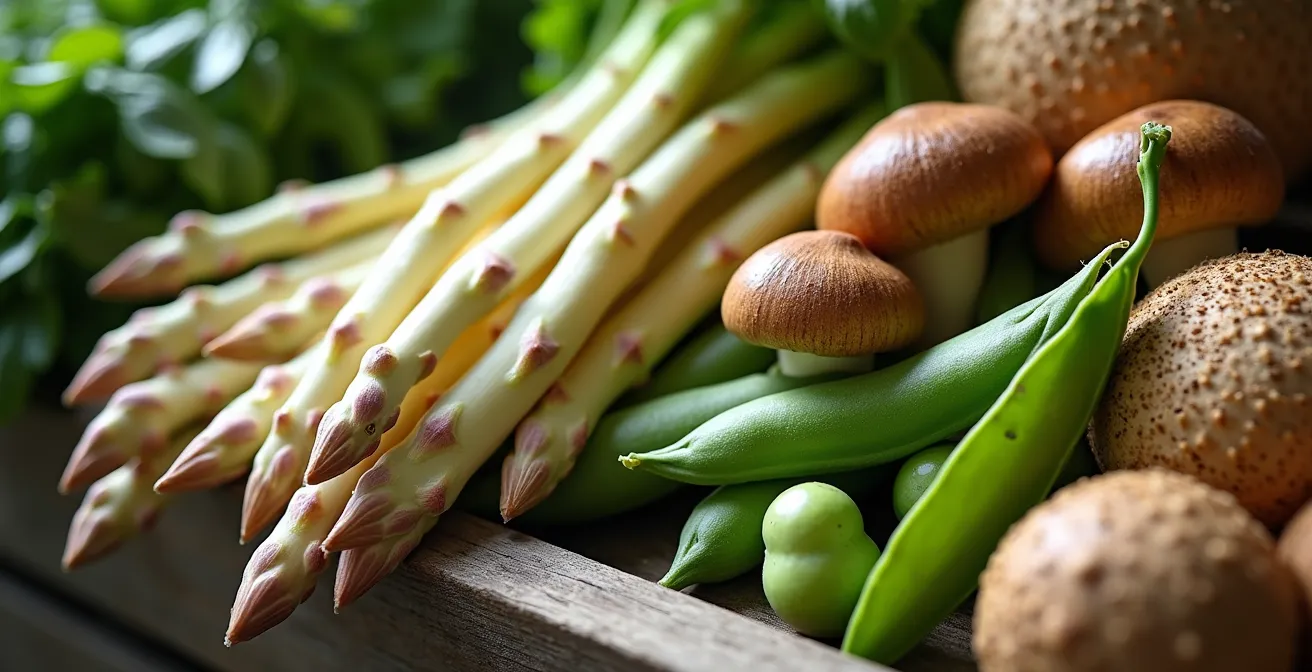
As the image of fresh market produce suggests, the ‘carte blanche’ menu is a direct reflection of seasonality. What the chef finds at the market at 6 AM is what you will be eating that evening. This approach ensures a level of freshness and spontaneity that traditional gastronomy, with its fixed and printed menus, can rarely match.
Case Study: The Pierre Sang Model
Pierre Sang in Oberkampf perfectly embodies the “carte blanche” concept. His restaurant offers a daily-changing six-course mystery menu that blends his Korean heritage with classic French techniques. Diners are encouraged to guess the ingredients as they eat, turning the meal into an interactive and playful experience. The full menu is only revealed at the very end, after dessert. This model has proven so successful that his restaurants are consistently booked out, despite guests having no idea what they will be served, proving that trust in the chef is the ultimate currency.
Saying “yes” to a blind menu isn’t just about being brave; it’s a strategic move. You are signaling to the kitchen that you are an adventurous diner, often resulting in a more personal and memorable experience.
Natural Wine Lists: How to Order Something That Doesn’t Taste Like Cider?
Navigating a bistronomy wine list can feel like deciphering a secret code. Forget the familiar Bordeaux and Burgundy classifications. You’re now in the land of “Vin de France,” obscure grape varieties, and the wild, wonderful world of natural wine. This is not a passing fad; it’s a full-blown movement. With Paris leading the world with nearly 600 establishments serving natural wine, understanding it is crucial. These wines prioritize minimal intervention, which can lead to vibrant, expressive flavors… or something that tastes suspiciously like funky apple cider.
The key to ordering successfully is to abandon your preconceived notions and learn the new vocabulary. Many of these wines are classified as “Vin de France” not because they are low quality, but because their rebellious winemakers refuse to conform to the strict, often homogenizing rules of the traditional AOC (Appellation d’Origine Contrôlée) system. The official “Vin Méthode Nature” charter provides a baseline, requiring organic grapes and minimal sulfur, but many winemakers go even further. Learning to spot these terms on a list is your first step to culinary code-breaking.
This decoder table is your secret weapon for navigating the often-cryptic terms on a modern Parisian wine list. It helps translate the jargon into real-world flavor expectations.
| Label Term | What It Means | Flavor Expectation |
|---|---|---|
| Vin de France | Often indicates natural wine rebellion against AOC rules | More experimental, potentially funkier |
| Sans soufre ajouté | No added sulfites | Livelier, potentially more volatile |
| S.A.I.N.S. | Sans Aucun Intrant Ni Sulfite (No Inputs or Sulfites) | Pure expression, can be cloudy |
| Méthode Nature | Official natural wine charter | Cleaner than most natural wines |
Don’t be afraid to talk to the sommelier or server. Use descriptive words about what you usually like (“I enjoy light, peppery reds like a Loire Cabernet Franc” or “I’m looking for a mineral-driven, non-oaky white”). This gives them a map to guide you through their world, ensuring you get a bottle you’ll love.
The “Second Service” Rule: Why You Might Be Asked to Leave Your Table by 9:PM?
You’ve secured a 7:30 PM reservation at a hot bistro. The food is incredible, the wine is flowing. Then, around 8:45 PM, the bill arrives unsolicited, and you get the distinct feeling you’re being gently ushered out. Welcome to the “second service,” one of the most misunderstood and crucial economic engines of bistronomy. This is not rudeness; it’s the fundamental business model that allows these small, independent restaurants to serve high-quality food at accessible prices. By turning tables once, a tiny 20-seat restaurant can serve 40 people a night, effectively doubling its revenue without compromising on quality.
This is the “Second Service Gambit.” The first seating (typically 7:00 or 7:30 PM) comes with an implicit understanding that the table is needed for the second seating (around 9:30 PM). Diners in the second seating, however, have the luxury of lingering as long as they wish. Understanding this rule is key to a stress-free experience. If you want a long, leisurely meal, always book for the second service. If you’re heading to a show or simply want to eat earlier, the first service is perfect, but you must be prepared to cede your spot.
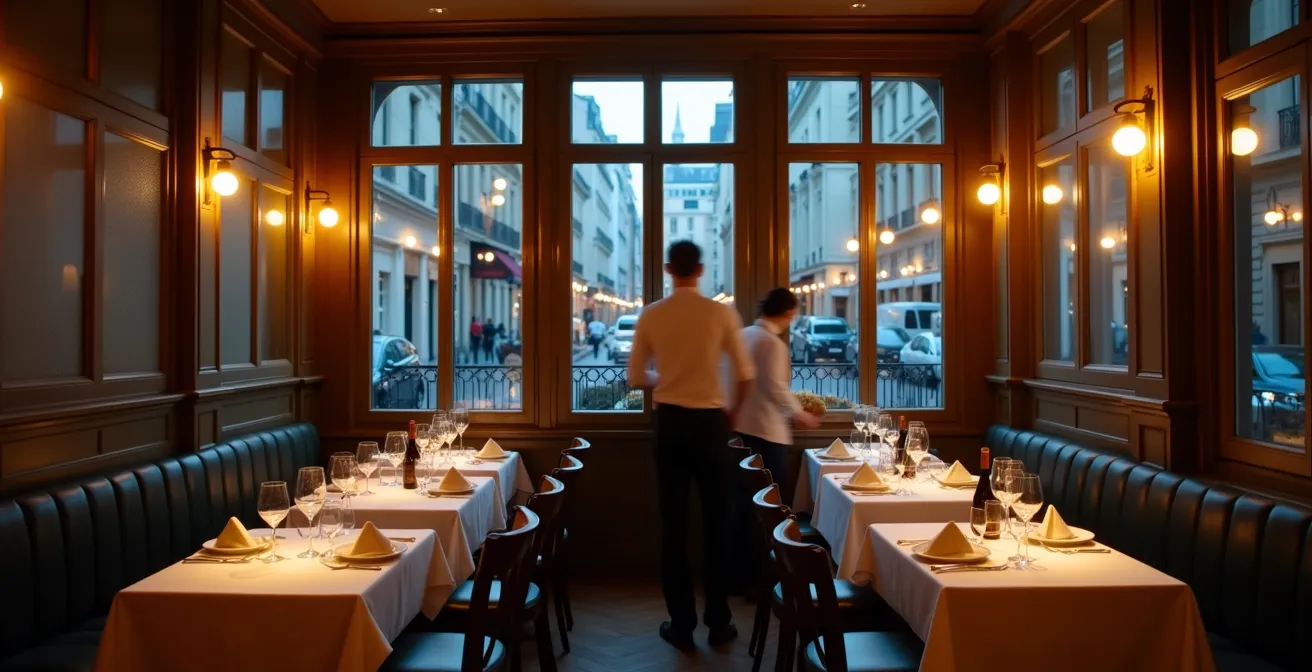
The brief, almost balletic period between services is a critical moment for the restaurant, as staff efficiently reset the entire dining room for the next wave of guests. This operational efficiency is precisely what enables the affordable excellence that defines the movement.
Case Study: The Le Comptoir du Relais Model
Chef Yves Camdeborde’s Le Comptoir du Relais in the 6th arrondissement is a pioneer of this strict two-service system. It established the benchmark for modern bistronomy: the first service at 7:30 PM must vacate by 9:00 PM to make way for the 9:30 PM seating, which has no time limit. This disciplined approach allows the famously small restaurant to maintain its Michelin Bib Gourmand standards while remaining one of the city’s most sought-after and relatively affordable reservations, proving the model’s success.
Far from being an inconvenience, recognizing the two-service rule is a sign of respect for the restaurant’s craft and business model. It’s another piece of the playbook that separates the tourist from the insider.
Top Chef Alumni: Which Restaurants Are Run by TV Show Contestants?
The French reality TV show Top Chef has become a powerful star-maker in the Parisian food world, launching the careers of dozens of talented young chefs. Visiting a restaurant run by a former contestant can be an exciting way to tap into the city’s culinary zeitgeist. These chefs often open establishments that perfectly embody the bistronomy spirit: creative, technique-driven, and full of youthful energy. However, the “Top Chef effect” is a double-edged sword that the savvy diner must navigate carefully.
The instant fame from the show can have a dramatic impact on accessibility and price. As food writer and bistronomy expert Jane Sigal notes, the hype can be immediate and intense.
A contestant’s appearance on Top Chef can cause prices to double overnight, often pushing them out of the bistronomy bracket.
– Jane Sigal, Author of Bistronomy: Recipes from the Best New Paris Bistros
This means timing is everything. The sweet spot for value is often in the first few months after a chef opens their restaurant, before the media storm fully hits. Furthermore, the best value is often found not with the winners, but with talented semi-finalists or fan favorites who open more personal, less-hyped bistros away from the tourist-heavy center. These are the true hidden gems, where the chef’s passion is palpable on every plate, and the prices remain grounded in the bistronomy ethos of accessibility.
Chinatown 13th vs Belleville: Which District Has the Best Pho?
While bistronomy is rooted in French cuisine, its core principles—high-level technique, quality ingredients, and exceptional value—have transcended their origins. A savvy food trend hunter knows these principles can be used as a lens to evaluate any cuisine. There’s no better example in Paris than the passionate debate over the city’s best Phở, centered on the historic Vietnamese communities in the 13th arrondissement’s Chinatown versus the vibrant, multicultural neighborhood of Belleville.
On the surface, a steaming bowl of noodle soup seems a world away from a modern French bistro. But look closer, and the parallels are striking. The best Phở restaurants are defined by their fanatical devotion to a single element: the broth. This is not a simple stock; it’s a complex, aromatic elixir that often simmers for over 24 hours, a feat of technique rivaling any classic French sauce reduction. They showcase obsessive sourcing, from specific cuts of beef from high-quality French farms to a dazzling array of ultra-fresh herbs that are the soul of the dish.
Case Study: The Bistronomy of Broth
Even Michelin inspectors have recognized that the principles of culinary excellence are universal. They’ve noted how Paris’s top Vietnamese establishments in both districts demonstrate bistronomy values. The kitchens are built around technique-driven broths, premium sourcing of meats and herbs, and an unwavering commitment to freshness. Delivering this level of quality for under 20€ is a masterclass in the bistronomy ethos, proving that the pursuit of affordable excellence is a global language spoken fluently in the best soup kitchens of Paris.
So, 13th or Belleville? The 13th is known for its more traditional, deeply savory southern-style Phở, while Belleville often features a wider variety of regional specialties and a more contemporary buzz. The real answer for the foodie is to try both, applying the bistronomy lens to appreciate the craft behind the comfort.
Coworking Friendly: Which Bistros Allow Laptops During Lunch Rush?
In our digitally connected world, the line between work and life often blurs. For a visitor or remote worker in Paris, the idea of tapping away on a laptop in a charming bistro seems idyllic. However, attempting this during peak hours is one of the quickest ways to earn the silent scorn of a Parisian waiter. The lunch rush, typically from 12:00 PM to 2:00 PM, is sacred. Tables are a precious, fast-turning commodity, and occupying one with a laptop is considered a major breach of etiquette.
As food writer Emily Monaco, an expert on Parisian café culture, puts it, the traditional bistro is not a coworking space.
Working on a laptop during lunch service (12 PM – 2 PM) in a traditional French bistro is a major faux pas.
– Emily Monaco, Food writer for Life & Thyme
However, the Parisian food scene is evolving. The rise of modern “café-bistrots,” “cantines,” and “caves à manger” has created new spaces with different rules. The key is knowing how to read the room and understand the specific etiquette of the establishment you’re in. A traditional, white-tablecloth bistro is a no-go, but a modern, all-day “cantine” with counter service and communal tables might be perfectly fine outside the 12:30-1:30 PM peak. Knowing the difference is crucial for a harmonious experience.
This table serves as your field guide to laptop etiquette in Paris. Understanding these unwritten rules will save you from an awkward encounter with a disgruntled waiter.
| Venue Type | Laptop Acceptable Hours | Minimum Order Expected |
|---|---|---|
| Traditional Bistro | Never during service | Full meal required |
| Café-Bistrot | 14:30-18:00 only | Drink + food item |
| La Cantine Modern | All day except 12:30-13:30 | 15€ minimum |
| Cave à Manger | Afternoon only (15:00+) | Wine + small plate |
The golden rule is simple: when in doubt, ask. And never, ever occupy a table for four with just one person and a laptop during a busy period. It’s about respecting the establishment’s primary function: serving food.
Key Takeaways
- Bistronomy is a system defined by value-driven creativity, using models like the “second service” and “carte blanche” menus to make excellence accessible.
- Digital savviness is crucial: use booking apps strategically but know that a direct phone call is often your most powerful tool for securing a table.
- True mastery comes from knowledge: learning to decode natural wine labels, understanding the Top Chef hype-cycle, and respecting unwritten cultural rules will elevate your dining experience.
How to Select a Natural Wine in a Parisian Cave Without Tasting Like Cider?
Your bistronomy education isn’t complete without a visit to a *cave à manger*—a hybrid wine shop and small plates bar. This is where you can buy a bottle to take home or enjoy on-site, often for a small corkage fee. It’s the perfect place to explore natural wines in a relaxed setting. But the challenge remains: with hundreds of unfamiliar labels, how do you pick a winner? The stakes are higher here, as you’re buying a full bottle. And considering that data shows natural wine enthusiasts pay over four times the average French wine price, making an informed choice is key.
The secret weapon in any good *cave* is the *caviste* (the shop owner). They are not salespeople; they are passionate evangelists and curators. Your mission is to give them the clues they need to be your guide. Forget trying to pronounce the winemaker’s name. Instead, use a three-part communication strategy:
- State Your Context: “I’m looking for a wine to have with roast chicken tonight,” or “I want something light and fun for an apéritif.”
- Use Descriptive Adjectives: Instead of grape varieties, use flavors and feelings. “I love something peppery and spicy,” “I’m looking for a white that is mineral and crisp, not fruity,” or even “I want to try something a little funky and adventurous.”
- Set Your Budget: Be upfront. “I’d like to stay around 20€.” This is not considered rude; it’s helpful and respectful of their time and your wallet.
By using this framework, you are moving beyond brand names and tapping into the deep expertise of the *caviste*. They know every bottle in their shop personally. Trusting their recommendation is the final and most important step in the playbook. This is how you discover the small-batch gems that never make it to the export market, and how you find a wine that truly sings, rather than one that simply fizzes.
Frequently Asked Questions about Top Chef Restaurants
When is the best time to visit a Top Chef contestant’s restaurant for value?
Visit during their soft opening period or within the first three months after opening, before media coverage drives up demand and prices.
How can I identify which contestants maintain bistronomy principles?
Look for fixed-price lunch menus under 35€, seasonal menu changes, and locations outside prime tourist areas – these indicate commitment to accessibility.
Are there hidden gems from non-winning contestants?
Yes, contestants who didn’t win often open excellent value bistros without the pressure and hype, particularly those eliminated mid-season who return to their roots.