
The biggest mistake visitors make in Parisian parks isn’t breaking the rules, but failing to understand the unwritten social contract behind them.
- “Pelouse au repos” (lawn at rest) is about preserving fragile, historic garden designs, not just arbitrary prohibition.
- Discreet behaviour regarding alcohol, chair use, and noise is often more important than the literal, written-down rule.
Recommendation: Observe how locals act and adjust your behaviour to the park’s current atmosphere—when in doubt, do as the Parisians do.
The sound is unmistakable: a sharp, piercing whistle that cuts through the evening air. For many visitors enjoying a Parisian park, this is a moment of confusion, often followed by a guard’s firm but polite call of “On ferme!” (We’re closing!). This scene captures the central challenge of enjoying Paris’s magnificent green spaces: navigating a complex web of written rules and unwritten customs. You see locals sprawled on a vast lawn in one park, while in another, stepping a single foot onto the grass earns you a swift rebuke.
Many guides will simply tell you to “look for the signs,” but that advice barely scratches the surface. The reality is a delicate dance between preservation and recreation. From a park ranger’s perspective, these rules aren’t arbitrary punishments; they are a code designed to protect centuries-old landscapes while allowing millions of people to find peace and pleasure within them. It’s a system built on a shared social contract, where understanding the ‘why’ behind a rule is more important than just knowing the ‘what’.
This guide will decode that system for you. We’ll move beyond the simple question of sitting on the grass to cover everything from the sunset whistle and dog etiquette to the proper use of those iconic green chairs. By the end, you’ll be able to navigate any of the 536 public parks maintained by the City of Paris not as a tourist, but with the quiet confidence of a local.
To help you master these nuances, this guide breaks down the essential etiquette and regulations you need to know. Below is a summary of the key areas we will cover, giving you the complete ranger’s handbook to Parisian park life.
Summary: A Ranger’s Handbook to Parisian Park Etiquette
- The Whistle at Sunset: How Fast Must You Leave When the Guards Signal?
- Reading Alone: Is the Parc Monceau Safe for Solo Women?
- Leash or Free: Where Can Your Dog Run in Parisian Parks?
- The Green Chairs: Is It Rude to Hog Two Chairs for Your Feet?
- Wallace Fountains: Is the Water Safe to Drink in Paris Parks?
- Rodin or Maillol: Where to See Their Statues for Free in Public Gardens?
- Can You Drink Alcohol in Public Parks After 9 PM?
- How to Keep Kids Entertained in the Tuileries Without Spending a Fortune?
The Whistle at Sunset: How Fast Must You Leave When the Guards Signal?
The first whistle is a signal, not an eviction notice. It typically sounds 15 to 30 minutes before the actual closing time posted at the entrance. This is your cue to begin packing up calmly. There is no need to panic or rush. The ranger’s logic here is crowd management; a gradual exit is safer and more orderly than a sudden stampede at the final moment. Guards begin a methodical sweep from the furthest points of the park, calling out “On ferme!” to ensure everyone is aware.
Your strategy should be to head toward the main entrances. Side gates and smaller exits are often locked first, sometimes 5 to 10 minutes before the primary gates. By moving toward the largest, most frequented exits, you maximize your time and avoid getting trapped. The guards’ final priority is to clear the main pathways and secure the main gates. As long as you are packed and moving steadily towards an exit when the final calls are made, you are respecting the process.
Think of it as a well-rehearsed, city-wide ritual. The guards are not there to chastise stragglers but to ensure the parks are safely secured for the night. Your calm cooperation is a key part of this daily social contract.
Reading Alone: Is the Parc Monceau Safe for Solo Women?
Absolutely. Parks like Monceau, Luxembourg, and the Tuileries are generally very safe for solo visitors, including women, during daylight hours. The key to feeling comfortable is not just the park’s inherent safety but adopting a local technique that could be called ‘social camouflage’. This is about blending in and projecting a sense of purpose and confidence, which naturally discourages unwanted attention. Parisian locals master this art, and you can too.
The technique involves appearing occupied and aware. Find a high-visibility spot, such as a bench along a main path or near a popular feature like a pond or kiosk, rather than a secluded corner. Being absorbed in a book or listening to music (even with the headphones off) signals that you are not there to be approached. It’s also wise to avoid prolonged, direct eye contact with strangers, which can sometimes be misinterpreted. This isn’t about being unfriendly; it’s about navigating a public space with mindful privacy.
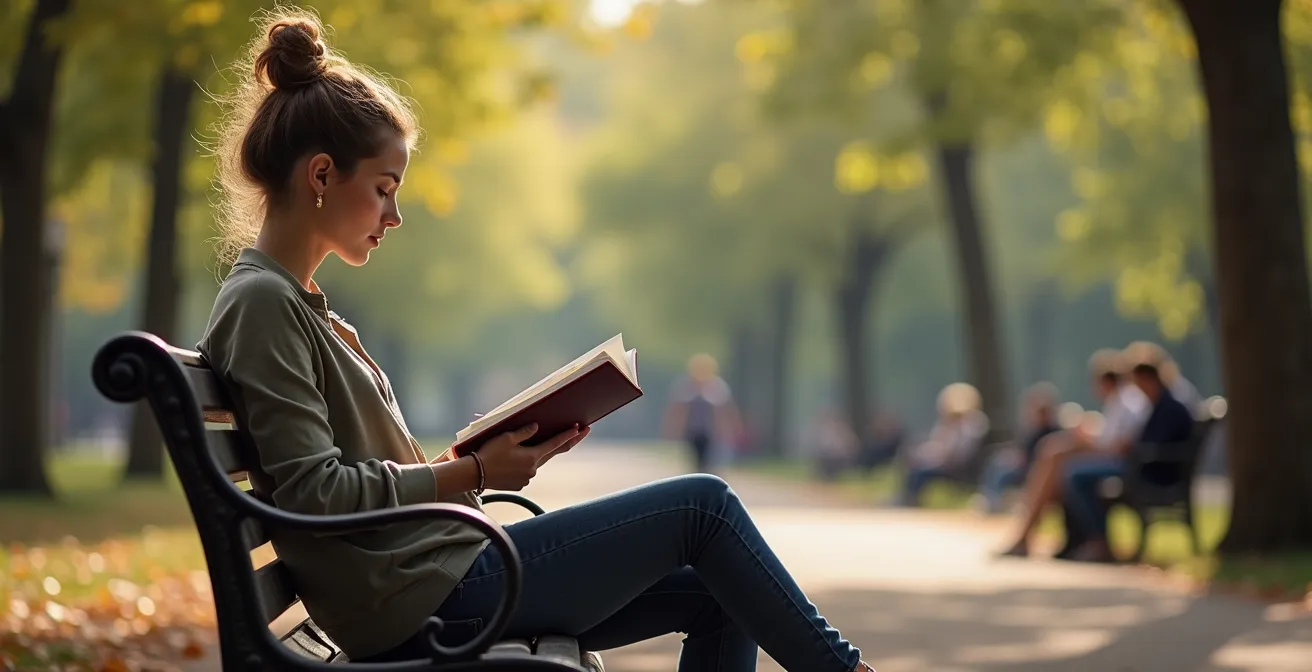
As you can see, the environment in these central parks is one of peaceful coexistence. The presence of other people—families, joggers, fellow readers—creates a collective sense of security. By positioning yourself within this public flow, you are both enjoying your solitude and benefiting from the safety of the crowd. It’s the perfect balance for a quiet afternoon of reading.
Leash or Free: Where Can Your Dog Run in Parisian Parks?
The official rule is simple: in most of Paris’s formal gardens and squares, dogs must be kept on a leash (‘tenu en laisse’). Many smaller, ornate gardens and all children’s play areas (‘aires de jeux’) prohibit dogs entirely—look for signs with a crossed-out dog symbol at the entrance. The ranger’s logic for this is twofold: protecting the meticulously maintained flowerbeds and ensuring the safety and comfort of all visitors, especially small children.
However, Paris operates on a layer of unwritten rules, and dog owners have established one of the most well-known informal agreements. In many neighbourhood parks, the very early morning hours, typically before 9 AM, are an unofficial off-leash time. During this window, enforcement is often relaxed as long as the dogs are well-behaved and owners are attentive. This is a tolerated custom, a nod to the needs of the city’s canine residents.
For official, all-day freedom, you must go to the city’s two great “woods”: the Bois de Boulogne and the Bois de Vincennes. These vast parks have specific, designated off-leash zones where dogs can run freely. As a local guide mentions, these larger spaces are designed for more rugged recreation, making them the designated outlet for energetic pups, in contrast to the more ‘manicured’ central gardens. The key is to match your activity to the park’s character.
The Green Chairs: Is It Rude to Hog Two Chairs for Your Feet?
This is a classic Parisian park dilemma, and the answer depends entirely on context. The etiquette of the iconic green ‘chaises Luxembourg’ is a perfect example of the unwritten social contract. The key is to practice what we can call the ‘crowd-density rule’. If the park is sparse, with plenty of empty chairs scattered around, feel free to take a second one for your feet or your belongings. In this situation, you are simply using available resources without inconveniencing anyone.
However, the moment the park begins to fill up, using a second chair becomes a ‘faux pas’. When people are actively searching for a place to sit, occupying two chairs is seen as inconsiderate. The history of these chairs provides a clue: they were once a paid amenity, which is why they are movable and not bolted down. Today, they are a free, shared public good. The expectation is that you use only what you need when the resource is in demand.
You will rarely be asked directly to give up your second chair. Instead, Parisians employ subtle, non-verbal cues. A person might stand nearby, glancing pointedly at the empty chair. This is your signal to gracefully retract your feet and free up the seat. Acknowledging this silent request with a nod and a quick adjustment is the smoothest way to handle the situation, showing you understand and respect the shared nature of the space, as some guides on Parisian etiquette point out.
Wallace Fountains: Is the Water Safe to Drink in Paris Parks?
Yes, the water from the iconic, dark green Wallace Fountains is perfectly safe to drink. These historic fountains provide the exact same high-quality, potable tap water (‘eau potable’) that flows into every Parisian apartment. The city’s water utility, Eau de Paris, rigorously and constantly tests its quality. Filling your bottle from a Wallace Fountain is not only safe but also a smart, eco-friendly, and economical choice.
The important distinction to make is between these functional Wallace Fountains and the purely decorative fountains you see in ponds and basins. The latter often operate on closed-loop systems with untreated water and will be clearly marked with signs saying ‘Eau Non Potable’ (Non-Potable Water). The rule of thumb is simple: if it’s a green, cast-iron Wallace Fountain with a steady trickle of water, it is designed for drinking.

These fountains are a beloved part of Paris’s heritage, installed by philanthropist Sir Richard Wallace after the siege of 1870 to provide free, clean water to all citizens. Using them connects you to this history of public-spiritedness. By choosing to refill your bottle, you are participating in a century-and-a-half-old Parisian tradition and helping to reduce plastic waste in the city’s beautiful parks.
Rodin or Maillol: Where to See Their Statues for Free in Public Gardens?
Paris is an open-air museum, and its gardens are some of the finest galleries. For lovers of Aristide Maillol, the Jardin des Tuileries is your primary destination. A significant collection of his powerful female figures is clustered near the Arc de Triomphe du Carrousel end of the garden, free for anyone to admire. Wandering among these masterpieces with the Louvre as a backdrop is one of the city’s great, no-cost cultural experiences.
Finding Auguste Rodin’s work for free is slightly trickier. While his most famous sculptures, ‘The Thinker’ and ‘The Gates of Hell’, are located at the Musée Rodin, you don’t necessarily need a full museum ticket to see them. The museum offers a garden-only ticket for a small fee (around €4), which allows you to experience these monumental works in their intended outdoor setting. It’s a fantastic, budget-friendly option.
But the Tuileries is not the only option. To expand your free sculpture tour, head to the Jardin du Ranelagh in the 16th arrondissement to find works by Antoine Bourdelle, a contemporary of Rodin and Maillol. These gardens offer a chance to engage with world-class art in a relaxed, natural environment, a stark contrast to the crowded halls of a museum. As one cultural guide notes, the Tuileries functions as a true outdoor annex to the Louvre, integrating art directly into public life.
Can You Drink Alcohol in Public Parks After 9 PM?
Here again, we must distinguish between the official rule and the cultural practice. An ‘arrêté préfectoral’ (prefectural order) does technically forbid the public consumption of alcohol in many areas, including parks, after certain hours. However, the enforcement of this rule is all about context and behaviour. The ranger’s logic is to target disruptive public drunkenness, not a peaceful picnic.
The key is the Parisian concept of ‘l’apéro’. A bottle of wine or rosé shared discreetly among friends with bread, cheese, and other snacks is a cherished social ritual. This type of civilized, food-accompanied drinking is widely tolerated, especially on the large lawns of Esplanade des Invalides or along the banks of the Canal Saint-Martin. It is seen as part of the city’s social fabric.
What attracts negative attention from guards is behaviour that deviates from this cultural norm. Bringing hard liquor, cases of beer, or becoming loud and disruptive will quickly get you shut down. The rule is enforced not against the alcohol itself, but against the anti-social behaviour it can fuel. As observed by cultural experts, the distinction is between a convivial ‘apéro’ and public intoxication. As long as you are discreet, respectful, and clean up after yourself, you are participating in the social contract and are unlikely to be bothered.
Key Takeaways
- The ‘why’ is key: Park rules are primarily designed to protect historic garden layouts and ensure a peaceful environment, not just to forbid things.
- Observe local customs: The unwritten rules about using chairs, managing dogs, and enjoying a drink are best learned by watching how Parisians behave.
- Discretion is your best tool: A quiet, respectful picnic with wine is part of the culture; a loud, disruptive party is what draws negative attention.
How to Keep Kids Entertained in the Tuileries Without Spending a Fortune?
The Jardin des Tuileries can seem like a financial minefield for parents, with its pony rides, carousels, and the expensive Fête des Tuileries funfair in the summer. However, with a little planning, it can be a fantastic and nearly free playground. The key is to engage with the park’s inherent features rather than its commercial attractions. Preparing your children in advance that the funfair is not on the agenda can also help manage expectations.
One of the most classic and affordable activities is renting a small wooden sailboat (‘petit voilier’) to push around the Grand Bassin Octogonal. For a few euros, children can enjoy a timeless Parisian pastime that has been cherished for generations. Another excellent free activity is to create your own statue scavenger hunt. Challenge your kids to find specific things: an animal, a person who looks sleepy, a statue with a sword. This turns the garden’s art into an interactive game.
Don’t forget that the Tuileries has a free, dedicated playground (‘aire de jeux’) with trampolines, slides, and climbing structures. Its location is marked on the maps at the park entrances. These simple, built-in entertainments provide more than enough fun to fill an afternoon without breaking the bank. The park is a space for imagination, not just consumption.
Action Plan: Your Tuileries Low-Cost Activity Checklist
- Locate the playground: Upon entering, check the park map for the ‘aire de jeux’ to have a go-to spot for energetic kids.
- Prepare a scavenger hunt: Before you go, list 5-10 items for kids to find (e.g., “a statue of a lion,” “a person holding a book,” “a hidden path”).
- Set a sailboat budget: Allocate a few euros specifically for renting a ‘petit voilier’ at the Grand Bassin as a special treat.
- Pack your own snacks: Bring water and snacks to avoid the overpriced kiosks and vendors inside the park.
- Manage funfair expectations: If visiting in summer, explain beforehand that the Fête des Tuileries is not part of the day’s plan.
Now that you have the complete ranger’s handbook, your next step is to explore these magnificent green spaces with the confidence and respect of a true Parisian. Enjoy the parks!