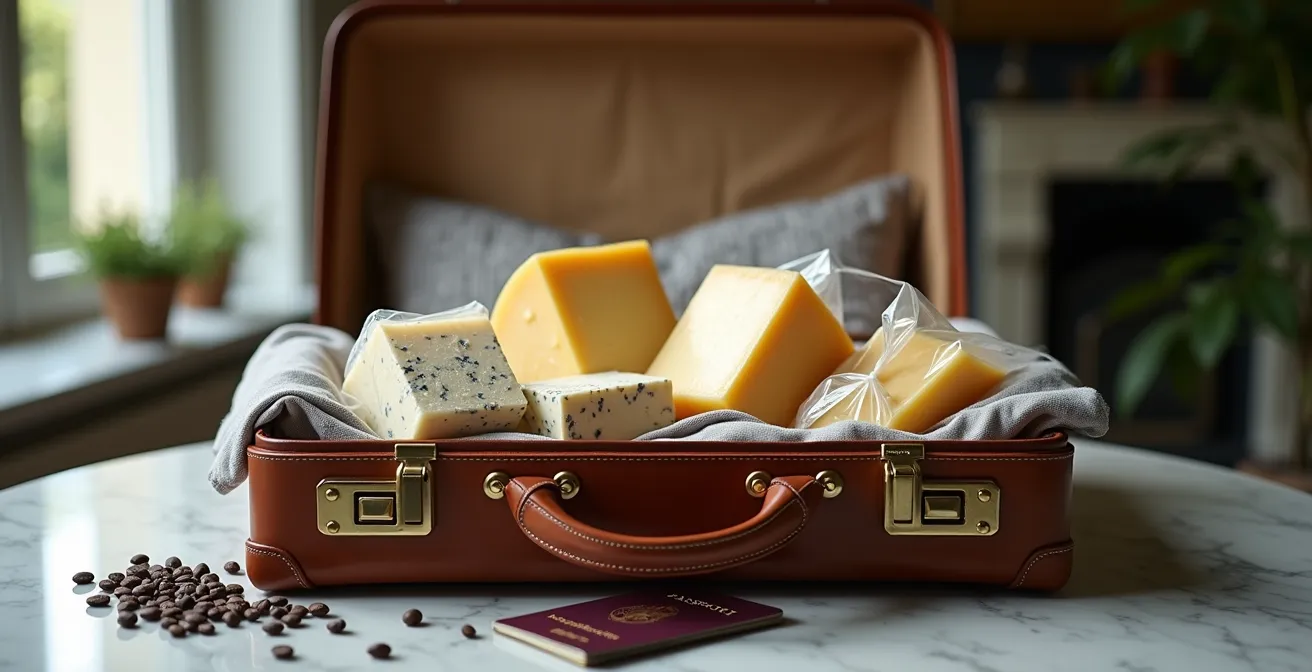
Successfully bringing artisanal cheese through U.S. customs is not a gamble; it’s a precise logistical operation based on selection, professional packing, and transparent declaration.
- Your success depends more on the cheese’s texture and packaging than its raw-milk status. Hard, low-moisture cheeses are your safest bet.
- Leverage your French fromager’s expertise. They offer professional vacuum-sealing (sous-vide), which is the cornerstone of your transport strategy.
Recommendation: Treat your fromagerie visit as the first step in an export process. Clearly state your travel plans and request their specialized packing services to ensure your cheese arrives in perfect condition.
The thought of bringing a wheel of perfectly ripe Camembert or a wedge of nutty Comté back from your French vacation is intoxicating. Yet, this dream is often crushed by a wave of anxiety. You’re met with a barrage of conflicting advice from fellow travelers and vague government websites, leaving you terrified of a stern customs officer seizing your precious, expensive souvenirs. Many travelers simply give up, resigning themselves to airport-quality cheese or, worse, none at all. The common wisdom to “just declare it” offers little comfort when you don’t understand the rules that determine whether your cheese will be celebrated or confiscated.
The truth is, the U.S. Customs and Border Protection (CBP) rules are less about whether the milk is raw or pasteurized and more about the cheese’s texture and potential to carry diseases. The key isn’t to hope for the best, but to approach the task like a professional. But what if the secret wasn’t in memorizing obscure regulations, but in mastering a simple, repeatable logistical process? The solution lies in shifting your mindset: you are not just a tourist with cheese, you are overseeing a small-scale, personal export operation. This requires understanding the science of cheese travel and leveraging the expertise of the people who know it best: the French fromagers themselves.
This guide will provide you with that precise framework. We will deconstruct the process, from selecting the right cheese based on its travel durability to mastering professional packing techniques. We will explore the nuances of cheese etiquette, compare the offerings of Paris’s most acclaimed cheese masters, and even cover the transport of other delicate French delicacies. By the end, you will have a clear, actionable plan to transform customs anxiety into a confident and successful culinary mission.
This article provides a comprehensive logistical plan for your culinary treasures. Explore the sections below to master each step of your “export” process, from packing and selection to navigating customs with confidence.
Summary: How to Bring Artisanal French Cheese Home
- The Triple-Wrap Method: How to Pack Époisses in Your Suitcase?
- Why You Should Never Buy Vacherin Mont d’Or in August?
- Comte 12 Months vs 36 Months: Which One Justifies the Price Difference?
- Cutting the Point: The Etiquette Mistake That Offends French Hosts
- Fromagerie Laurent Dubois or Quatrehomme: Who Has the Best MOF Selection?
- Macarons vs Calissons: Which Sweet Survives a 10-Hour Flight Better?
- VAT Refund: How to Ship a Painting to the US Tax-Free?
- Foie Gras or Terrine: Which Souvenir Tins Are Allowed in Carry-On Luggage?
The Triple-Wrap Method: How to Pack Époisses in Your Suitcase?
Transporting a soft, pungent cheese like Époisses de Bourgogne is the ultimate test of your logistical planning. Its creamy texture and powerful aroma require a robust containment strategy to protect both the cheese and your belongings. The key is not just wrapping, but creating a multi-layered system that controls moisture, odor, and structural integrity. This begins at the fromagerie, where you initiate the first and most critical step: professional vacuum-sealing. Most high-end French cheese shops are equipped for this and are accustomed to helping travelers.
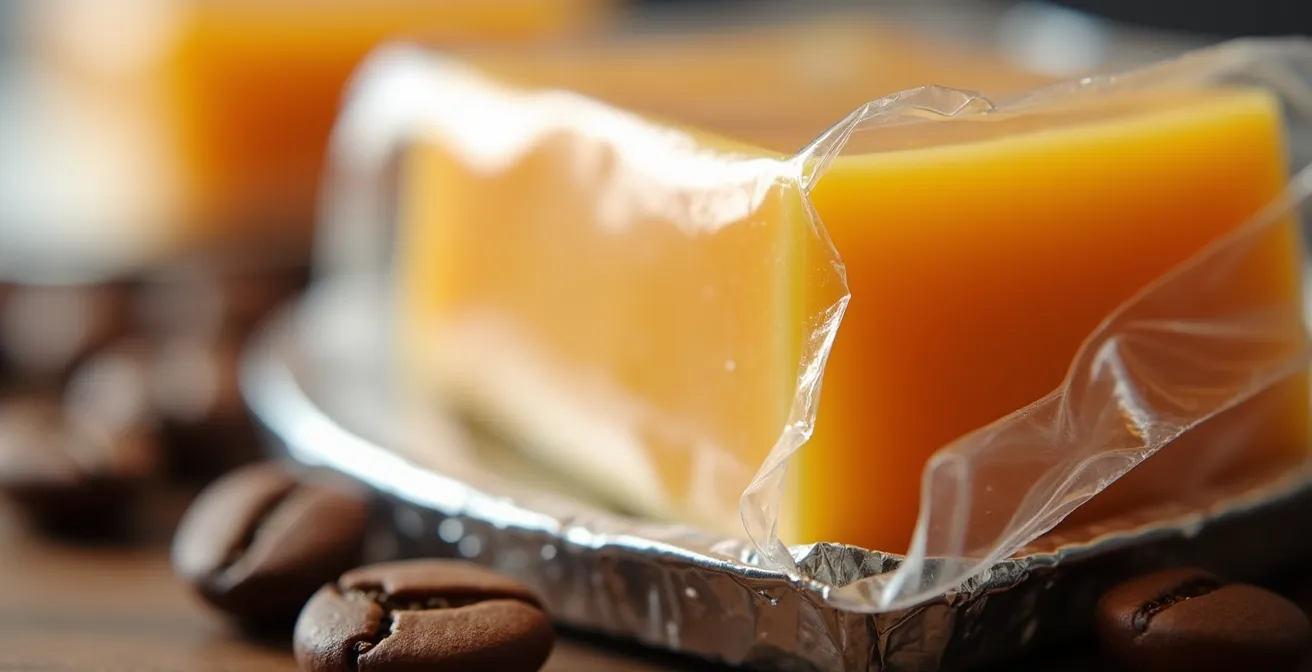
Once the cheese is professionally sealed, your job is to provide two additional layers of protection. The second layer is a hard-sided, airtight container. This physical shield is non-negotiable; it prevents the vacuum-sealed package from being crushed by other items in your luggage, which would ruin the cheese’s delicate structure. The third and final layer addresses odor control. Place the hard container in your suitcase surrounded by natural odor absorbers. A small bag of unused coffee beans or a few activated charcoal sachets work wonders in neutralizing any faint aromas that might escape, ensuring your clothes don’t arrive smelling like a Burgundian cellar.
Your Action Plan: Professional Packing for Soft Cheeses
- Initiate the Process: At the fromagerie, clearly state your travel plans and request vacuum-sealing. Use the phrase: “Pourriez-vous le mettre sous vide pour un long voyage, s’il vous plaît?” (Could you vacuum-seal this for a long trip, please?).
- Ensure Structural Integrity: For very soft cheeses, ask if they can briefly freeze it before sealing. A professional fromager will know the ‘soft air’ setting on their machine to prevent crushing.
- Add Physical Protection: Place the sealed cheese inside a rigid, airtight container. This is the most crucial step to prevent compression damage in your suitcase.
- Implement Odor Control: Pack the container in your checked luggage alongside odor absorbers like a small pouch of coffee beans or activated charcoal.
- Final Placement: Position the container in the center of your suitcase, cushioned by soft clothing on all sides to minimize movement and impact.
–
Why You Should Never Buy Vacherin Mont d’Or in August?
A key principle of a successful cheese-importing operation is understanding that not all cheeses are available, or at their best, year-round. This is especially true for seasonal AOP (Appellation d’Origine Protégée) cheeses, whose production is strictly governed by tradition and the natural cycles of agriculture. Vacherin Mont d’Or is the prime example. This famously gooey, spruce-bound cheese is a winter delicacy. Its production is tied to the cows’ diet; it’s made when they descend from their summer mountain pastures and their milk becomes richer.
Consequently, French regulations are incredibly strict. According to official AOP rules, Vacherin Mont d’Or can only be produced between August 15th and March 15th. Attempting to buy it in July or August means you’ll either find it’s unavailable or you’re being sold an inferior, non-AOP product. A savvy traveler aligns their desires with the seasons. Instead of fighting nature, lean into what the French summer has to offer. The warmer months are the peak season for a different profile of cheeses, particularly fresh and semi-soft varieties that are light and perfectly suited to the climate.
If you’re traveling in the summer, pivot your strategy to these excellent alternatives:
- Fresh chèvre fermier (Goat Cheese): Especially from the Loire Valley, its season peaks from June through September.
- Saint-Félicien: A decadently creamy cow’s milk cheese that is glorious when temperatures rise.
- Beaufort d’été: A special “summer” version of Beaufort, made from the milk of cows grazing on high alpine flowers and grasses.
- Ossau-Iraty: A sheep’s milk cheese from the Basque region that is at its absolute best during the summer.
Comte 12 Months vs 36 Months: Which One Justifies the Price Difference?
When standing before a wall of massive Comté wheels, you’ll notice tags indicating different aging periods: 12, 18, 24, or even 36+ months. The price rises steeply with age, and for the international traveler, the choice isn’t just about taste—it’s about logistics. The aging process, or affinage, dramatically transforms the cheese’s structure, making older Comté far superior for travel. A younger, 12-month Comté is creamier and more fragile, with a milky, buttery flavor. A 36-month Comté, however, has lost significant moisture, resulting in a hard, dense texture that is incredibly robust.
This older Comté is characterized by the presence of tyrosine crystals, crunchy, salt-like specks that are a sign of expert aging. These crystals, along with the complex flavors of roasted nuts and salted caramel, are the result of the affineur‘s (cheese-aging expert’s) painstaking work. As Meilleur Ouvrier de France Laurent Dubois explains, this expertise is what commands the higher price.
The expertise of the ‘affineur’ is crucial – they select and care for the wheels, turning them into cheese worth the high price. I am still turning over the Comtés, delivering cheeses to my shops.
– Laurent Dubois, Meilleur Ouvrier de France, Interview 2023
For your “export operation,” the 36-month Comté is the clear winner. Its low moisture content and hard texture make it exceptionally durable, less prone to sweating, and better at withstanding temperature fluctuations during a long-haul flight. While more expensive, you are paying for both a more complex flavor experience and, crucially, a far greater chance of a successful journey back home.
| Characteristic | 12-Month Comté | 36-Month Comté |
|---|---|---|
| Texture | Creamy, more fragile | Hard, crystalline with tyrosine crystals |
| Travel Durability | Requires careful packing | Extremely robust for travel |
| Flavor Profile | Milky, buttery, hints of hazelnut | Roasted nuts, salted caramel, leather notes |
| Bell Color Indicator | Standard grade | Green bell = higher grade selected for aging |
| Price Premium | Base price | 2-3x more expensive |
Cutting the Point: The Etiquette Mistake That Offends French Hosts
Your logistical mission extends beyond packing and customs. It includes respecting the cultural norms surrounding cheese once it’s on the platter. In France, a cheese board is an exercise in sharing and respect, and how you cut the cheese matters. The most egregious faux pas a guest can make is “cutting the point” or “cutting the nose” off a wedge of Brie or other triangular cheese. This act is seen as selfish because you are taking the best part—the creamy, ripe tip—and ruining the geometry of the cheese for everyone else.
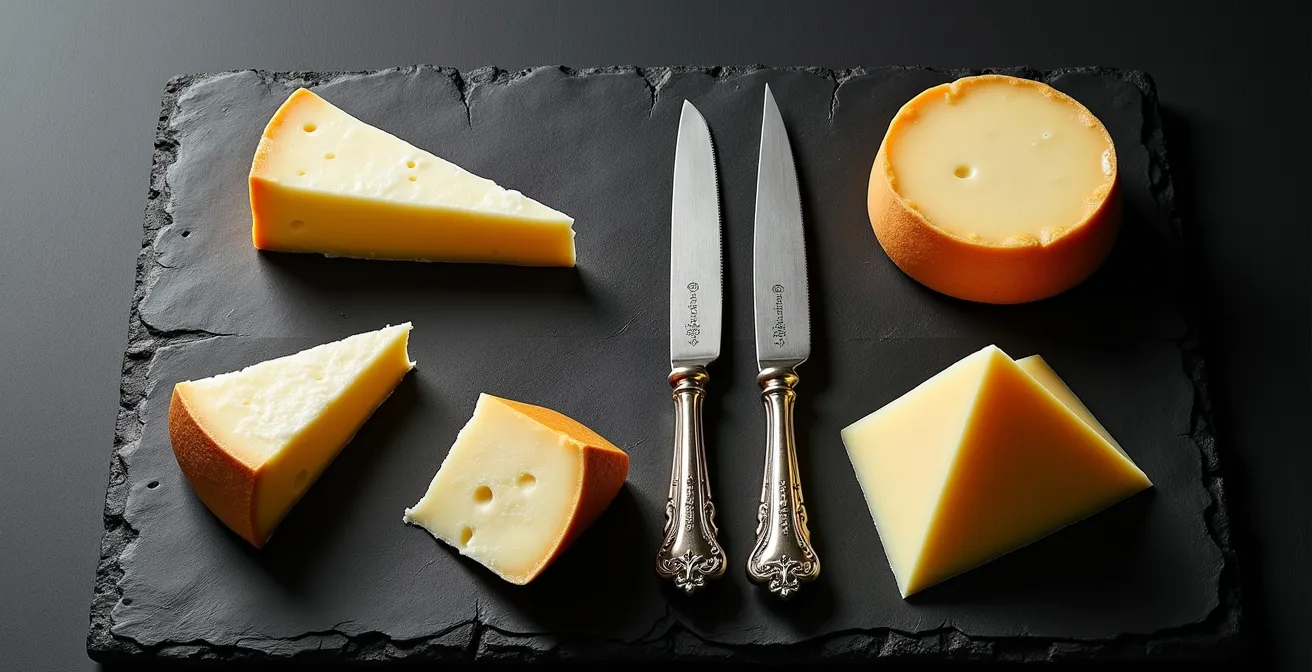
The guiding principle is partage (sharing): each person should receive a fair portion that includes both the rind and the creamy center (the pâte). This ensures everyone has a similar tasting experience. For a wedge of Brie, you should cut long, thin slices along the side. For a round cheese like Camembert, it should be cut into wedges like a cake. For log-shaped goat cheeses (bûches), you cut parallel slices. This thoughtful approach shows your host that you understand and respect the product and the culture it comes from.
The etiquette also extends to the rind. Whether you eat it depends on the type of cheese. On soft, bloomy-rind cheeses like Brie and Camembert, the croûte fleurie is meant to be eaten; it’s an integral part of the flavor. Conversely, the hard rinds on aged cheeses like Comté are too tough and are not consumed. Washed rinds (croûte lavée) on pungent cheeses like Époisses or Munster are edible but have very strong flavors, making it a matter of personal preference.
Fromagerie Laurent Dubois or Quatrehomme: Who Has the Best MOF Selection?
For the serious cheese traveler, selecting the right fromagerie in Paris is a critical strategic decision. Two names stand above the rest, both helmed by recipients of the prestigious Meilleur Ouvrier de France (MOF) title: Laurent Dubois and Marie Quatrehomme. Choosing between them depends on your objective: are you seeking innovation or the perfection of tradition? Laurent Dubois is the innovator. Famed for his creative pairings, he offers unique creations like Roquefort layered with quince paste and Brie with truffles. His shops are a modern culinary laboratory.
Marie Quatrehomme, on the other hand, is the guardian of tradition. Her expertise lies in ‘affinage’—the art of aging. She takes classic cheeses and ages them to their absolute peak of perfection. A visit to Quatrehomme is about experiencing a classic cheese in its most ideal state. From a logistical standpoint, both offer excellent services for travelers. However, Laurent Dubois’s operation is particularly well-suited for North American visitors. With three locations, including one in the Marais open seven days a week, and a clear offering of vacuum-sealing services with English-speaking staff, his fromageries are structured to cater to the international client.
The following comparison breaks down the key differences to help you choose your “operations base”:
| Aspect | Laurent Dubois | Marie Quatrehomme |
|---|---|---|
| Philosophy | Innovation & creative pairings | Guardian of tradition |
| Signature Offering | Dessert-inspired cheese creations | Perfectly aged classic varieties |
| Best For | 40-month aged Comté, innovative combinations | Traditional affinage excellence |
| Travel Services | Vacuum sealing at all 3 locations | Professional wrapping for travel |
| Language Support | English-speaking staff available | Traditional French service |
Macarons vs Calissons: Which Sweet Survives a 10-Hour Flight Better?
The principles of logistical transport—structural integrity and moisture control—apply equally to delicate French sweets. The two most popular choices for souvenirs, Parisian macarons and Provençal calissons, have vastly different travel capabilities. Macarons, from famous houses like Ladurée or Pierre Hermé, are notoriously fragile. Their delicate meringue shells and moist ganache filling are highly sensitive to humidity and pressure changes. They must be consumed within a tight timeframe for optimal texture; travel experts suggest they are best enjoyed within 24-48 hours after a flight. To survive, they require a hard-sided box and must be hand-carried to prevent the shells from cracking and the delicate “foot” from collapsing.
Calissons d’Aix, in contrast, are practically indestructible. These lozenge-shaped sweets from Aix-en-Provence are made from a dense paste of almonds and candied melon, topped with a thin layer of royal icing. Their low moisture content and sturdy composition make them incredibly durable. Their traditional packaging is often a sturdy tin or a robust cardboard box designed for travel. Unlike macarons, calissons can be safely packed in checked luggage without fear of being crushed or spoiling. Their flavor and texture can last for weeks, making them a far more reliable and less stressful culinary souvenir for a long journey.
Essentially, the macaron is a high-maintenance, short-term delight, whereas the calisson is a low-maintenance, long-lasting treasure. For the traveler focused on a successful and stress-free “export,” the calisson is the clear logistical winner. It offers the joy of a regional French specialty without the operational headache of protecting a fragile product.
VAT Refund: How to Ship a Painting to the US Tax-Free?
While your primary mission might be cheese, a successful trip to France often involves other valuable acquisitions, like art. Understanding the Value Added Tax (VAT, or TVA in French) refund process is crucial for any significant purchase. This tax, included in the price of most goods, can often be reclaimed by non-EU residents, representing a substantial saving. The key is to be methodical. The process applies to goods you are taking with you, including art, provided you meet the minimum purchase amount at a single store on the same day. As of 2024, the legal threshold for VAT refund eligibility in France is for purchases over €100.01.
At the time of purchase from the gallery or shop, you must ask for the “bordereau de vente à l’exportation,” commonly known as the détaxe form. Keep this form with your receipt and the artwork, which must remain in its original, unused condition for potential inspection. At the airport (like Charles de Gaulle – CDG), you must complete the VAT process *before* you check your luggage. The easiest way is using the blue self-service “PABLO” kiosks. This digital system allows for quick validation.
Follow these steps for a smooth PABLO kiosk process:
- Obtain Form: Get the détaxe form from the vendor at the time of purchase.
- Keep Items Ready: Have the artwork in its packaging and the receipt ready in case of inspection.
- Arrive Early: Give yourself at least 3 hours before your flight to handle the refund process without stress.
- Locate Kiosk: Find a PABLO self-service kiosk in your departure terminal.
- Scan and Validate: Scan the barcode on your détaxe form. If you get a green smiley face, you are done. The refund will be processed to your credit card.
- Handle Inspection: If you get a red frowny face, it means you must go to the nearby customs desk for a manual inspection and validation.
Key Takeaways
- Success hinges on choosing the right cheese: hard, aged varieties with low moisture (like old Comté) are far more durable for travel than soft, creamy ones.
- Professional vacuum-sealing (sous-vide) by your fromager is the single most important step in controlling odor and preserving freshness.
- Always declare all food items. Transparency with U.S. customs officers, combined with proper packaging, is the best strategy to avoid confiscation and fines.
Foie Gras or Terrine: Which Souvenir Tins Are Allowed in Carry-On Luggage?
Your culinary export mission may also include another quintessential French delicacy: foie gras. Here, the rules become even more specific, and understanding the labels is paramount. The key distinction for customs and TSA purposes is between fully sterilized, shelf-stable products and partially cooked ones. Tins labeled ‘Conserve‘ or ‘Stérilisé‘ have been heat-treated to a high temperature, making them shelf-stable for years. These are generally considered solid goods and are permissible.
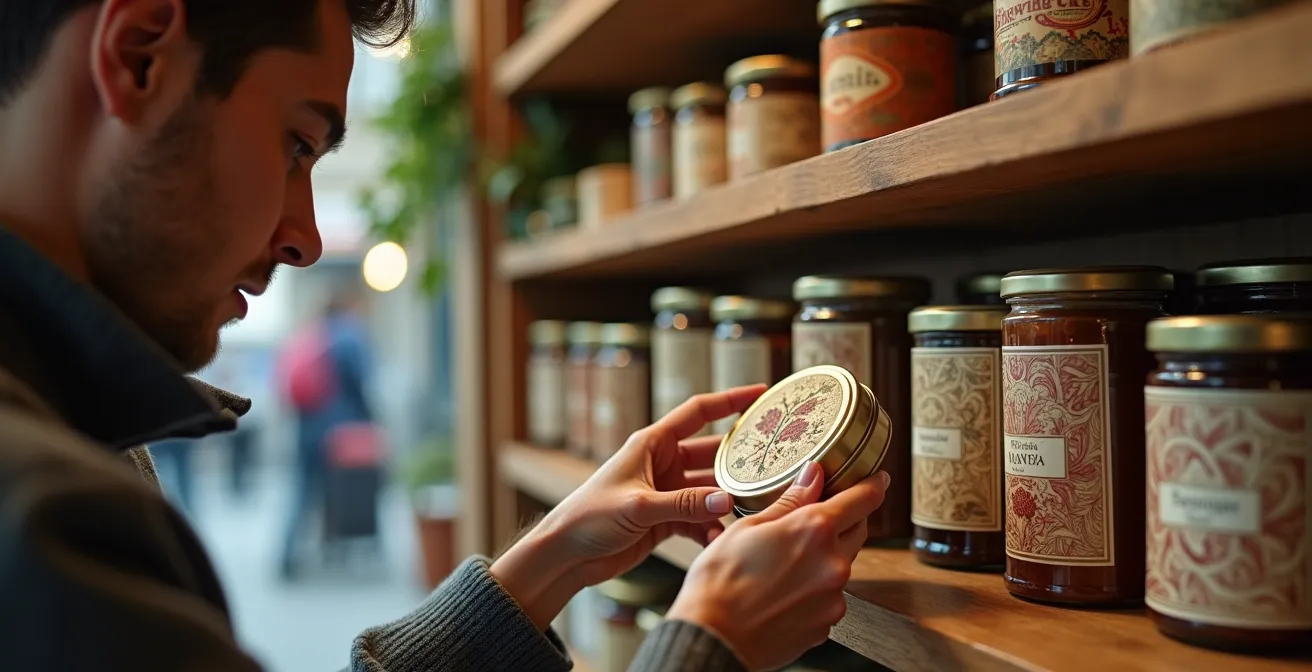
In contrast, products labeled ‘Mi-Cuit‘ (semi-cooked) have been cooked at a lower temperature. They require refrigeration and have a much shorter shelf life. These are often treated as gels or liquids and are subject to the TSA’s 3.4oz/100ml rule if in carry-on luggage. To avoid any issues, always opt for ‘Foie Gras Entier en Conserve’. While you can technically carry these tins in your hand luggage, it’s wiser to place them in your checked bags to avoid lengthy discussions at the security checkpoint. Most importantly, regardless of the type, you must declare them.
The U.S. Food and Drug Administration is unequivocal about the consequences of failing to declare food items. The potential penalties far outweigh any perceived benefit of being discreet.
Failure to declare food products can result in up to $10,000 in fines and penalties.
This reinforces the core principle of our entire operation: transparency is your best ally. A well-packaged, correctly chosen, and honestly declared item is almost always waved through. It is the attempt to hide something that raises suspicion and leads to trouble.
With this detailed logistical plan, you can approach your next trip to France with the confidence of a seasoned importer. Plan your acquisitions, partner with expert fromagers, and manage your documentation. The reward will be a kitchen filled with the authentic tastes of your journey, legally and safely brought home.
Frequently Asked Questions about French Culinary Souvenirs
Should you eat the rind on Brie and Camembert?
Yes, ‘fleurie’ (bloomy) rinds like those on Brie and Camembert are meant to be eaten and are an integral part of the cheese experience. They contribute texture and earthy, mushroom-like flavors.
What about hard cheese rinds like Comté?
Hard rinds on aged cheeses like Comté are not eaten. They serve as natural protection during the long aging process but are too tough and flavorless to be enjoyable.
Are washed rinds edible?
‘Croûte lavée’ (washed rinds) like on Munster or Époisses are technically edible but have very strong, pungent flavors. Whether to eat them is a matter of personal taste; many people scrape most of it off.
What’s the difference between ‘conserve’ and ‘mi-cuit’ foie gras?
‘Conserve’ or ‘stérilisé’ versions are fully sterilized in tins or jars, making them shelf-stable for long periods. They are treated as solid goods by customs. ‘Mi-cuit’ (semi-cooked) versions require refrigeration, have a shorter shelf life, and are often subject to liquid/gel restrictions by airport security.
Which label words indicate travel-safe tins of foie gras?
Look for the words ‘Foie Gras Entier en Conserve‘ for the safest and most permissible option. Avoid any packaging that says ‘Mi-Cuit’ or ‘à conserver au réfrigérateur’ (keep refrigerated) if you are concerned about customs or security rules.
Should foie gras tins go in carry-on or checked luggage?
Even fully-tinned, allowed versions of foie gras are best placed in your checked luggage. This avoids any potential debate with security agents over whether the contents constitute a solid or a gel, simplifying your journey through the airport.