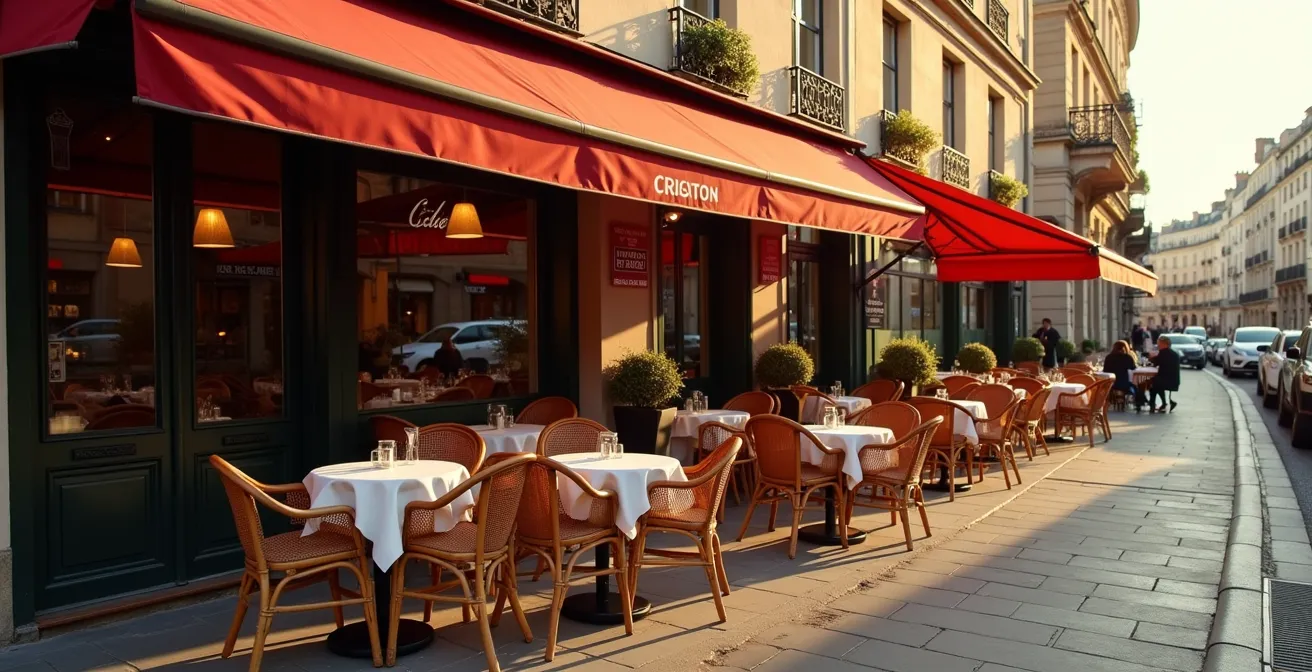
In summary:
- Parisian dining isn’t about rigid rules but understanding a different cultural system where service is a respected profession, not servitude.
- Respecting the “rhythm of the city,” especially the midday break (la coupure), is key to avoiding frustration and closed kitchens.
- Tipping is a small gesture of appreciation, not an obligation, as a 15% service charge is already included by law in all menu prices.
- Knowing key phrases like “une carafe d’eau” and looking for a “formule déjeuner” signals you’re an informed visitor and unlocks significant value.
- The best meals are often found by spotting signs of quality—like short, seasonal menus—rather than relying on tourist-facing logos.
You’ve navigated the Métro, you’ve found the perfect-looking bistro on a charming side street, but then you hit the wall. A literal sign says “Complet” (Full), or worse, you get a table only to feel a wave of awkwardness. Is it okay to call the waiter over? Why did they bring you expensive bottled water when you just wanted tap? And why is every kitchen in the city seemingly closed at 3:30 PM? The frustration for a spontaneous traveler in Paris is real. Many guides offer simple “dos and don’ts,” like saying ‘Bonjour’ and ‘Merci,’ which are essential but only scratch the surface.
These guides often miss the most crucial element: the cultural logic behind the rules. Parisian dining etiquette isn’t a secret code designed to exclude tourists; it’s a system built on a deep respect for food, a different philosophy of service, and the rhythm of a working city. The key to a great dining experience isn’t just memorizing a few French phrases, but understanding the ‘why’ behind the customs. It’s about recognizing that a waiter is a salaried professional, that meal times are a protected part of the day, and that value is often found where you least expect it.
This guide moves beyond the basics. We will deconstruct the system so you can navigate it with the ease of a local. We’ll explore why you can’t just shout “Garçon!”, how to get free water without feeling ashamed, and why the “service compris” on your bill changes everything about tipping. By the end, you’ll not only avoid common pitfalls but also discover how to enjoy Michelin-quality food for a fraction of the price. You’ll learn to see the Parisian dining scene not as a series of obstacles, but as a predictable and rewarding system to master.
To help you master the art of Parisian dining, this guide is structured to tackle the most common points of confusion one by one. Below is a summary of the key areas we will demystify, giving you the confidence to order, dine, and pay like a true Parisian.
Summary: The Unwritten Rules of Parisian Dining
- The “Garçon” Myth: How to Properly Call a Waiter in Paris?
- Carafe d’Eau vs Mineral Water: How to Ask for Free Water Without Shame?
- Why You Cannot Eat Lunch at 3 PM in Most Traditional Brasseries?
- Service Compris: Do You Really Need to Leave a Tip in Paris?
- The “Fait Maison” Logo: How to Know If Your Dish Was Actually Cooked on Site?
- Eating at 4 PM: Which Top Bistros Won’t Turn You Away?
- The 50€ Pizza: How to Spot a Predatory Menu on the Avenue?
- Bistronomy vs Gastronomy: How to Eat Michelin-Quality Food for 50€?
The “Garçon” Myth: How to Properly Call a Waiter in Paris?
One of the fastest ways to mark yourself as a tourist is to call out “Garçon!” to get a waiter’s attention. While it literally means “boy,” in a modern restaurant context, it’s considered condescending and outdated. The root of this etiquette lies in the French perception of the service industry. Unlike in many countries where serving is a temporary job based on tips, in France, it is a legitimate career with professional training. Your waiter is a salaried professional, and addressing them with respect is paramount.
The entire service system is different. As dining guides point out, French servers receive a full wage, with a 15% service charge already included in the menu prices by law. This financial independence means their goal is efficient, professional service, not building a rapport to earn a tip. They manage a section of tables, known as a “rang,” and will attend to you as part of their methodical flow. Waving your hand wildly or shouting disrupts this system and is seen as rude.
So, how do you get their attention? The Parisian method is a ladder of escalating subtlety. It starts with trying to make eye contact. A simple, knowing nod when they look your way is often enough. If that fails, a slight raise of the hand (no higher than your shoulder) is the next step. If you need to use your voice, a polite and quiet “S’il vous plaît?” (“Please?”) or “Excusez-moi?” (“Excuse me?”) as they pass by is the correct approach. It’s a quiet signal, not a loud demand, showing you respect their professional space.
Carafe d’Eau vs Mineral Water: How to Ask for Free Water Without Shame?
You’re thirsty and ask for water. The waiter immediately replies, “Plate ou gazeuse?” (“Still or sparkling?”). You pick one, and a 7€ bottle of Evian or Badoit appears on your bill. This is a classic, gentle upsell that many travelers fall for. In France, restaurants are legally required to provide free, safe-to-drink tap water upon request. Asking for it is not a cheap move; it is a standard, local practice.
The magic phrase is “une carafe d’eau, s’il vous plaît.” This specifically requests a pitcher of tap water. If you simply ask for “de l’eau” (water), you leave the door open for the waiter to offer the paid bottled options. By using the term “carafe,” you signal that you are an informed diner who understands the local custom. There is absolutely no shame in this; Parisians do it all the time. It is both economical and more environmentally friendly.
This small piece of knowledge shifts the dynamic. It’s a form of value signaling that shows you’ve done your homework. As the Baker Street Society notes in their guide to Parisian dining etiquette, choosing tap water is not just about saving money.
Choosing a ‘carafe d’eau’ is a local, eco-friendly, and perfectly normal habit.
– Baker Street Society, Dining Etiquette at Restaurants in Paris
Don’t be afraid to be firm but polite. If you ask for a “carafe d’eau” and are still presented with the still-or-sparkling question, simply repeat, “Non, une carafe d’eau, s’il vous plaît.” You are not being difficult; you are simply exercising a right and behaving like a local.
Why You Cannot Eat Lunch at 3 PM in Most Traditional Brasseries?
For travelers coming from cultures with all-day dining, one of Paris’s most baffling aspects is the sacredness of meal times. You’ll find that in most traditional restaurants and bistros, the kitchen is firmly closed between lunch and dinner service. This break, known as “la coupure,” typically runs from around 2:30 PM to 7:00 PM. It’s not an arbitrary rule; it’s a fundamental part of the city’s rhythm, deeply tied to French labor laws and a cultural respect for the culinary craft.
The strict service window, which often sees lunch service running strictly from noon to 2:00 PM, allows the kitchen and service staff to rest, perform “mise en place” (prep work for the dinner rush), and have their own meals. It ensures that when the kitchen is open, the team is focused and delivering the highest quality food. Trying to get a full hot meal during “la coupure” in a traditional bistro is like trying to shop when a store is closed—it’s just not part of the system.
However, being hungry at 4 PM doesn’t mean you have to starve. You just need to know where to look. This is where the Parisian café, the brasserie with “service continu,” and the “salon de thé” come into their own. Cafés will serve lighter fare like a croque-monsieur or a sandwich all day. Wine bars are perfect for a “planche” of cheese or charcuterie. Understanding these alternatives is key to happy, spontaneous afternoon snacking.
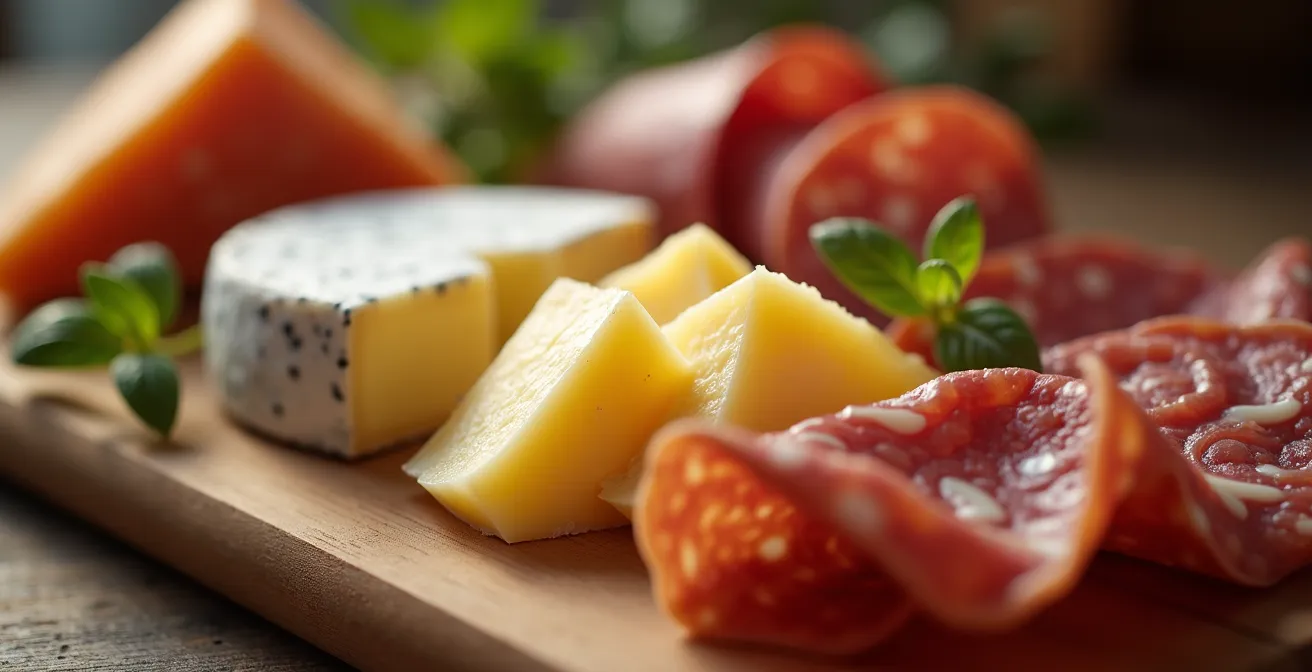
This image of a classic French cheese and charcuterie board exemplifies the perfect afternoon meal available at many wine bars and cafés during “la coupure.” Instead of fighting the system, you can embrace these delicious alternatives and enjoy a different, equally authentic, Parisian culinary experience.
Service Compris: Do You Really Need to Leave a Tip in Paris?
The question of tipping is a major source of anxiety for many visitors, especially those from North America where tipping culture is dominant. The simple answer is: no, you are not required to leave a significant tip in Paris. The phrase you’ll see on every menu, “service compris 15%,” means that a 15% service charge is already included in the price of every item by law. This is not an optional extra; it is part of the price you pay, and it goes toward providing servers with a full, living wage.
This fundamental difference in how servers are compensated changes the entire tipping dynamic. A tip, or “pourboire” (literally “for a drink”), is a small gesture of appreciation for excellent service, not a mandatory part of the server’s income. For a typical sit-down meal, leaving a few euros in coins on the table after you’ve paid is a perfectly normal way to show you were happy with the experience. For a 45€ dinner, a 2-3€ tip is considered a generous gesture. For a simple coffee at a café, rounding up to the nearest euro or leaving the small change is common.
To clarify this cultural difference, a direct comparison is often the most helpful. The following table breaks down the key distinctions between the restaurant culture in Paris and the USA.
This table, based on information from guides like HiP Paris on dining etiquette, highlights why a 20% tip in Paris can seem confusing or even excessive.
| Aspect | Paris | USA |
|---|---|---|
| Service Charge | 15% included in price by law | Not included, added separately |
| Server Wages | Full living wage guaranteed | Below minimum wage + tips |
| Expected Tip | 0-5% for exceptional service | 18-25% standard |
| How to Tip | Cash left on table after paying | Added to credit card slip |
| Small Purchase | Round up to nearest euro | 15-20% even for coffee |
The “Fait Maison” Logo: How to Know If Your Dish Was Actually Cooked on Site?
In an effort to promote fresh cooking and combat the rise of pre-prepared meals, the French government introduced the “Fait Maison” (homemade) logo, a stylized saucepan with a roof. In theory, seeing this logo next to a dish on a menu guarantees it was cooked on-site from raw ingredients. However, for the discerning traveler, it’s important to understand the nuance behind this label. It is not the perfect seal of quality it appears to be.
The legislation has significant loopholes. For example, as industry observers have noted, French legislation from 2014 reveals that the ‘Fait Maison’ law allows restaurants to use frozen raw ingredients, pre-peeled vegetables, and other processed base components while still claiming homemade status. This means the logo doesn’t necessarily distinguish a chef who meticulously sources fresh market produce from one who thaws a frozen fish fillet. While it does rule out fully pre-cooked, microwaved meals, it’s not a guarantee of high-level gastronomy.
So, how do you spot a kitchen committed to true freshness? Locals and food critics rely on more subtle clues beyond the official logo. A short menu (“carte courte”) with only 5-8 main dishes is a classic sign of a small kitchen cooking with fresh ingredients, as they can’t support a sprawling menu. Look for daily specials written on a chalkboard (“l’ardoise”), which indicates the chef is cooking with what’s fresh and available that day. A menu that changes seasonally is another excellent sign. True quality is communicated through the food and the operation, not just a logo.
Your Action Plan: Auditing for True ‘Fait Maison’ Quality
- Menu Length Analysis: Count the number of main courses (‘plats’). Is it a concise list (under 8), or a novel-length menu trying to be everything to everyone? A short menu signals focus and freshness.
- Check for Daily Specials: Look for the ‘ardoise’ (chalkboard) or an insert in the menu. The presence of daily or weekly specials shows the kitchen adapts to market availability.
- Supplier Provenance Check: Scan the menu for mentions of specific suppliers or regions (e.g., ‘Volaille de Bresse,’ ‘Légumes de Joël Thiébault’). Naming sources is a strong sign of pride and quality.
- Seasonal Ingredient Scan: Does the menu feature asparagus in spring, tomatoes in summer, and squash in autumn? A menu that reflects the current season is a reliable indicator of a fresh-focused kitchen.
- Simplicity of Descriptions: Observe how dishes are described. Menus that use simple, direct language (‘Duck confit, sarladaise potatoes’) are often more confident in their product than those using vague, flowery descriptions.
Eating at 4 PM: Which Top Bistros Won’t Turn You Away?
While most traditional Parisian kitchens close during “la coupure,” a frustrated traveler’s salvation lies in a specific type of establishment: the grand brasserie offering “service continu” (continuous service). These places are institutions, often large and historic, that were originally designed to serve travelers and theater-goers at all hours. They are your best bet for a proper sit-down meal outside of the rigid lunch (noon-2:30 PM) and dinner (7-10:30 PM) windows.
These brasseries are an integral part of the Parisian landscape and offer a classic, bustling atmosphere that is an experience in itself. You may not get the same intimate, experimental cooking of a small neighborhood bistro, but you will get well-executed French classics like onion soup, steak frites, and impressive seafood platters. Be aware that even with continuous service, many will offer a slightly reduced menu in the mid-afternoon between the main lunch and dinner rushes.
Among the most famous examples are historic halls that have been serving around the clock for decades. Au Pied de Cochon in the Les Halles district, for instance, has famously been open 24/7 since 1947, making it a legendary spot for late-night workers and early-morning revelers. Similarly, the iconic Bouillon Chartier, with its stunning Belle Époque decor, serves a simple, affordable menu non-stop from noon until midnight. These places prove that you can indeed find a satisfying French meal at unconventional hours if you know where to go.
The 50€ Pizza: How to Spot a Predatory Menu on the Avenue?
Just as there are hidden gems in Paris, there are also tourist traps, especially concentrated around major monuments. These establishments prey on tired, hungry visitors with inflated prices and mediocre food. The most obvious sign is a “rabatteur”—a tout standing outside trying to aggressively lure you in. A quality Parisian restaurant never needs to do this; its reputation and food speak for themselves. If someone is trying to sell you on the restaurant from the sidewalk, walk away.
The menu itself provides a wealth of red flags. A menu translated into six or more languages, often accompanied by faded, laminated photos of the dishes, is a classic warning sign. It signals that the restaurant caters exclusively to tourists, not locals. Another major giveaway is an absurdly eclectic menu that mixes completely unrelated cuisines. A place offering coq au vin, paella, and pizza on the same menu lacks a clear culinary vision and is likely serving pre-prepared, frozen food.
Price is the final, undeniable clue. Learn to perform the “Coca-Cola Test.” Before committing to a meal, check the price of a simple drink like a Coke or a coffee. If a Coca-Cola costs over 6€, or a simple espresso at the counter is over 2.50€, it’s a clear indicator that the entire menu is drastically overpriced. You can expect to pay a premium for a view, but some prices are simply predatory. A few streets away from the main thoroughfare, you will almost always find better food at a much more reasonable price.
Checklist: Red Flags of a Parisian Tourist Trap
- The Outdoor Host: Is there a “rabatteur” (tout) outside actively trying to pull you in? A confident restaurant lets the food do the talking.
- The Photo Menu: Is the menu a large, laminated billboard with faded pictures and translations in more than five languages? This is designed for tourists, not discerning diners.
- The “Everything” Menu: Does the menu offer an illogical mix of cuisines like French, Italian, and Spanish all at once? This suggests a reliance on frozen, pre-made dishes.
- The Prime Location Premium: Is the restaurant directly facing a major monument (e.g., Notre-Dame, Sacré-Cœur, Eiffel Tower)? While some are good, many charge a premium for the view, not the food quality.
- The Drink Price Test: Does a single Coca-Cola cost more than 6€? This is a quick and reliable indicator that all other menu items will be significantly inflated.
Key Takeaways
- The key to good service is quiet respect; make eye contact and say “S’il vous plaît?” instead of shouting.
- Always specify “une carafe d’eau” for free tap water to avoid being upsold to expensive bottled water.
- Embrace “la coupure” (afternoon break) by seeking out cafés or brasseries with “service continu” for off-hour meals.
Bistronomy vs Gastronomy: How to Eat Michelin-Quality Food for 50€?
Perhaps the greatest insider secret to dining in Paris is knowing how to access high-end, creative cuisine without the astronomical prices of a world-famous gastronomic temple. The key lies in two concepts: “bistronomy” and the “formule déjeuner” (lunch menu). Bistronomy is a movement that combines the relaxed atmosphere of a traditional bistro with the inventive, high-quality cooking of a gastronomic restaurant. These places, often run by young, ambitious chefs, offer incredible value.
The Michelin guide itself recognizes this category of high-value excellence with its Bib Gourmand award. This distinction is specifically for establishments that offer exceptional food at a moderate price. According to official criteria, restaurants offering a complete 3-course meal for under 45€ in Paris can qualify, making the Bib Gourmand list an excellent starting point for any food-loving traveler on a budget.
Even more accessible is the “formule déjeuner.” Many top-tier, Michelin-starred restaurants that charge upwards of 150€ for dinner offer a weekday lunch menu for a fraction of that price. A one-star restaurant might feature a two or three-course lunch menu for between 40€ and 65€. This isn’t a “lesser” meal; it’s a showcase of the chef’s talent and seasonal ingredients, designed to be served efficiently to a lunch crowd. It is, without a doubt, the single best way to experience the pinnacle of Parisian cooking affordably. It allows you to enjoy the creativity, technique, and exceptional products of a top kitchen in a more accessible format.
Armed with this cultural knowledge, you are no longer just a tourist hoping for a good meal; you are an informed traveler ready to engage with the Parisian dining scene on its own terms. The next step is to step out with confidence, choose a neighborhood that intrigues you, and start discovering its hidden culinary gems for yourself.