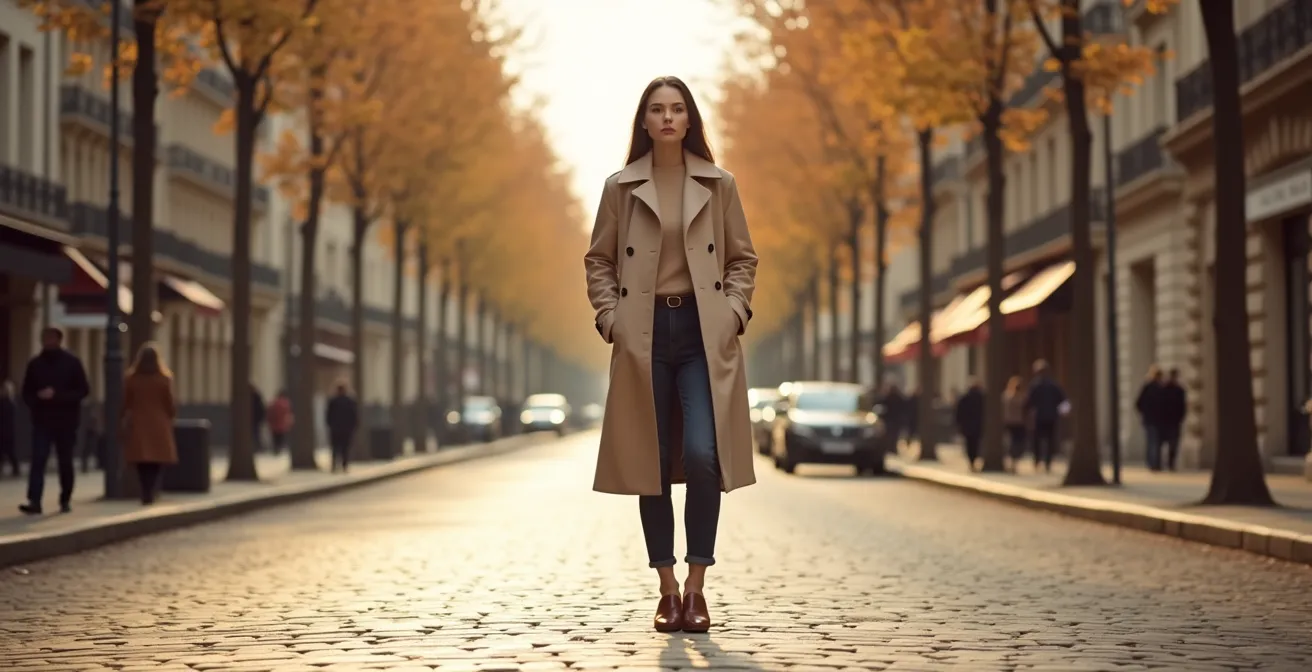
The secret to Parisian chic isn’t a checklist of items; it’s a strategic mindset that prioritizes context, function, and effortless confidence over trends.
- Your outfit must adapt to the specific occasion and arrondissement, from a casual neo-bistrot to a 3-Michelin-star restaurant.
- Function dictates form: accessories like scarves and bags are practical tools first, which is the source of their elegance.
- The goal is to look put-together, not “dressed up,” by mastering a silhouette that respects the body’s natural lines.
Recommendation: Stop trying to wear a “Parisian costume” and start thinking about how your clothes function within the city’s daily life. That is the true key to blending in.
The moment of hesitation in front of your suitcase is a familiar one for any traveler bound for Paris. You want to blend in, to glide through the Marais with the same ease as a local, not stick out as a tourist, a potential target for pickpockets and scammers. The internet offers a deluge of advice, a uniform of trench coats, striped marinière shirts, and the occasional—and deeply misguided—beret. This checklist approach is the most common trap for visitors.
While these items are part of the Parisian wardrobe, they are not the essence of it. True Parisian style is not a costume you put on. It’s a pragmatic and subtle language of context, function, and silhouette. It’s less about *what* you wear and more about *how* and *why* you wear it in a specific situation. It’s understanding that a city navigated on foot, with its unpredictable micro-climates and distinct social codes, demands more than a generic fashion formula. The real key isn’t in owning the right pieces, but in mastering the mindset behind them.
This guide will deconstruct that mindset. We will move beyond the clichés to explore the practical logic that governs Parisian style choices. From the functional reason for a scarf to the unwritten rules of wearing sneakers in a restaurant, you will learn the strategic thinking that allows you to navigate Paris with quiet confidence, looking not like a tourist in disguise, but like someone who simply belongs.
Table of Contents: How to Master Parisian Style Strategy
- Why Wearing Shorts in October Marks You as a Tourist Immediately?
- The Parisian Knot: How to Wear a Scarf Without Looking Like You Are Strangling Yourself?
- Sneakers vs Leather: Can You Wear Running Shoes to a Restaurant?
- Red Lip, Bare Eye: How to Master the “No-Makeup” Makeup Look?
- The Man Bag: Why French Men Carry Leather Bags and You Should Too?
- Jacket Required: Do You Really Need a Tie for Lunch at Le Pré Catelan?
- Dress Code at Bar Hemingway: Will They Refuse You for Wearing Jeans?
- How to Walk Through Place Vendôme Like You Belong There?
Why Wearing Shorts in October Marks You as a Tourist Immediately?
Wearing shorts in Paris in October is one of the quickest ways to broadcast your visitor status. The issue isn’t a strict fashion rule, but a fundamental disconnect with the city’s seasonal rhythm and practical mindset. For Parisians, October marks a definitive shift into autumn. The air grows crisp, the light changes, and the wardrobe transitions to richer textures and deeper colors. Showing up in summer attire signals that you are out of sync with the local environment. It’s a matter of functionality and context.
Locals don’t discard their entire summer wardrobe; they adapt it. The key is layering and evolving pieces for the new season. For instance, some stylish Parisians might still wear shorts, but they will be part of a considered autumn ensemble. As one style analysis notes, the combination of tights with shorts represents a classic trendy style seen in transitional seasons. This demonstrates a sophisticated understanding of layering. However, the far more common and safer choice is to switch to trousers. High-waisted trousers, dark wash jeans, and fine-wale corduroys in navy, burgundy, or forest green become the uniform of the season.
The fabrics themselves tell a story. A Parisian’s October wardrobe is a tactile experience of wool, cashmere, and suede. These materials provide necessary warmth and align with the visual palette of the city in autumn. Wearing thin cotton shorts is not just a style misstep; it’s a practical one. It suggests you haven’t prepared for the cool winds that sweep through the Haussmannian boulevards, marking you as someone just passing through, rather than someone living in the city’s rhythm.
The Parisian Knot: How to Wear a Scarf Without Looking Like You Are Strangling Yourself?
The scarf is a quintessential Parisian accessory, but tourists often get it wrong by treating it as a purely decorative element. They opt for complex, tight knots and loud patterns that scream “I’m trying to look French.” The authentic Parisian approach is rooted in effortless functionality. A scarf’s primary job is to protect you from the city’s unpredictable micro-climates and the notorious wind tunnels between buildings. The style comes from this practicality, not from an elaborate folding technique.
The secret is in the drape, or “le drapé.” Instead of a constricting knot, the scarf is typically looped once, loosely, and allowed to hang asymmetrically. The goal is nonchalance. It should look like you threw it on as an afterthought while rushing out the door. The material does the work: a quality scarf in cashmere, silk, or fine wool has a natural weight and texture that falls beautifully without any effort. As French style expert Marie-Anne Lecoeur states, the philosophy is “less is more […] we like more solid colours and simple prints.” A solid grey, navy, or camel scarf is far more versatile and chic than a busy, multi-colored one.
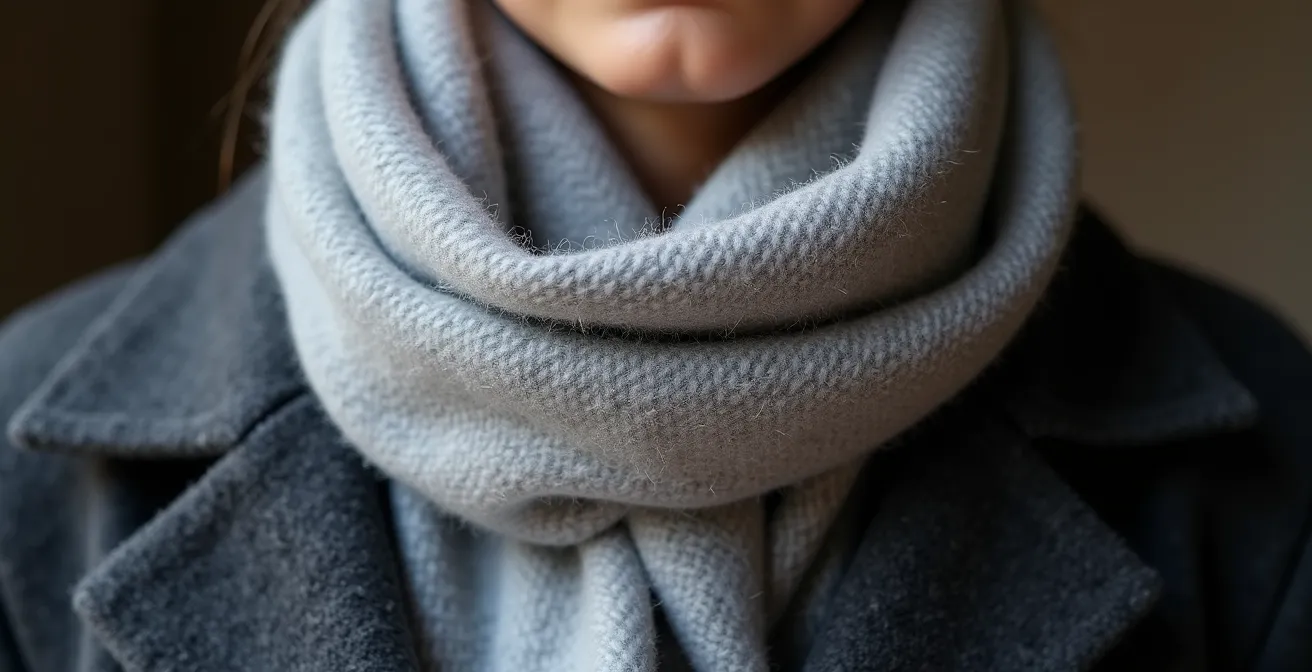
This “less is more” approach extends to all accessories. French women rarely wear more than a few delicate pieces of jewelry. They let one statement piece, like a scarf or a hat, complete the look. The overly-accessorized tourist, with a complicated scarf knot, clunky jewelry, and a designer bag, signals effort. The Parisian projects ease. Choosing a simple drape over a complex knot is a deliberate act of understated confidence, proving you understand that simplicity is the ultimate sophistication.
Sneakers vs Leather: Can You Wear Running Shoes to a Restaurant?
The question of sneakers in Paris is a minefield of nuance, and the answer perfectly illustrates the importance of strategic context. There is no simple “yes” or “no”; it depends entirely on the sneaker, the restaurant, and the overall outfit. Wearing your bulky, brightly colored running shoes to a traditional bistro is a mistake. However, wearing a pair of sleek, minimalist leather sneakers to a trendy neo-bistrot in the 11th arrondissement is perfectly acceptable and chic.
The key distinction is between athletic sportswear and stylish, city-appropriate sneakers. Parisians walk everywhere, so comfortable footwear is a necessity. They have embraced sneakers, but they favor clean, low-profile designs from brands that align with their understated aesthetic. According to French fashion experts, local favorites include brands like Veja, National Standard, and Pied de biche, which represent authentic Parisian street style. These are not the shoes you wear to the gym; they are an integrated part of a polished, casual look, often paired with tailored trousers or dark-wash jeans and a blazer.
The acceptability of sneakers is directly tied to the establishment’s standing and atmosphere. A casual café or a modern bistro will not blink at stylish sneakers. A classic “bouillon” might tolerate them, but you’ll feel more appropriate in loafers. However, as you ascend the culinary ladder, expectations change dramatically. At a Michelin-starred restaurant, sneakers are almost universally unacceptable for dinner. Here, respect for the institution, the chef, and the other diners demands more formal attire, meaning leather dress shoes for men and elegant shoes for women.
This table breaks down the unwritten rules for men’s footwear, but the principle applies to everyone.
| Restaurant Type | Sneaker Acceptability | Recommended Footwear |
|---|---|---|
| Neo-bistrot (11th arrondissement) | Acceptable | Veja, Common Projects, National Standard |
| Traditional Bouillon | Tolerated | Leather sneakers, loafers preferred |
| Michelin-starred | Not acceptable | Leather dress shoes only |
Red Lip, Bare Eye: How to Master the “No-Makeup” Makeup Look?
The Parisian “no-makeup” makeup look is one of the most misunderstood aspects of French style. It is not about wearing no makeup. It is a highly strategic, minimalist approach designed to create an aura of effortless, natural beauty. The philosophy is simple: enhance one feature and keep the rest of the face fresh and luminous. The classic combination is a bold red lip paired with a nearly bare eye. This creates a single point of focus, projecting confidence without the mask-like effect of a full face of heavy makeup.
The foundation of this look is impeccable skincare. Parisian women prioritize what’s underneath, investing in high-quality French pharmacy products to ensure their skin is healthy and radiant. The makeup is secondary. The goal is to look like you have great skin, not great foundation. The “bare” eye is also an illusion. It involves subtle techniques to define the eyes without making them look “done.” A thin line of brown or black crayon khôl smudged into the upper lash line (a technique called “tightlining”) and a single coat of separating mascara add definition that is nearly invisible to the untrained eye. Brows are groomed but never overdrawn, maintaining a natural shape.
Choosing the right red lipstick is the final, crucial step. It’s not about finding the trendiest shade, but the one that complements your specific skin undertone, hair, and eye color. It’s worn like an accessory—a classic, personal signature rather than a loud fashion statement. This look is a testament to the Parisian belief in a mature and self-aware elegance. As French fashion expert Nathalie Piegney observes, “The Parisian also knows that after age forty, there are a few things she will have to give up if she wants to be chic and elegant. She knows the limits of her body and face.” This self-awareness is the core of the “no-makeup” look: it’s about knowing what works for you and editing out everything else.
The Man Bag: Why French Men Carry Leather Bags and You Should Too?
For many male tourists, the idea of carrying a bag feels foreign, but in Paris, it’s a mark of a well-dressed man. The French man’s adoption of the “sacoche” (crossbody bag) or “porte-documents” (slim briefcase) isn’t driven by fleeting trends but by a deep-seated principle: the preservation of silhouette integrity. Parisian style, for both men and women, is obsessed with fit. Clothes should skim the body perfectly, creating clean, uninterrupted lines. Nothing ruins this line faster than pockets bulging with a phone, keys, and a thick wallet.
The man bag is the elegant solution to a practical problem. It allows a man to carry his daily essentials without compromising the cut of his trousers or the drape of his jacket. This commitment to a sleek silhouette is paramount; in Parisian fashion, baggy or overly tight clothing is a definite no. The bag becomes an essential tool for maintaining this tailored look. It’s a choice rooted in function, which, in the Parisian mindset, is the very definition of style.
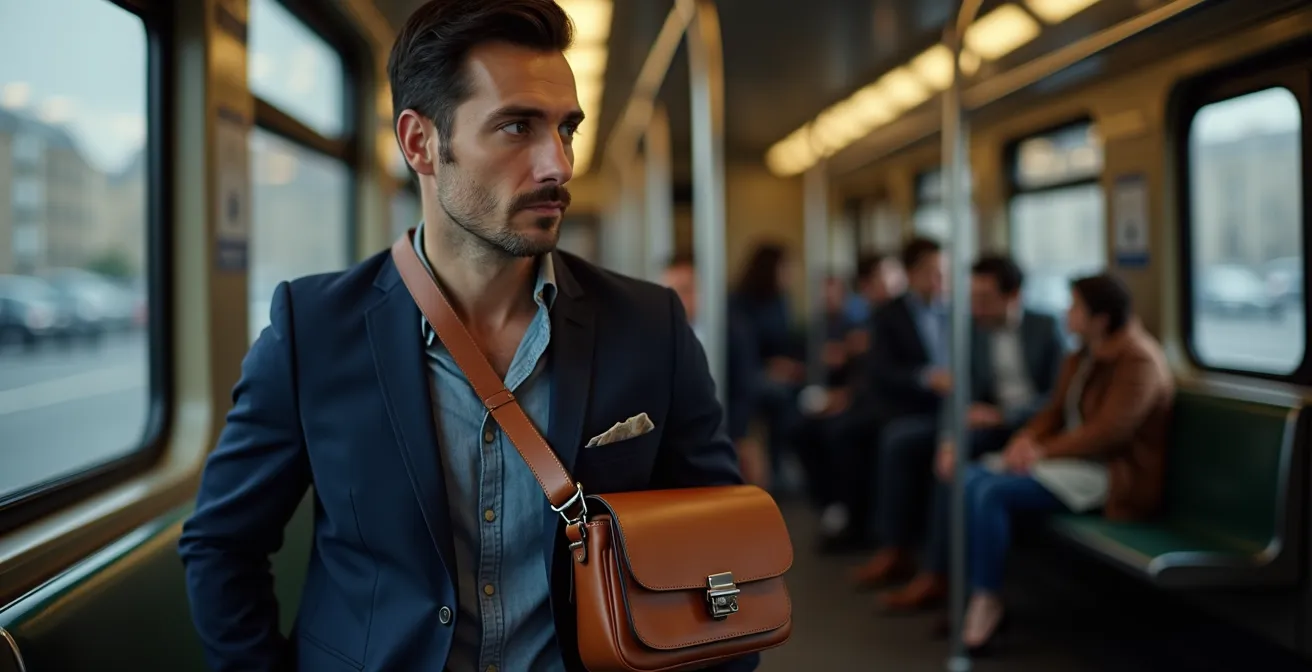
The choice of bag is, of course, deliberate. It’s rarely a purely functional nylon backpack. Instead, you’ll see high-quality leather crossbody bags, slim briefcases, or stylish canvas-and-leather backpacks from brands like Bleu de Chauffe. These pieces are investments that, like a good pair of shoes or a classic watch, add a touch of polish and signal an appreciation for quality craftsmanship. By carrying a stylish, functional bag, you are not only solving a practical issue but also communicating non-verbally that you understand and respect this fundamental rule of Parisian aesthetics. You’re showing that you care about the details.
Jacket Required: Do You Really Need a Tie for Lunch at Le Pré Catelan?
When dining at the highest echelons of Parisian gastronomy, such as a 3-Michelin-star restaurant like Le Pré Catelan, the dress code is a non-negotiable part of the experience. It is not an arbitrary rule but a sign of respect—for the chef, the staff, the history of the establishment, and the other patrons who have come for a special occasion. The phrase often seen is “tenue correcte exigée,” which translates to “proper attire required.” In this context, a jacket for men is the absolute minimum, and a tie is almost always strongly recommended, even for lunch.
To arrive without a jacket is to fundamentally misunderstand the social contract of such a place. While the restaurant may have a loaner jacket, being forced to wear one marks you as unprepared. The dress code varies slightly based on the restaurant’s character. Classic, palatial establishments like L’Ambroisie or Arpège will hold to the strictest standards (jacket and tie). A more modern 1-star restaurant might have a “smart casual” code where a jacket is optional. However, for a 3-star temple of cuisine, there is no ambiguity. The expectation is formal.
For women, the code is less prescriptive but no less important. It’s about overall “allure.” This means no jeans, no sneakers, and nothing overly casual. An elegant dress, a chic trouser suit, or a skirt ensemble is appropriate. The goal is to contribute to the sophisticated atmosphere of the room. Failing to adhere to the dress code is not just a personal fashion choice; it is seen as a disruption to the collective experience. It shows a lack of awareness and respect for the immense effort that goes into creating a world-class dining environment. In short, yes, you absolutely need a jacket, and you should wear a tie.
Dress Code at Bar Hemingway: Will They Refuse You for Wearing Jeans?
Navigating the dress codes of Paris’s legendary palace hotel bars, like the Bar Hemingway at the Ritz, requires a nuanced understanding of smart casual. The answer to whether they will refuse you for wearing jeans is: it depends entirely on the jeans and what you wear with them. These establishments work hard to cultivate an atmosphere of exclusive, timeless luxury. While they have adapted to modern style, there are clear lines that cannot be crossed. Ripped, faded, distressed, or baggy jeans will almost certainly result in a polite refusal at the door.
However, you can often gain entry wearing jeans if they are part of a polished ensemble. The key is to elevate them. For men, a pair of high-end, dark wash, well-fitting jeans paired with a blazer and leather shoes has a high chance of being accepted, especially for an early evening drink. For women, the same dark wash jeans can work with heels or elegant flats and a silk blouse or blazer. The goal is to show that you made an effort and respect the bar’s sophisticated ambiance. The jeans are the casual element in an otherwise smart outfit.
It’s also crucial to consider the time of day. The “jeans and blazer” combination that might be acceptable at 5 PM becomes less so as the evening progresses. After 8 PM, the expectation for elegance increases, and cocktail attire becomes the safer bet. When in doubt, always apply the principle of being slightly overdressed rather than underdressed. No one has ever been turned away from the Bar Hemingway for being too elegant. A cocktail dress or a suit will always be appropriate. This strategic approach shows you’re not just there to tick a box, but to participate in the bar’s storied atmosphere.
Your Action Plan: Bar Hemingway Dress Code Strategy
- If wearing jeans, choose only dark wash, well-fitted styles without any distressing.
- Always pair jeans with a blazer and leather shoes (men) or heels/elegant flats (women).
- After 8 PM, switch to a cocktail dress or suit for guaranteed acceptance.
- Apply the ‘better to be overdressed’ principle—cocktail attire never feels out of place.
- Call ahead to confirm the current dress code; this shows sophistication, not ignorance.
Key takeaways
- True Parisian style is a mindset, not a uniform; it’s about adapting to the specific context of place and time.
- Functionality is the root of elegance. Parisians choose items like scarves and bags for their practical benefits, and the style follows naturally.
- The goal is quiet confidence. This is achieved through a mastery of fit, silhouette, and an understated approach that enhances rather than overwhelms.
How to Walk Through Place Vendôme Like You Belong There?
Dressing the part is only half the battle. To truly blend in, especially in the city’s most luxurious districts like Place Vendôme, your demeanor is as important as your clothing. It’s about projecting an air of quiet confidence and purpose. This is the art of the “flâneur”—the individual who strolls through the city not as a wide-eyed tourist, but as an observant participant. You are there to see, but also to be seen, as part of the elegant urban tapestry.
This attitude starts with your posture and pace. Walk at a steady, unhurried pace, with your gaze level. Appreciate the magnificent architecture, but avoid the “tourist shuffle”—the slow, meandering walk of someone lost or overwhelmed. You are walking *through* the Place, perhaps on your way to an appointment or to browse at Galignani, the historic bookshop on the nearby rue de Rivoli. Carrying a prop that signals participation in city life, like a shopping bag from Le Bon Marché or a book, can act as a subtle social cue. It says “I am part of this,” not “I am just looking at this.”
Before you leave your house, look in the mirror and take one thing off.
– Coco Chanel
This famous advice from Coco Chanel is the perfect guiding principle for your overall look. It’s about editing. Parisians build their wardrobes around a core of neutral colors, ensuring that pieces are versatile and harmonious. As a style guide on the topic notes, Parisians work their whole wardrobe around neutral colors that don’t conflict with any other. This creates a cohesive look that is sophisticated and never loud. Your goal is to look put-together, not to be a spectacle. By combining an understated, well-fitting outfit with a purposeful and confident demeanor, you will move through Place Vendôme not as an outsider looking in, but as someone who belongs in the picture.
Now that you understand the strategic mindset behind Parisian chic, you possess the tools to go beyond imitation. The next step is to observe, adapt, and walk the streets of Paris with the quiet confidence of someone who truly understands the city’s sartorial language. It’s time to assemble your own version of Parisian style, one that is authentic to you and respectful of the culture you’ve come to admire.