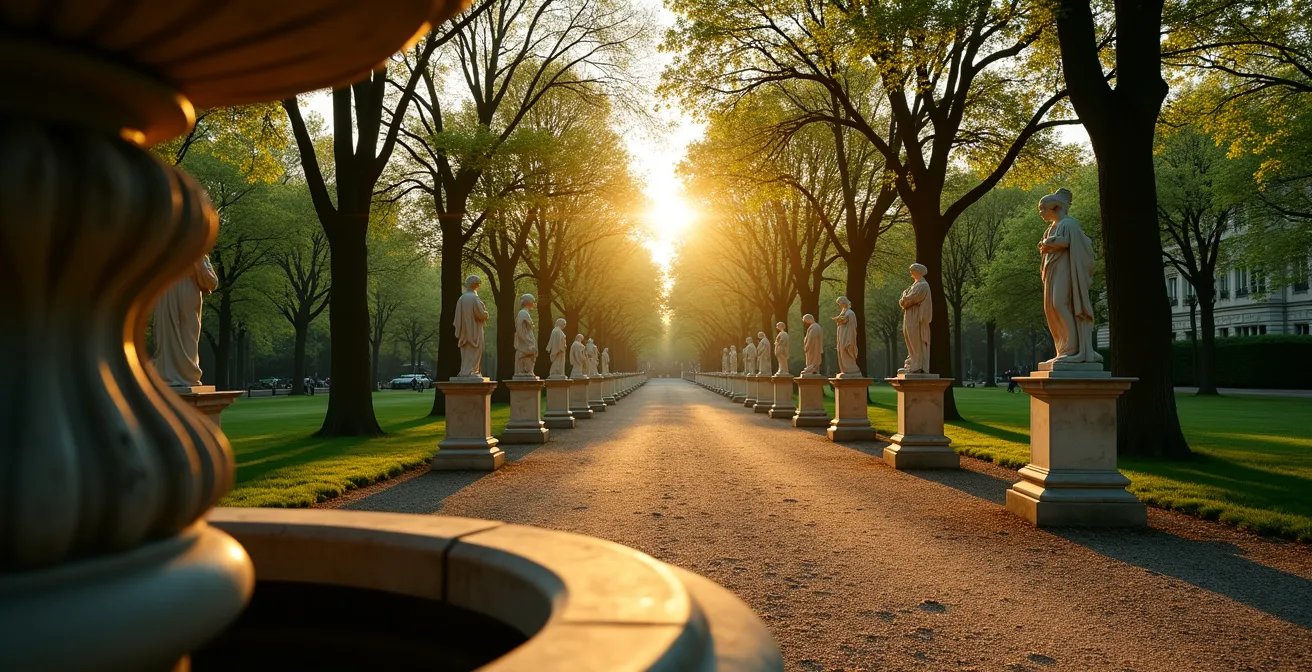
Thinking you need a hefty budget to experience Parisian art is a common mistake. The truth is, the city itself is the greatest gallery, open 24/7 and completely free. This guide moves beyond crowded museum free-days to teach you the visual literacy needed to decode the art hiding in plain sight—from masterful sculptures in public gardens to architectural details on metro stations and faded advertisements that whisper tales of a bygone era. You’ll learn not just where to look, but how to see.
The magnetic pull of Paris is often synonymous with its world-class museums: the Louvre, the Musée d’Orsay, the Centre Pompidou. For the budget-conscious traveler, this can present a frustrating paradox. The desire for deep cultural immersion clashes with the reality of steep entrance fees. While many guides point to the crowded “first Sunday of the month” as the go-to solution, this strategy often leads to long queues and a rushed, overwhelming experience that misses the point of art appreciation.
But what if the most profound, authentic, and enriching museum experience in Paris required no ticket, no queue, and no specific opening hours? What if the key wasn’t about finding a loophole to get into a building, but about learning to read the building itself, the street it stands on, and the very air above it? This is the core secret of the savvy travel hacker: Paris is not a city with museums *in* it; the city *is* the museum. Every stroll can become a curated exhibition if you know the visual language.
This guide is your Rosetta Stone for that language. We will equip you with the knowledge to transform a simple walk into a sophisticated treasure hunt. Forget the velvet ropes and hushed galleries. We’re stepping outside to discover how to spot masterpieces in public gardens, appreciate the architectural genius of the Métro, decode history on forgotten shop signs, and witness how the changing light can transform a familiar sculpture into a breathtaking new discovery. Get ready to see the City of Light in a whole new light.
To help you navigate this magnificent open-air gallery, we’ve structured this guide into a series of focused explorations. Each section will unlock a different layer of the city’s artistic soul, providing you with the tools to become your own expert curator.
Summary: Your Itinerary for Paris’s Free Open-Air Museum
- Rodin or Maillol: Where to See Their Statues for Free in Public Gardens?
- Which 5 Metro Stations Are Considered Architectural Masterpieces?
- The Ancient Shop Signs Walk: How to Spot History Above Your Head?
- The Mistake of Trying to Visit the Palais Royal Columns During State Events
- Why Visiting the Tuileries Sculptures at Sunset Changes Everything?
- Wallace Fountains: Is the Water Safe to Drink in Paris Parks?
- Ghost Signs: Where to Find Faded Painted Ads from the 1920s?
- Where to Find the Boldest Contemporary Architecture Hiding in Historic Paris?
Rodin or Maillol: Where to See Their Statues for Free in Public Gardens?
While the Musée Rodin famously houses masterpieces like ‘The Thinker’ and ‘The Kiss’, many travelers assume seeing these works requires a full museum ticket. Here’s a travel-hacker secret: you can experience the genius of France’s greatest sculptors without the museum price tag by turning Paris’s public gardens into your personal sculpture gallery. The key is to know where to look. Aristide Maillol, known for his serene and sensual female forms, has a significant presence in the Jardin des Tuileries, offering a free and breathtaking introduction to his work.
Instead of aimless wandering, you can create a “curated stroll” to appreciate these masters. A fantastic route begins with Maillol and extends to other sculptural giants. By following a planned path, you transform a simple park visit into a structured art history tour. This approach allows you to see the dialogue between different artists and styles in a natural, open setting.
Here is a potential walking itinerary to get you started:
- Start at the Tuileries Gardens: Begin near the Arc de Triomphe du Carrousel to find Maillol’s tranquil bronze figures like ‘Les Trois Grâces’.
- Visit the Musée Bourdelle Garden: A 20-minute walk takes you to this museum where the garden, filled with Antoine Bourdelle’s powerful bronze statues, has free access.
- Discover Musée Zadkine: Near the Luxembourg Gardens, the garden of this museum is also free to enter and showcases Ossip Zadkine’s unique Cubist sculptures.
- Explore the Musée de la Sculpture en Plein Air: Along the Seine between Pont de Sully and Pont d’Austerlitz, this riverside park is a dedicated outdoor sculpture museum.
- End at the Musée Rodin Garden: Here’s the hack: access to the sculpture garden alone, where you can see ‘The Thinker’ and ‘The Gates of Hell’, costs only a symbolic 1€ (and is free for those under 18), a fraction of the full museum price.
This self-guided tour not only saves you money but provides a more intimate and leisurely experience. You can contemplate these powerful works in the environments they were often designed for, with the changing seasons providing an ever-evolving backdrop. The harmony between nature and sculpture, particularly in the Rodin garden, offers a moment of calm contemplation that is priceless.
Which 5 Metro Stations Are Considered Architectural Masterpieces?
The Paris Métro is far more than a transportation system; it’s the city’s circulatory system and, in many places, an underground art museum. While millions rush through its tunnels daily, the savvy visitor knows to pause and look up. Several stations are not just stops, but destinations in themselves, showcasing over a century of architectural innovation. From the iconic Art Nouveau entrances of Hector Guimard to futuristic modern designs, the Métro offers a free, accessible exhibition of public art and design history.
Hector Guimard’s organic, plant-like entrances are perhaps the most famous, but they are just the beginning. The RATP has preserved these historic gems while also commissioning bold new designs, turning the daily commute into an aesthetic experience. The preservation efforts have been significant; an Artnet report confirms that 88 out of 141 original Guimard-designed Métro entrances survive today, each a testament to the elegance of the Belle Époque. Below is a curated list of stations you shouldn’t miss.
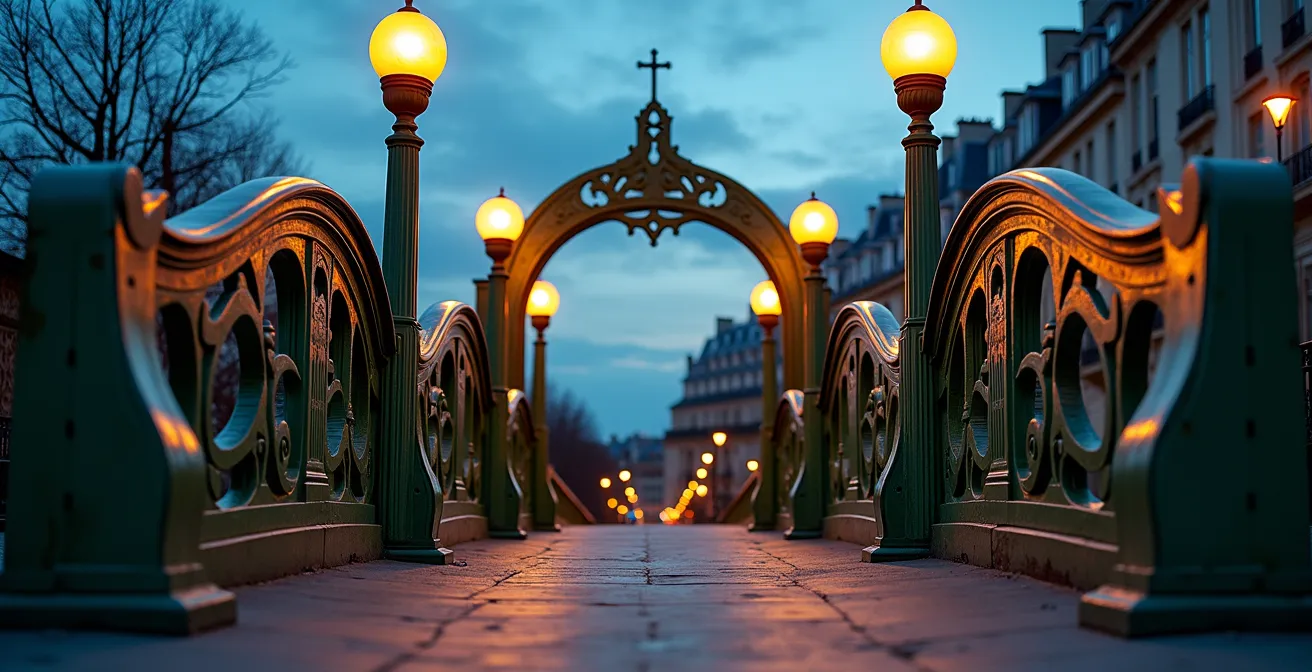
This table acts as your guide to the five essential architectural archetypes you can find within the network, each representing a distinct era and artistic vision. This is your checklist for an underground architectural tour.
| Station Category | Station Name | Architectural Features | Design Era |
|---|---|---|---|
| Art Nouveau Original | Porte Dauphine | Only surviving Guimard ‘dragonfly’ pavilion with fan-shaped glass awning | 1900 |
| Art Nouveau Classic | Abbesses | Complete Guimard édicule relocated from Hôtel de Ville in 1974 | 1912 |
| Cultural Antechamber | Louvre-Rivoli | Museum copies and art installations throughout | Various |
| Industrial Steampunk | Arts et Métiers | Copper riveting, portholes evoking Jules Verne’s Nautilus | 1994 renovation |
| Modernist Gateway | Line 14 stations | Futuristic glass and steel design | 1998-2003 |
The Ancient Shop Signs Walk: How to Spot History Above Your Head?
To discover some of Paris’s most charming historical artifacts, you simply need to look up. High above the modern storefronts and bustling crowds, a treasure trove of antique shop signs tells the story of the city’s commercial past. These are not just advertisements; they are works of art and craftsmanship from the 18th, 19th, and early 20th centuries. Wrought iron, painted glass, and intricate mosaics reveal the trade of a long-gone baker, butcher, or cobbler, turning a walk through a district like Le Marais into an archaeological expedition.
Spotting these signs requires training your eye to scan the space between the first and second floors of buildings—the sweet spot for historical signage. These signs were designed to be seen from the street in an era before neon and LEDs. Each material and style is a clue to its time period. An ornate wrought iron sign likely dates back to the 1700s, while a sign with elegant painted glass (églomisé) points to the Art Nouveau boom of the early 1900s. Mosaic work often signals the Art Deco period that followed.
Some of these storefronts (devantures) are so historically significant they are officially protected as heritage sites, marked by a small plaque. The boulangerie at 48 rue de Richelieu, for example, features stunning painted panels from the time of Louis XV. By learning to decode these visual cues, you unlock a hidden layer of Parisian history that most tourists—and even many locals—walk right past every day. This is the essence of urban exploration: finding the extraordinary in the ordinary.
The Mistake of Trying to Visit the Palais Royal Columns During State Events
Daniel Buren’s iconic black-and-white striped columns, officially titled “Les Deux Plateaux,” are a must-see piece of public art. Located in the courtyard of the historic Palais Royal, they offer a striking contrast between contemporary art and classical architecture. They are free to visit, endlessly photogenic, and a beloved spot for locals and tourists alike. However, there is one crucial mistake to avoid: trying to visit them at the wrong time. The Palais Royal is not just a historical site; it houses several key government bodies, including the Ministry of Culture and the Council of State (Conseil d’État).
Because of its official status, the entire Palais Royal complex, including the courtyard with Buren’s columns, can be unexpectedly closed to the public during state visits, official ceremonies, or for security reasons. There is often little to no advance public notice. Showing up to find the gates locked can be a major disappointment, especially if it was a key part of your itinerary. The best way to avoid this is to have a flexible schedule. If you find it closed, simply pivot to another nearby attraction like the Tuileries Garden and try again later or the next day.
The installation itself is a fascinating piece of 1980s public art that initially caused a huge controversy. Now, it’s a celebrated landmark. As you walk among them, you’re experiencing a major moment in French cultural history. According to a travel overview on Parisian public art, the installation features 260 striped columns of varying heights, creating an interactive and playful landscape that invites exploration. Just be sure to check for any large-scale official events in the city during your visit to minimize your chances of a fruitless trip.
Why Visiting the Tuileries Sculptures at Sunset Changes Everything?
Anyone can walk through the Tuileries Garden in the middle of the day, but the true art connoisseur knows that the experience is completely transformed during the “golden hour”—the period shortly before sunset. At this time, the harsh midday sun is replaced by a warm, low-angled light that works magic on the garden’s extensive collection of marble and bronze sculptures. This is not just a prettier time for photos; the light fundamentally changes how you perceive the art itself.
The raking light of the setting sun creates dramatic shadows and highlights, a natural chiaroscuro effect that reveals the three-dimensionality and subtle textures of the sculptures in a way that flat overhead light cannot. The smooth, pure forms of Aristide Maillol’s female figures, scattered throughout the garden, seem to glow from within. The sensuality of their rounded shapes and elegant postures is heightened, making the marble appear softer and more life-like. It’s an ephemeral exhibition curated by the sun, and it’s completely free.
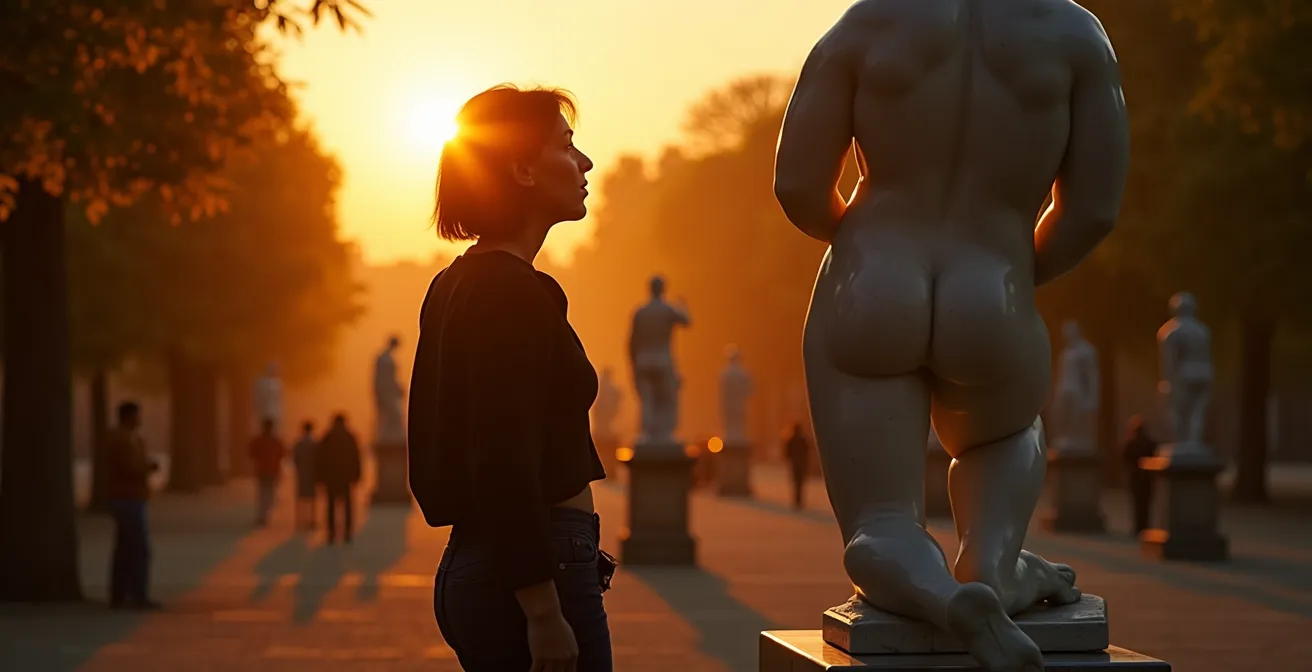
To make the most of this experience, plan a “sunset sculpture trail.” Start near the Place de la Concorde with grand Baroque works like Antoine Coysevox’s ‘Fame Riding Pegasus’, which spectacularly catches the last direct rays of light. As the sun dips lower, move east through the garden toward the Arc de Triomphe du Carrousel, where the Maillol figures become beautifully silhouetted against the vibrant, colorful sky. This simple act of timing your visit elevates a pleasant walk into a deeply moving artistic experience, proving that sometimes the “how” and “when” of seeing art are just as important as the “what.”
Wallace Fountains: Is the Water Safe to Drink in Paris Parks?
Yes, absolutely! The water from Paris’s iconic green Wallace Fountains is not only safe to drink, but it is the very same high-quality tap water that flows into every Parisian home and restaurant. These fountains are a beloved symbol of the city and a beautiful, practical piece of its public infrastructure. Tapping into this free resource is a classic budget travel hack, saving you money on bottled water while connecting you to a piece of Parisian history. In fact, the city continues to invest heavily in its public water access; in a recent push for the 2024 Olympics, the city has expanded its water infrastructure with 70 new fountains and equipped 50 Wallace fountains with misting systems for hot days.
These fountains are more than just water sources; they are monuments to philanthropy. As the publication World In Paris explains, they are a gift from a 19th-century Englishman who was moved by the plight of Parisians during a devastating siege.
Behind these iconic fountains, there’s Sir Richard Wallace (1818-1890), a rich Englishman who lived most of the time in Paris. Moved by the suffering endured by Parisians during the Franco-Prussian War, which deprived the capital of running water, this wealthy Englishman donated funds to bring free, clean drinking water to Parisians.
– World In Paris, Can You Drink Tap Water in Paris?
You can become a connoisseur of these fountains by learning to identify the different models. While the classic version is most common, spotting the rarer wall-mounted model can be a fun challenge. Here’s what to look for:
- Classic Caryatid Model: This is the most famous design, featuring four female figures (caryatids) representing Kindness, Simplicity, Charity, and Sobriety, all supporting a decorative dome.
- Wall-Mounted Model: A rarer version designed for narrow streets, featuring a naiad’s head from which the water flows.
- Authentic Color: All official Wallace fountains are painted in a specific dark green known as ‘Carriage Green’.
- Seasonal Flow: The water typically flows continuously from March 15th to November 15th and is shut off in winter to prevent the pipes from freezing.
So, fill your bottle with confidence. Each sip is a taste of Parisian history and a nod to a legacy of generosity that continues to serve the city today.
Ghost Signs: Where to Find Faded Painted Ads from the 1920s?
For the urban explorer, one of the most exciting discoveries is a “ghost sign”—a faded, hand-painted advertisement from a bygone era still clinging to the side of a building. These are the whispers of the city’s commercial past, advertising products and businesses that have long since vanished. Finding them is like a treasure hunt, rewarding the patient observer with a glimpse into the Paris of the 1920s and beyond. The 11th arrondissement, particularly around streets like Rue Oberkampf and Boulevard Voltaire, is a fantastic hunting ground.
These signs were painted on brick and stone walls at a time when this was a primary form of mass advertising. They were often placed high up on building gables to be visible over the bustling street life. Decades of sun and rain have weathered them into beautiful, ghostly images. You might spot ads for apéritifs like ‘Byrrh’, long-forgotten tonics, or the famous ‘Ripolin’ paint. Each one is a piece of graphic design history and a testament to the craftsmanship of the painters who created them.
Some buildings are a living canvas where these historical layers mix with modern art. A perfect example is “Les Frigos” in the 13th arrondissement. This former refrigerated warehouse preserves traces of its industrial past, including old signage, alongside an ever-evolving collection of contemporary street art and graffiti, creating a true urban palimpsest.
Case Study: Les Frigos, a Living Canvas
This former refrigerated warehouse in the 13th arrondissement has become an ever-evolving canvas for street artists. Now a hub for artists’ studios, its exterior is adorned with graffiti, murals, and other art forms. The building preserves layers of artistic expression from different eras, including ghost signs from its industrial past alongside contemporary street art, making it a living canvas for Paris’ vibrant street art culture and a prime example of the city’s layered history.
Your Action Plan: Ghost Sign Treasure Hunt in the 11th
- Start on Rue Oberkampf and look for faded ‘Byrrh’ apéritif advertisements on building facades.
- Check the corners of Rue de la Roquette for old factory signs and workshop advertisements.
- Search building walls along Boulevard Voltaire for iconic ‘Ripolin’ paint ads from the early DIY era.
- Look up at the third and fourth-floor levels, where signs were painted to be visible above street traffic and early trams.
- Plan your walk for early morning or late afternoon, as the angled sunlight often highlights the faded paint, making it more visible.
Key takeaways
- The true museum is the city itself; learn to read its visual language instead of just visiting landmarks.
- Art is everywhere: integrated into infrastructure like metro stations and functional objects like Wallace Fountains.
- Perception is key: the time of day and quality of light can completely transform your experience of a public sculpture.
- Look for the layers: Paris is an urban palimpsest where history, like ghost signs and old architecture, shows through the modern city.
Where to Find the Boldest Contemporary Architecture Hiding in Historic Paris?
While Paris is celebrated for its Haussmannian elegance and historical monuments, it is not a city frozen in time. The “open-air museum” is constantly evolving, with world-renowned contemporary architects adding bold, and sometimes controversial, new layers to the urban fabric. Finding these modern masterpieces tucked within historic districts is a thrilling experience, showcasing the dynamic dialogue between Paris’s past and its future. From Jean Nouvel’s light-responsive facade at the Institut du Monde Arabe to Renzo Piano’s inside-out Centre Pompidou, these buildings are as much a part of the city’s artistic identity as any classical sculpture.
These structures often challenge traditional aesthetics, using glass, steel, and deconstructed forms to create a new architectural language. A walk through the Parc de Bercy to see Frank Gehry’s tumbling, sculptural Cinémathèque Française is a journey into modern art itself. Even social housing can be a source of architectural wonder, as seen in Frédéric Borel’s colorful and angular buildings in the Belleville neighborhood. For an even more concentrated dose of modern public art, a trip to the business district of La Défense is essential. Just outside the historic center, its grand esplanade is a veritable sculpture park. Paris La Défense’s official open-air collection features an impressive 69 monumental pieces visible from the Esplanade, open 24/7 and completely free, including works by Calder, Miró and César.
The following table provides a “Starchitects vs. History” walking tour itinerary, guiding you to some of the most significant contemporary buildings and the best free spots from which to view them.
| Architect | Building | Architectural Approach | Free Viewing Location |
|---|---|---|---|
| Jean Nouvel | Institut du Monde Arabe | Mechanical mashrabiya facade responding to light | Best viewed from Quai de la Tournelle |
| Renzo Piano | Centre Pompidou | Inside-out design with exposed structural elements | Piazza offers full facade view |
| Frank Gehry | Cinémathèque Française | Deconstructivist forms in former American Center | Parc de Bercy provides best angle |
| Frédéric Borel | Social Housing Rue Piat | Bold colors and angular forms in Belleville | Street level provides dramatic views |
Now that you are equipped with the visual literacy to decode Paris’s streets, the final step is to put it into practice. The true souvenir from your trip will not be an object, but this new way of seeing. Apply these principles on your next walk, in Paris or any city, and you will uncover a world of art and history that has been hiding in plain sight all along.