Contrary to popular belief, the exclusive Parisian art world is not a closed club; it’s a conversation you’re invited to join.
- Gallery openings (vernissages) are intentionally public events designed for discovery.
- Asking for a price is not rude; it’s the beginning of a dialogue about the artwork’s value.
- Starting a collection with an affordable print is seen as a welcome, long-term investment in an artist’s career.
Recommendation: Shift your mindset from being a passive visitor to an active participant. Your curiosity is your most valuable asset.
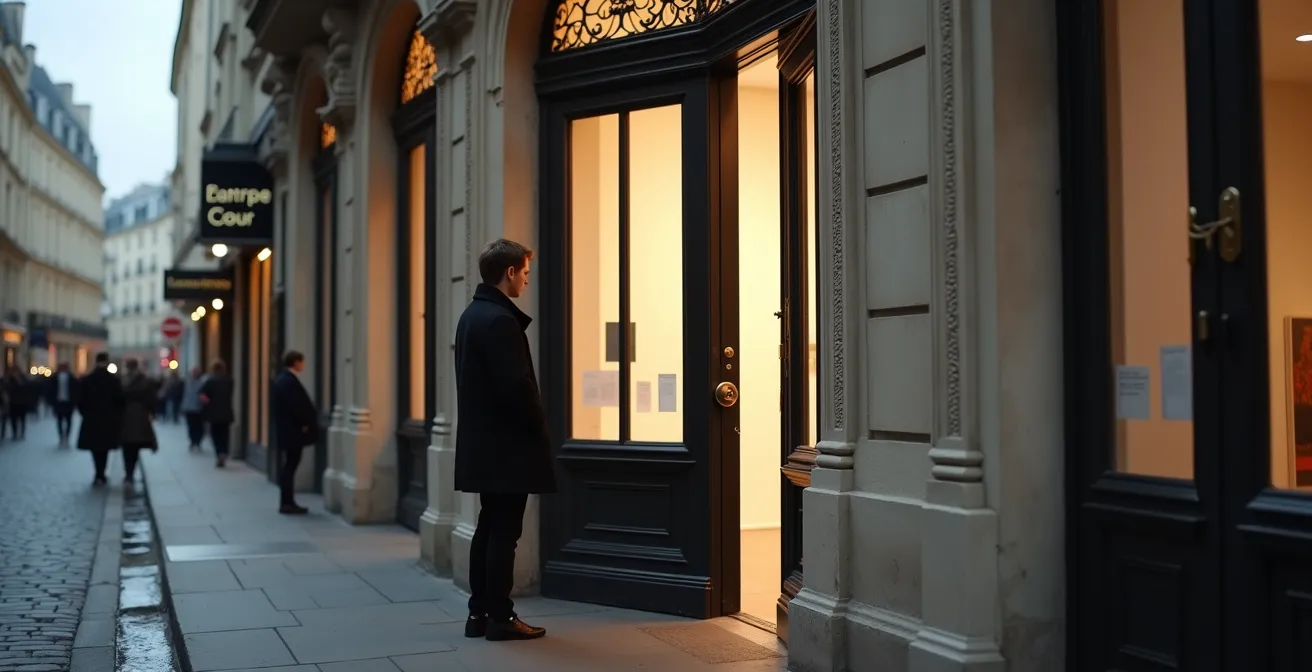
The feeling is universally understood among aspiring art lovers in Paris. You stand before a sleek, minimalist gallery facade in the Marais. There’s no handle, just a small, inscrutable doorbell. A wave of “threshold anxiety” washes over you. Am I dressed well enough? Do I know enough about art? What if they think I don’t belong? This hesitation prevents countless people from discovering incredible art and connecting with the vibrant heart of the city’s creative scene.
Most guides offer simple advice like “just be confident” or “dress nicely,” but this fails to address the root of the issue. The art world operates on a set of unwritten rules and cues that can feel like a secret language. The good news? It’s a language designed not to exclude, but to facilitate a deeper engagement with art. It’s a language you can learn.
This guide moves beyond the platitudes. From a gallery director’s perspective, the goal is to demystify the process entirely. Forget the idea of being judged. Instead, think of this as learning the steps to a dance. We will decode the etiquette of gallery openings, provide exact scripts for inquiring about prices, and reveal how starting a collection is far more accessible than you imagine. The true key isn’t faking confidence; it’s understanding the system so that genuine confidence can flourish.
This article will guide you through the essential aspects of navigating the Parisian art scene, from the practicalities of purchasing art to the cultural nuances of each district. Follow along to transform your gallery visits from intimidating tests into enriching cultural experiences.
Summary: Navigating the Parisian Art Scene Like an Insider
- VAT Refund: How to Ship a Painting to the US Tax-Free?
- Gallery Openings: Can Anyone Walk into a “Vernissage” on Thursday Night?
- Prints vs Originals: Where to Start Your Collection Under 500€?
- Rue de Turenne or Saint-Germain: Which District Has the boldest New Art?
- Price on Request: Is It Rude to Ask “How Much” Immediately?
- How to Plan a Street Art Hunt in the 13th Arrondissement Without a Guide?
- Stamps or Comics: Which Bank Has the Best Specialists?
- Where to Find the Boldest Contemporary Architecture Hiding in Historic Paris?
VAT Refund: How to Ship a Painting to the US Tax-Free?
Let’s begin with a crucial, practical aspect for any international visitor who falls in love with a piece of art: getting it home. The process of claiming a Value-Added Tax (VAT) refund in France can seem complex, but it’s a well-established system designed to encourage cultural purchases. For non-EU residents, this translates into a significant saving, effectively making your art acquisition more affordable. The key is to be prepared and understand the steps before you even make a purchase.
The first requirement is meeting the minimum purchase amount. To be eligible for a tax refund, the total price of the artwork must be over €100.01 on the same day in the same gallery. Most significant artworks will easily meet this threshold. When you buy the piece, you must immediately inform the gallerist that you intend to claim the VAT refund. You will need to present your passport to prove your non-EU residency. The gallery will then issue a “bordereau de vente à l’exportation,” which is now typically an electronic form with a barcode.
The final and most critical step happens at the airport before your departure. You must have the artwork with you, ideally in its original packaging, as customs officers may request to inspect it. Before checking your luggage, locate the PABLO (Programme d’Apurement des Bordereaux par Lecture Optique de code-barres) kiosk. These self-service terminals allow you to validate your refund by simply scanning the barcode on your form. Once validated, you’ll receive your refund, which is typically around 12% if sent to a credit card or a slightly lower 10.8% if you opt for a cash refund at a currency exchange counter. A well-informed gallery will guide you through their part of the process seamlessly.
Gallery Openings: Can Anyone Walk into a “Vernissage” on Thursday Night?
The “vernissage,” or opening night, is perhaps the most mythical and misunderstood event in the art world. In Paris, particularly in districts like the Marais, Thursday night is the traditional time for these events. The question on many minds is: are these private, invitation-only parties for the elite? The answer, for the most part, is a resounding no. Vernissages are marketing and community events, and galleries want people to attend.
Think of a vernissage not as an exclusive party, but as an open house. It’s the moment a gallery presents a new body of work to the world. The primary goals are to generate buzz, allow critics and curators to see the work, and, most importantly, to welcome both seasoned collectors and the art-curious public. The presence of a lively, engaged crowd is a sign of a successful exhibition. According to the Paris Tourist Office, many Paris galleries offer free entrance to exhibitions all year round, and the Thursday night opening tradition is a cornerstone of this accessible spirit, especially in the contemporary art hubs of the Marais and Haut Marais.
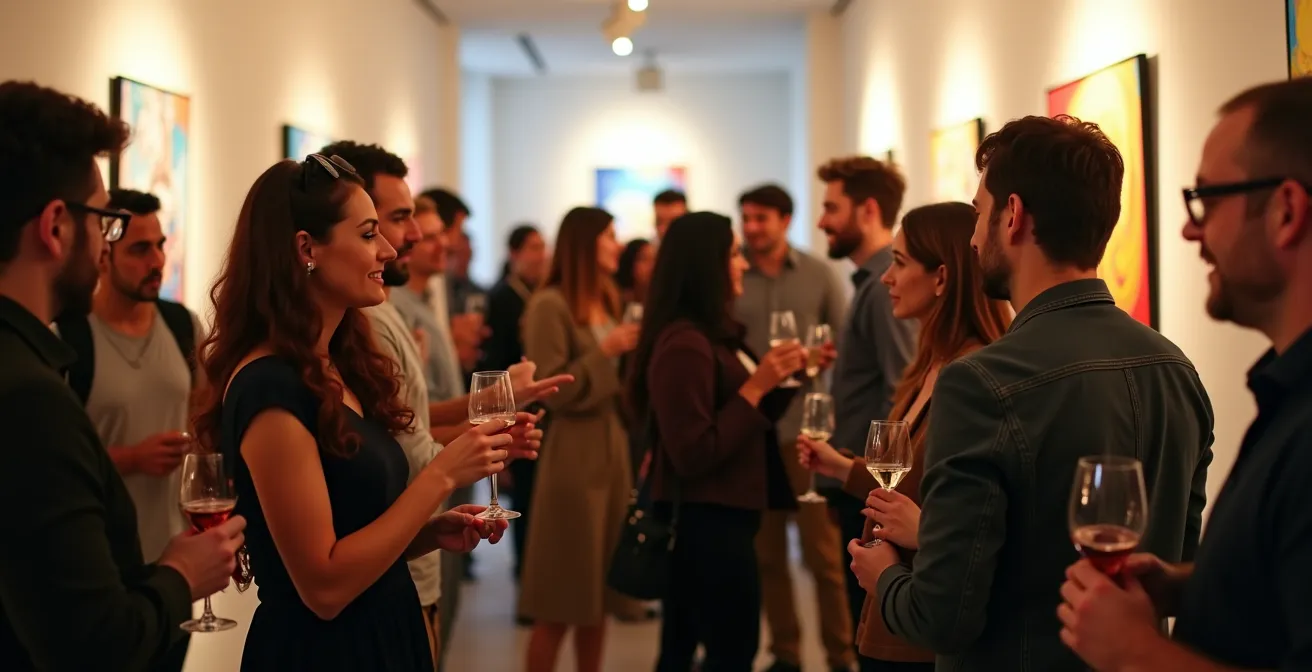
So, yes, you can absolutely walk in. There’s no need for an invitation. Dress smartly but comfortably—there’s no strict dress code. Feel free to have a glass of wine if offered, but remember the main purpose is to see the art. Move through the space, observe the works, and listen to the conversations around you. It’s a fantastic, low-pressure way to gauge the energy of a gallery and discover new artists. If the gallery director or artist is present, they will be busy, but it’s the best time to see the social ecosystem of the art world in action.
Prints vs Originals: Where to Start Your Collection Under 500€?
A common misconception is that art collecting is a hobby reserved for the ultra-wealthy. While headline-grabbing auction prices fuel this idea, the reality is that a meaningful and beautiful collection can be started on a modest budget. The secret lies in understanding the difference between original works and high-quality prints or editions. For a new collector, a budget of under 500€ is a fantastic starting point, and Parisian galleries are well-equipped to cater to this market.
The most accessible entry point is often a limited-edition print. These are not mere posters; they are original works of art conceived by the artist to exist as a series. Look for markings like a fraction (e.g., 7/100), which indicates its number in the edition, and the artist’s signature. Some of the most valuable prints are marked “E.A.” (épreuve d’artiste) or “A.P.” (artist’s proof), which are the first prints pulled for the artist’s approval. Beyond prints, consider “multiples”—small sculptures or objects produced in a limited series. Specialized venues like Atelier-Galerie A. Piroir offer incredible original prints, and annual events like Circulation(s) are perfect for discovering emerging photographers at accessible price points.
Most importantly, never feel that a small purchase is a waste of a gallerist’s time. The opposite is true. We see it as the beginning of a relationship. As one Parisian art guide notes, it’s about investing in a future enthusiast.
For a Parisian gallerist, selling a 300€ print is not a waste of time but a long-term investment in a potential future collector.
– Gallery perspective, Paris Art Collecting Guide
This perspective is key. Your first purchase, no matter the size, marks your entry into the artistic ecosystem. It supports an artist and a gallery, and it establishes you as someone with a genuine interest—a budding collector.
Rue de Turenne or Saint-Germain: Which District Has the boldest New Art?
Once you’re ready to explore, the question becomes: where to go? Paris is not a monolithic art scene; it’s a collection of distinct villages, each with its own artistic identity. The two most famous are Le Marais and Saint-Germain-des-Prés, but the truly “bold” new art often emerges elsewhere. Understanding the character of each district is essential for a targeted and rewarding gallery crawl.
Le Marais, centered around streets like Rue de Turenne, is the undisputed heavyweight of contemporary art. Here you’ll find the Parisian outposts of global “blue-chip” galleries like Perrotin and Thaddaeus Ropac. The art is established, the spaces are immense, and the vibe is international and professional. Across the river, Saint-Germain-des-Prés has a more classic, intellectual feel. It’s the historic home of post-war and modern masters, with prestigious galleries like Kamel Mennour showcasing artists who are already part of art history.
However, for the boldest and most experimental work, one must look to the east. As an article on the city’s art scene explains, a major shift occurred in the early 2000s when many gallerists seeking to promote emerging talent set up shop in Belleville. Today, this district has become a true “laboratory for contemporary art,” home to galleries that take an innovative and cutting-edge approach. The table below, based on data from a recent analysis of Paris art galleries, breaks down the different vibes.
| District | Art Style | Key Galleries | Vibe |
|---|---|---|---|
| Le Marais (Rue de Turenne) | Blue-chip contemporary | Perrotin, Templon, Thaddaeus Ropac | Established, international |
| Saint-Germain | Modern masters, post-war | Kamel Mennour, Kréo | Classic, intellectual |
| Belleville | Emerging, experimental | Bugada & Cargnel, Marcelle Alix | Bold, cutting-edge |
Your choice of district depends on your goal. Go to the Marais for a masterclass in the global art market, Saint-Germain for a lesson in art history, and Belleville to feel the pulse of what’s next.
Price on Request: Is It Rude to Ask “How Much” Immediately?
You’ve entered the gallery, admired the art, and one piece has truly captivated you. You scan the wall for a label, but next to the title, it simply says, “Price on Request.” This is often the moment of peak anxiety for a new visitor. Is it rude to ask? Will they laugh at me if I can’t afford it? The short answer is: no, it is not rude to ask. However, there is an art to the inquiry. The “Price on Request” convention isn’t meant to be secretive; it’s an invitation to start a conversation.
From a gallery’s perspective, this practice serves several purposes. It protects the privacy of collectors, prevents competitors from easily tracking market prices, and, most importantly, encourages a dialogue. A price tag can reduce an artwork to a mere commodity. By asking you to inquire, the gallerist gets a chance to tell you about the piece’s context, the artist’s process, and what makes it valuable—beyond the number. It transforms a transaction into an exchange of knowledge.
The key is to approach it as a dialogue, not a demand. Most galleries have a printed price list at the front desk. Simply asking, “Avez-vous la liste des œuvres?” (Do you have the price list?) is a perfectly polite and direct approach. If you want to be more subtle, start by showing genuine interest in a specific piece. This signals you’re not just a price shopper but a potential enthusiast. The following checklist provides a roadmap for this delicate but essential conversation.
Action Plan: How to Inquire About an Artwork’s Price
- Start with curiosity: Approach a gallerist and point to the work. Begin with a general question like, “Pouvez-vous m’en dire plus sur cette œuvre?” (Can you tell me more about this work?). This shows you value the art itself.
- Gauge the artist’s market: A great follow-up is to ask about the artist’s general price level. “Quelle est la gamme de prix pour les œuvres de cet artiste?” (What is the price range for this artist’s works?). This is a low-pressure way to see if it’s within your budget.
- Request the official list: If you feel comfortable, the most straightforward step is to ask for the list. A simple, “Avez-vous la liste des prix?” (Do you have the price list?) is standard practice.
- Check the front desk: Before initiating a conversation, always discreetly check the reception desk. Often, a binder or a single sheet with the exhibition’s price list is available for visitors to consult freely.
- Frame your interest: Remember to frame your inquiry as the start of a relationship. Even if the price is out of reach, you can say, “Thank you, it’s a beautiful piece. I’ll be following this artist’s work.” This leaves a positive impression for future visits.
Mastering this exchange is perhaps the single most empowering skill for a new gallery-goer. It replaces fear with a structured, respectful process that benefits both you and the gallery.
How to Plan a Street Art Hunt in the 13th Arrondissement Without a Guide?
While the white-walled galleries offer one view of the art world, the streets of Paris provide another, equally vibrant one. The 13th arrondissement, in particular, has transformed itself into a massive open-air museum, making it the perfect destination for a self-guided art hunt. This is a fantastic way to engage with contemporary art in a completely accessible, pressure-free environment, proving that great art isn’t always behind a door with a bell.
The heart of this district’s street art scene is Boulevard Vincent Auriol. Thanks to a dedicated cultural project, the sides of residential buildings have been turned into monumental canvases for internationally renowned artists. According to Paris tourism data, this single boulevard now features 26 giant works of art, making for an impressive spectacle. The best way to see them is from the elevated Métro Line 6 (stations Nationale, Chevaleret, or Quai de la Gare), which offers a panoramic, moving-gallery view of the murals.
To plan your hunt, you don’t need a formal guide—just a starting point and a list of key works to spot. Here’s a simple itinerary to get you started:
- Begin at the Métro Nationale station (Line 6). This places you directly on Boulevard Vincent Auriol.
- Walk to number 141 to see Shepard Fairey’s iconic “Liberté, Égalité, Fraternité” mural, a tribute to Paris.
- At number 155, look up to find D*Face’s massive, 25-meter-high pop-art portrait, “Turncoat.”
- Don’t miss Inti’s “La Madre Secular 2” at number 81, a stunning piece by the Chilean artist.
- Wander into the surrounding streets to discover the stenciled portraits of local residents by French artist C215, a more intimate counterpoint to the giant murals.
This kind of art exploration is about discovery and personal connection. It strips away all the layers of etiquette and commerce, leaving only the direct relationship between the viewer, the art, and the city itself.
Stamps or Comics: Which Bank Has the Best Specialists?
As you begin to think about art not just as decoration but as a potential asset, the question of investment and expertise arises. The title of this section is a bit of a trick question. While some high-end private banks do have art advisory departments, thinking in terms of “banks” and “specialists” misses the point for 99% of collectors. The most valuable expertise doesn’t come from a financial institution.
In France, art is recognized as a unique asset class. For instance, art ownership benefits from favorable tax treatment, including a complete exemption from the “Impôt sur la Fortune Immobilière” (the wealth tax on real estate). This official recognition makes collecting an attractive proposition even at a small scale. But the best advisor on this journey is not a banker who also handles stamps and comics. It’s the gallerist.
Building a trusted relationship with a few key gallery owners is the single most important investment you can make. They are the true specialists. Their knowledge is their business. A good gallerist can offer guidance, educate you on an artist’s career trajectory, and, most importantly, provide you with first access to new works. They are your “bank” of knowledge. This sentiment is echoed by art advisors across the city.
The best ‘bank’ of knowledge is not a financial institution but a trusted relationship with a few key Parisian gallerists who can offer guidance and first access to new works.
– Art Advisory Perspective, Paris Art Investment Guide
Therefore, the answer to “Which bank has the best specialists?” is this: the best specialists are the passionate, knowledgeable gallerists you meet in Belleville, Saint-Germain, and the Marais. Your investment in those relationships will pay far greater dividends than any financial product.
Key Takeaways
- Threshold anxiety is normal; the key is understanding the gallery’s purpose is to welcome you.
- Vernissages are public, your presence is desired, and they are the best way to feel the pulse of the art scene.
- Start small: a print under 500€ is not a minor sale, but the beginning of a respected collector’s journey.
Where to Find the Boldest Contemporary Architecture Hiding in Historic Paris?
The final piece of the puzzle is to appreciate the galleries themselves as physical spaces. In a city as architecturally rich as Paris, a gallery is never just a neutral white box. It’s often a stunning piece of architecture in its own right, where a dialogue happens between the historic shell and the contemporary art within. Paying attention to this can add a whole new layer to your visit.
Many of the most famous galleries in the Marais are housed in former “hôtels particuliers”—grand private mansions from the 17th and 18th centuries. The contrast between ornate moldings and minimalist art is a quintessential Parisian experience. A prime example is the David Zwirner gallery, which occupies a legendary space featuring a magnificent 19th-century “Eiffel-style” skylight. The renovation intentionally preserved these historic features, creating a space that is as much a draw as the art on the walls.
This trend extends beyond the Marais. The Bourse de Commerce, now home to the Pinault Collection, is a masterclass in architectural conversion by Tadao Ando, who inserted a massive concrete cylinder within the historic rotunda. Frank Gehry’s Fondation Louis Vuitton is a destination in itself. Even the scale of art is influenced by architecture; the prevalence of smaller Parisian apartments has historically fueled a strong market for more intimately sized works on paper and prints. Your architectural art walk could include:
- The breathtaking modernism of the Fondation Louis Vuitton in the Bois de Boulogne.
- The dialogue between past and present at the Bourse de Commerce – Pinault Collection.
- The repurposed industrial grandeur of Thaddaeus Ropac’s second gallery in Pantin, just outside Paris.
- The classic charm of converted “hôtels particuliers” throughout the Marais.
Seeing the art is one thing. Seeing it within its carefully considered architectural context is another. It completes the story and makes you appreciate the gallery not just as a store, but as a curated, total-environment experience.
Now that you are equipped with this insider knowledge, the next logical step is to put it into practice. The city’s galleries are not fortresses; they are treasure chests waiting to be opened. Start by exploring the districts that pique your interest, walk into a Thursday vernissage, or simply begin a conversation about a piece that catches your eye. Your journey as a confident art explorer starts now.