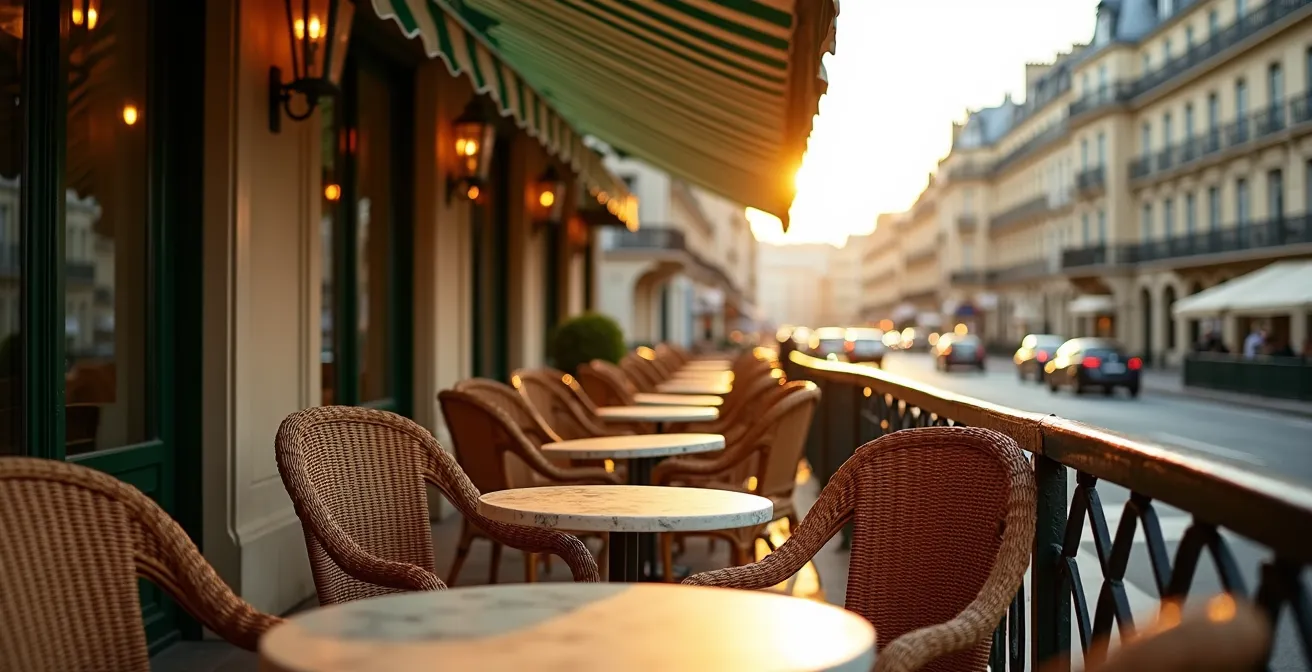
Contrary to popular belief, the spirit of Sartre and de Beauvoir is not found at the bottom of an overpriced coffee cup, but in the intellectual freedom the neighbourhood still offers.
- The legendary cafés are now primarily high-end tourist destinations, not intellectual hubs.
- True cultural engagement lies in accessing free public lectures, browsing riverside bookstalls, and exploring historic art-house cinemas.
Recommendation: Ditch the consumerist itinerary. Adopt the mindset of a ‘flâneur’—an active observer—to unlock the authentic, budget-friendly soul of the Left Bank.
To walk through Saint-Germain-des-Prés is to walk through the pages of literary history. The ghost of Hemingway haunts the Jardin du Luxembourg, the arguments of Sartre and de Beauvoir echo from the café terraces, and the shadow of the Sorbonne promises intellectual enlightenment. The pull is undeniable. You come here seeking that ineffable existentialist vibe, a connection to a time when ideas, not Instagram posts, were the currency of the realm. But the modern reality can be jarring: a single coffee at a legendary café costs a small fortune, and the crowds at Shakespeare and Company make quiet browsing impossible.
The common advice is to simply follow the tourist trail, pay the price, and consider it an investment in experience. But this approach misses the entire point. The existentialists were thinkers, rebels, and often, struggling artists. Their lives were defined by intellectual freedom and authentic engagement, not by conspicuous consumption. They sought out spaces for thought, debate, and observation—activities that cost very little. To truly connect with their spirit, one must look beyond the gleaming facade of the commercialised landmarks.
This guide proposes a radical shift in perspective. Instead of asking where to spend your money, we will ask how to invest your time and attention. We will uncover the places where the neighbourhood’s intellectual heart still beats, often for free. From the hidden V.O. (Version Originale) sections in local bookshops to the public lectures at France’s most prestigious institutions, you will learn to navigate Saint-Germain not as a tourist, but as a savvy insider. It’s time to trade the performance of literary tourism for the profound, and profoundly cheaper, art of observation.
This article provides a roadmap to rediscover the authentic soul of the Left Bank. By exploring its historic cafés with a critical eye, seeking out its true literary havens, and tapping into its academic and cinematic culture, you will find that the existentialist vibe is not something you buy, but something you live.
Summary: A Thinking Traveler’s Guide to Saint-Germain-des-Prés
- Les Deux Magots or Café de Flore: Which One Has More Authentic History?
- Beyond Shakespeare and Co: Where Do Locals Actually Buy English Books?
- How to Visit the Sorbonne Courtyard as a Non-Student?
- The Art House Cinemas of the Latin Quarter: Which One Shows Movies with English Subtitles?
- The Hemingway Walk: How to Follow His Route Through the Latin Quarter?
- Why the Pantheon Dome View Is the Least Crowded Panorama in Paris?
- Books on Terraces: Is It Weird to Read a Kindle at Café de Flore?
- Is the Canal Saint-Germain the New Seine for Young Travelers?
Les Deux Magots or Café de Flore: Which One Has More Authentic History?
The question itself is a classic Parisian debate, but for the modern seeker of existentialist truth, it’s a bit of a red herring. Both Les Deux Magots and Café de Flore possess unimpeachable historical credentials. They were the stages upon which Sartre, de Beauvoir, Camus, and Picasso lived, wrote, and argued. However, the “authenticity” of their history is now carefully curated and monetized. To choose between them is to choose between two magnificent, yet similar, museums of café culture.
The raw data reveals the transformation. A 2016 study highlighted that 60% of Les Deux Magots’ clientele were international tourists, a figure that underscores their shift from local intellectual canteens to global landmarks. The experience, while steeped in history, is now primarily one of high-end tourism. The real existentialist act isn’t choosing a side in this historic rivalry, but understanding the system and engaging with it on your own terms. The most budget-savvy and arguably most authentic way to experience these places is to do as the French do: order a simple ‘café au comptoir’ (at the bar). The price can be 50-70% lower than a seat on the terrace, and the view of the bustling room is just as enlightening.
To help you appreciate the nuances, here is a direct comparison of their historical claims:
| Criteria | Les Deux Magots | Café de Flore |
|---|---|---|
| Founded | 1873 (current location) | 1880s |
| Literary Prize | Prix des Deux Magots (since 1933) | Prix de Flore (since 1994) |
| Famous Patrons | Sartre, de Beauvoir, Hemingway, Joyce | Sartre, de Beauvoir, Camus, Picasso |
| Unique Feature | Two Chinese figurine statues (original) | Heated upper floor during WWII |
| Current Status | 60% tourist clientele | More local fashion crowd |
Ultimately, the history is real, but the contemporary experience is commercial. Embrace the French ‘droit de chaise’—the right to linger for hours over a single drink. This, more than anything, is the true legacy of the café as a “second living room” for thinkers and writers.
Beyond Shakespeare and Co: Where Do Locals Actually Buy English Books?
Shakespeare and Company is an enchanting place, an institution that has earned its legendary status. Yet, for a quiet browse or a serendipitous discovery, its modern incarnation can be overwhelming. The true spirit of literary Paris—the joy of the hunt, the scent of old paper—thrives elsewhere, in places frequented by locals seeking their next read without the crowds. For the budget-conscious bibliophile, these alternatives offer a more authentic and rewarding experience.
The most Parisian experience of all is to browse the ‘bouquinistes’ along the Seine. These dark green stalls, numbering over 240, are a treasure trove of second-hand books. Sifting through the boxes, you can find vintage English-language paperbacks, often for just a few euros. This is not just shopping; it’s an act of cultural archaeology. Another institution, predating even Shakespeare and Co., is Galignani on Rue de Rivoli, Paris’s first English bookshop, opened in 1801. It offers a stately, classic atmosphere worlds away from the tourist bustle.

For a more academic or comprehensive selection, the sprawling Gibert Jeune in the heart of the Latin Quarter has a large and well-organized ‘V.O.’ (Version Originale) section with both new and used books. And for a cozy, charming alternative, The Abbey Bookshop, a Canadian-owned haven tucked away in a side street, is packed to the ceiling with second-hand English titles. These are the places where you can truly practice the art of observation, discovering a book that finds you, rather than one you were told to buy.
How to Visit the Sorbonne Courtyard as a Non-Student?
The Sorbonne is the historical and intellectual epicenter of the Latin Quarter. To walk its courtyard is to feel the weight of centuries of scholarship. But as an official university, its doors are not wide open to the public. However, a little local knowledge—and a shift in perspective—can grant you access to the heart of Parisian academic life, embodying the existentialist pursuit of knowledge for its own sake.
While a guided tour is the most straightforward method, there are more subtle, independent ways. The main entrance is often guarded, but the administrative entrance at 17 rue de la Sorbonne can sometimes be less strictly monitored, especially outside of peak hours. A confident, purposeful stride can often get you into the main courtyard for a brief, respectful look. For guaranteed access, time your visit with the ‘Journées européennes du patrimoine’ (European Heritage Days) in September, when many official buildings, including parts of the Sorbonne, open to the public for free.
But the true “existentialist hack” is to sidestep the Sorbonne entirely and head to the nearby Collège de France. This prestigious institution, founded in 1530, holds a unique and powerful mission: all lectures are, by statute, free and open to the public. No registration, no student ID required. You can simply check the schedule online and walk into a lecture by one of France’s leading academics. This is the ultimate expression of cultural access—engaging directly with high-level thought without any barrier to entry, a far more profound experience than merely glimpsing a historic courtyard.
The Art House Cinemas of the Latin Quarter: Which One Shows Movies with English Subtitles?
Long before streaming services, the ‘cinémas d’art et d’essai’ (art house cinemas) of the Latin Quarter were the temples of world cinema for Parisian intellectuals. They were places of discovery and debate, central to the cultural life of the Left Bank. For an English-speaking visitor, they offer an incredible opportunity to dive into this tradition, provided you know how to navigate the listings. The key term to look for is ‘VOSTFR’: Version Originale Sous-Titrée Français. This means the film is shown in its original language (e.g., English) with French subtitles.
The Latin Quarter is dotted with these historic cinemas, each with its own personality. Le Champo, famous for its ‘Nuits du Champo’ all-nighters, frequently shows French New Wave classics and other retrospectives in VOSTFR. The Filmothèque du Quartier Latin is another bastion of classic cinema, often featuring restored prints of films from the 1940s to the 1960s. For a more cult experience, Studio Galande is legendary for its interactive Friday and Saturday night screenings of The Rocky Horror Picture Show, a tradition that has lasted for decades.
Finding what’s playing is simple. Websites like ‘L’Officiel des Spectacles’ or dedicated cinema apps allow you to filter by ‘VO’ or ‘VOSTFR’. This small effort unlocks an authentic, affordable, and deeply Parisian cultural experience. For the price of a movie ticket, you can participate in a ritual that has been part of the neighbourhood’s intellectual fabric for generations. Below is a guide to some of the key players.
| Cinema | English Options | Specialty | Price Range |
|---|---|---|---|
| Le Champo | VOSTFR frequent | New Wave classics, all-nighters | €8-10 |
| Filmothèque Quartier Latin | Many VOSTFR | 1940s-60s retrospectives | €7-9 |
| Studio Galande | VOSTFR available | Rocky Horror (Fridays) | €9-11 |
| Le Reflet Médicis | Some VOSTFR | Author cinema | €8-10 |
| VOSTFR = Version Originale Sous-Titrée Français (original with French subtitles) | |||
The Hemingway Walk: How to Follow His Route Through the Latin Quarter?
Ernest Hemingway’s memoir, ‘A Moveable Feast’, is perhaps the most famous ode to a writer’s life in Paris. Following his footsteps through the Latin Quarter is a pilgrimage for many, but it can be done with the spirit of the writer himself: with an eye for detail, a respect for solitude, and a very light wallet. The key is to focus on the places he frequented when he was a poor, struggling writer, as these reveal more about his connection to the city than the famous bars he patronized after achieving fame.
A self-guided tour can be a profound exercise in observation. Here is a simple, authentic route:
- Start at 74 rue du Cardinal Lemoine, his first, humble apartment in Paris. Imagine him climbing the stairs after a long day of writing.
- Walk to the nearby Place de la Contrescarpe. This was his local square, filled with working-class cafés where he would sit when he was broke.
- Continue to the original location of Shakespeare and Company at 12 rue de l’Odéon. This is where Sylvia Beach first published ‘Ulysses’ and supported writers like Hemingway.
- Cross over to the Jardin du Luxembourg. As he famously wrote, this was where he would walk to “get hungry” when he had no money for lunch, observing the life of the park. This is a perfect spot for quiet contemplation.
- End your walk at La Closerie des Lilas in Montparnasse. While now an expensive restaurant, it was his favourite writing café. You can stand outside and peer in, paying homage without paying the bill, just as a young, aspiring writer might do.
This walk is not about spending money. It is about connecting with the geography of creativity and poverty that shaped one of the 20th century’s greatest writers. It’s about seeing the city as he saw it: a place of beauty, struggle, and endless inspiration.
Why the Pantheon Dome View Is the Least Crowded Panorama in Paris?
In a city of famous viewpoints, from the Eiffel Tower to the Arc de Triomphe, the panorama from the dome of the Panthéon remains a remarkably well-kept secret. The reason for its relative tranquility is simple: access is controlled and requires effort. This natural filter makes it the perfect destination for the savvy traveler seeking a breathtaking view without the suffocating crowds. It is a reward for those willing to earn it.
Unlike other monuments where you can simply queue for an elevator, reaching the Panthéon’s colonnade is a more intimate affair. The journey involves climbing 206 steps through the internal structure of the dome, with access limited to small, timed-entry groups. This strict regulation ensures that the viewing platform is never overwhelmed. You have space to breathe, to take in the 360-degree view over the Latin Quarter, and to see the Eiffel Tower perfectly framed by the streets of Paris.
This is not just a viewpoint; it’s a small adventure that aligns perfectly with the ethos of authentic engagement. The effort required makes the final reward all the sweeter. While you’re there, don’t miss the chance to visit the crypt, where the remains of French luminaries like Voltaire, Rousseau, Victor Hugo, and Marie Curie are interred. The experience combines a stunning visual with a deep dive into the nation’s intellectual history.
Your Action Plan: Auditing for an Authentic Saint-Germain Experience
- Points of Contact: List the primary tourist “checkpoints” you feel pressured to visit (e.g., terrace at Café de Flore, buying a new book at Shakespeare and Co).
- Collect Alternatives: Inventory the authentic, low-cost activities suggested in this guide (e.g., browsing bouquinistes, attending a Collège de France lecture, watching a VOSTFR film).
- Check for Coherence: Confront your options with the core value of “intellectual freedom.” Is the activity about passive consumption or active, mindful engagement?
- Assess Memorability: Will this create a unique, personal memory (finding a forgotten author in a dusty bookstall) or a generic, shared one (the same photo of a hot chocolate everyone else takes)?
- Build Your Plan: Consciously replace one or two high-cost, low-engagement “tourist” tasks with high-value, authentic experiences from your alternative list.
Books on Terraces: Is It Weird to Read a Kindle at Café de Flore?
This question reveals a common anxiety for the modern literary traveler: how to merge contemporary habits with historic settings without feeling like an imposter. Is pulling out a Kindle or laptop at the Café de Flore a cultural faux pas, a betrayal of the paper-and-ink legacy of its famous patrons? The short answer, from a local’s perspective, is not at all. In fact, it’s a sign that you understand the café’s true, enduring function.
The spirit of a Parisian café is not about preserving the past in amber; it’s about being a functional “third space” for the city’s inhabitants. It is a place for work, thought, reading, and conversation. In the 1940s, the tools were notebooks and Gauloises cigarettes. Today, they are MacBooks and Kindles. The medium has changed, but the purpose remains the same. Locals, students, and writers regularly use these historic cafés as their offices and reading rooms, with digital devices sitting comfortably next to traditional ‘café crèmes’.
The culture of these places has always adapted. In a fascinating show of modern existentialism, some historic venues continue to foster intellectual discourse directly. For instance, a recent report notes that ‘philo-café’ discussions are held upstairs at one of the famous cafés on the first Wednesday of the month. This demonstrates a living intellectual tradition, not a static one. To worry about using a Kindle is to treat the café like a museum exhibit. To use it confidently is to treat it as it was always intended: as a vibrant space for the life of the mind, in whatever form it takes in the 21st century.
Key Takeaways
- The authentic existentialist experience is a mindset of active observation and intellectual curiosity, not a shopping list of expensive landmarks.
- Prioritize free or low-cost cultural access—like public lectures, riverside bookstalls, and self-guided walks—over high-cost tourist rituals.
- Embrace modern tools and habits; the spirit of Saint-Germain lies in its function as a living intellectual space, not as a historical reenactment.
Is the Canal Saint-Martin the New Seine for Young Travelers?
The question of where the “real” Paris is for young, budget-conscious travelers often leads to a comparison between the historic heart of Saint-Germain and the trendy, bohemian banks of the Canal Saint-Martin. To suggest the Canal is the “new Seine” is to frame it as a replacement, but a more nuanced view reveals they offer two fundamentally different, and equally valid, Parisian experiences. Understanding their differences is the final step in appreciating what makes the Saint-Germain ethos unique.
The Canal Saint-Martin, with its iron footbridges and shaded quays, is the epicenter of a young, social, and collective Paris. The vibe is about gathering. Groups of friends bring their own wine and pizza to sit by the water, the air buzzes with music and conversation, and the surrounding streets are filled with trendy bars and concept stores. It’s a vibrant, contemporary, and communal experience. It is Paris as a social playground.
The Seine at Saint-Germain, by contrast, offers a more contemplative, individual, and intellectual experience. Here, the act of sitting by the river is often solitary. It’s about reading a book with Notre-Dame in the distance, engaging in a quiet conversation, or simply watching the ‘bateaux-mouches’ glide by. The atmosphere is historical, shaped by the weight of the institutions that line its banks—the Louvre, the Institut de France, the Conciergerie. It is Paris as a landscape for thought. One is not better than the other; they simply serve different needs.
| Aspect | Canal Saint-Martin | Seine at Saint-Germain |
|---|---|---|
| Crowd | Young, social, bobo scene | Mixed ages, contemplative |
| Vibe | Trendy bars, picnics | Historical, literary |
| Budget Option | BYOB canal-side gathering | Wine on quais near Pont des Arts |
| Experience | Collective, social | Individual, intellectual |
To truly experience the existentialist vibe, then, is to choose the path of intellectual engagement. It is to understand that the greatest value of Saint-Germain-des-Prés lies not in what it sells, but in the thoughts it inspires. Begin your journey today by consciously choosing one authentic experience over one tourist trap, and discover the rich, thinking person’s Paris that awaits.