Visiting Notre-Dame’s perimeter today offers a once-in-a-lifetime historical experience, far more profound than seeing a closed cathedral.
- Discover 2,000 years of Parisian history buried in the archaeological crypt right beneath the forecourt.
- Witness the rebirth of a global icon by capturing the new spire from unique, crowd-free vantage points.
- Explore the island’s hidden stories, from a lost medieval river to the symbolic heart of France.
Recommendation: Shift your perspective from ‘what’s closed’ to ‘what unique story is unfolding’ and you’ll find a visit to the area is more magical than ever.
The image of Notre-Dame engulfed in flames is seared into the world’s collective memory. For many visitors to Paris, the logical conclusion is that the cathedral and its entire vicinity are a no-go zone, a tragic void on the tourist map best skipped until the grand reopening. They might reason that a trip to the Île de la Cité will only yield views of scaffolding and the sounds of construction, a pale shadow of its former glory. The common advice is often to simply visit other attractions, treating the area as a temporary loss.
But what if this perspective is entirely wrong? What if, as a heritage journalist who has covered this restoration daily, I told you that visiting Notre-Dame’s perimeter *now*, during this final phase of its reconstruction, is not a consolation prize but a unique historical pilgrimage? The fences and cranes do not signify an absence, but rather a vibrant, living workshop (atelier vivant) where centuries of craftsmanship are being resurrected before your eyes. This is a fleeting opportunity to witness a historical palimpsest, where the layers of Paris’s past—from its Gallo-Roman foundations to its 21st-century rebirth—are all visible at once.
This guide is designed to transform your understanding of what’s possible. It will not just point you to nearby landmarks. Instead, it will lead you on a chronological journey through the island’s soul, showing you how to read the stories etched in its stones, its surroundings, and even in the very air of reconstruction. We will uncover the deep past below the forecourt, find the perfect angles to photograph its revival, and understand what the much-anticipated 2024 reopening truly means for the public.
This article provides a complete itinerary for experiencing the magic of Notre-Dame and its historic island heart while the cathedral undergoes its final transformation. Discover how to turn what seems like a limitation into an unforgettable journey through time.
Summary: A Guide to Experiencing Notre-Dame’s Rebirth
- Why the Crypt Archaeologique Is the Best Alternative to Entering the Cathedral?
- Quai de Montebello: Where to Get the Best Photo of the Reconstruction Progress?
- Shakespeare and Company: How to Visit the Famous Bookstore Without Waiting an Hour?
- Reopening 2024: What Will Actually Be Accessible to the Public in December?
- Saint-Sulpice or Saint-Eustache: Which Church Offers a Similar Choir Experience?
- Point Zéro: Where is the Brass Star That Measures All Distances in France?
- The Bièvre River: Where Can You See the Lost River of Paris?
- How to Visit the Palais de Justice Without Being Summoned to Court?
Why the Crypt Archaeologique Is the Best Alternative to Entering the Cathedral?
While the great nave of Notre-Dame remains inaccessible, the true historical foundation of the Île de la Cité lies just a few meters below the bustling forecourt. The Crypt Archéologique du parvis de Notre-Dame is not merely a substitute visit; it is the essential starting point for understanding the cathedral’s profound significance. To descend into the crypt is to travel back in time, standing on the very ground where Paris, then Lutetia, was born. It offers what the cathedral itself cannot: a tangible connection to the Gallo-Roman port foundations and the layers of civilization upon which Notre-Dame was eventually built.
The experience has been made even more poignant since the fire. The exhibits have been updated to place the cathedral’s long history in context, with restored 14th-century bas-reliefs and 19th-century paintings now visible in stunning detail. You are not just looking at ruins; you are walking through the heated rooms of a Roman residence and tracing the lines of the 3rd-century ramparts. This subterranean world reveals a historical palimpsest where each era built upon the last, providing a deep, physical understanding of why this specific spot on the Seine became the spiritual heart of France. It turns a visit from one of passive viewing into an active archaeological discovery.
Rather than feeling the absence of the cathedral’s interior, the crypt fills that void with a richer, more ancient story. It demonstrates that Notre-Dame is the culmination of a history that spans over two millennia. Understanding this foundation makes the sight of the reconstruction above ground all the more meaningful—it’s just the latest chapter being written on this sacred site.
Your Action Plan: A Journey into Notre-Dame’s Deep History
- Start at Musée Carnavalet to grasp Paris’s complete timeline from Gallo-Roman times to the present day.
- Visit the Crypt Archéologique to see the actual Gallo-Roman port foundations of Lutetia beneath Notre-Dame.
- Study the updated exhibition ‘Notre-Dame de Paris, de Victor Hugo à Viollet-le-Duc’ showcasing the cathedral’s transformations.
- Explore the preserved Roman ramparts and 3rd-century heated room (hypocaust) systems within the crypt.
- Connect the archaeological layers to understand how each civilization built upon the previous one, leading to the cathedral’s construction.
Quai de Montebello: Where to Get the Best Photo of the Reconstruction Progress?
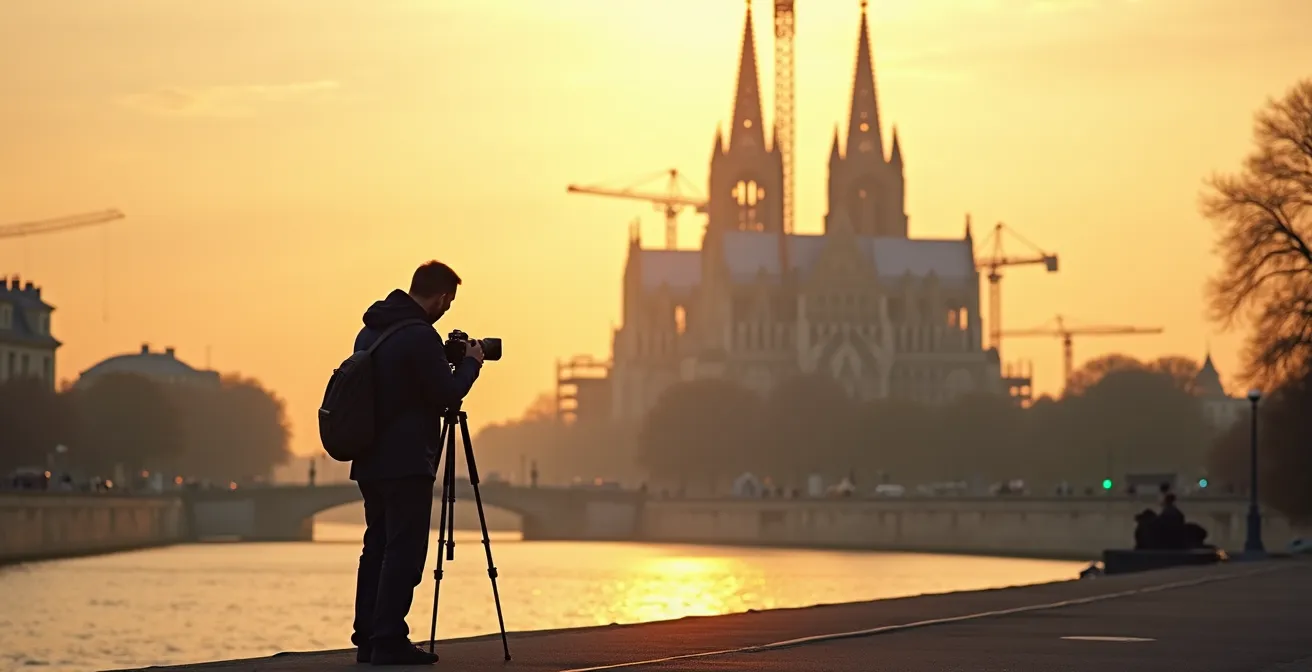
Photographing Notre-Dame today is not about capturing a static monument; it’s about documenting a historic moment of rebirth. The challenge is finding a viewpoint that tells this story of resilience and renewal. While the classic frontal view from the parvis is obscured, several key locations offer breathtaking perspectives of the living workshop. The Quai de Montebello, especially at dawn during the “golden hour,” remains a prime spot. Here, the soft morning light catches the warm tones of the stone, and the Seine provides a timeless reflection, beautifully contrasting the ancient structure with the modern cranes that signal its revival.
However, for the most dramatic and symbolic shot, the panoramic terrace of the Institut du Monde Arabe is unparalleled. Access requires a museum ticket, but the reward is a stunning, elevated view of the cathedral’s apse and the full, triumphant height of the new oak spire. Capturing this scene at “blue hour,” just after sunset, creates a theatrical atmosphere as the worksite lights illuminate the intricate scaffolding against a deep twilight sky. This angle transforms the reconstruction into a powerful symbol of hope and perseverance, framing the new spire as a beacon in the Parisian night.
Choosing the right spot is about deciding which story you want to tell. Do you want the classic, romantic view from the quays, or the powerful, modern narrative of rebirth from above? Each location offers a unique way to engage with the cathedral’s ongoing transformation.
| Viewpoint | Best Time | Unique Feature | Access |
|---|---|---|---|
| Institut du Monde Arabe Terrace | Blue Hour (Dusk) | Elevated view of apse and full spire height | Museum admission required |
| Quai de Montebello | Golden Hour (Dawn) | Classic frontal view with Seine reflections | Free public access |
| Square René-Le Gall | Midday | Distance view showing full reconstruction context | Free public garden |
| Pont de la Tournelle | Sunset | Side angle with Île Saint-Louis framing | Free public bridge |
Shakespeare and Company: How to Visit the Famous Bookstore Without Waiting an Hour?
Just across the river from the silent cathedral, another literary and cultural icon thrives: Shakespeare and Company. For many, a visit is as essential as seeing Notre-Dame itself, but its popularity often means long queues snaking down the street. The key to enjoying its magical, labyrinthine interior without the wait is strategic timing and knowing its secrets. The most effective tactic is to bypass the main entrance altogether. The antiquarian section, located next door at 37 rue de la Bûcherie, has a separate side door that typically has no queue, allowing you to slip into the quieter, more historic part of the shop first.
Timing is also crucial. The bookstore is at its most peaceful on weekday mornings right at its 10 am opening. Alternatively, visiting during Sunday morning mass times, when many tourists are elsewhere, can also provide a brief window of calm. Another clever approach is to visit in the evening for one of their free events, such as the regular poetry readings. You get to experience the shop’s vibrant community spirit and can browse the shelves after the event without the daytime crowds.
If the store is simply too busy, don’t despair. You can find a different kind of literary connection to Notre-Dame right outside. The nearby bouquinistes, the famous green stalls of the riverside booksellers, offer an authentic alternative. Many specialize in vintage prints, historical engravings, and old postcards of the cathedral, allowing you to hold a piece of its past in your hands while you watch its future being rebuilt across the Seine.
Reopening 2024: What Will Actually Be Accessible to the Public in December?
The grand reopening of Notre-Dame, set for December 2024, is a moment the world has been eagerly anticipating. However, it’s crucial for visitors to understand that this will be a phased process, not an instant return to pre-fire normality. The official reopening ceremony is scheduled for December 8th, 2024, after which the nave, choir, and main altar will be accessible for services. Full public access for tourists is slated to begin on December 16th, managed initially through an online reservation system to handle the immense interest.
Upon entering, visitors will discover a cathedral that is both familiar and new. The restoration has not only repaired the damage but also introduced contemporary elements to mark this 21st-century chapter in its history. This includes new bronze liturgical furniture designed by Guillaume Bardet and, most notably, six new stained-glass windows commissioned from contemporary artists by President Macron. These additions ensure the cathedral is not a static museum but a living place of worship that continues to evolve.
However, some areas will remain off-limits. Restoration work on the exterior, particularly the north tower, will continue into 2025, and some side chapels may still be closed. The beloved tower visits are not expected to resume until September 2025. Furthermore, the extensive redevelopment of the forecourt into a greener public space is a longer-term project lasting until 2030. Authorities are preparing for this renewed enthusiasm, with projections suggesting that 14 to 15 million visitors are expected annually, a significant increase from pre-fire numbers.
Saint-Sulpice or Saint-Eustache: Which Church Offers a Similar Choir Experience?
For centuries, the spiritual experience of Notre-Dame was inseparable from its soundscape: the celestial voices of its choir and the thunderous power of its grand organ. While the cathedral is silent, this “acoustic pilgrimage” can be continued in other great Parisian churches that offer profoundly moving musical experiences. The choice between them depends on what aspect of Notre-Dame’s musical soul you seek. For those who revered the organ, Saint-Sulpice is the undeniable destination. It houses the world-renowned Cavaillé-Coll organ, a masterpiece of organ building and a site of pilgrimage for musicians worldwide. The free, 30-minute public recitals held every Sunday at noon are a transcendent experience, offering a sound of comparable majesty and power to Notre-Dame’s own instrument.
For those seeking a blend of stunning architecture and diverse musical programming, Saint-Eustache is the premier choice. Its unique Gothic-Renaissance structure creates spectacular acoustics, making it a top venue for classical and contemporary concerts. Its musical tradition is vibrant and forward-looking, much like the new vision for Notre-Dame itself. A third, historically significant option is Saint-Germain-l’Auxerrois. As the royal parish, it has its own deep heritage, but its most recent claim to fame is having hosted Notre-Dame’s services in the immediate aftermath of the fire, making it a poignant place of connection to the cathedral’s displaced congregation.
Each church offers a different facet of the sacred music that once filled Notre-Dame. Whether it’s the organ’s raw power at Saint-Sulpice or the acoustic perfection of Saint-Eustache, the musical spirit of Paris’s great cathedral lives on in these sacred spaces.
| Church | Specialty | Free Events | Historical Connection |
|---|---|---|---|
| Saint-Sulpice | World-renowned Cavaillé-Coll organ | Sundays 12pm: 30-min public recitals | Organist’s pilgrimage site |
| Saint-Eustache | Gothic-Renaissance acoustics | Regular classical concerts | Premier venue for contemporary music |
| Saint-Germain-l’Auxerrois | Royal parish heritage | Occasional vespers | Hosted Notre-Dame services post-fire |
Point Zéro: Where is the Brass Star That Measures All Distances in France?
Embedded discreetly in the cobblestones of the cathedral’s forecourt lies a small brass star that is easy to miss, yet monumental in its significance. This is Point zéro des routes de France, the geographic marker from which all road distances in France are measured. Finding it is an essential part of any pilgrimage to Notre-Dame, as it symbolizes the cathedral’s position as the literal and figurative heart of the nation. To locate it, look for small groups of people peering at the ground near the main entrance. The ongoing reconstruction of the parvis may affect its visibility, but the search is part of the experience.
Once you find the octagonal plaque, you can participate in a cherished Parisian tradition: stand on the star, make a wish, and spin on your heel for good luck. Some say this ensures your return to Paris. But the marker’s importance goes far beyond superstition. It is a powerful political and cultural symbol of French centralization.
Point Zéro represents the concept of French centralization, ‘Paris and the French desert’, a political and cultural idea dating back to Louis XV, making it a symbol of the state’s power.
– Urban Planning Historical Archives, Paris City Planning Department
This small star is a tangible link to the idea of Paris as the epicenter of French life. Standing on it, with the recovering cathedral in your view, is a profound moment of connection—a realization that you are at the very center from which the entire country radiates. It reinforces the idea that Notre-Dame is not just a Parisian landmark but the soul of France itself.
The Bièvre River: Where Can You See the Lost River of Paris?
One of the most poetic ways to connect with the deep history of the Notre-Dame district is to search for something that is no longer there: the Bièvre River. This ancient tributary of the Seine once flowed through what is now the 5th arrondissement, its waters powering the tanneries and tapestry workshops of medieval Paris before meeting the main river near the Jardin des Plantes. The river represents another layer of the area’s historical palimpsest, a story buried but not entirely lost.
During Baron Haussmann’s massive 19th-century urban renewal projects, the heavily polluted Bièvre was covered over and transformed into a sewer, disappearing from the Parisian landscape. However, you can still trace its phantom path today. A self-guided walking tour can start at the charming Square René-Le Gall, a park built in the river’s former valley. From there, you can follow a series of bronze medallions embedded in the pavement that mark the river’s historic course along streets like Rue de Bièvre and Rue de la Clef, where the echoes of its industrial past remain.
This journey into the past is also a look into the future. In a hopeful echo of Notre-Dame’s own revival, the Mairie de Paris is undertaking ecological projects to resurrect the lost river. According to ongoing efforts by Friends of Notre-Dame de Paris, these initiatives aim to reopen and restore sections of the Bièvre, bringing this piece of natural heritage back to life. Tracing its path is a meditative experience, a way of understanding the forces of history, industry, and nature that have shaped the land around the cathedral for centuries.
Key Takeaways
- A visit to Notre-Dame’s surroundings is not a disappointment but a unique historical journey into Paris’s deep past and vibrant future.
- The area offers exclusive experiences unavailable anywhere else, from documenting the reconstruction at unique photo spots to embarking on an “acoustic pilgrimage” in other great churches.
- The 2024 reopening will be a phased process, making the current period a fleeting chance to witness the “living workshop” before the crowds return en masse.
How to Visit the Palais de Justice Without Being Summoned to Court?
Dominating the western end of the Île de la Cité is the vast Palais de Justice complex, a place that can seem intimidating to visitors. Yet, this active courthouse is also a monumental museum of French history, and it is possible to visit parts of it freely. The key is to understand that the Palais de Justice, the Conciergerie, and the breathtaking Sainte-Chapelle are all part of a single original royal palace. Together, they form a historic “power triangle” that traces the arc of French history from absolute monarchy to revolution and the modern republic.
To visit without a court summons, you can enter through the main public entrance on the Boulevard du Palais on weekdays. After passing a respectful security check (ID is required, and photography is forbidden inside), you will step into the magnificent Salle des Pas Perdus. This grand public lobby, with its soaring vaulted ceilings, was once the great hall of the medieval palace. It’s a space where centuries of legal and royal history have unfolded. While there, you can seek out the monument to Malesherbes, the brave lawyer who defended King Louis XVI during his trial.
Visiting this space offers a profound counterpoint to Notre-Dame. While the cathedral represents the spiritual power of the island, the Palais de Justice represents its temporal and political authority. Seeing them in tandem allows you to fully appreciate the Île de la Cité as the dual-hearted center of French power for over a thousand years. It’s a crucial piece of the island’s story, accessible to any curious visitor who knows where to look.
The magic of Notre-Dame today lies not in what is absent, but in what is uniquely present: a moment of visible transformation. By shifting your focus from the closed doors of the cathedral to the rich historical tapestry of the island, you discover a Paris that few tourists get to see. This is your chance to be more than a visitor; it’s an invitation to be a witness to history. Go and see it for yourself, before this chapter closes forever.