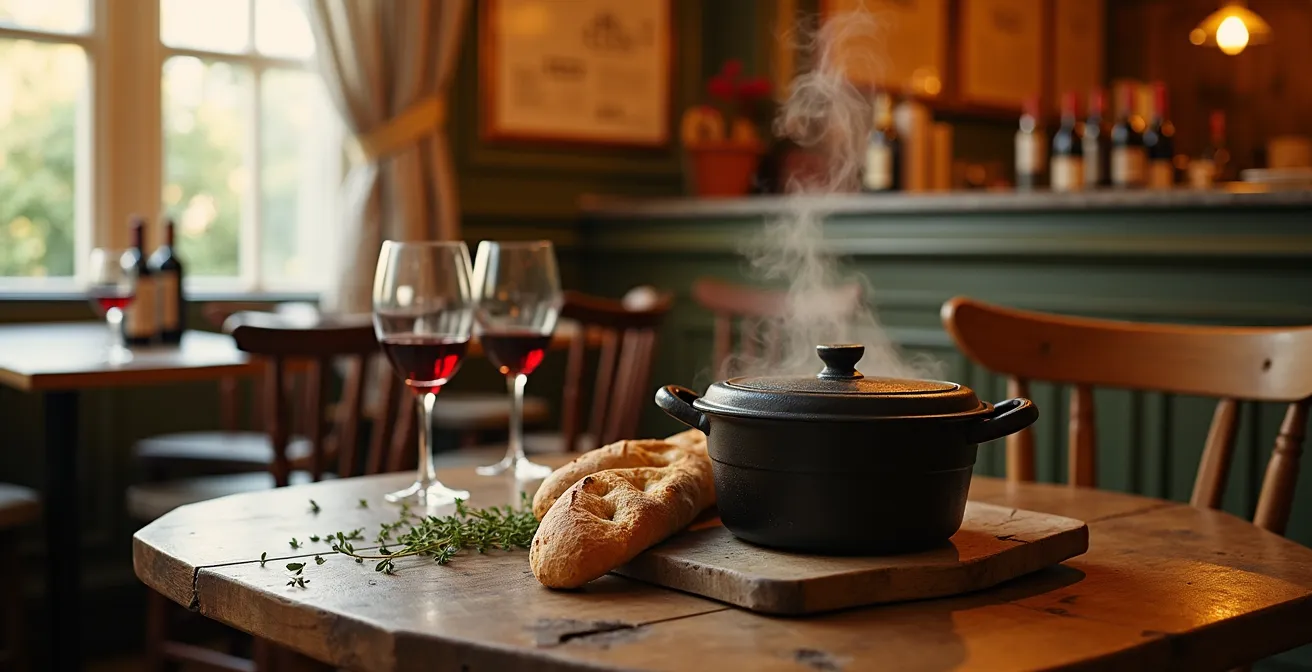
The secret to avoiding tourist-trap food in France isn’t about avoiding certain streets; it’s about learning to read the hidden language of culinary authenticity.
- Authenticity is proven by “structural signals” like AOP/IGP labels and short, seasonal menus (`ardoise`), not just a French-only menu.
- Modern “neo-bistros” are not inauthentic; they are your best bet for creative dishes and accommodating dietary needs like vegetarianism.
Recommendation: Stop looking for “hidden gems” and start looking for verifiable quality signals. Your best meal will come from a place whose standards you can verify before you even order.
There’s a specific dread that haunts every food lover visiting Paris. It’s the fear of sitting down for what should be a sublime Boeuf Bourguignon, only to be served a lukewarm, soulless dish from a vacuum-sealed bag, accompanied by a basket of stale bread. You’ve followed the common advice: you avoided the Champs-Élysées, you found a place bustling with what looked like locals, and yet, the disappointment is as palpable as the soggy frites on your plate. This experience is the quintessential Parisian tourist trap, a culinary bait-and-switch that leaves you questioning the city’s gastronomic reputation.
The internet is filled with platitudes: “look for a short menu,” “avoid places with pictures of the food,” “only eat where you hear French.” While not entirely wrong, this advice is surface-level. It fails to equip you with the deep knowledge needed to navigate the complex, evolving landscape of French dining. The truth is, many excellent bistros now offer English menus, and some of the most innovative chefs are reinterpreting classics in ways that might seem “inauthentic” to the untrained eye. The fear of microwaved bags has pushed many to cling to an idealized, rigid version of French cuisine, missing out on the vibrant reality.
But what if the real defense against tourist traps wasn’t a set of rigid rules, but a form of literacy? The key isn’t about *where* you look, but *what* you look for. This guide is built on a single premise: to eat authentically, you must learn to decode the structural signals of quality hidden in plain sight. From official food labels and menu terminology to the very rhythm of the dinner service, authentic restaurants leave a trail of clues. This is your guide to reading them. We will dismantle the common myths and arm you with the critical eye of a local, turning you from a fearful tourist into a confident connoisseur.
This article will provide you with the essential knowledge to navigate the Parisian food scene. Each section is a lesson in culinary literacy, designed to help you identify true quality and make choices that lead to unforgettable meals. Get ready to explore the nuances of everything from onion soup to oysters.
Summary: Your Guide to Authentic Parisian Dining
- Vegetarian Onion Soup: Where to Find It Without Beef Broth?
- Escargots and Frog Legs: How to Try Them for the First Time Without Fear?
- Why You Should Never Order Oysters in Paris in July?
- Frites or Purée: What Is the Correct Side for a Steak Tartare?
- Crêpes vs Galettes: What Is the Difference and Which One is for Dinner?
- The “Fait Maison” Logo: How to Know If Your Dish Was Actually Cooked on Site?
- IGP vs AOP: Which Label Guarantees the Product Actually Comes from the Region?
- How to Get a Table at a Popular Parisian Bistro Without a Reservation?
Vegetarian Onion Soup: Where to Find It Without Beef Broth?
The classic French onion soup is a fortress of tradition, built on a foundation of rich, dark beef broth. For a vegetarian, ordering it is often a losing battle. A traditional bistro chef would likely consider a vegetable-broth version an aberration, an insult to the dish’s very soul. This rigidity is a hallmark of classic French cuisine. So, does this mean you’re destined to miss out? Absolutely not. The solution lies not in convincing a traditionalist to change their ways, but in seeking out a different kind of establishment: the neo-bistro.
These modern establishments, often run by younger, ambitious chefs, are where culinary innovation thrives. They respect tradition but are not enslaved by it. Look for menus with keywords like ‘revisité’ (revisited) or ‘notre version de…’ (our version of), as these are clear signals of a creative approach. Neighborhoods like South Pigalle (SoPi) and the 11th arrondissement are epicenters of this movement, mixing classic spots with restaurants where seasonal produce and dietary flexibility are celebrated. Some even have a dedicated ‘menu végétal’ (plant-based menu), removing all guesswork. When in doubt, a direct question in polite French goes a long way: “Bonjour, excusez-moi, votre soupe à l’oignon est-elle préparée avec un bouillon de légumes?” The answer will tell you everything you need to know about the restaurant’s philosophy. According to one guide on finding local food in Paris, these younger, chef-owned establishments are far more open to accommodating dietary needs.
This quest for a vegetarian-friendly classic highlights a core principle of modern Parisian dining. Don’t fight tradition where it’s most entrenched; instead, seek out the places where the rules are being thoughtfully rewritten. The best meal is often found where creativity and customer needs are seen as an opportunity, not an inconvenience.
Escargots and Frog Legs: How to Try Them for the First Time Without Fear?
For many visitors, escargots (snails) and cuisses de grenouilles (frog legs) represent the final frontier of French cuisine—dishes approached with a mix of curiosity and trepidation. The fear is understandable, but it’s almost always misplaced. The key to a positive first experience is not bravery, but quality control. A poorly prepared, low-quality snail is a rubbery, earthy disappointment. A perfectly executed one is a tender, savory delight, a vehicle for garlic, parsley, and butter.
Your mission is to ensure you’re getting the latter. The first signal of quality is on the menu: look specifically for “Escargots de Bourgogne.” This doesn’t just refer to the recipe; it refers to the Helix Pomatia species, the prized Burgundy snail known for its superior taste and texture. Don’t be shy to ask if they are sourced from a French ‘héliciculteur’ (snail farmer) rather than being cheaper imports. The classic preparation, swimming in ‘beurre persillade’ (garlic and parsley butter), is the most forgiving and iconic. The intense, aromatic butter is the star of the show, making the snail itself secondary.
The environment matters just as much. Ordering this dish in a tourist-heavy café is a gamble. A real bistro, one that takes pride in its classics, is the only acceptable venue. The preparation there will be authentic, turning a culinary challenge into a memorable experience. This is a dish where context and product provenance are everything. Paired with a crisp Bourgogne Aligoté wine, it’s a transportive taste of a specific French region.
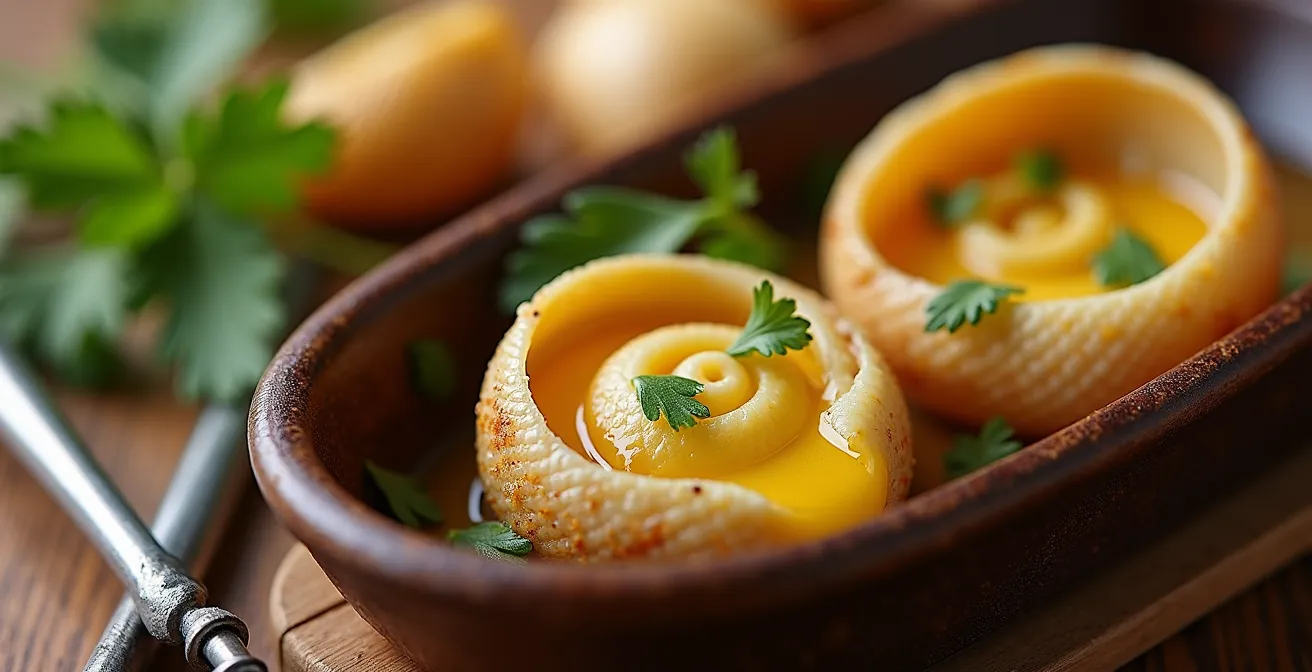
As you can see, the presentation itself is part of the tradition, complete with specialized tongs to hold the hot shell and a two-pronged fork to extract the prize within. Mastering the tools is part of the fun, and a clear sign you’ve chosen an establishment that respects the ritual.
Why You Should Never Order Oysters in Paris in July?
There’s an old rule in France: you only eat oysters (‘huîtres’) in months with the letter ‘r’ in their name. This means from September through April, oysters are at their peak. Ordering them in May, June, July, or August is traditionally seen as a rookie mistake. This isn’t just a quaint superstition; it’s rooted in marine biology. During the warm summer months, oysters enter their reproductive cycle, known as the ‘période de laitance’. This makes them milky, alters their firm texture, and can give them a less pleasant, stronger flavor. The risk of spoilage also increases with the heat, despite France’s stringent ‘chaîne du froid’ (cold chain) regulations for shellfish transport.
For a traditionalist, the case is closed. Summer is for mussels and grilled fish, not oysters. However, a true food connoisseur knows that rules are often made to be broken—or at least, updated by innovation. The modern exception to this age-old rule is the ‘huître des quatre saisons’ (four-season oyster). As detailed in a guide to avoiding tourist traps, French oyster farmers have developed sterile, triploid oysters that do not reproduce. Because they never enter the ‘laiteuse’ phase, they maintain their firm texture and clean, briny flavor year-round.
This creates a new level of culinary literacy. A tourist orders oysters in July and risks disappointment. A knowledgeable diner, however, approaches the ‘écailler’ (the oyster shucker at a seafood stall or restaurant) and asks specifically for ‘quatre saisons’ or triploid oysters. Doing so sends a clear signal: you are not a typical tourist. You understand the nuances. The old rule still serves as a crucial baseline of caution, but knowing the exception is what separates the novice from the insider.
Frites or Purée: What Is the Correct Side for a Steak Tartare?
Steak Tartare is a bistro icon: a mound of raw, hand-chopped beef, seasoned with capers, onions, mustard, and crowned with a glistening egg yolk. It’s a bold dish, a testament to freshness and confidence. When you order it, the waiter will almost invariably ask: “Avec frites ou purée?” (With fries or mashed potatoes?). This question, however, is a modern convenience, a slight deviation from the dish’s purest form. For the traditionalist, the answer is a trick question.
As French culinary tradition dictates, the most authentic accompaniment is neither of those options. A highly respected guide to bistro food clarifies this point perfectly:
The most traditional accompaniment is neither frites nor purée, but simple toasted country bread and a lightly dressed green salad.
– French Culinary Tradition, Traditional Bistro Standards
The logic is one of texture and purpose. The toasted bread (‘tartines’ or ‘mouillettes’) serves as a crisp vehicle for the soft, rich meat, while the acidic vinaigrette of the salad cuts through the richness. The modern preference for frites offers a different, albeit delicious, contrast: the pleasure of hot and crispy against cold and soft. The ultimate sign of a superior tartare, however, is not the side dish but the preparation itself. Look for menus offering it ‘préparé en salle’ (prepared tableside). This theatrical service, where the waiter mixes the ingredients before your eyes, is not just for show; it’s the ultimate guarantee of freshness.
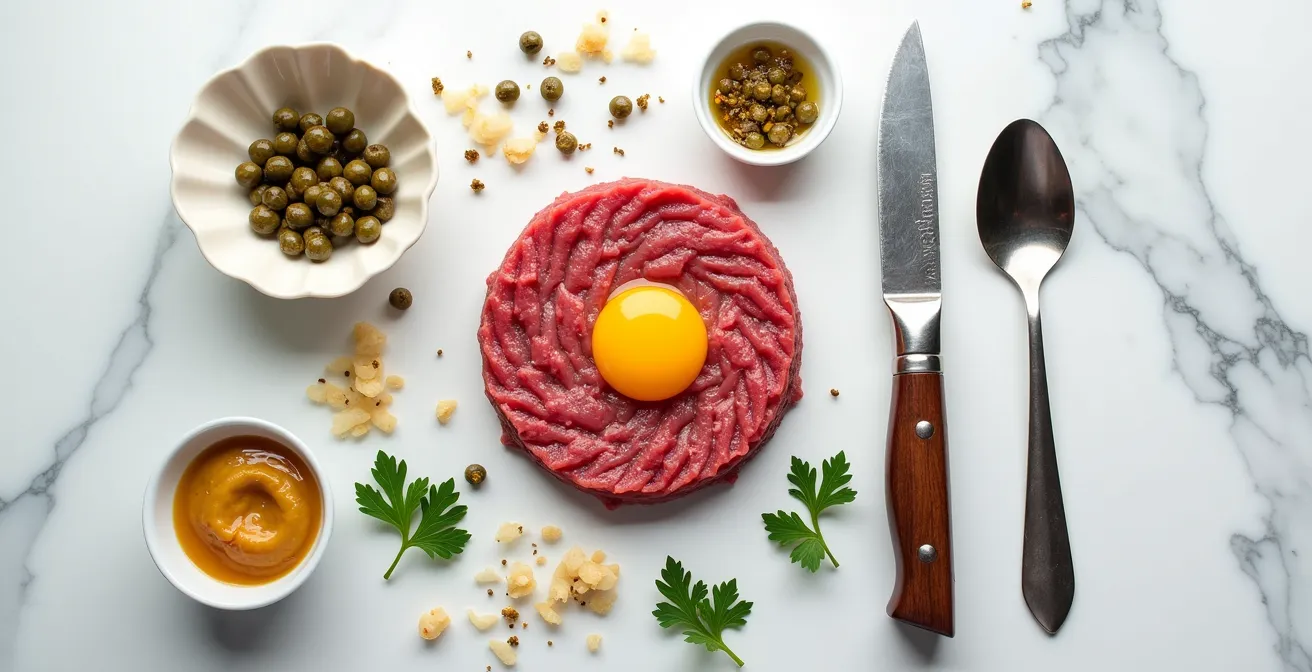
The deconstructed ingredients, as shown above, highlight the dish’s essence: it’s all about the quality of the raw components. When a restaurant is confident enough to prepare it in front of you, you know you’re in the right place. So while a side of perfect, golden frites is a legitimate pleasure, the true connoisseur knows that the heart of the dish lies in its simple, unadulterated origins.
Crêpes vs Galettes: What Is the Difference and Which One is for Dinner?
Walking through Paris, you’ll see countless ‘crêperies’, many of them street-side stands slinging sweet crêpes drenched in Nutella. This has led many visitors to believe that a crêpe is just a French pancake, suitable for a snack or dessert. This is a fundamental misunderstanding that can lead you to miss out on one of France’s most satisfying and traditional meals. The key is to understand the crucial distinction between a crêpe and a galette.
A galette is savory. It is made from dark, nutty buckwheat flour (‘sarrasin’ or ‘blé noir’), giving it a speckled brown color and a crispy texture. It originates from Brittany and is traditionally served as a main course for lunch or dinner. The classic filling is the ‘complète’: ham, grated cheese, and a sunny-side-up egg. A crêpe, on the other hand, is a dessert. It’s made from light wheat flour, is golden in color, soft in texture, and filled with sweet things like sugar, jam, or chocolate. In a real Breton crêperie, you eat your savory galette first, then order a sweet crêpe for dessert. The two are never confused.
| Aspect | Galettes | Crêpes |
|---|---|---|
| Flour Type | Buckwheat (Sarrasin) | Wheat flour |
| Color | Dark, speckled brown | Light, golden |
| Traditional Use | Savory dinner dishes | Sweet desserts |
| Classic Filling | Ham, egg, cheese (complète) | Sugar, butter, Nutella, jam |
| Texture | Crispy, slightly nutty | Soft, delicate |
| Origin | Brittany tradition | French dessert tradition |
To experience this tradition authentically, you must avoid the tourist traps and seek out a genuine crêperie. The quality of a crêpier’s skill is revealed in their ‘galette complète’—the crispiness of the galette and the perfect runniness of the egg yolk are tell-tale signs. An authentic experience also involves the proper drink.
Your Action Plan: The Breton Rules for Authentic Crêperie Dining
- Verify the Flour: Look for the ‘IGP Sarrasin de Bretagne’ label on the menu. This protected buckwheat flour from Brittany is a non-negotiable sign of authenticity.
- Order the Right Drink: Always order ‘cidre’ (cider) and ensure it’s served in a ‘bolée’ (a traditional ceramic bowl), never a glass. This is a core part of the ritual.
- Judge the ‘Complète’: Order the classic ‘galette complète’ (ham, egg, cheese). The quality of this simple dish is the benchmark by which a crêpier’s skill is measured.
- Avoid Street Vendors: Steer clear of street vendors near major tourist sites. Charging €5-€8 for pre-made, reheated crêpes is a classic tourist trap. A real crêperie makes everything to order.
- Seek Quality Establishments: Target well-regarded crêperies like Breizh Café, known for using high-quality ingredients to create light, crispy galettes and crêpes that honor the Breton tradition.
The “Fait Maison” Logo: How to Know If Your Dish Was Actually Cooked on Site?
In 2014, the French government introduced the ‘Fait Maison’ (homemade) logo—a small graphic of a saucepan topped with a roof—to help diners distinguish restaurants that cook from scratch from those that rely on industrial, pre-prepared meals. In theory, if you see this logo on a menu, it means the dish (or its primary ingredients) was cooked on-site from raw ingredients. This was a direct response to the rising tide of ‘cuisine d’assemblage’ (assembly cooking) that plagues tourist areas.
This logo is a useful first-level filter. Indeed, the law is strict; according to French restaurant regulations, fraudulent use of the label can lead to significant fines and even jail time. However, a savvy diner knows that the ‘Fait Maison’ logo is merely the baseline for quality, not the gold standard. There are loopholes: a restaurant can use frozen raw vegetables, for example, and still qualify. The logo tells you something was cooked here, but not necessarily how well or from what quality of ingredients.
For a higher guarantee of quality, you need to look for superior labels. The title of ‘Maître Restaurateur’ is a much stronger signal. It is an official state title awarded to chefs with proven professional qualifications who commit to using a high percentage of raw, unprocessed ingredients. Another sign of excellence is a sticker from the ‘Collège Culinaire de France’, an association of top chefs that audits and recognizes ‘Restaurants de Qualité’. These labels are earned, not just declared. The clearest signal of all, however, might be the menu itself. A long, sprawling menu with dishes from multiple French regions is a red flag. A true ‘fait maison’ establishment will almost always have a short, focused menu written on an ‘ardoise’ (chalkboard) that changes daily or weekly based on what is fresh and in season.
IGP vs AOP: Which Label Guarantees the Product Actually Comes from the Region?
If the ‘Fait Maison’ logo is the first step in identifying authenticity, then understanding European Union and French food labels is the master class. These labels are the most powerful “structural signals” you can find, offering a legally binding guarantee of product provenance and quality. They are your ultimate defense against impostors. The two most important labels to know are IGP and AOP.
IGP (Indication Géographique Protégée), or Protected Geographical Indication, is a strong guarantee. It certifies that at least one stage of the product’s production (growing, processing, or preparation) took place in the designated geographical region. For example, ‘Sarrasin de Bretagne IGP’ ensures the buckwheat in your galette was grown in Brittany. It’s a mark of regional connection.
However, the gold standard, the absolute pinnacle of authenticity, is the AOP (Appellation d’Origine Protégée), or Protected Designation of Origin. This label is far stricter. It guarantees that *every single step* of the production process, from the raw material to the final product, occurred within the specific region and according to a rigorous, traditional method. AOP is a promise of terroir—the unique combination of soil, climate, and human skill that defines a product. It’s not just a food; it’s a piece of cultural heritage.
Understanding this hierarchy is crucial when reading a menu. A restaurant that proudly names its AOP products is showing, not just telling, its commitment to quality.
| Label | Level | Requirements | Example Products |
|---|---|---|---|
| AOP (Appellation d’Origine Protégée) | Gold Standard | Every production step in specific region | Bœuf de Charolles, Poulet de Bresse, Roquefort |
| IGP (Indication Géographique Protégée) | Silver | At least one production stage in region | IGP Sarrasin de Bretagne |
| Label Rouge | Bronze | Superior quality, not origin-specific | Various high-quality products |
| No Label | Basic | No regional or quality guarantee | Standard commercial products |
When you see these on a menu, you know you’re in a serious establishment. Look for champions of AOP like:
- Poulet de Bresse: The only poultry in the world with AOP status, famous for its incredible flavor.
- Roquefort: Blue cheese aged only in the natural Combalou caves.
- Lentilles Vertes du Puy: Unique green lentils grown in the volcanic soil of Le Puy-en-Velay.
- Bœuf de Charolles: Beef from Charolais cattle raised in a specific part of Burgundy.
Key takeaways
- True culinary authenticity is found by decoding “structural signals” like AOP labels and seasonal ‘ardoise’ menus, not by following outdated tourist rules.
- Dietary needs are best met at modern “neo-bistros” in areas like the 11th arrondissement, which creatively reinterpret classics, rather than at rigid traditional establishments.
- Insider knowledge, such as asking for “four-season oysters” in summer or aiming for the “deuxième service” (second seating) around 9:45 PM, is your most powerful tool for a superior dining experience.
How to Get a Table at a Popular Parisian Bistro Without a Reservation?
You’ve done your research. You’ve identified a highly-praised bistro, one with a stellar ‘ardoise’ and a commitment to AOP products. There’s just one problem: it’s fully booked for weeks, and making a reservation often involves calling during a narrow, inconvenient time window. This is a common frustration, but it doesn’t have to be a dead end. In Paris, persistence and strategic timing can often triumph where planning fails. The key is to understand the rhythm of a Parisian restaurant.
The first strategy is to aim for the ‘deuxième service’ (second seating). Most popular bistros have their first wave of diners arriving between 7:30 PM and 8:00 PM. By showing up around 9:45 PM, you stand a good chance of snagging a table as the first-seaters are finishing their coffee and digestifs. This tactic requires patience and a bit of luck, but it’s a classic insider move. Another powerful option is to ask for a seat at the ‘comptoir’ (the bar counter). Many bistros keep these seats open specifically for walk-ins. Eating at the counter offers a more dynamic, less formal experience and is perfect for solo diners or pairs. It puts you right in the heart of the action.
Beyond timing your dinner, consider your timing in general. Lunch, especially the ‘formule déjeuner’ (a set-price lunch menu), is often cheaper and less crowded than dinner service. Arriving for a late lunch around 1:45 PM, after the main rush but before the kitchen closes (usually around 2:30 PM), can be a sweet spot. Finally, avoid the peak times of Friday and Saturday evenings. Your odds of walking into a great place are significantly higher from Tuesday to Thursday. These timing tactics are your best bet for turning a ‘complet’ sign into a memorable meal.
With this newfound culinary literacy, you are no longer just a tourist hoping for a good meal; you are an active participant, capable of making informed choices. The next step is to put this knowledge into practice and start discovering the truly authentic taste of Paris with confidence.