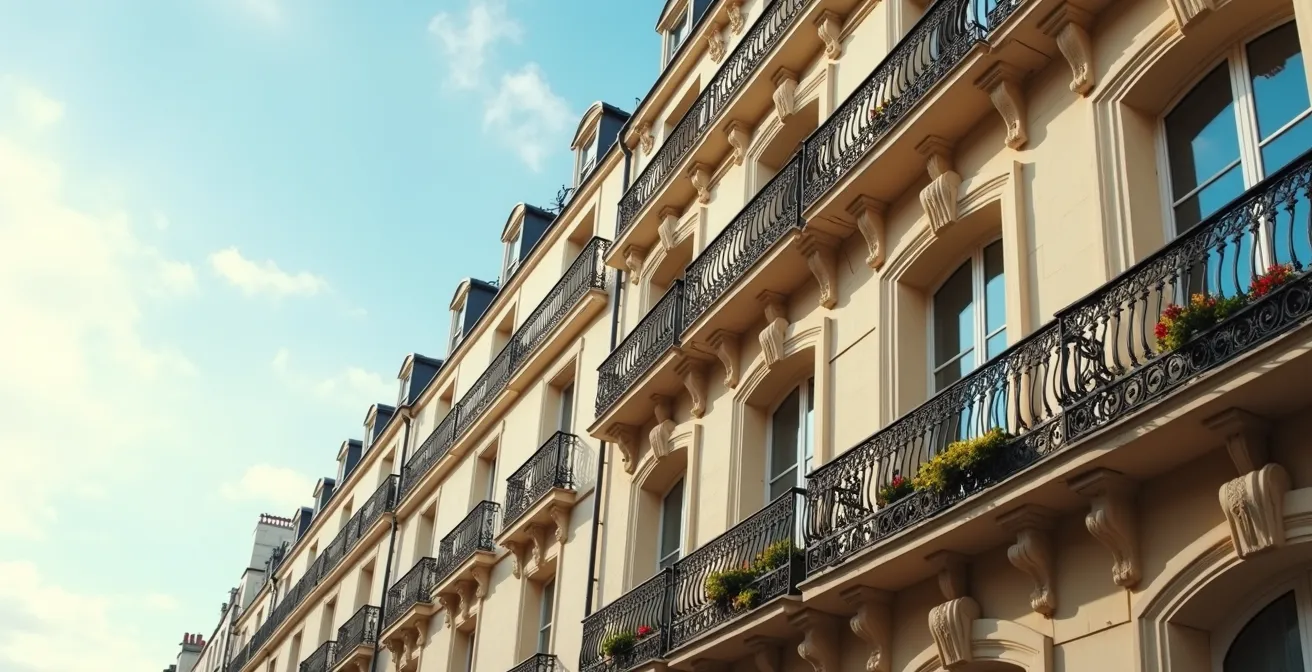
Identifying a true Haussmannian building is less about a simple checklist and more about reading a social story carved in stone.
- The placement and style of balconies reveal a rigid 19th-century class structure, from the noble second floor to the bourgeois fifth.
- Authenticity lies in the details: original plaster moldings have tell-tale imperfections that modern polyurethane fakes lack.
- Even the roofline tells a story, with the iconic zinc mansards hiding the notoriously hot former servants’ quarters.
Recommendation: Next time you’re in Paris, don’t just look at a facade—decode it. Pay attention to the ‘balcony code’ to understand the history and hierarchy of the building before you.
For any architecture enthusiast walking through Paris, the uniform cream-colored facades, wrought-iron balconies, and elegant mansard roofs are an unforgettable sight. This is the signature of Georges-Eugène Haussmann, the prefect who radically reshaped the city under Napoleon III. Many guides offer a basic checklist for identifying these buildings: six storeys, limestone construction, specific roof angles. But this approach misses the soul of the design. A true Haussmannian building isn’t just a collection of features; it’s a meticulously coded narrative of 19th-century Parisian society.
The key to unlocking this narrative lies not just in acknowledging the balconies, but in learning to read them. Their design, placement, and relationship with the windows and stonework tell a story of wealth, status, and social hierarchy—a concept we can call social stratigraphy. From an architect’s perspective, the facade is a vertical map of the class structure of its time, from the wealthy family on the “noble floor” to the servants living under the roof. Understanding this architectural language allows you to distinguish a genuine, historically significant structure from a later imitation or a poorly renovated apartment.
This guide will move beyond the superficial checklist. We will delve into the architectural forensics needed to spot authenticity, decode the stylistic shifts that came after Haussmann, and even explore the practical realities of living in these historic structures today. By the end, you’ll see every Parisian facade not as a static piece of stone, but as a living document of the city’s history.
This article provides a detailed framework for analyzing these iconic structures. Below, the summary outlines the key aspects we will explore to turn you into a discerning observer of Parisian architecture.
Summary: A Guide to Decoding Parisian Haussmannian Architecture
- Why the 2nd Floor Was Historically More Expensive Than the 5th?
- Renovated vs Original: How to Spot Fake Haussmannian Moldings in a Rental?
- Haussmann vs Post-Haussmann: Which Style Defines the 16th Arrondissement?
- Where to Enter a Haussmannian Lobby Legally to See the Grand Staircase?
- The Heat Wave Risk: Why You Should Avoid the “Chambre de Bonne” in August?
- Blocked Windows: Why Do Some Buildings Have Fake Windows Painted On?
- The Samaritaine Glass Facade: Why Did It Cause Such a Scandal Among Purists?
- Art Nouveau vs Art Deco: How to Distinguish the Styles of Parisian Metro Entrances?
Why the 2nd Floor Was Historically More Expensive Than the 5th?
The most crucial element in reading a Haussmannian facade is understanding the hierarchy of its floors. In the mid-19th century, before the widespread use of elevators, the most desirable apartment was on the second floor (the *étage noble*). This floor was the easiest to reach via the grand staircase, elevating it far above the noise and grime of the street while sparing its wealthy occupants a long climb. This status is not just historical trivia; it is explicitly carved into the building’s exterior.
The second floor is almost always distinguished by a long, continuous balcony, known as a *balcon filant*, that often wraps around the building. This balcony was a stage for the wealthy to see and be seen. The windows on this floor are taller, allowing more light into rooms with higher ceilings—an architectural analysis by Paris Property Group notes a typical 3.2 meters ceiling height on the 2nd floor, which progressively decreases on the levels above. The stonework and window frames are more ornate, and the wrought-iron railings more intricate. In contrast, the third and fourth floors, intended for the less affluent bourgeoisie, have individual, less-decorated balconies. The fifth floor often features another *balcon filant*, but its ironwork is simpler and its windows shorter, signaling a drop in status.
This deliberate design creates a visual “social stratigraphy.” The ground and mezzanine floors were for businesses and their owners, the second floor for the aristocracy, the middle for the upper-middle class, and the top floor, with its tiny dormer windows, for the servants. By recognizing this pattern, you can instantly grasp the building’s original social structure.
Your Checklist: How to Identify the Noble Floor Hierarchy
- Continuous Balcony: Look for the ‘balcon filant’ running the entire facade length on the 2nd floor. This is the clearest indicator of the noble floor.
- Ornamentation: Notice the richer window frames and more elaborate stone carvings on the 2nd floor compared to the plainer 3rd and 4th floors.
- Ceiling Height: Observe from the street that the 2nd-floor windows are visibly taller than those on the floors directly above them.
- Ironwork Detail: Compare the balcony ironwork. The 2nd floor should feature more intricate, decorative designs than the simpler railings on the 5th-floor balcony.
- Social Gradient: Read the building from bottom to top: ground floor for shops, 2nd for nobility, 3rd-4th for bourgeoisie, and the top floor with small windows for servants.
Understanding this vertical hierarchy is the first and most important step in reading a Haussmannian building, transforming a simple observation into an act of historical and social decoding.
Renovated vs Original: How to Spot Fake Haussmannian Moldings in a Rental?
For those looking to rent or buy, appreciating a building’s exterior is only half the battle. The real challenge often lies inside: distinguishing authentic 19th-century interiors from modern renovations that mimic the style. The most common casualties of renovation are the ornate plaster moldings (*moulures*), cornices, and ceiling roses (*rosaces*) that define the Haussmannian apartment. Spotting fakes requires a bit of architectural forensics.
Original moldings were handcrafted from plaster by specialized artisans known as *staffeurs-ornemanistes*. Over 150 years, these features have settled with the building, developing hairline cracks and subtle imperfections. They have been painted over many times, softening their edges. Modern reproductions, often made from polyurethane or plastic composites, are a common cost-cutting measure in renovations. These fakes look too perfect: their lines are sharp, their surfaces are flawless, and they lack the subtle, hand-carved character of the originals. An authentic Haussmannian cornice is also substantial, typically measuring 15-20 centimeters deep, whereas modern additions can appear flimsy and undersized.
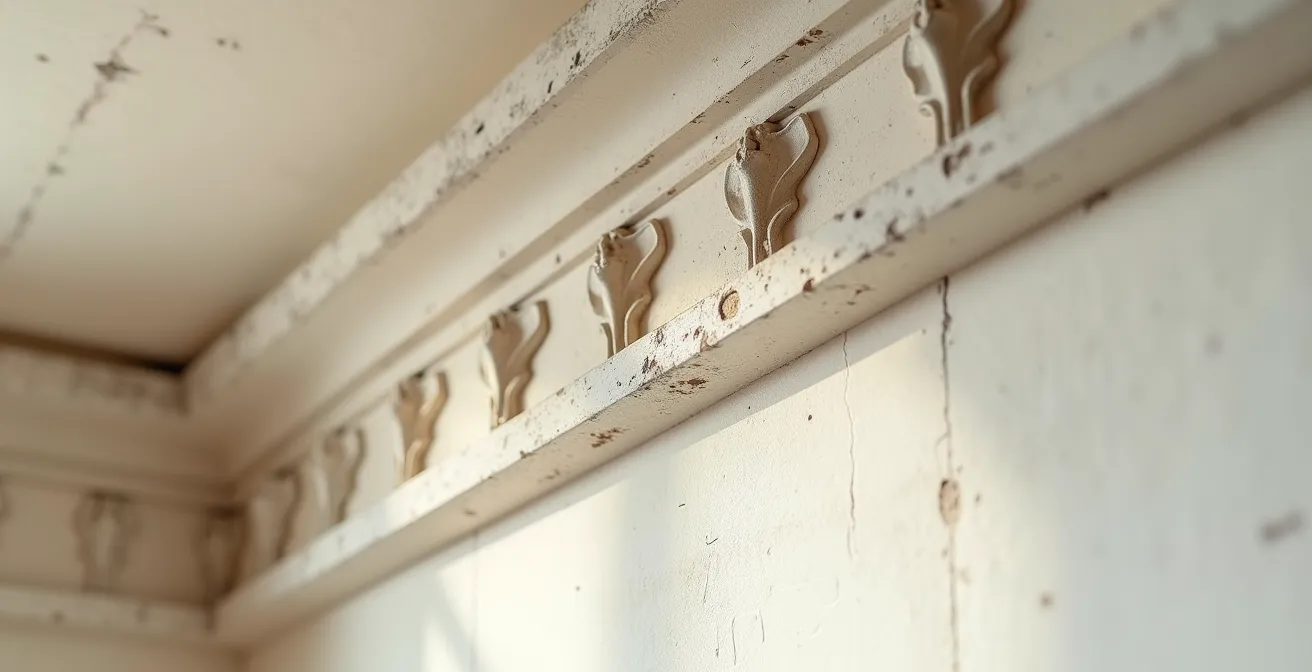
As the detail shot above illustrates, the beauty of an original molding is in its texture and history. The fine cracks and slightly uneven surfaces are not defects; they are proof of authenticity and the passage of time. When inspecting a potential rental, run your hand over the moldings. Original plaster feels cool and solid, while a polyurethane fake can feel lightweight and plasticky. Look closely at the corners and joints for the tell-tale signs of a life lived.
Case Study: The Art of Restoration
In authentic restorations, plasterwork artisans (*staffeurs-ornementalistes*) use traditional methods to preserve the apartment’s soul. They carefully examine existing details, create silicone molds from intact sections, and then reproduce any missing or damaged pieces using period-appropriate plaster techniques. This process ensures that the new sections blend seamlessly with the old. The goal is not to create a perfect, factory-made look, but to honor the natural imperfections that come with a building that has stood for over a century, a stark contrast to modern polyurethane replacements that appear unnaturally flawless.
Ultimately, a true Haussmannian interior feels integrated and organic. A fake one often feels like a stage set. Trust your eye and your touch to tell the difference.
Haussmann vs Post-Haussmann: Which Style Defines the 16th Arrondissement?
While much of central Paris is defined by the rigid uniformity of the Second Empire, venturing into areas like the 16th arrondissement reveals a stylistic shift. After Haussmann’s tenure ended in 1870 and building regulations were relaxed in the 1880s, architects began to rebel against the strict aesthetic constraints. This gave rise to the Post-Haussmannian style, a more creative and individualistic evolution that paved the way for Art Nouveau.
The core difference is a move from uniformity to individuality. A classic Haussmannian street presents a cohesive, almost monolithic facade, where each building is a subservient part of a greater whole. Post-Haussmannian buildings, however, begin to assert their own personalities. Facades become more ornate, incorporating projecting bow windows, varied materials, and more expressive decoration. The strict rule of balconies on the second and fifth floors gave way to more freely placed, individual balconies with increasingly decorative ironwork. As the guide “Un Jour de Plus à Paris” notes in its analysis:
Facing growing architects discontentment who have seen their creativity broken by the rules, they will be reduced from 1880, promoting the emergence of a free and exuberant style: Art Nouveau
– Un Jour de Plus à Paris, Architectural Walking Tours Guide
This transition is beautifully illustrated by comparing the key features of the two periods. While the underlying structure remains similar, the differences in expression are stark.
The following table, based on an analysis of Parisian architectural features, breaks down the key distinctions you can spot.
| Feature | Classic Haussmann (1850s-1870s) | Post-Haussmann (1880s-1900s) |
|---|---|---|
| Building Height | 17.55m standard, max 20m on wide streets | More varied heights after 1880 regulations relaxed |
| Facade Style | Strict uniformity, cream limestone | More ornate, individual expression allowed |
| Balconies | 2nd and 5th floor continuous balconies | Individual balconies appeared, more decorative ironwork |
| Architectural Movement | Second Empire classicism | Transition to Art Nouveau elements |
| Roof Angle | 45-degree mansard strictly regulated | More variation in roof designs permitted |
The 16th arrondissement is not purely one or the other but a fascinating blend, making it a perfect neighborhood to practice distinguishing the disciplined classicism of Haussmann from the burgeoning freedom of what came next.
Where to Enter a Haussmannian Lobby Legally to See the Grand Staircase?
Once you’ve learned to appreciate the intricate stories told by Haussmannian facades, the natural next desire is to see the interiors. The grand entrance halls and magnificent staircases are often as impressive as the exteriors, but these are typically private residential buildings. So, how can an architecture enthusiast get a legal glimpse inside without trespassing?
Fortunately, with a bit of knowledge and respectful timing, there are several legitimate ways. These buildings are not fortresses; many house professional offices, museums, or hotels, offering public or semi-public access. Given that a study highlights that about 60% of Paris’s buildings are Haussmannian in style, your opportunities are plentiful if you know where to look. The key is to seek out buildings that serve a public function, even if it’s a subtle one. A discreet visit during business hours to a building housing a doctor’s or lawyer’s office to “check the directory” in the lobby is a time-honored trick for a quick, respectful look.
For more immersive experiences, planning your visit around specific events or venues is the best strategy. Here are several effective and perfectly legal methods:
- Visit during the annual European Heritage Days (*Journées du Patrimoine*) in September, when many private buildings and residences open their doors to the public for free.
- Book a guided heritage tour at a landmark department store like Galeries Lafayette to see its stunningly restored Haussmannian dome and grand staircase.
- Explore house museums located in former Haussmannian mansions, such as the Musée Jacquemart-André or the Musée Nissim de Camondo.
- Discreetly enter buildings that house professional offices (doctors, lawyers, notaries) during business hours to view the lobby and main staircase.
- Stay at one of the many boutique hotels in Paris that are housed in converted Haussmannian buildings for full, unfettered interior access.
By using these strategies, you can move beyond the facade and experience the full three-dimensional artistry of Haussmann’s vision, from the street to the grand staircase.
The Heat Wave Risk: Why You Should Avoid the “Chambre de Bonne” in August?
While the *étage noble* represents the peak of Haussmannian luxury, the very top of the building tells a different story: that of the servants. The iconic 45-degree zinc mansard roofs are dotted with small dormer windows, each opening into a *chambre de bonne* (servant’s room). Originally spartan quarters for domestic staff, these tiny rooms have since been converted into studios, popular among students and those on a budget. However, their architectural design comes with a significant modern-day risk: extreme heat.
The thin zinc roofing, a hallmark of the Haussmannian skyline, is a poor insulator. It absorbs and radiates solar heat with startling efficiency. During Parisian heatwaves, temperatures inside these top-floor rooms can become dangerously high, far exceeding the temperatures in the apartments below, which are protected by thick *pierre de taille* (limestone) walls. This creates a significant comfort and health risk, particularly in July and August.

The aerial view above highlights the vast expanse of zinc that acts like a city-wide radiator in the summer. While the thick stone walls of the main building provide a degree of natural thermal comfort, the roof structure offers very little protection from the sun’s intensity. Renovating these spaces to improve living conditions presents a unique challenge, balancing modern comfort with heritage preservation.
Case Study: The Thermal Challenge of Top-Floor Renovations
Modern renovation case studies show that while a Haussmannian building’s thick stone walls offer decent thermal mass, the primary source of heat gain and loss is the zinc roof. The 45-degree mansard design, while architecturally iconic, creates challenging living conditions in the former servants’ quarters. Contemporary solutions often involve installing advanced humidity-sensitive mechanical ventilation systems (VMC) and adding high-performance insulation. However, insulating the ceilings is notoriously difficult without altering or damaging the historic moldings and structural elements, a common roadblock due to strict heritage preservation requirements.
So, while a *chambre de bonne* might offer romantic rooftop views, it’s a living choice that requires careful consideration of the season. The same architecture that gives Paris its character also creates these microclimates of extreme heat.
Blocked Windows: Why Do Some Buildings Have Fake Windows Painted On?
One of the most curious features you might spot on a Parisian facade is the “blind window” (*fenêtre aveugle*). This can be a window-shaped recess in the stonework, a roughly bricked-up opening, or even a skillfully painted *trompe-l’œil* creating the illusion of a window that isn’t there. These architectural quirks are not random; they are the scars of a battle between two powerful, opposing forces: Haussmann’s obsession with symmetry and a long-standing French tax law.
The primary culprit was the “door and window tax,” a levy on property owners based on the number of openings in their building. A historical review on Wikipedia confirms that the door and window tax existed from 1798 to 1926, a 128-year period that directly incentivized property owners to minimize their window count. To save money, many owners simply bricked up existing windows. However, this created a new problem: it violated the strict aesthetic rules of uniformity and symmetry that Haussmann’s plan demanded for the grand new boulevards.
This led to two distinct types of blind windows. Some were part of Haussmann’s original design; if an internal staircase or wall fell where a window was needed for external symmetry, an architect would include a shallow, blind recess in the facade to maintain the pattern. Others are the result of tax avoidance. A building owner might brick up a real window and then, to satisfy aesthetic codes, hire an artist to paint a fake one in its place. This *trompe-l’œil* solution was the perfect compromise, satisfying both the taxman and the city planner. You can often tell the difference: a planned blind window is seamlessly integrated into the stonework, while a tax-motivated one may show signs of rougher brickwork behind the paint.
These features are a testament to the tension between grand aesthetic ideals and the practical, economic realities of the people who inhabited these buildings, adding another layer to the story written on the facade.
Key Takeaways
- The “Balcony Code”: Balconies are the primary indicators of a Haussmannian building’s internal social hierarchy, with continuous balconies on the 2nd and 5th floors being the classic sign.
- Authenticity is in the Imperfection: True 19th-century interior details like plaster moldings will show subtle, age-related imperfections, unlike flawless modern plastic reproductions.
- Evolution, Not Revolution: The Post-Haussmann style (common in the 16th arr.) is an evolution, moving from rigid uniformity to more individualistic and ornate designs that led to Art Nouveau.
The Samaritaine Glass Facade: Why Did It Cause Such a Scandal Among Purists?
The story of Parisian architecture doesn’t end with Haussmann. It is a continuous dialogue between preservation and innovation, a tension perfectly embodied by the recent renovation of La Samaritaine department store. While the store’s original 1905 structure was a masterpiece of Art Nouveau—itself a departure from Haussmannian rigidity—the addition of a modern, undulating glass facade on the Rue de Rivoli side sparked a fierce debate among architectural purists.
The controversy wasn’t just about a single building; it was about the soul of Paris. Haussmann’s legacy is a city of aesthetic coherence, where stone, rhythm, and proportion create a harmonious urban fabric. The shimmering, futuristic glass wall of La Samaritaine, designed by the Japanese firm SANAA, is a deliberate and provocative break from this tradition. For supporters, it represents a bold, 21st-century architectural statement, proving that Paris is a living city, not an open-air museum. They argue that every great era has added its own layer to the city, from Gothic to Renaissance to Haussmann’s own radical redesign.
For critics, however, the facade is a jarring disruption of the historic streetscape. They see it as a concession to globalized “starchitect” culture that disrespects the finely tuned context of the surrounding limestone buildings. The scandal highlights a fundamental question: should Paris be preserved as a perfect, Haussmann-era artifact, or should it continue to evolve, even if that evolution creates stylistic friction? La Samaritaine’s renovation is a powerful symbol of this ongoing cultural conversation.
Case Study: La Samaritaine’s Architectural Evolution
The original La Samaritaine store, built in 1905, was itself a revolutionary break from Haussmann’s rigid rules regarding moldings and balconies, championing the new Art Nouveau style. The recently restored building and its controversial new facade represent the full arc of Parisian architecture: from the homogeneous Haussmannian ideal to the individualistic expression of Art Nouveau, and now to the tension between preserving that historic character and allowing contemporary architectural expression. It serves as a physical timeline of the city’s changing aesthetic values.
Ultimately, La Samaritaine stands as a monument to the fact that the architectural story of Paris is still being written, with each new chapter generating as much passion and debate as the last.
Art Nouveau vs Art Deco: How to Distinguish the Styles of Parisian Metro Entrances?
Just as the city’s buildings evolved from Haussmann’s classicism, so too did its public infrastructure. The iconic entrances to the Parisian Métro are miniature architectural masterclasses, primarily showcasing two distinct, successive styles: Art Nouveau and Art Deco. Learning to distinguish between them is a final, crucial step in reading the city’s design language, a skill that complements your understanding of Haussmannian and Post-Haussmannian buildings.
Art Nouveau, the style of the Belle Époque (roughly 1900-1910), is organic, flowing, and inspired by nature. Its most famous Parisian proponent was Hector Guimard, who designed the original Métro entrances. These are characterized by their “whiplash” curves, cast-iron structures resembling plant stems, and distinctive green patina. The famous entrance at Abbesses station is a perfect example of this “noodle style,” with its amber lamps like flower buds and signage in a fluid, custom typeface. It represents a pre-WWI optimism and a celebration of craftsmanship.
Art Deco emerged after World War I, during the “Années Folles” of the 1920s and 30s. It was a reaction against the perceived fussiness of Art Nouveau. Influenced by the machine age, industrialization, and a desire for order, Art Deco is all about geometry, symmetry, and strong, straight lines. Art Deco Métro entrances, like the one at Pelleport, are far more austere. They often feature simplified ironwork, concrete frames, and bold, angular typography. The philosophy shifted from nature-inspired fantasy to sleek, functional modernity.
This comparative table, drawing on insights from sources like My Modern Met’s architectural guides, clarifies the essential differences.
| Characteristic | Art Nouveau (Guimard) | Art Deco |
|---|---|---|
| Time Period | 1900-1910 (Belle Époque) | 1920s-1930s (Années Folles) |
| Design Philosophy | Organic, nature-inspired | Geometric, machine-age |
| Line Style | Flowing curves, ‘noodle style’ | Straight lines, angular forms |
| Materials | Cast iron with green patina | Concrete, simplified ironwork |
| Iconic Example | Abbesses station entrance | Pelleport station entrance |
| Cultural Context | Pre-WWI optimism | Post-WWI modernity |
By applying this knowledge, you can see the entire city—from its grandest boulevards to its subterranean transit—as a gallery showcasing a century of breathtaking architectural evolution.
Frequently Asked Questions on Haussmannian Windows
How can I tell if a blocked window was due to the tax or original Haussmannian design?
If the window appears roughly bricked-up with visible mortar lines, it was likely blocked to avoid the window tax. If it is seamlessly integrated into the stone facade with matching limestone, it was probably part of Haussmann’s original symmetrical design from the start.
Why did Haussmann include blind windows in his designs?
Haussmann’s obsession with facade uniformity meant that even when an interior wall or staircase would interrupt a window opening, the exterior needed to maintain perfect visual symmetry. These planned blind windows preserved the harmonious rhythm of the boulevard’s facade.
Are trompe-l’œil painted windows common in Paris?
Yes, they are relatively common. Property owners often painted fake windows to maintain the facade’s symmetry after bricking up real ones. These trompe-l’œil solutions were a clever way to satisfy both the need for tax avoidance and the city’s strict aesthetic requirements.