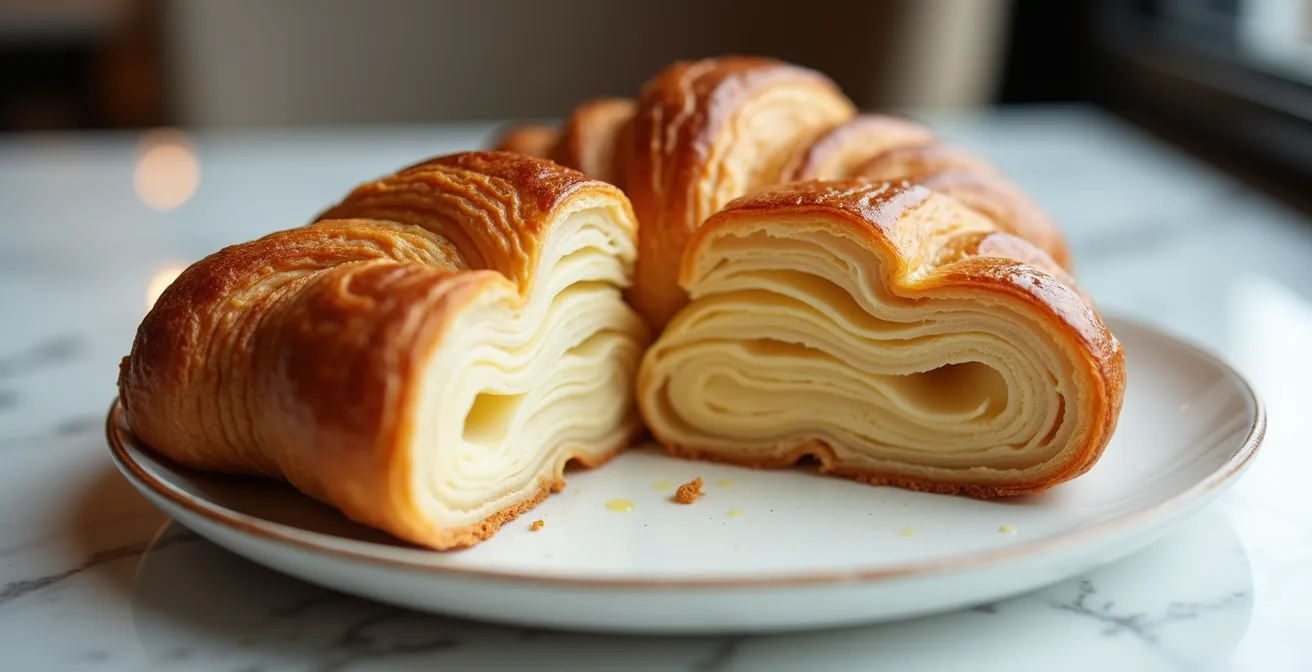
The best croissant is rarely the most expensive or the most famous; it’s the one that passes a rigorous sensory and technical inspection.
- Authenticity is signaled by technique and ingredients (like AOP butter), not just the croissant’s shape or the bakery’s reputation.
- Timing is critical: the freshest batches often appear mid-morning, long after the initial morning rush.
Recommendation: Become your own judge. Learn to identify the subtle cues of quality—from lamination to aroma—to discover hidden gems beyond the tourist trail.
The scent of warm butter, the delicate crackle of a shattering crust—the promise of a perfect Parisian croissant is a powerful one. Yet, it is a promise too often broken. We’ve all felt the deep disappointment of a limp, greasy, or bread-like pastry, a pale imitation of the real thing. In the quest for an authentic experience, many fall back on common but flawed assumptions: a higher price must mean better quality, a long queue signals a must-visit spot, or a famous name guarantees excellence. These are the platitudes of the pastry tourist.
As a judge for Parisian bakery competitions, I can assure you that finding a prize-worthy croissant has nothing to do with these superficial markers. It is a forensic exercise, a sensory evaluation where you learn to disqualify the mediocre. It requires you to look past the branding and assess the product on its own merits. The true craft is not in finding a good croissant, but in understanding the production signals that betray an industrial, or “impostor,” croissant. This isn’t about just eating a pastry; it’s about appreciating the art of viennoiserie.
This guide will equip you with a judge’s scorecard. We will dissect the myths surrounding shape and timing, discuss the unwritten rules of consumption etiquette, and analyze the price-quality paradox. By the end, you will have the confidence to walk into any French boulangerie and identify a true champion.
To navigate this expert tasting journey, here is a breakdown of the key criteria we will examine. Each section will dismantle a common myth and replace it with a judge’s practical insight, turning you from a simple consumer into a true connoisseur.
Summary: How to Identify the “Best Butter Croissant” Winner in Your Neighborhood?
- Straight vs Curved: Why Does the Shape of the Croissant Matter?
- 7 AM or 9 AM: When Is the Best Batch of Croissants Coming Out of the Oven?
- Dipping or Not: Is It Socially Acceptable to Dunk Your Croissant in Coffee?
- Is a 2€ Croissant at a Famous Pastry Shop Really Better Than a 1.30€ Neighborhood One?
- The Almond Croissant: Is It a Delicacy or Just a Way to Use Stale Pastries?
- How to Carry a Saint-Honoré on the Metro Without Destroying It?
- 18€ for Croissants: Is the Hotel Breakfast Worth the Price?
- Angelina vs Ladurée: Which Tea Room Justifies the 45-Minute Wait in the Rain?
Straight vs Curved: Why Does the Shape of the Croissant Matter?
The most enduring piece of Parisian croissant lore dictates that shape is a direct indicator of fat content: straight for a croissant au beurre (butter croissant) and curved for a croissant ordinaire made with margarine. For decades, this was a reliable, legally-backed code for consumers. A straight croissant was a declaration of its noble, all-butter origins. The curved shape signaled the inferior, less flavorful alternative. However, in the modern Parisian landscape, this rule has become more of a guideline than a gospel. Many elite bakers, confident in their reputation and the quality of their ingredients, now craft beautiful, curved butter croissants simply for aesthetic preference.
Case Study: The La Maison d’Isabelle Precedent
When La Maison d’Isabelle won the coveted first prize for the best butter croissant in Paris in 2018, they did so with a pastry that defied convention. Their focus was not on adhering to a traditional shape but on perfecting the essentials: sourcing high-quality organic butter and executing flawless lamination. This victory demonstrated to the entire city that excellence comes from artisanal, hand-made techniques and superior ingredients, rendering the straight-versus-curved debate secondary. The real signals of quality are far more subtle.
Instead of relying solely on shape, a true evaluation requires a multi-sensory approach. Your eyes should look for the visible layers of dough and butter, known as lamination, along the side. The color must be a deep, even golden-brown, not pale or anemic. And if you must ask, always be specific. Ordering a “croissant” might get you the default; asking for a “croissant au beurre” is a clear statement of intent.
Action Plan: How to Identify an Authentic Butter Croissant
- Ask Specifically: Never order just a ‘croissant’. Always request a ‘croissant au beurre’ to ensure you’re getting the all-butter version, which is the standard for any quality bakery.
- Analyze the Shape (with caution): In traditional bakeries, straight often still means butter and curved means margarine. But in high-end or competition-winning spots, this rule is frequently ignored. Use it as a first clue, not a final verdict.
- Judge the Color: Look for a rich, consistent golden-brown hue. A pale or unevenly baked croissant suggests issues with the oven or the dough’s proofing. A true butter croissant has a vibrant, appetizing color.
- Observe the Texture: From the side, you should be able to see distinct, paper-thin layers. This visible lamination is the hallmark of a well-made croissant and promises a light, airy interior.
- Notice the Sheen: Real butter gives the surface a slight, natural gloss. An overly shiny or greasy-looking croissant might be made with lower-quality fats, whereas a completely dull one may be stale.
7 AM or 9 AM: When Is the Best Batch of Croissants Coming Out of the Oven?
The “early bird gets the worm” logic does not apply to croissant hunting. Arriving at a boulangerie at the crack of dawn is a rookie mistake. Many bakeries, to cope with the morning rush, bake an initial batch the evening before or in the very early hours. By 7 AM, these croissants may have already been sitting for a few hours, losing their optimal texture. The true connoisseur knows that patience is a virtue. The golden hour for croissants is not at sunrise, but mid-morning. According to Parisian bakery experts, the freshest croissants emerge between 9 AM and for the afternoon ‘goûter hour’ around 4 PM. This is when the second, often superior, batch is baked to replenish stocks after the initial commuter surge.
This strategic timing ensures you experience the croissant as the baker intended: still warm, with a fragile, shattering crust and a soft, steamy interior that releases the full aroma of fermented dough and caramelized butter. A croissant tasted at 9 AM versus one at 11 AM can be a completely different experience. The latter will have begun to dry out, its crust turning leathery and its interior dense. Therefore, timing your visit is just as crucial as selecting the right bakery. An award-winning croissant eaten at the wrong time is just another mediocre pastry.
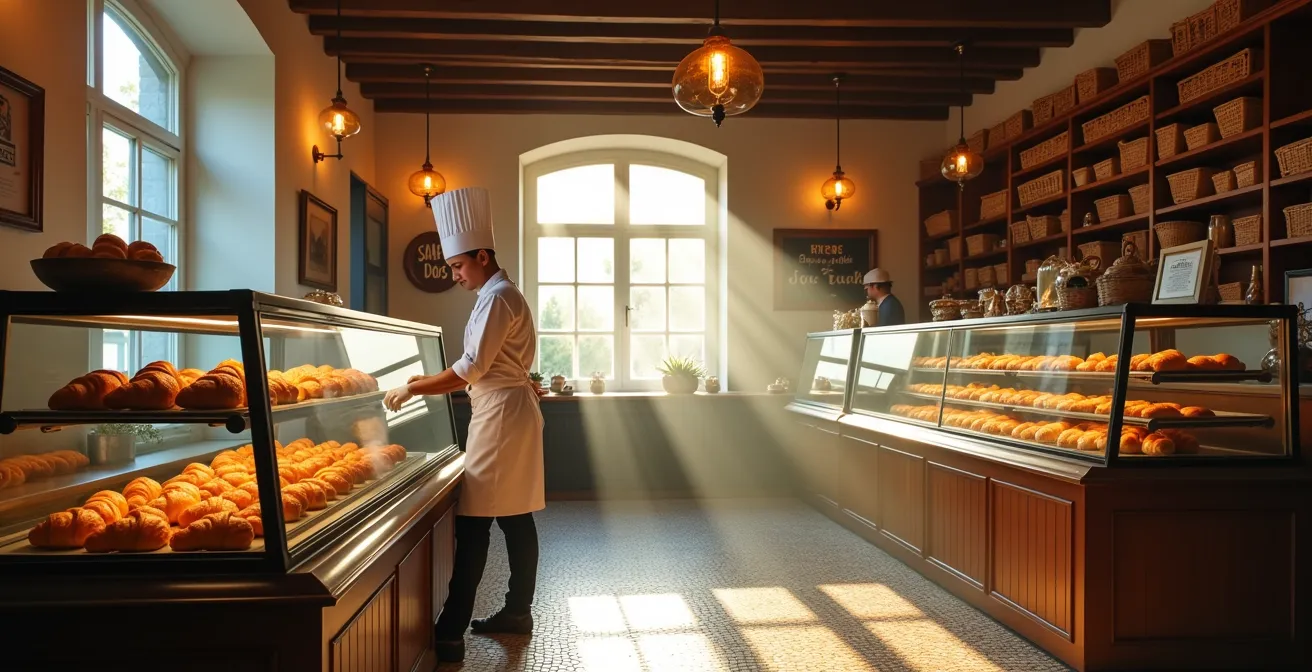
The afternoon batch around 4 PM is another strategic window, designed to capture the after-school snack crowd. This goûter tradition means you have a second chance at achieving peak freshness. Be wary of late Friday afternoons, however, as the best bakeries often sell out completely before closing for the weekend, leaving only the dregs. A true hunter plans their expedition with precision.
Dipping or Not: Is It Socially Acceptable to Dunk Your Croissant in Coffee?
The question of dunking a croissant—faire trempette—is a matter of context and reveals a deep-seated aspect of French culinary etiquette. There is no single “yes” or “no” answer; rather, it depends entirely on your surroundings. At home, for a private breakfast, it is not only acceptable but a cherished ritual. The French typically use a wide, handleless bowl, a bol, for their morning coffee or hot chocolate, specifically designed to accommodate the dunking of croissants or day-old baguette slices (tartines). In this informal setting, softening the flaky pastry in a warm beverage is a comforting and perfectly legitimate act.
However, the social acceptability plummets as the setting becomes more formal. In a casual neighborhood café, you will likely see locals dunking their croissants into a café au lait, and no one will bat an eye. It’s part of the relaxed, everyday fabric of French life. But step into a high-end salon de thé like Angelina or Ladurée, and the rules change. Here, pastries are considered refined creations to be savored on their own. Dunking would be seen as a minor faux pas, akin to eating a delicate cake with your hands. In these establishments, you are expected to break the croissant into small, bite-sized pieces with your fingers or, in the most formal settings, use a fork and knife.
At a business breakfast, dunking is absolutely not recommended. It’s messy and lacks the professional decorum required for such an occasion. Here, the proper method is to tear off a small piece of the croissant with your hands before eating it. The key is to demonstrate restraint and respect for both the pastry and the social situation. Ultimately, viennoiserie etiquette is about reading the room: what is a comfortable ritual at home can be an awkward misstep in a formal environment.
Is a 2€ Croissant at a Famous Pastry Shop Really Better Than a 1.30€ Neighborhood One?
This is the central price-quality paradox of the Parisian pastry world. It’s easy to assume that a higher price tag, especially from a bakery with a famous name or in a chic arrondissement, equates to a superior product. This is often untrue. My experience judging competitions has consistently shown that excellence has little correlation with price. In fact, many of the most decorated croissants come from humble, unassuming neighborhood bakeries where the focus is on craft, not marketing.
Case Study: The Maison Doucet Upset
The 2024 ‘Concours du Meilleur Croissant au Beurre’ provided the perfect example. First place was awarded to Maison Doucet, a local boulangerie in the 12th arrondissement. Their winning croissant was praised for its perfectly light dough, flaky inner layers, and rich buttery flavor. This masterpiece of viennoiserie beat out countless luxury establishments and palace hotel bakeries, proving that true quality lies in the baker’s skill, not the shop’s rent. The price of this award-winning creation? A very reasonable €1.50 at the time of the win, shattering the myth that you must pay a premium for the best.
So, if not price, what should you look for? The most reliable indicators of quality are official certifications and competition awards. These are the true marks of a master craftsman. A wise consumer learns to read these signals, which are almost always proudly displayed in the bakery’s window.
This table breaks down the most reliable quality indicators, which often have little to do with the final price you pay.
| Quality Indicator | What to Look For | Typical Price Range | Reliability |
|---|---|---|---|
| Competition Winner Sticker | ‘Concours du Meilleur Croissant’ award | €1.30-€1.80 | Very High |
| Boulanger de France Label | Certification of on-site production | €1.20-€1.60 | High |
| MOF (Meilleur Ouvrier de France) | Master craftsman designation | €1.50-€2.50 | Very High |
| Premium Butter Type | AOP Charentes-Poitou or Isigny butter | €1.80-€3.00 | Medium-High |
| Palace Hotel Bakery | Luxury hotel setting | €3.00-€5.00 | Variable |
The lesson is clear: trust the accolades, not the price tag. A “Boulanger de France” label guarantees the croissant is made from scratch on-site, not from frozen industrial dough. A “Concours” sticker is a direct testament to peer-reviewed excellence. These are the signals that matter.
The Almond Croissant: Is It a Delicacy or Just a Way to Use Stale Pastries?
The croissant aux amandes occupies a controversial space in the pastry world. Cynics dismiss it as a mere recycling project—a way for bakeries to repurpose day-old, unsold butter croissants by dousing them in syrup and masking them with almond cream. While this is certainly true in lesser establishments, for a true artisan, the almond croissant is an act of transformation, an entirely new creation that elevates its humble origins. It is not about salvaging waste, but about building layers of flavor and texture. The original croissant is merely the canvas.
The process, when executed with mastery, is an art form. The day-old croissant, having lost some moisture, is the perfect vessel to absorb a carefully prepared syrup—often subtly flavored with rum or high-quality almond extract. It is then generously filled with rich, house-made crème d’amande (almond cream) and topped with sliced almonds before being baked a second time. This second bake crisps the exterior and toasts the almonds to a fragrant golden-brown, creating a product that is simultaneously moist, decadent, crunchy, and soft. It is a complex textural experience that a plain croissant cannot offer.
Case Study: Stohrer’s Alchemical Creation
One needs only to look to Stohrer, the oldest pastry shop in Paris, founded in 1730 on the vibrant rue Montorgueil. As a historic institution and former pastry chef to King Louis XV, its reputation is built on perfecting classic French pastries. Their almond croissant is widely considered one of the best in the city, a testament to what this pastry can be. At Stohrer, the transformation of a day-old croissant is not a compromise but an elevation. They demonstrate that with quality ingredients and time-honored technique, the almond croissant is a delicacy in its own right, not an afterthought.
A superior almond croissant should feel substantial but not heavy or soggy. The almond flavor should be authentic and rich, not cloyingly sweet from cheap syrup. The toasted almonds on top must provide a nutty crunch that contrasts with the soft, decadent filling. In the hands of a master, it is one of the most luxurious items in the viennoiserie case.
How to Carry a Saint-Honoré on the Metro Without Destroying It?
Transporting a delicate, high-end pastry like a Saint-Honoré or a fraisier through the Parisian metro system is a high-stakes mission that demands strategy and vigilance. This is not a trivial matter; it is the final, crucial step in preserving the artistry of the pâtissier. The iconic cardboard box with its flimsy string handle is a trap for the unwary. Never, under any circumstances, trust the string alone. The box must be supported firmly from the bottom with both hands, as if you were carrying a sacred object.
The journey itself is fraught with peril. The jostling crowds of rush hour (7-9 AM and 5-7 PM) are the natural enemy of delicate cream and spun sugar. A strategic agent will avoid these periods at all costs, even if it means taking a longer, less crowded route. Lines notorious for their density, like the perpetually packed Line 13, should be blacklisted from your itinerary. Once on board, secure a seat and place the box flat on your lap. It is your personal, shock-absorbent shelf. Placing it on the floor invites disaster from stray feet, and holding it while standing is a recipe for a crushed masterpiece.

For added security, a seasoned operative will employ the “bag-in-bag” technique. Placing the pastry box inside a large, sturdy shopping bag with a flat bottom provides an extra layer of stability and protection from bumps and scrapes. When standing, position yourself in a corner or near the doors, using your body as a human shield to guard the precious cargo. In an age of convenience, one might be tempted by modern solutions like Uber or specialized delivery services. While effective for the most fragile creations, successfully navigating the metro with a pastry intact is a quintessential Parisian rite of passage—a test of one’s dedication to the art of dessert.
Key Takeaways
- True croissant quality is judged by technique (lamination, color) and ingredients (AOP butter), not by its shape.
- Strategic timing is crucial; the best croissants are often found mid-morning (around 9 AM) or for the afternoon ‘goûter’, not at dawn.
- Price is a poor indicator of quality. Official awards (‘Concours’) and labels (‘Boulanger de France’) are the most reliable signals of excellence.
18€ for Croissants: Is the Hotel Breakfast Worth the Price?
The hotel breakfast buffet presents a classic dilemma: convenience versus authenticity. For a price of €18 or more, it promises a civilized, leisurely start to the day with unlimited coffee and a wide selection of items. However, from a pastry judge’s perspective, it is often a poor value proposition. The vast majority of hotels, even some luxury ones, serve industrial or frozen viennoiseries that lack the soul and character of an artisanal product. They prioritize consistency and ease of preparation over genuine quality. Before committing to the hotel breakfast, an informed connoisseur must become an investigator.
The single most important action is to approach the staff and ask the essential question. This simple inquiry separates the tourist from the aficionado.
D’où viennent vos viennoiseries?
– Essential question to ask hotel staff, Expert tip from Paris hospitality insiders
This question—”Where do your pastries come from?”—is perfectly polite and immensely revealing. If the staff proudly names a respected local boulanger, you may be in luck. If they evade the question or admit they are baked from frozen, you have your answer. The convenience is not worth the compromise in quality. A far superior experience can be had for a fraction of the cost by stepping outside.
A cost-benefit analysis makes the verdict clear. The “Hybrid Strategy” almost always emerges as the winner for those who value both quality and experience.
A comparison between the hotel offering and local alternatives reveals a stark difference in value. The following analysis pits the typical hotel package against the options available just a short walk away.
| Option | Items Included | Total Cost | Pros | Cons |
|---|---|---|---|---|
| Hotel Breakfast Package | Croissant, unlimited coffee, juice, eggs, fruits, service | €18-25 | Convenience, variety, ambiance, no waiting | Industrial pastries common, less authentic |
| Local Café | Croissant + grand crème + fresh juice (à la carte) | €11-13 | Authentic quality, local experience | Limited selection, possible queue |
| Award-Winning Bakery | Premium croissant + takeaway coffee | €4-5 | Best quality, authentic, very affordable | No seating, must walk/search |
| Hybrid Strategy | Hotel coffee + bakery croissant brought back | €2-3 (just croissant) | Best of both worlds, luxury setting + quality | Requires 10-min walk, some effort |
Angelina vs Ladurée: Which Tea Room Justifies the 45-Minute Wait in the Rain?
Pitting Angelina against Ladurée is the quintessential tourist debate, a question fundamentally flawed in its premise. From a judge’s perspective, the answer to which justifies the 45-minute queue is simple: neither. While these historic salons de thé offer opulent decor and a certain old-world charm, their fame often eclipses the quality of their standard viennoiseries. They have become victims of their own success, prioritizing brand experience and high-volume service over the singular perfection of a croissant. The wait is for the brand, not for the pastry.
A true connoisseur understands that the finest creations are often found away from the Champs-Élysées, in bakeries where the artisan’s focus remains squarely on the product. These establishments may not have velvet ropes, but they have something far more valuable: uncompromising dedication to the craft.
Case Study: The Du Pain et des Idées Alternative
Consider Du Pain et des Idées, a bakery lauded by locals and discerning visitors, including public figures like YouTuber Luis Sal. They are famous for their unique “escargot” pastries in flavors like pistachio-chocolate, but their traditional croissants are equally sublime. While queues can form at its walk-up window, they are queues for exceptional, freshly-baked goods, not for a photo opportunity. This type of bakery offers a level of quality and innovation that rivals, and often surpasses, the more famous tea rooms, without the tourist markup or excessive wait.
If you absolutely must experience one of the iconic tea rooms, do so intelligently. Never queue for the main dining room just for a croissant. Opt for the takeaway boutique section to bypass the line entirely. Choose less-crowded locations (e.g., Ladurée in Saint-Germain over the one on the Champs-Élysées) and try to book a table online, a feature many tourists overlook. A truly Parisian experience would be to buy the pastries to-go and savor them in the nearby Jardin des Tuileries, creating your own moment of luxury without the queue. The ultimate power move is to realize that the best experience is the one you curate yourself, not the one you wait for.
Now, armed with this knowledge, your next step is to put it into practice. Go out and become the judge of your own neighborhood, applying this sensory scorecard to every bakery you encounter and discovering the hidden champions that await.