
The secret to a peaceful Sacré-Cœur visit isn’t confronting scammers; it’s making yourself invisible to them by using tactical avoidance and local knowledge.
- Bypass the main scammer “kill zone” on the stairs by taking the funicular; it accepts standard metro tickets.
- Approach the basilica from the quieter northern side via Metro Lamarck-Caulaincourt for a completely scam-free walk.
- Wear proper shoes. Slippery cobblestones and 500+ steps are a bigger threat than any hustler.
Recommendation: Stop planning how to say “no.” Start planning a route that ensures you never have to.
Listen up. You’ve seen the videos, you’ve read the warnings. The infamous “string bracelet” scammers on the steps of the Sacré-Cœur. The advice is always the same: be firm, say “no,” and walk away. I’m here to tell you that’s a losing strategy. As a member of the local safety watch, I see it every day: tourists trying to navigate the gauntlet, getting flustered, intimidated, and starting their visit on a sour note. You don’t win by playing their game.
The real solution is to think like a local. It’s not about confrontation; it’s about geography. The scammers operate in a very specific, predictable territory. The key to a stress-free visit is to treat this area like a roadblock and simply route around it. It’s a form of “geographical judo”—using the landscape of Montmartre to your advantage. Your goal isn’t to be tough; it’s to be invisible. You achieve that by choosing the right path, the right transport, and even the right shoes.
This isn’t just about avoiding a minor annoyance. It’s about protecting the spirit of your visit. The Sacré-Cœur is a place of peace and breathtaking views, not a stage for a street hustle. This guide will give you the operational playbook to ensure you experience the former without ever dealing with the latter. We’ll cover the tactical routes, the essential etiquette inside, and the small choices that signal “savvy visitor,” not “easy target.”
This article outlines the complete operational strategy for a safe and memorable visit. Follow these steps, and your only concern will be the climb to the top.
Summary: Your Tactical Guide to a Scam-Free Sacré-Cœur Visit
- Funicular vs Stairs: Is the Metro Ticket Worth Saving Your Breath?
- The Silence Rule: Why Guards Will Shush You Inside the Basilica?
- Why Climbing the Dome at 9 AM Is Crucial for a Clear View?
- Behind the Basilica: Why Rue de l’Abreuvoir Is Prettier Than the Front Steps?
- Shorts and Tank Tops: Will You Be Denied Entry to Sacré-Cœur in Summer?
- Parc de Belleville: Why This View Rivals Montmartre Without the Tourists?
- Navigo Easy vs Paper Tickets: Why You Should Stop Buying Carnets?
- Why Your Choice of Shoes Determines the Success of Your Montmartre Visit?
Funicular vs Stairs: Is the Metro Ticket Worth Saving Your Breath?
Let’s be blunt: the 222 steps leading up to the basilica are the primary scammer “kill zone.” This is where the bracelet scheme is most aggressive. Thinking you can just power-walk through it is your first mistake. The smart move—the local move—is to bypass this area entirely. The funicular isn’t a tourist trap; it’s your best tactical asset. It’s a 90-second ride that takes you from the base of the hill directly to the basilica’s forecourt, well away from the main concentration of hustlers on the stairs.
This is not about being lazy; it’s about being strategic. The funicular is part of the RATP public transport system, meaning it accepts standard T+ metro tickets and all Navigo passes. There is no special, inflated tourist price. With over 2 million passengers per year, it’s a legitimate and efficient workhorse of the neighborhood. By using it, you sidestep the entire confrontation. You arrive refreshed and, more importantly, unbothered.
For those determined to walk, do not take the central staircase from Square Louise-Michel. Instead, take the metro to Abbesses or Lamarck-Caulaincourt and use the quieter, winding back streets like Rue Lepic. This “back-door approach” not only avoids the scams but also shows you a more authentic side of Montmartre.
The Silence Rule: Why Guards Will Shush You Inside the Basilica?
Once you’re safely inside, the challenge shifts from external security to internal etiquette. You will see signs asking for silence, and guards will not hesitate to enforce the rule with a firm “Shhh!” This isn’t arbitrary or because they dislike tourists. The Sacré-Cœur is not just a monument; it is an active place of worship with a unique and profound distinction: perpetual adoration. This means that day and night, without interruption since 1885, the Blessed Sacrament has been on display for continuous prayer.
Your voice, even a whisper, carries in the cavernous nave and disrupts this constant prayer. The official guidelines are clear about the reason for this solemnity.
In the central nave, due to Mass and Office celebrations, as well as out of respect for the presence of the exposed Blessed Sacrament — for Catholics, this is the real presence of Christ — please enter only the areas dedicated to prayer
– Basilique du Sacré-Cœur Official Guidelines, Official Basilica Website
Respecting this rule is non-negotiable. Turn off your phone, don’t talk to your companions, and move slowly and quietly. Take your photos without flash and be mindful that you are a guest in a sacred space. Understanding the “why” behind the silence—the unbroken chain of prayer—transforms it from an annoying restriction into a beautiful tradition you are privileged to witness.
Why Climbing the Dome at 9 AM Is Crucial for a Clear View?
The main basilica is free to enter, but the real prize is the view from the dome, and it comes with a price: €8 and a climb up 300 narrow, winding steps with no elevator. To make this effort worthwhile, timing is everything. Aim to arrive right when the dome opens, typically around 10:15 AM (check the official site for seasonal hours). Being among the first in line means you’ll have the viewing gallery almost to yourself before the crowds surge.
More importantly, the morning offers the best light and clearest air. Paris can get hazy, especially on warm afternoons. A morning climb maximizes your chances of seeing the full, crisp panorama. The circular gallery offers a breathtaking 360-degree panoramic view that, on a clear day, can stretch for 30 kilometers. You’ll see the Eiffel Tower, Notre Dame, and the sprawl of the city laid out before you. Access to the dome is not inside the main church; it’s located outside, to the left of the main entrance, after you pass the initial security check. You’ll descend into a small “moat” area to find the ticket office and the start of the climb.
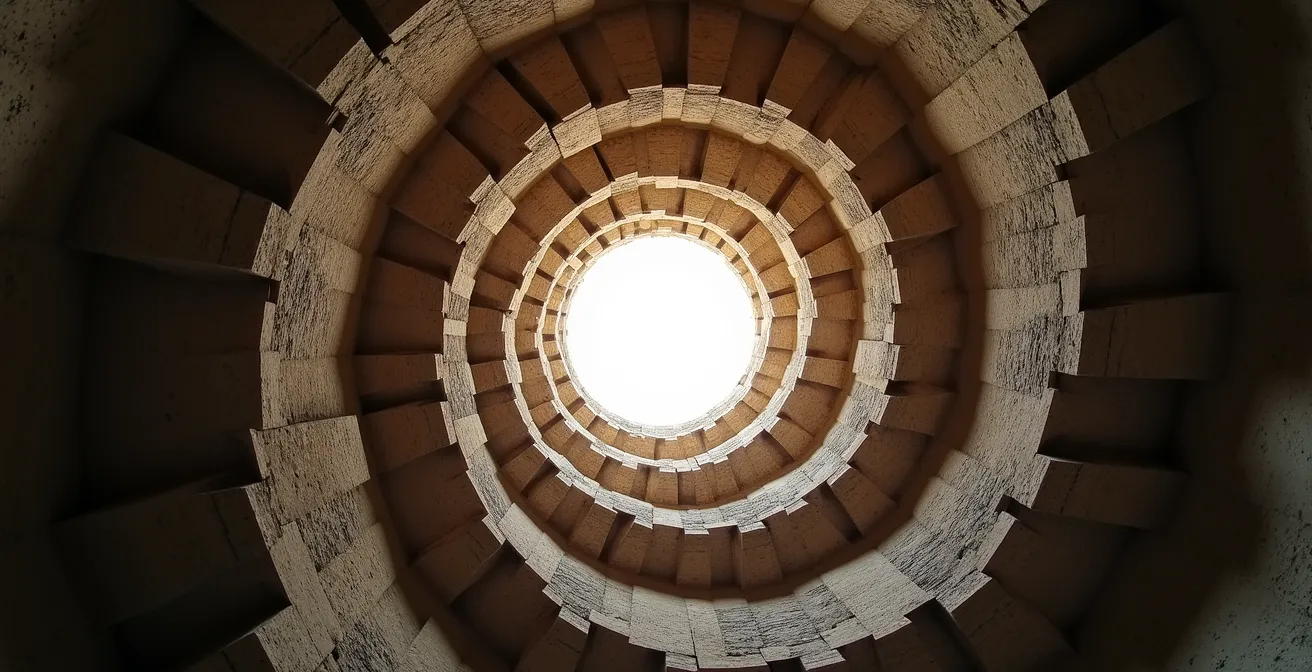
This climb is not for the faint of heart or those with claustrophobia. The stone spiral staircase is tight and unrelenting, a physical challenge that rewards you with one of the most spectacular, and highest, viewpoints in all of Paris.
Behind the Basilica: Why Rue de l’Abreuvoir Is Prettier Than the Front Steps?
The tourist-clogged front of the Sacré-Cœur is not the real Montmartre. The true charm of the neighborhood lies in its hidden backstreets. If you want a genuinely beautiful, peaceful, and scam-free approach to the basilica, you must embrace the “back-door approach.” This means starting your journey from the north side, at Metro Lamarck-Caulaincourt. From there, a short walk leads you to Rue de l’Abreuvoir, often cited as one of the prettiest streets in Paris.
Instead of crowds and hustlers, you’ll find ivy-covered houses, quiet cobblestone lanes, and the famous La Maison Rose café. The best photo opportunity is from the bottom of the street at Place Dalida, looking up towards the dome of the Sacré-Cœur rising above the rooftops. The light here is best in the afternoon, casting a golden glow on the buildings. This route allows you to see the basilica as part of the living, breathing neighborhood it inhabits, not as an isolated tourist island.
This path is a core tenet of our “geographical judo.” It completely removes you from the high-traffic, high-stress environment of the southern approach (Anvers metro, Rue de Steinkerque). You’ll pass local bakeries and the peaceful Montmartre Cemetery, arriving at the basilica from the north with your good mood and your wallet intact.
Shorts and Tank Tops: Will You Be Denied Entry to Sacré-Cœur in Summer?
Yes, you can and will be denied entry. In the summer heat, it’s tempting to wear as little as possible, but remember: the Sacré-Cœur is a consecrated church, not a tourist attraction. There is a dress code, and it is enforced. The signs at the entrance state it clearly: “Please dress appropriately.” This means your shoulders and knees should be covered. This applies to everyone, regardless of gender.
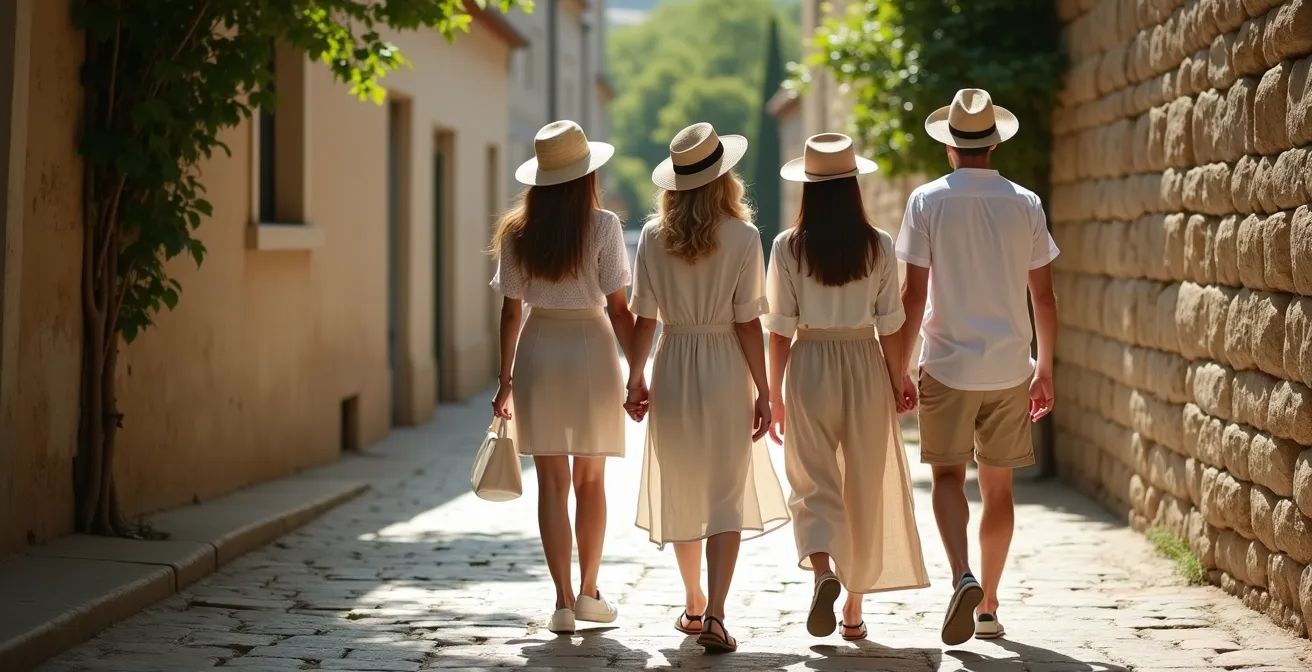
Being turned away at the door after navigating the hill is a frustrating and entirely avoidable experience. You don’t need to dress formally. Lightweight, breathable fabrics are your friend. Think linen trousers, a midi skirt or dress, or a simple t-shirt instead of a tank top. A great tip for those wearing sleeveless tops is to carry a light scarf or pashmina in your bag. You can easily drape it over your shoulders before entering the basilica and remove it once you’re back outside.
You are entering a holy place… Please dress appropriately and remain silent
– Basilica Official Entry Guidelines, Sacré-Cœur Montmartre Official Website
Following the dress code is more than just a rule; it’s a sign of respect. It’s also a form of “signal control.” Dressing appropriately signals that you are a mindful visitor, not a clueless tourist, which subtly changes how you are perceived and treated.
Parc de Belleville: Why This View Rivals Montmartre Without the Tourists?
Let me give you a true insider tip. If your main goal is a stunning panoramic view of Paris, you might not need to go to Montmartre at all. For a more authentic, less crowded experience, head to the Parc de Belleville in the 20th arrondissement. This is where locals go. The atmosphere is completely different: a multicultural, working-class neighborhood vibe, free from the tourist-centric commercialism of Montmartre.
From the Belvédère de Belleville terrace at the top of the park, you get a sprawling, wide-angle vista of the city. Crucially, the view from Belleville prominently features the Eiffel Tower, which is harder to see well from the Sacré-Cœur’s parvis. The park itself is beautiful, with waterfalls and lush greenery. You can enjoy the view at any time of day without being jostled by crowds or approached by anyone trying to sell you something.
The choice between these two viewpoints comes down to what you’re looking for. The following table breaks down the key differences to help you decide.
| Aspect | Sacré-Cœur View | Parc de Belleville |
|---|---|---|
| Tourist Density | Extremely high | Local atmosphere |
| Best Time | Early morning only | All day enjoyment |
| View Includes | Historic center | Eiffel Tower prominent |
| Access | 222 steps or funicular | Direct metro access |
| Atmosphere | Tourist-centric | Authentic Parisian |
Navigo Easy vs Paper Tickets: Why You Should Stop Buying Carnets?
How you pay for your transport is another form of “signal control.” Fumbling with cash for a single paper ticket at a machine marks you as a first-time visitor. The old paper “carnets” (books of 10 tickets) are being phased out. The modern, savvy way to travel is with a Navigo Easy pass. It’s a plastic card you buy once for a €2 fee and then load with as many journeys as you need. Each trip on the metro, bus, or the Montmartre funicular uses one journey from your pass.
Using a Navigo Easy is faster—you just tap it on the reader—and more secure. You’re not pulling out your wallet at every turn. It immediately signals that you know how the system works. More importantly, when you approach the funicular, you can walk straight to the contactless gate and tap your pass like a local, bypassing any potential ticket-selling hustlers and the often-crowded ticket machines at the Anvers station, where a single métro/RER ticket costs €2.50 under current RATP pricing. It’s a small detail that makes a big difference in projecting confidence and preparedness.
Action Plan: How to Use Navigo Easy for Your Montmartre Visit
- Purchase the Navigo Easy card for a one-time €2 fee at the counter or machine of any metro station upon your arrival in Paris.
- Load the card with individual T+ journeys or a block of 10 at a discounted rate using a ticket machine (they accept credit cards and cash).
- Use this single pass for all your transport: tap it to enter the metro, board a bus, or, crucially, to go through the funicular gates.
- Each trip, including the 90-second funicular ride, will simply deduct one journey from the balance on your card.
- The contactless system means you can keep the card in an accessible pocket and tap it without even taking out your wallet.
Key takeaways
- The best defense is avoidance: Use the funicular or back-street routes to bypass the main staircase where scammers congregate.
- Respect the sanctity of the space: The basilica requires silence due to perpetual prayer, and a modest dress code (shoulders and knees covered) is strictly enforced.
- Your footwear is critical: Montmartre is a steep hill with polished cobblestones and hundreds of steps; comfortable, grippy shoes are essential for safety and comfort.
Why Your Choice of Shoes Determines the Success of Your Montmartre Visit?
This may sound trivial, but it’s the most practical piece of advice I can give you: your entire Montmartre experience hinges on your choice of footwear. Forget fashion; prioritize function. The name itself is a warning—a reality confirmed by a look at its name: Montmartre’s key syllable means ‘mount’. This is a steep hill. The streets are paved with old, uneven cobblestones that have been polished smooth and slippery by millions of feet over centuries. Add a little rain, and they become treacherous.
Furthermore, the scale of the climb is significant. Even if you use the funicular, you’ll face stairs. If you want to see the view from the dome, you first need to climb 222 steps to reach the basilica, and then an additional 300 to get to the top. That’s 522 steps up and 522 steps down. Doing this in flimsy sandals, heels, or shoes with no grip is not just uncomfortable; it’s dangerous. A twisted ankle will ruin your trip far more effectively than any scammer.
Choose comfortable shoes with good traction and support, like sneakers or sturdy walking shoes. This isn’t a suggestion; it’s a requirement for a safe and enjoyable visit. Proper footwear allows you to be nimble, to confidently walk the back streets, to handle the stairs, and to focus on the beauty around you instead of worrying about your next step. It’s the foundation upon which all other safety strategies are built.
Now you have the local’s playbook. A successful visit to the Sacré-Cœur isn’t about luck; it’s about preparation. By choosing your route, your transport, and your attire with intention, you take control of your experience. Stop seeing yourself as a potential target and start acting like a prepared visitor. Your best defense is a good plan. Use this one.