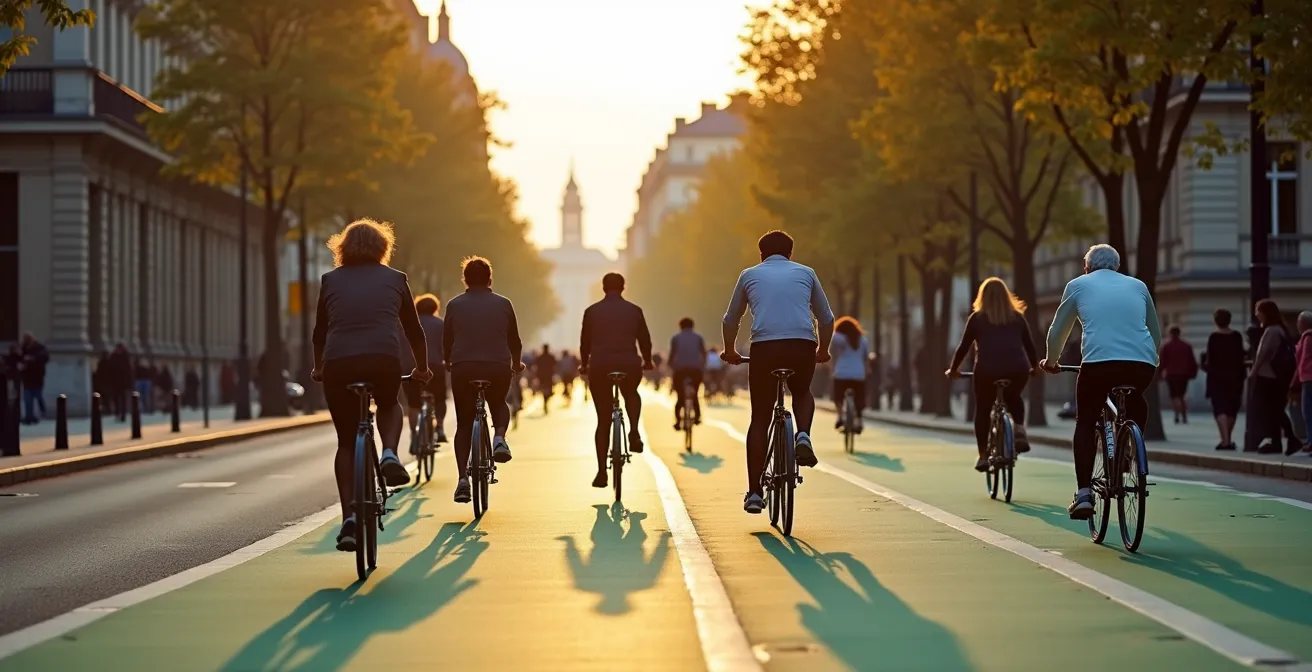
Feeling intimidated by the idea of cycling in Paris? You’re not alone. The key to safely navigating the city’s bustling streets isn’t just about knowing the rules, but about understanding its unique “street rhythm.” This guide moves beyond generic advice to teach you how to think like a Parisian cyclist, empowering you to read the traffic, choose the right bike, and confidently explore the capital on two wheels.
The dream of gliding past Parisian landmarks on a bicycle is a powerful one. You picture yourself with a baguette in your basket, the Eiffel Tower in the distance. But then, reality hits: the swirling traffic of a roundabout, the sheer number of cars, scooters, and pedestrians. For many visitors, the desire to explore Paris sustainably is quickly overshadowed by a very real intimidation of its traffic. Common advice like “wear a helmet” or “watch out for cars” feels inadequate when faced with the complex choreography of a Parisian boulevard.
But what if the secret wasn’t about fear, but about fluency? What if you could learn to “read” the streets and anticipate the flow? As a daily commuter in these streets, I can tell you that safety in Paris isn’t just about following signs; it’s about understanding the unwritten rules and the specific mindset that turns chaos into a predictable, manageable system. It’s about developing an infrastructure literacy that allows you to feel in control.
This guide is designed to give you that fluency. We’re going to move past the platitudes and give you the practical, on-the-ground knowledge you need. We’ll start by helping you choose the right tool for the job—your Vélib’. Then, we’ll decode the critical rules and behaviors you need to know, explore some of the best car-free routes, and tackle specific navigational challenges. By the end, you’ll have more than just a map; you’ll have the confidence to make cycling the highlight of your Parisian adventure.
This article breaks down everything you need to know to transform from a nervous visitor into a confident city cyclist. Explore the sections below to master each aspect of your Parisian biking journey.
Summary: A Practical Guide to Conquering Parisian Bike Lanes
- Electric or Mechanical Vélib’: Which One to Choose for Climbing to Belleville?
- The Pedestrian Rule That Can Cause Accidents on Shared Parisian Boulevards
- Promenade Plantée vs Petite Ceinture: Which Linear Park Is Best for a Jog?
- Crit’Air Sticker: Do You Need One for a Rental Car Inside the A86?
- How the Transformation of Place de la Bastille Changed the Walking Experience?
- The Climbing Wall: Where Exactly is the Kids’ Zone Near Pont des Invalides?
- Paris Respire: When Can You Walk in the Middle of the Avenue?
- How to Spot and Avoid Pickpocket Teams on Metro Line 1?
Electric or Mechanical Vélib’: Which One to Choose for Climbing to Belleville?
Your first decision sets the tone for your entire ride: which Vélib’ to unlock? The classic green mechanical bike is iconic, but the blue electric Vélib’ is often the smarter choice for anyone but the most athletic purists. Paris isn’t flat, and areas like Montmartre or Belleville feature surprisingly steep grades. Choosing the right bike is the first step toward a positive and non-exhausting experience.
The electric Vélib’ provides three levels of assistance, making hills feel almost effortless. This isn’t just about comfort; it’s about safety. Maintaining momentum on a climb helps you stay stable and predictable to other road users. It’s no surprise that more than 50% of kilometers travelled on Vélib’ use electric bikes, according to official data. They are the workhorses of the system for daily commuters and explorers alike. While they are heavier, which you’ll notice on downhills, the assistance on the way up is a game-changer.
For a specific challenge like the climb to Parc de Belleville, the choice is clear. Cyclists report that the steep sections, such as Rue Piat, are nearly impossible on a mechanical bike without dismounting. With an electric Vélib’, you can conquer the hill with minimal effort, saving your energy for the stunning panoramic view of Paris at the top. The electric assistance is your key to unlocking the entire city, not just its flat riverbanks.
To help you decide at a glance, this comparison breaks down the key differences for tackling Parisian geography.
| Feature | Electric Vélib’ (Blue) | Mechanical Vélib’ (Green) |
|---|---|---|
| Assistance levels | 3 levels (up to 25 km/h) | None |
| Weight | Heavier (affects downhill speed) | 22.5 kg (lighter) |
| First period free | 45 minutes | 30-60 minutes (varies by pass) |
| Battery range | 50 km | N/A |
| Ideal for hills | Yes – minimal effort required | No – requires significant effort |
The Pedestrian Rule That Can Cause Accidents on Shared Parisian Boulevards
Understanding the hierarchy of the Parisian street is crucial for your safety. In Paris, the pedestrian is king. This isn’t just a courtesy; it’s a fundamental rule of the road that you must internalize. The most important, and often misunderstood, rule for cyclists is your obligation at a `passage piéton` (pedestrian crosswalk). You must give absolute priority to pedestrians, even if they are only waiting on the sidewalk and have not yet stepped onto the crossing. This principle of defensive awareness is key to avoiding accidents.
Tourists and locals alike will step into the crosswalk expecting you to stop. Failing to do so is not only illegal but also extremely dangerous and goes against the entire local cycling etiquette. Anticipate this behavior at every crossing. Slow down, make eye contact if possible, and be prepared to stop completely. This single habit will do more for your safety than almost any other. It is a core part of the city’s “street rhythm.”
This same principle applies with even more force in designated `zones de rencontre` (meeting zones) and pedestrian areas. In these zones, you are technically a guest in a pedestrian’s space. You are required by law to ride at walking speed, or `allure du pas`. This means being able to stop instantly and always yielding. Thinking you can weave through crowds at speed is the fastest way to cause an incident and marks you as an inexperienced rider.
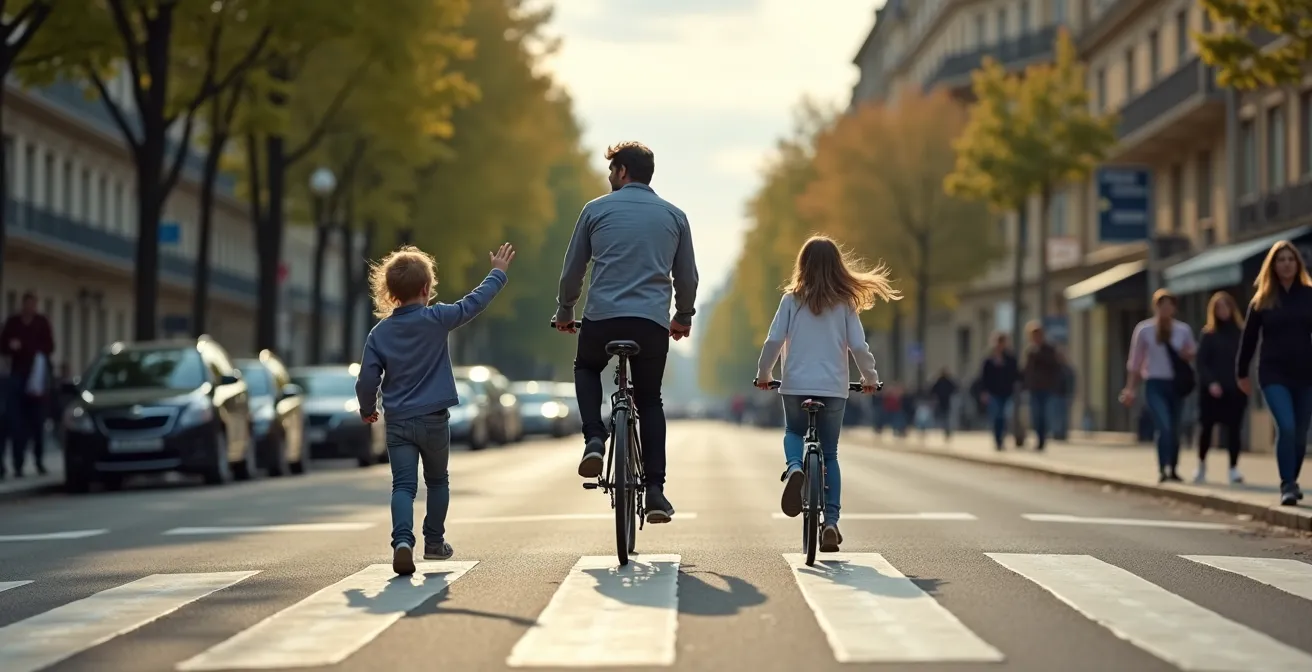
To integrate smoothly and safely, focus on being predictable and courteous. A friendly “ding” from your bell far in advance is much better than an aggressive, last-minute ring. The visual below captures the ideal interaction: a moment of mutual respect between cyclist and pedestrian that defines safe Parisian cycling.
Other critical rules to adopt include never overtaking a bus on the right side, especially when it’s at a stop, as passengers may be disembarking. Also, pay close attention at red lights; some are equipped with a small triangular sign with a yellow bike symbol. This indicates you may proceed with caution, yielding to crossing traffic and pedestrians, but it is not a green light.
Promenade Plantée vs Petite Ceinture: Which Linear Park Is Best for a Jog?
When you’re looking for a break from traffic, Paris’s linear parks seem like a perfect escape. However, it’s vital to know which ones are for you. The famous Promenade Plantée (or Coulée Verte René-Dumont), an elevated greenway built on an old railway viaduct, is a beautiful place for a stroll or a jog. But here’s the crucial piece of information for cyclists: biking is strictly forbidden on its elevated sections. Attempting to ride here will only lead to frustration and conflicts with pedestrians.
Similarly, the Petite Ceinture, another abandoned railway line circling the city, is being gradually opened to the public in sections. While it’s a fascinating urban wilderness to explore, it is primarily a walking path. The terrain is often uneven and not designed for cycling. You can park your bike near an entrance and explore on foot, but don’t plan on riding along it.
So where should you go for that linear, car-free cycling experience? The best options are purpose-built for bikes. The Parc Rives de Seine is the city’s crown jewel for cyclists. As confirmed by Paris’s official tourism guidance, this 10-hectare park offers wide, smooth, completely car-free paths along both banks of the river, taking you past major landmarks. Another excellent choice is riding along the canals. The towpaths of the Canal Saint-Martin and the Canal de l’Ourcq provide peaceful, continuous routes that take you from the heart of the city northeast into quieter areas. These routes are part of the city’s cycling DNA and are perfect for a leisurely ride away from traffic.
Best Bike-Accessible Linear Routes in Paris
- Berges de Seine: Completely car-free with segregated paths running along the river. It’s the top choice for safe, scenic cycling.
- Canal de l’Ourcq towpaths: A tranquil route extending from the Bassin de la Villette northeast out of Paris.
- Canal Saint-Martin: Protected paths connecting the Bastille area to La Villette, famous for its locks and iron footbridges.
- Bois de Vincennes: A massive 995-hectare park on the eastern edge of Paris with an extensive network of trails perfect for cycling.
Crit’Air Sticker: Do You Need One for a Rental Car Inside the A86?
If you’re considering renting a car in Paris, you’ll quickly encounter the term Crit’Air. This is a mandatory anti-pollution sticker that categorizes vehicles by their emissions levels. The sticker is required to drive within the ZFE (Zone à Faibles Émissions, or Low Emission Zone), an area which essentially covers all of Paris and the surrounding region inside the A86 motorway ring. Driving without the correct sticker can result in a fine.
However, as a visitor aiming for sustainable exploration, this question presents a perfect opportunity to reinforce the ultimate transport solution: the bicycle. While dealing with rental car agencies, ZFE restrictions, and Parisian traffic is a complex headache, the answer for cyclists is beautifully simple. Your bike is your golden ticket to unrestricted movement. This is not just an opinion, but official policy.
The City of Paris itself provides the definitive answer, bringing total clarity to the matter. This official stance liberates you from all the bureaucracy associated with driving.
All bicycles, including electric ones and public bike-share systems like Vélib’, are completely exempt from all Crit’Air and ZFE (Zone à Faibles Émissions) restrictions.
– City of Paris, Paris Cycling Infrastructure Report
Choosing to cycle isn’t just an eco-friendly choice; it’s the most practical and freeing one. You don’t need to worry about stickers, restrictions, or pollution-based traffic bans. You have the freedom to go anywhere, anytime. This is the true luxury of soft mobility in a modern city. By choosing two wheels, you are actively opting out of a complex and restrictive system designed to discourage car use in the city center.
How the Transformation of Place de la Bastille Changed the Walking Experience?
The Place de la Bastille, once a notoriously chaotic and car-centric roundabout, has undergone a radical transformation. For pedestrians and cyclists, the change is revolutionary. What was once a daunting space to cross is now a major, well-designed hub for soft mobility, making the experience safer and far more pleasant. The key has been a significant reduction in car lanes and the creation of wide, protected spaces for people.
The most significant change for cyclists is the implementation of a large, two-way protected bike lane that circles a large portion of the square. This creates a safe “ring” that connects the major cycling arteries that converge on Bastille. You can now seamlessly connect from the protected lane on Rue de Rivoli (coming from the west) to the paths along the Canal Saint-Martin (heading north) or the Boulevard Henri-IV (heading south towards the Seine) without having to merge into heavy traffic.
This new infrastructure requires a new kind of “infrastructure literacy.” You need to understand how to use it. Pay close attention to the dedicated traffic signals for bikes and pedestrians and be aware of the marked “conflict points,” especially where buses exit the roundabout and cross the bike path. The redesign includes large pedestrian islands that make crossing the square on foot much easier, but as a cyclist, you must remain vigilant at these wide crossings leading towards the July Column at the center.
Navigating the new Place de la Bastille by bike
To navigate this new hub like a local, follow these steps:
- Use the main two-way protected bike lane that circles the square to get your bearings.
- Watch for specific signals for cyclists and be vigilant for buses exiting the roundabout at marked conflict points.
- Be extra cautious at the wide pedestrian crossings near the July Column, always anticipating that people will cross.
- To head west towards the Louvre, connect directly onto the protected Rue de Rivoli bike lane.
- To go north, follow the signs that direct you safely onto the bike path along the Canal Saint-Martin for a scenic, traffic-free ride.
The new Place de la Bastille is a prime example of Paris’s commitment to becoming a 100% bikeable city. By understanding the new layout, you can use it as a safe and efficient crossroads for your explorations rather than an obstacle to be feared.
The Climbing Wall: Where Exactly is the Kids’ Zone Near Pont des Invalides?
One of the best family-friendly cycling destinations is located right in the heart of Paris, along the car-free Berges de Seine. Tucked away between the Pont des Invalides and the Pont de l’Alma is a free, open-air climbing wall, part of a larger kids’ play area. Finding it is easy if you know where to look, and getting there by bike is a safe and enjoyable family outing.
The key is to use the Berges de Seine bike path. This is a completely segregated, wide, and smooth pavement that runs along the river, totally separated from car traffic. It’s the safest possible environment for cycling with children. You don’t have to worry about cars, and the wide path allows for slower speeds and side-by-side riding if the path is not crowded. The route is dotted with water fountains, public restrooms, and places to sit, making it ideal for a family adventure.
To get there, simply make your way to the Seine riverbank from any Vélib’ station and join the bike path. Head in the direction of the Eiffel Tower from the Musée d’Orsay, or away from it if you’re starting further west. The climbing wall and play area are on the Rive Gauche (Left Bank). You can’t miss the colorful climbing holds on the stone embankment wall. There are plenty of `arceaux` (metal hoop bike stands) along the riverbank to securely park your bikes while the kids play.
For families with children too young to cycle on their own but too old for a baby seat, rental companies in Paris offer options like tandem attachments. These are perfect for the Berges de Seine, allowing the whole family to participate. After the climbing wall, you can easily continue your ride along the river to other attractions like the playgrounds in the Jardin des Tuileries, accessible via protected bike lanes.
Paris Respire: When Can You Walk in the Middle of the Avenue?
Paris Respire (“Paris Breathes”) is a wonderful initiative that transforms parts of the city into pedestrian- and cyclist-first zones by closing them to motor traffic. This is your chance to experience the city in a completely different way—cycling down the middle of the Champs-Élysées or exploring the Marais without the constant noise and presence of cars. Typically, these closures happen on Sundays and public holidays, but the exact zones and times can vary.
The most famous Paris Respire event is the closure of the Champs-Élysées, which usually occurs on the first Sunday of each month. On these days, the “world’s most beautiful avenue” becomes a massive promenade for thousands of people walking, cycling, and skating. It’s a fantastic experience, but it requires a shift in your cycling mindset. You are no longer in a space designed for transit, but in a shared recreational area. This means riding at a slow, respectful speed and being extremely vigilant for pedestrians, especially small children, who may be unaccustomed to sharing the road with cyclists.
To make the most of these events, it’s essential to plan ahead. Always check the official Mairie de Paris (City of Paris) website for the most up-to-date calendar of car-free zones, as they can change seasonally. During Paris Respire, your bell is your best friend. Use it judiciously with a friendly “ding” well in advance to signal your presence to walkers who might not hear you approaching. This is a key part of the shared space etiquette that keeps the experience pleasant for everyone. It’s your opportunity to enjoy the city’s grand avenues at a human pace.
Tips for Cycling During Paris Respire Events
- Always check the Mairie de Paris website for the latest car-free zone schedules.
- Experience the joy of cycling down the Champs-Élysées, typically on the first Sunday of each month.
- Ride at slow, respectful speeds, remembering you are sharing the space with many pedestrians.
- Use your bell courteously to let walkers know you are approaching from behind.
- Be especially vigilant for small children and tourists who might make sudden movements.
Key Takeaways
- Prioritize Confidence: Choosing an electric Vélib’ for hilly areas isn’t weakness; it’s a smart strategy for safety and enjoyment.
- Pedestrians are Priority: Always be prepared to stop for pedestrians at crosswalks, even if they haven’t stepped off the curb yet. This is non-negotiable.
- Know Your Route: Not all greenways are for bikes. Use the Berges de Seine and canal towpaths for car-free cycling, not the Promenade Plantée.
- Embrace Freedom: Cycling exempts you from all Crit’Air and low-emission zone restrictions, making it the most liberating way to explore Paris.
How to Spot and Avoid Pickpocket Teams on Metro Line 1?
Metro Line 1 is the backbone of Paris’s tourist corridor, connecting major sights from the Louvre to the Champs-Élysées. Unfortunately, its crowded cars also make it a prime territory for pickpocket teams. They are experts at using the close quarters and distractions of the metro to their advantage. But what if the best way to avoid them wasn’t a new way to hide your wallet, but an entirely different way to travel?
Cycling offers a powerful and effective antidote to the threat of pickpockets. When you’re on a bike, you are in control of your personal space. You avoid the forced close contact with strangers that is inherent to a crowded metro car, effectively eliminating the primary opportunity for pickpockets to operate. This insight is one of the most compelling arguments for choosing a bike over the metro for cross-city travel.
A compelling analysis from local experts at Secrets of Paris highlights this very strategy. It points out that the recently renovated Rue de Rivoli bike lane—a wide, protected, two-way bikeway—perfectly mirrors the route of Metro Line 1 through the heart of the city. By choosing to ride along this axis, you are not only getting fresh air and exercise but you are also actively removing yourself from a high-risk environment. You can travel from Place de la Concorde to the Hôtel de Ville and beyond in a safe, open-air bubble.
Of course, switching to a bike introduces a different security concern: bike theft. While Vélib’ neatly solves this for one-way trips (you just dock it and walk away), if you use your own bike, you must be vigilant. Always use two high-quality U-locks to secure both the frame and a wheel to a fixed, solid object. Paris provides over 60,000 free metal hoop stands, so finding a spot is rarely an issue. For ultimate peace of mind, guarded bike parking facilities (`vélostations`) are available near major hubs like Gare de Lyon.
Your Action Plan: Securing Your Bike in Paris
- Lock It Right: Always use two high-quality U-locks. Secure the frame to a fixed point with the first lock, and a wheel to the frame with the second.
- Choose Vélib’ for Sightseeing: For trips to high-traffic tourist sites, using the Vélib’ bike-share system eliminates theft concerns entirely.
- Use Guarded Parking: For longer-term parking near major train stations, look for secure `vélostations` (guarded bike parking).
- Be Smart Overnight: Never leave a personal bike locked on a quiet street overnight. Bring it inside if possible.
- Use Official Stands: Stick to the 60,000 designated metal hoop stands (`arceaux`) located throughout the city. Avoid locking to flimsy posts or fences.
By adopting a cyclist’s mindset, you not only see the city from a more intimate perspective but also sidestep some of its most common frustrations. Now that you have the tools to ride with confidence, the next step is simple: get on a bike and start exploring. Your Parisian adventure awaits.