Seeing “Complet / Sold Out” on a Paris museum’s website isn’t the end of the road; it’s the start of a strategic game.
- Ticket releases follow a predictable rhythm, with key drops happening 7 days in advance and within the final 48 hours.
- Annual passes can be a smart hack even for a short trip, offering skip-the-line access that single tickets don’t.
Recommendation: Instead of endlessly refreshing, focus your efforts on specific days and times when ticket allocations are released back into the system, and use evening “nocturne” slots to bypass the crowds.
The feeling is a familiar one for any culture enthusiast in Paris: you’ve planned your trip around a once-in-a-lifetime exhibition at the Grand Palais or the Louvre, only to be met with the dreaded red letters: “Complet / Sold Out.” The immediate assumption is that the door is closed, that you’ve missed your chance. Mainstream advice often boils down to generic tips like “book months in advance,” which is of little help when you’re already on the ground.
But what if securing a ticket wasn’t about luck, but about understanding the system’s hidden clock? The Parisian museum world operates on a specific, often unstated, cadence. From the precise moment last-minute tickets are released online to the strategic calculation of when a membership pass becomes a tourist’s best friend, there are layers of opportunity just beneath the surface. It’s not just about finding a ticket; it’s about making smart choices that weigh the value of your time against the hype of a two-hour queue.
The true key lies in shifting your perspective from that of a standard tourist to a savvy insider. It means knowing why a Friday evening slot at the Louvre is more valuable than a Tuesday morning, understanding the unwritten rules of gallery etiquette in the Marais, and recognizing the security protocols that can make or break your entry. This guide will move beyond the platitudes to give you the actionable intelligence needed to navigate Paris’s high-demand cultural scene. We will decode the ticketing systems, compare the real value of passes, and reveal the strategies that turn frustration into access.
This article will provide a structured approach to conquering the “sold out” notice. We will explore the precise timing for online ticket drops, analyze the cost-benefit of various museum passes for tourists, and offer strategies for choosing which exhibitions are truly worth your time, all leading to a more fulfilling and less stressful cultural experience in Paris.
Summary: A Strategic Guide to Paris’s Most Coveted Exhibition Tickets
- The “Refresh” Strategy: When Do Museums Release Last-Minute Tickets Online?
- Carte Blanche vs Single Entry: When Does the Annual Pass Pay Off for a Tourist?
- Is the “Basquiat x Warhol” Exhibition Worth the 2-Hour Queue?
- Nocturnes: Why Evening Slots Are Easier to Book for Popular Shows?
- Grand Palais Éphémère: What You Need to Know About Security and Bag Size?
- Bourse de Commerce or Louis Vuitton Foundation: Which One to Prioritize for Modern Art?
- King’s Private Apartments: What Do You See That Regular Tourists Don’t?
- How to Enter a Marais Gallery Without Feeling Intimidated by the Bell?
The “Refresh” Strategy: When Do Museums Release Last-Minute Tickets Online?
Constantly refreshing a museum’s booking page is a frustrating exercise in futility—unless you know when to look. The “sold out” status is often not permanent. Tickets are released back into the system in predictable waves, a rhythm I call the “ticketing cadence.” Understanding this timing is the single most effective strategy for securing a last-minute spot. With institutions like the Louvre welcoming a staggering 7 million visitors in 2022 alone, competition is fierce, but the system has built-in release points.
The first and most significant window is often exactly seven days before your desired visit date. For the Louvre, this typically happens at 1 PM Paris time. This is a major release of timed-entry slots. A more dynamic window opens 24 to 48 hours before a given day. This is when tour operators and group booking agents must finalize their numbers and release any unsold ticket allocations back to the public. Monday mornings are another key moment to check, as many museums add new slots for the upcoming week.
Finally, there’s the same-day cancellation effect. Check the museum’s website during Paris evening hours, between 7 PM and 9 PM CET. This is when tickets from no-shows or same-day cancellations are sometimes re-listed. For the most in-demand blockbuster exhibitions, the 2 to 3 days leading up to a date are a prime hunting ground, as prepaid, non-refundable tickets from people whose plans have changed are returned to the inventory. Forget random refreshing; target these specific windows to turn a “sold out” page into a confirmed booking.
Carte Blanche vs Single Entry: When Does the Annual Pass Pay Off for a Tourist?
For a tourist, buying an annual museum membership might seem counterintuitive. Why pay for a year of access for a one-week trip? The answer lies in “membership arbitrage”: strategically using a pass not for its annual value, but for its immediate, high-value perks like skip-the-line access and entry to sold-out exhibitions, which are often reserved for members. Single-entry tickets may be cheaper, but they put you at the mercy of the queue and limited availability.
The calculation becomes a simple cost-benefit analysis. A “Carte Blanche” for the Musée d’Orsay and Musée de l’Orangerie gives you unlimited, priority access. If you plan to visit both, and perhaps revisit one for a special exhibition, the pass pays for itself in just a few visits while saving you hours of queuing time. The “Amis du Louvre” membership offers similar benefits, including access to special exhibitions that are otherwise sold out for months. These passes transform your visit from a stressful logistical challenge into a seamless experience.
To determine if a pass is right for you, you need to compare the costs against your planned itinerary, factoring in the priceless value of your time. As the following breakdown based on official museum membership details shows, the break-even point is often surprisingly low.
| Pass Type | Annual Cost | Benefits | Break-Even Point |
|---|---|---|---|
| Carte Blanche Solo (Orsay) | €52 | Unlimited access to Orsay & Orangerie, skip-the-line, 10% boutique discount | 4 visits |
| Carte Blanche Duo | €82 | All Solo benefits + bring one guest each visit | 3 visits with guest |
| Amis du Louvre | €70 (single) / €110 (duo) | Unlimited Louvre access, special exhibitions included, Friday night guest privileges | 3-4 visits including exhibitions |
| Paris Museum Pass (6 days) | €92 | 50+ museums, skip some lines, single entry per museum | 5-6 museum visits |
Is the “Basquiat x Warhol” Exhibition Worth the 2-Hour Queue?
The allure of a blockbuster exhibition is powerful, but it often comes with an equally powerful deterrent: the queue. Before committing half a day to a line, it’s crucial to consider the queue’s opportunity cost. A two-hour wait for one show is time you could have spent fully exploring an entire, equally brilliant but less-hyped museum, like the Musée Rodin with its serene sculpture garden or the Musée Marmottan Monet, home to the world’s largest Monet collection.
Visitor patterns show a predictable surge in crowds that savvy travelers can avoid. As noted by analysis of museum visitor patterns, queues for popular exhibitions often double or even triple in the final weeks as the “last chance” effect kicks in. If your visit coincides with the end of a show’s run, the time-value proposition diminishes significantly. The experience inside, jostling for a view of the artwork, can be compromised by the sheer volume of people.
This is where an insider’s perspective becomes invaluable. While the masses are lining up for the big-name show, the Parisian art scene offers incredible alternatives. Here’s a real-world example of the strategic choice you face:
Time-Value Analysis for Blockbuster Exhibitions
A blockbuster like the ‘Renoir and Love’ exhibition at Orsay, featuring over 90 major works, will undoubtedly require booking well in advance and still involve crowds. The opportunity cost of a 2-hour queue for this single event is the time needed to fully immerse yourself in two smaller, world-class museums. For those shut out of sold-out shows, the alternative “insider’s choice” often lies in the cutting-edge contemporary programs at venues like the Palais de Tokyo or Lafayette Anticipations, which offer a vibrant, crowd-free experience.
The question isn’t just about the art; it’s about the quality of your experience with it. Sometimes, the most rewarding cultural encounters in Paris are the ones you find when you strategically step out of the longest line.
Nocturnes: Why Evening Slots Are Easier to Book for Popular Shows?
One of the most underutilized strategies for accessing popular museums is leveraging the “nocturne” or late-night opening. The Nocturne Advantage is twofold: not only are there significantly fewer people, but ticket availability is often much better. Most tourists follow a traditional daytime schedule, leaving the evening hours relatively open. This is your window of opportunity to experience masterpieces in a more intimate and serene atmosphere.
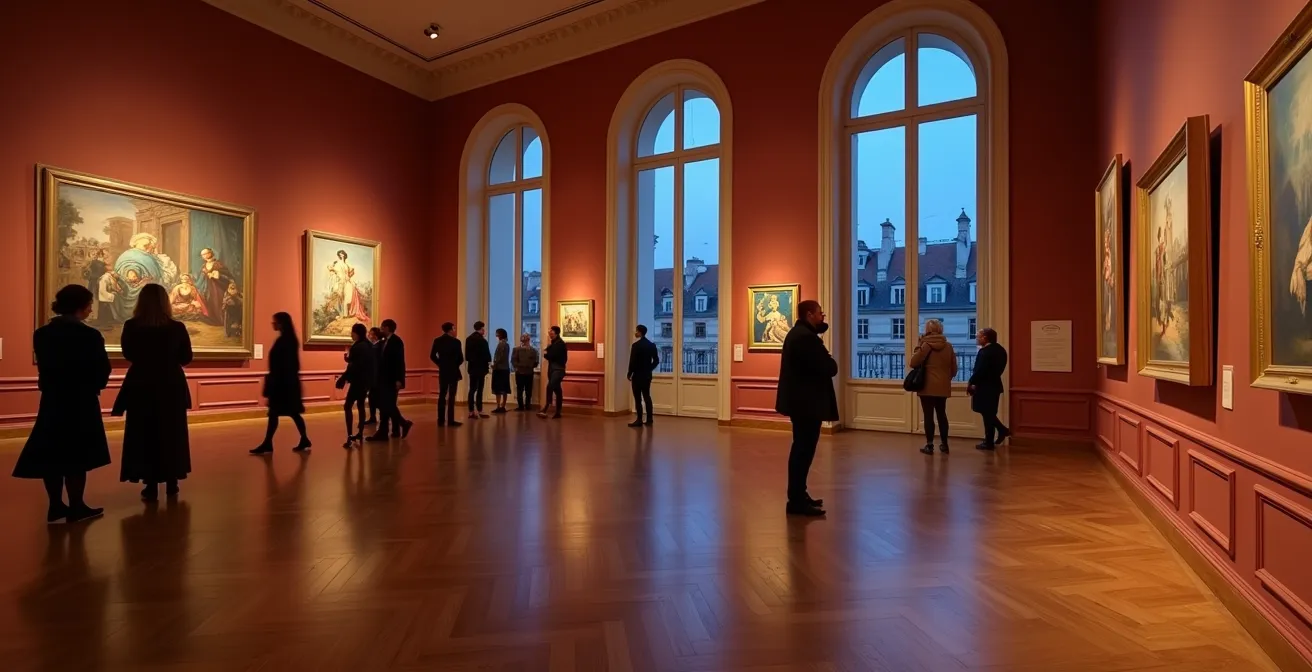
Major institutions have specific evenings they stay open late. The Louvre, for example, is open until 9:45 PM on Fridays. After 6 PM, the large tour groups have departed, and the atmosphere in the galleries transforms. Similarly, the Musée d’Orsay offers a Thursday nocturne until 9:45 PM, with a reduced entry fee for those arriving after 6 PM. These aren’t just extended hours; they are a different, more sophisticated way to experience art. The warm gallery lighting and quieter halls allow for a deeper connection with the works.
Booking a nocturne slot is often easier because demand is lower than for peak daytime slots. This makes it a prime strategy for sold-out exhibitions. If daytime tickets are gone, check for evening availability. The experience is not just about seeing the art; it’s about the context. Viewing the glass pyramid of the Louvre lit up against the night sky or seeing Paris from the rooftop of the Centre Pompidou at dusk adds a layer of magic that a daytime visit simply can’t match. Smart visitors don’t just go to museums; they strategically choose when to go.
Grand Palais Éphémère: What You Need to Know About Security and Bag Size?
Successfully entering a major Parisian venue like the Grand Palais Éphémère isn’t just about having a ticket; it’s also about navigating the strict security measures in place. France operates under the Plan Vigipirate, a national security alert system that mandates rigorous safety protocols at all public institutions. For a visitor, this translates into mandatory bag checks and, crucially, firm restrictions on bag size. Being turned away at the entrance because your backpack is too large is a frustrating and entirely avoidable scenario.
As a rule of thumb, most Parisian museums restrict bags to the size of standard cabin luggage, approximately 55x35x20cm. Anything larger, including big backpacks, hiking bags, or large shopping bags, will likely be refused entry or must be checked into a cloakroom (vestiaire). However, cloakrooms can have long queues and may be full during peak times, so relying on them is a gamble. The best strategy is to travel light. A small handbag or a compact daypack is your safest bet.
It’s also essential to know what’s inside your bag. Prohibited items typically include sharp objects, large umbrellas, and tripods. While single-use plastic bottles are often forbidden to reduce waste, a reusable water bottle (a gourde) is usually permitted. When taking photos, which is generally allowed without flash, ensure your camera’s flash is deactivated beforehand to avoid any issues with security staff. Understanding and respecting these rules is not just about compliance; it’s about ensuring a smooth and stress-free start to your visit.
Bourse de Commerce or Louis Vuitton Foundation: Which One to Prioritize for Modern Art?
For lovers of contemporary art, Paris offers two monumental, privately-owned institutions: the Bourse de Commerce (Pinault Collection) and the Fondation Louis Vuitton. While both are architectural marvels showcasing world-class art, they offer vastly different experiences. Choosing which one to prioritize depends entirely on your taste, your itinerary, and what you seek from a museum visit. The decision is less about which is “better” and more about which is the right fit for you.
The Bourse de Commerce, located in the heart of Paris, is an experience of architectural fusion. Tadao Ando’s masterful concrete cylinder inserted within the historic rotunda creates a powerful dialogue between past and present. The art itself, from the François Pinault collection, often leans towards the radical, political, and “gritty” side of contemporary practice. Its central location makes it easy to integrate into a day of exploring Les Halles or Le Marais.
In contrast, the Fondation Louis Vuitton is a destination in itself. Frank Gehry’s stunning glass “sails” rise out of the Bois de Boulogne, requiring a dedicated trip. The experience is one of monumental scale, both in architecture and art. The collection often features blue-chip, “polished” contemporary masters and large-scale installations. The panoramic rooftop views of Paris are a significant part of its appeal, making it a half-day affair. As this comparative overview of Parisian museums suggests, the choice is between central grit and destination glamour.
| Aspect | Bourse de Commerce (Pinault) | Foundation Louis Vuitton |
|---|---|---|
| Architecture | Tadao Ando’s concrete cylinder in historic rotunda | Frank Gehry’s glass sails design |
| Collection Style | Radical, political, ‘gritty’ contemporary art | Monumental, blue-chip, ‘polished’ works |
| Location | Central Paris (Les Halles) – easy walking access | Bois de Boulogne – dedicated trip needed |
| Photo Opportunities | Interior shots of Ando’s concrete masterpiece | Panoramic rooftop views of Paris |
| Visit Duration | 2-3 hours typical | Half-day destination experience |
Key Takeaways
- Ticket availability is not static; it operates on a predictable rhythm of releases you can anticipate.
- Museum passes offer more than just entry; they provide strategic advantages like priority access that save invaluable time.
- Choosing an exhibition involves weighing the hype against the “opportunity cost” of your time spent in a queue.
King’s Private Apartments: What Do You See That Regular Tourists Don’t?
A standard ticket to the Palace of Versailles grants you access to the grand, public-facing spaces like the Hall of Mirrors. But to truly understand the life of the monarchy, you must go behind the scenes. The “King’s Private Apartments” guided tour is the key to unlocking this hidden world. It reveals the more intimate, human-scale rooms where Louis XV and Louis XVI actually lived, worked, and governed, far from the performative pomp of the State Apartments.
This exclusive access, often requiring a separate booking even for pass holders, offers a tangible sense of the palace’s secret geography. According to first-hand visitor experiences, the tour takes you through a series of stunningly decorated rooms, including the King’s personal library and the exquisite “salle à manger des retours de chasse” (the post-hunt dining room). You’ll be led through hidden doors and secret corridors that connected the king’s private life to his public duties, seeing the palace as an intricate machine rather than just a gilded shell.
Is this exclusive tour for everyone? Not necessarily. As one expert from a Versailles Special Tours Review aptly puts it, this experience is “A must for history buffs, skippable for first-timers on a budget.” For those with a deep interest in French history and the daily life of its monarchs, it provides unparalleled insight. For a first-time visitor on a tight schedule, the grandeur of the main palace might be sufficient. This tour is the difference between seeing the public mask and getting a glimpse of the private face of Versailles.
How to Enter a Marais Gallery Without Feeling Intimidated by the Bell?
Exploring the contemporary art scene in Le Marais is a quintessential Parisian experience, but it can be intimidating. Unlike a public museum, many top galleries have closed doors and a doorbell (sonnette). This isn’t a barrier to keep you out; it’s for security and to maintain a serene atmosphere. The key to entering confidently is understanding and participating in the “Politeness Protocol,” a simple but crucial social ritual.
The interaction begins the moment you ring the bell. Do it with confidence. When the door buzzes open, step inside and immediately make eye contact with the gallerist, offering a clear and polite “Bonjour, Monsieur” or “Bonjour, Madame.” This simple greeting is non-negotiable; it signals respect and instantly changes the dynamic from that of a random intruder to a welcome visitor. You’ve acknowledged their space, and they will, in turn, acknowledge you.
You don’t need to be an art expert. Simple phrases show genuine interest. You can say, “Je peux jeter un coup d’œil?” (Can I have a look around?). If a piece catches your eye, asking “C’est quel artiste?” (Which artist is this?) is a perfect way to start a conversation. When you’re ready to leave, the ritual must be completed. A warm “Merci, au revoir” is essential. This adherence to politeness is what separates a tourist from someone who appreciates the local culture. By mastering this simple etiquette, you unlock access not just to the art, but to a more authentic Parisian experience.
Action Plan: Your Marais Gallery Etiquette Checklist
- Entry Protocol: Ring the doorbell confidently and greet with “Bonjour, Monsieur/Madame” upon entering to establish a respectful tone.
- Show Interest: Use a simple phrase like “Je peux jeter un coup d’œil?” to ask for permission to look around.
- Engage Simply: Ask “C’est quel artiste?” to learn more about the work without needing extensive art knowledge.
- Exit Gracefully: Always conclude your visit by saying “Merci, au revoir” to the gallerist when you leave.
- Insider Access: For future visits, sign up for gallery newsletters (like Perrotin or Thaddaeus Ropac) to get invitations to openings (vernissages), often with complimentary wine.