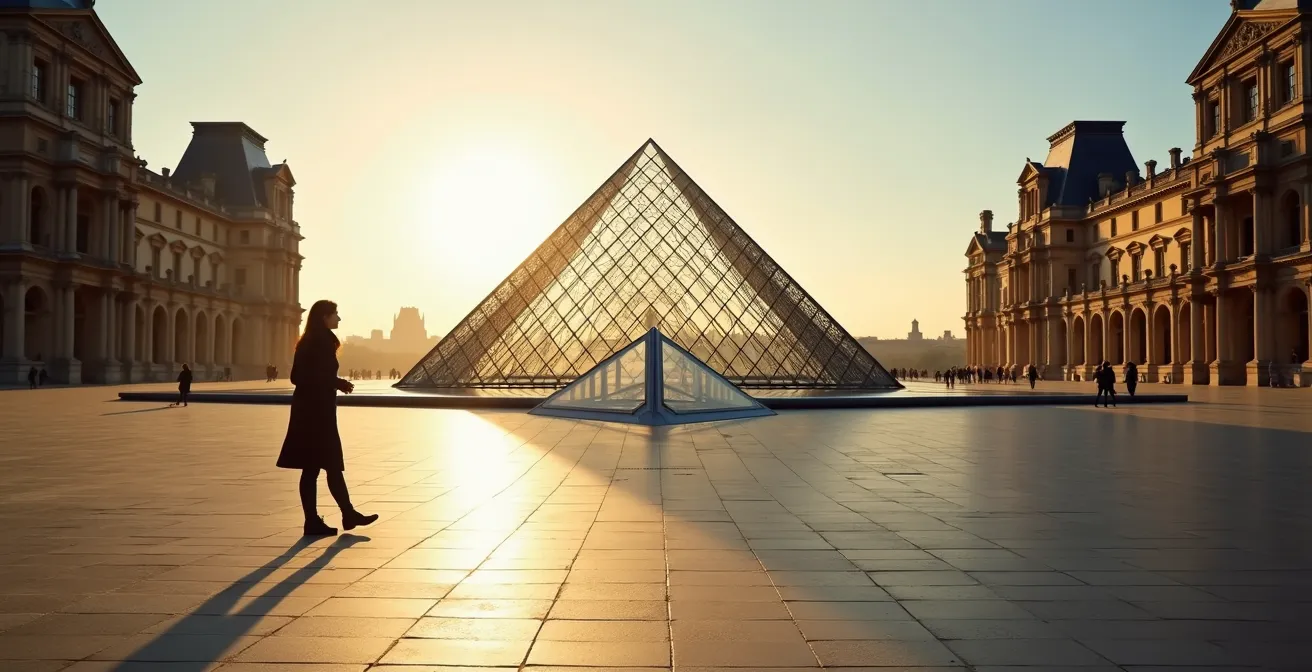
The key to seeing the Mona Lisa in under 30 minutes isn’t a secret pass; it’s exploiting the museum’s own design flaws and crowd-control patterns from an insider’s perspective.
- Utilize overlooked entrances like the Porte des Lions or Carrousel based on real-time queue length, not outdated advice.
- Leverage hidden elevators and service-adjacent staircases that 99% of visitors walk right past.
- Execute your visit like a surgical strike during “operational blindspots,” such as Friday nights, to bypass the main human current.
Recommendation: Treat your visit as a “heist.” Your goal is the prize—the Mona Lisa—not a leisurely stroll. Follow this plan, and you’ll be out before others have even found the Denon wing.
Alright, listen up. I spent years in a blue uniform watching thousands of people make the same mistakes every single day. They treat the Louvre like a normal museum. It’s not. It’s a palace, a fortress, and a beautifully designed labyrinth meant to swallow you whole. The official signs? They’re for tourists. They lead you along the “human current,” a slow-moving river of bodies shuffling towards the same overcrowded rooms. Every guide tells you to “buy tickets online” and “arrive early.” That’s not a strategy; that’s the bare minimum. You still end up in a two-hour-long human traffic jam inside.
The real secret, the one my old colleagues would hate me for sharing, is that the Louvre’s size and complexity are its greatest weaknesses. You just have to know how to exploit them. This isn’t about being rude or cutting in line. It’s about thinking like the staff. It’s about knowing the building’s pulse, its hidden arteries, and the operational blindspots that open up for those in the know. Forget what you’ve read in travel blogs. You’re about to learn the operational manual they don’t hand out at the door.
We’re going to treat this like a mission, a clean and quiet operation I call “The 30-Minute Heist.” It’s a surgical strike with one objective: get you in front of that enigmatic smile and back out before the crowds even know you were there. We’ll cover which entrance is a decoy and which is your real access point, how to navigate the wings like a pro, and why your water bottle could be a rookie mistake. This plan is your key to conquering the world’s biggest museum.
This guide will break down the exact, step-by-step strategy for your mission. Each section reveals a different piece of the puzzle, from choosing the right entry point to finding secret rest areas and even knowing when to abort and choose a different museum entirely.
Summary: A Former Guard’s Playbook for the Louvre
- Pyramid vs Carrousel: Which Entrance Has the Shortest Security Line at 9 AM?
- The Denon Wing Strategy: How to Avoid Getting Lost in Egyptian Antiquities?
- Where are the Secret Quiet Benches in the Richelieu Wing to Rest?
- The Water Bottle Mistake That Forces You to Buy Expensive Museum Water
- Why the Friday Night Slot Is the Best Secret for Avoiding School Groups?
- The Hidden Elevator at the Louvre: How to Avoid the Spiral Staircase?
- The 3 Egyptian Artifacts That Will Fascinate a 10-Year-Old (Not Just Mummies)
- Why Musée d’Orsay Is Often Preferred Over the Louvre by First-Time Visitors?
Pyramid vs Carrousel: Which Entrance Has the Shortest Security Line at 9 AM?
Your mission begins before you even see the glass Pyramid. This is your first test. Everyone flocks to the main Pyramid entrance because it’s iconic. It’s a trap. On a typical morning, that line is already a 45-minute commitment by 8:45 AM. With the museum’s new 30,000 daily visitor cap, every minute counts. The museum authorities want to channel the flow, but we’re going to bypass the main channel.
Your primary target should be the Carrousel du Louvre entrance, accessible via the underground shopping mall at 99 Rue de Rivoli or directly from the Palais Royal-Musée du Louvre metro station (Line 1). It’s weather-protected, and the security lines are serviced with the same efficiency but with a fraction of the crowd. Here’s the insider rule: if you arrive and see the Pyramid line snaking past the main fountain, don’t even hesitate. Immediately divert to the Carrousel. Your secondary, and often best, option is the Porte des Lions entrance. It’s the least known and sometimes opens for individuals, but its availability is erratic. You must check the official Louvre site on the day of your visit to see if it’s open. Using it is like finding an open side door to a fortress.
Don’t just follow the herd. Assess the situation in real-time. The difference between the Pyramid and Carrousel can be a 30-minute head start. That’s your entire mission time. Choosing the right door isn’t just a suggestion; it’s the critical first step of the heist.
The Denon Wing Strategy: How to Avoid Getting Lost in Egyptian Antiquities?
Once you’re past security, the next battle is navigation. The Louvre is composed of three wings: Richelieu, Sully, and your target, Denon. This is where the Mona Lisa is housed. The signs will point you toward the Denon wing, but they will lead you on a scenic route designed to disperse crowds through other exhibits, like the vast Egyptian antiquities. This is where most visitors get lost in a sea of sarcophagi. We won’t make that mistake.
Your goal is to get to the first floor of the Denon wing as directly as possible. After the ticket scan under the Pyramid, ignore the main flow of people heading towards the Sully wing (the big castle foundations). Instead, look for signs for “Peintures Italiennes.” This is your North Star. You’re heading for the Daru Staircase, crowned by the majestic Winged Victory of Samothrace. This monumental staircase is your gateway. Many tourists stop here for photos; you will not. Ascend with purpose.
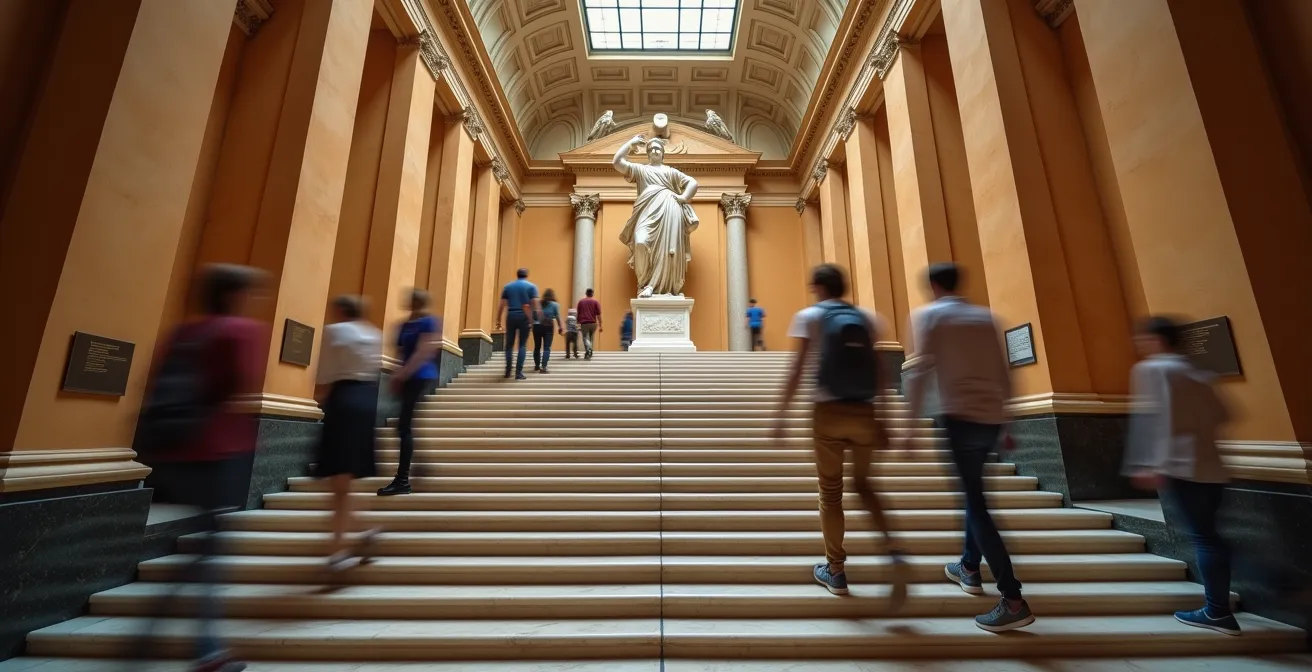
At the top of the stairs, you are moments away. The Mona Lisa is in Room 711, the Salle des États. They renovated this room specifically to manage the human current, placing the painting in a climate-controlled box and using the massive Wedding Feast at Cana opposite it to draw some of the crowd away. Use their system against them. Don’t get distracted. Head straight for the queue in front of the small painting in the glass box. You’ve arrived.
Where are the Secret Quiet Benches in the Richelieu Wing to Rest?
Let’s be realistic. Even a surgical strike can be taxing. The sheer scale of the building radiates a kind of energy that drains you. The museum calls it “museum fatigue.” I call it getting defeated by the architecture. Most people collapse on the benches in the main hallways, surrounded by noise and crowds. That’s not rest; it’s just a pause in the chaos. If you need a moment to regroup, or if a member of your party needs a genuine break, you need to know where the hidden pockets of silence are.
The best-kept secrets for tranquility are not in the busy Denon or Sully wings. They are in the Richelieu wing, the one most people ignore on their B-line to the Mona Lisa. This is your sanctuary. Specifically, you are looking for the two covered courtyards filled with French sculptures: the Cour Marly and the Cour Puget. They are covered by magnificent glass roofs, flooding the space with natural light and, most importantly, dampening the sound. You’ll find art students sketching and a peace that feels a world away from the shuffling crowds.
The following intel breaks down the best spots to find a moment of peace, far from the tourist highways. As an insider, this is the kind of information that separates a frantic visit from a strategic one, based on what analysis from seasoned museum-goers reveals.
| Location | Crowd Level | Best Features | Nearby Attractions |
|---|---|---|---|
| Cour Marly | Very Low | Glass roof, natural light, sound-dampening | French sculptures, art student sketching spots |
| Cour Puget | Low | Spacious courtyard, 17th-18th century sculptures | Napoleon III Apartments (steps away) |
| Mezzanine benches | Minimal | Overhead viewing angle, completely hidden | Bird’s eye view of courtyards |
These are not just benches; they are strategic outposts. Use them to check your map, have a quiet word, or simply let the grandeur of the palace sink in without the pressure of the human current at your back.
The Water Bottle Mistake That Forces You to Buy Expensive Museum Water
This is a rookie mistake, but I saw it happen hundreds of times a day. People get thirsty. They bring a disposable plastic water bottle, get to security, and are forced to throw it away. Now they’re inside for the next 3-4 hours, a captive audience for the museum’s cafes. And believe me, they know it. The price for hydration is steep.
Inside, you’re looking at a serious mark-up. For instance, insider tips reveal that water bottles inside the Louvre cost around €4 for a small 50cl bottle. For a family of four, that’s €16 for a single round of water. It’s a small detail, but it’s an unnecessary cost and a major annoyance. It breaks your focus and forces you into another queue for a cafe.
The solution is simple, but it requires planning. You cannot bring disposable plastic. But you absolutely can, and should, bring an empty, non-glass reusable bottle. Metal or hard plastic is perfect. Once you’re past security, there are free water fountains located near the main restrooms, especially under the Pyramid. You fill up, and you’re independent for the rest of your visit. This simple trick saves you money, time, and the frustration of being exploited.
My Hydration Heist Plan
- Bring an empty reusable bottle (metal or hard plastic, never glass).
- Declare it at security; they will see it is empty and let it through.
- Fill your bottle at the free fountains located near the main restrooms under the Pyramid immediately after entry.
- Pack a small, non-messy piece of fruit like an apple for energy; eating is only permitted in designated areas like the central rotunda.
- By following this plan, you can save €8-12 per person and avoid unnecessary queuing at cafes.
Why the Friday Night Slot Is the Best Secret for Avoiding School Groups?
If you have any flexibility in your schedule, this is the single most valuable piece of intelligence I can give you. Forget Wednesdays (when French schools are often out) and avoid weekends like the plague. The ultimate operational blindspot in the Louvre’s schedule is the Friday “nocturne,” or night opening.
Every Friday, the Louvre extends its hours on Friday evenings, staying open until 9:45 PM. By 6:00 PM, the dynamic of the museum completely changes. The massive tour groups have departed for dinner. The school groups, your greatest enemy in the fight for space, are gone. The museum is quieter, the crowds are thinner, and the demographic shifts to locals, students, and couples on dates. The atmosphere is transformed.
The harsh daytime light is replaced by the soft, warm glow of the palace’s lighting, and the art takes on a different character. It’s a completely different experience. As Paris-based author Oliver Gee notes in his guide, this is when the museum truly shines.
The Friday ‘nocturne’ feels less like a tourist attraction and more like a sophisticated Parisian social event.
– Oliver Gee, The Earful Tower Paris Guide
For your 30-minute Mona Lisa heist, a Friday evening visit is like playing on easy mode. The lines are shorter, the hallways are clearer, and the final approach to the Salle des États is significantly less congested. You can execute the plan with half the stress. If you want to see the Mona Lisa and actually enjoy the experience, this is the time to do it.
The Hidden Elevator at the Louvre: How to Avoid the Spiral Staircase?
This is a top-tier secret, a piece of infrastructure hidden in plain sight. After you enter and scan your ticket under the Pyramid, you’ll see the main spiral staircase, a beautiful but often congested chokepoint. Most people will either take the stairs or queue for the escalators. You will do neither. You will use the elevator that everyone else thinks is for staff.
Look for the cylindrical glass lift right in the center of that spiral staircase. It’s there, I promise. Most visitors assume it’s private or out of service because there’s never a line. It’s not. This elevator gives you direct access to all three wings, bypassing the escalator queues entirely. Taking this lift is your fast track to the main floor, putting you several minutes ahead of the pack. It’s the ultimate shortcut to begin your journey to the Denon wing.
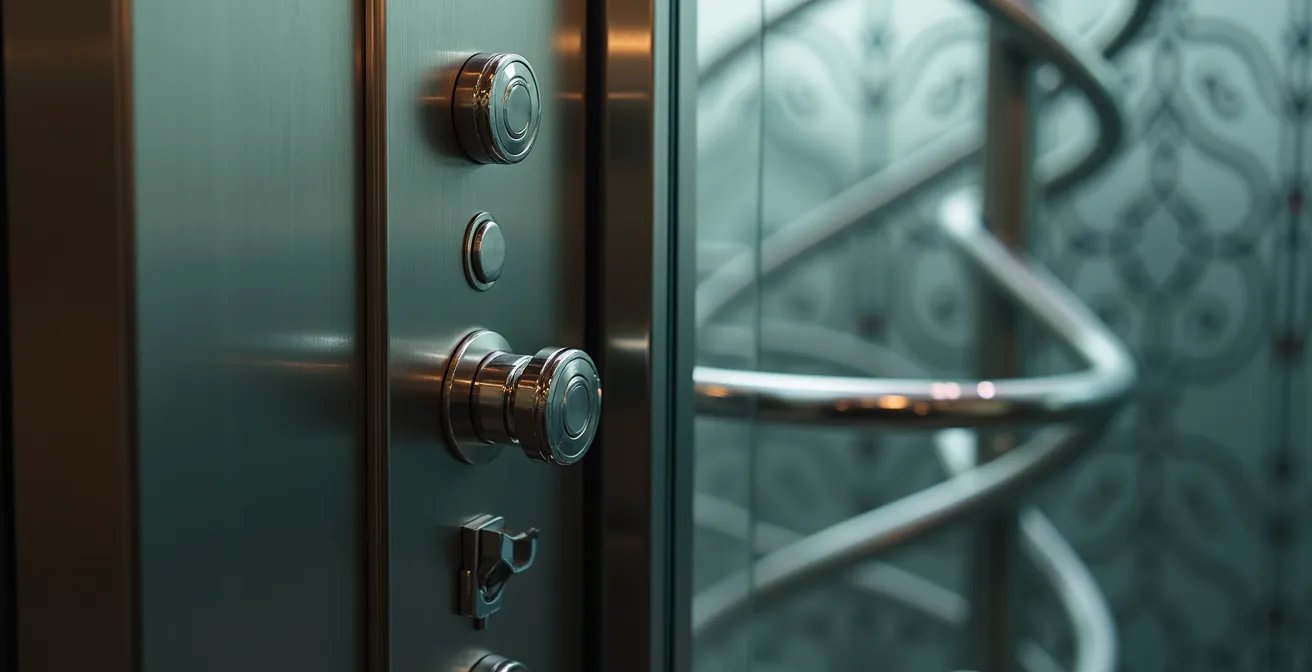
But there’s more. Once you’re in the wings, especially after a long walk, you’ll encounter grand staircases that sap your energy. For your exit from the Denon wing, after seeing the Mona Lisa, avoid the packed Daru Staircase on your way down. Instead, look for small signs for “Ascenseur A” (Elevator A) near the Winged Victory of Samothrace. These are small, almost hidden elevators that provide a peaceful and swift descent, dropping you back into the main hall while hundreds are still navigating the crowded stairs. Using these staff-adjacent pathways is the mark of a true Louvre strategist.
The 3 Egyptian Artifacts That Will Fascinate a 10-Year-Old (Not Just Mummies)
A chain is only as strong as its weakest link. If you’re on this mission with children, your weakest link is their attention span. A bored, whining child can sabotage the entire operation. While our primary objective is the Mona Lisa, a quick, 20-minute detour can act as a perfect “distraction mission” to keep morale high.
The Egyptian Antiquities section (Sully Wing, ground floor) is a common place to get lost, but if you go in with a plan, it can be a huge win. Forget the mummies; they’re often crowded and frankly, a bit one-note. The real treasures are the objects that tell a story. You’re going on a mini-treasure hunt for three specific items that are guaranteed to capture a child’s imagination. This turns a boring walk into an engaging game.
Your targets are the Seated Scribe, with his surprisingly realistic crystal eyes; the Great Sphinx of Tanis, a colossal stone guardian; and the four Canopic Jars that held a mummy’s organs. These artifacts are visually impressive and have fascinating backstories that are easy for a child to grasp. Frame it as a checklist they need to complete.
Your Kid’s Top-Secret Scavenger Hunt
- The Seated Scribe: Challenge them to get close enough to see his lifelike crystal eyes and the famous “belly rolls” that show he was an important man who didn’t do manual labor.
- The Canopic Jars: Find the four small, animal-headed jars. Explain that each one protected a different organ for the afterlife: stomach, lungs, intestines, and liver.
- Great Sphinx of Tanis: Locate the massive, 12-ton lion-human hybrid statue that guarded a temple. It’s one of the largest sphinxes outside of Egypt.
- Mission Time: Create a quick checklist on your phone for these three items. This targeted hunt should take no more than 45 minutes and will keep them engaged.
Key Takeaways
- The Louvre isn’t a museum; it’s a fortress. Use its architectural “flaws” like hidden elevators and secondary entrances to your advantage.
- Your biggest enemies are crowds and “museum fatigue.” Defeat them with strategic timing (Friday nights) and planned rests in quiet courtyards (Richelieu Wing).
- Success is in the details: bringing the right (reusable) water bottle and having a “distraction mission” for kids can make or break your visit.
Why Musée d’Orsay Is Often Preferred Over the Louvre by First-Time Visitors?
Now for the most controversial piece of insider advice I can offer. After all this planning for the “30-Minute Heist,” the ultimate strategy might be to call off the mission entirely. I’ve seen countless first-time visitors leave the Louvre exhausted, overwhelmed, and disappointed, feeling like they “failed” the museum. Sometimes, the smartest move is to choose a different battlefield. For many, that battlefield is the Musée d’Orsay.
The Louvre is a universal museum of history spanning 10,000 years. The d’Orsay is a focused gallery of French art from 1848 to 1914. It’s the difference between trying to read an entire encyclopedia and reading a single, brilliant chapter. Housed in a former train station, its layout is linear and intuitive. You can’t get lost in the same soul-crushing way you can in the Louvre’s three-winged palace. The risk of museum fatigue is dramatically lower, making the entire experience more manageable and, frankly, more enjoyable for non-specialists.
This isn’t about which museum has “better” art. It’s about the visitor experience. Choosing the d’Orsay for a first visit allows you to see masterpieces by Monet, Van Gogh, and Degas in a relaxed, comprehensible setting. The following comparison shows why it’s often the smarter tactical choice for those short on time or energy.
| Factor | Louvre | Musée d’Orsay |
|---|---|---|
| Size | 60,000 square meters | 16,000 square meters |
| Collection Scope | 10,000 years of world history | 1848-1914 French art focus |
| Average Visit Time | 3-6 hours | 2-3 hours |
| Layout | Palace labyrinth (3 wings) | Linear train station layout |
| Museum Fatigue Risk | Very High | Moderate |
Going to the Louvre is a rite of passage, but it doesn’t have to be your first. A successful trip to the d’Orsay can build your confidence and appetite for a future, more strategic assault on the Louvre. Don’t let ego dictate your itinerary. Acknowledging the Louvre’s challenge and choosing an alternative is not defeat; it’s the wisest strategy of all.
The choice is yours. Attempt the 30-minute heist with this insider playbook, or opt for the elegant simplicity of the Musée d’Orsay. Either way, you’ll now be visiting Paris not as a tourist, but as a strategist.