The secret to enjoying natural wine as a classic drinker is not to abandon your palate, but to learn a new ‘translation key’ for its unique language.
- Understand the difference between a desirable ‘funk’ (earth, leather) and a genuine flaw (vinegar, nail polish remover).
- Look beyond sulfites; focus on serving temperature and key French terms like ‘droit’ (straight/clean) to guide your choice.
Recommendation: Start by asking a Parisian sommelier for a ‘gouleyant’ (easy-drinking) red from Beaujolais or a ‘tendu’ (tense/acid-driven) white from the Loire to bridge the gap from classic to natural.
You’re standing in a small, effortlessly cool Parisian cave à vin. Bottles with whimsical, hand-drawn labels line the walls. The air is buzzing with a crowd that seems to know exactly what they’re doing. You, a devoted admirer of classic Bordeaux or a crisp Sancerre, feel a pang of intimidation. The world of natural wine feels alien, with its cloudy liquids and tales of flavours ranging from barnyard to kombucha. The biggest fear? Spending 30 euros on a bottle that tastes more like apple cider vinegar than the sophisticated grape expressions you’re used to.
Many guides will give you the standard, unhelpful advice: “it’s wine with nothing added,” or “just ask the sommelier.” But that doesn’t help when you don’t even know what to ask for. The common wisdom suggests hunting for specific labels or simply accepting that “funky” is part of the deal. But what if the problem isn’t the wine, but the way we’re approaching it? What if your classic palate is actually your greatest asset, once you learn how to translate it?
This guide is your translation key. We’re going to move beyond the fear of the unknown. Instead of telling you to forget what you know, we will show you how to apply your knowledge of structure, acidity, and balance to the world of low-intervention wines. We’ll decode the labels, differentiate the good funk from the bad, and give you the precise language to use so you can walk into any Parisian wine bar and order with confidence, not confusion. You will learn to identify the structural integrity you love in a classic wine, even when it’s hiding in a cloudy, vibrant bottle.
For those who prefer a visual journey, the following video offers a fun, immersive dive into the Parisian natural wine scene, perfectly complementing the practical advice in this guide. It captures the energy and passion that make this world so exciting.
This article is structured to walk you from understanding the basic characteristics of natural wine to confidently navigating a wine list and pairing your selection. Follow along to build your knowledge step-by-step.
Table of Contents: A Classic Drinker’s Guide to Parisian Natural Wine
- Why Does Your Natural Wine Smell Like a Farmyard?
- “Contains Sulphites”: How to Read the Back Label to Avoid Headaches?
- The Temperature Mistake That Turns Natural Wine into Vinegar in 24 Hours
- Chambre Noire or Septime La Cave: Which Bar is Best for Beginners?
- Orange Wine and Cheese: Which Comté Vintage Matches Best?
- Natural Wine Lists: How to Order Something That Doesn’t Taste Like Cider?
- Chinatown 13th vs Belleville: Which District Has the Best Pho?
- How to Get a Table at a Popular Parisian Bistro Without a Reservation?
Why Does Your Natural Wine Smell Like a Farmyard?
That “farmyard” or “barnyard” aroma, often described as brettanomyces (or “brett”), is one of the biggest hurdles for classic wine drinkers. In a Bordeaux, it might be considered a flaw, but in many natural wines, a controlled amount is seen as a layer of complexity. The key is learning to distinguish this “good funk” from a genuine flaw. Good funk adds notes of leather, wet earth, or mushroom, enhancing the wine’s character. It speaks of minimal intervention and a connection to the terroir.
However, this is a slippery slope. When these characteristics dominate or turn unpleasant, the wine is flawed. An aroma of nail polish remover points to excessive volatile acidity (ethyl acetate), while a strong vinegar smell indicates the wine has been taken over by acetic acid bacteria. The most notorious flaw is “mousiness,” a bizarre aftertaste reminiscent of a mouse cage that appears on your palate seconds after swallowing, caused by a specific strain of brett or lactic acid bacteria. A well-made natural wine should be vibrant and alive, not faulty. It’s crucial to remember that even without added sulfites, the fermentation process naturally produces 10-30 mg/L of SO2, which offers some protection.
Your Actionable Checklist: Distinguishing Good Funk from Fatal Flaws
- Good Funk: Wet Earth/Mushroom. This earthy aroma often comes from minimal intervention and is a pure expression of the soil (terroir). It should be an integrated layer, not the dominant smell.
- Good Funk: Leather/Barnyard. In small, controlled amounts, ‘brett’ can add a savoury, leathery complexity that many connoisseurs seek out, especially in reds.
- Red Flag: Nail Polish Remover. A sharp, chemical smell indicates high levels of ethyl acetate, a sign of volatile acidity that has gone too far. The wine is flawed.
- Red Flag: Strong Vinegar. If the wine smells distinctly of vinegar, acetic acid bacteria have taken over. It’s on its way to becoming salad dressing.
- Red Flag: Mousiness. This is a textural, unpleasant taste that develops on your palate *after* you’ve swallowed. It is a clear and irreversible fault. If you detect it, the bottle is a write-off.
Ultimately, your personal preference is what matters most. If you dislike even a hint of barnyard, that’s perfectly valid. The goal is to identify what you’re smelling so you can articulate your preferences and find wines you genuinely enjoy.
“Contains Sulphites”: How to Read the Back Label to Avoid Headaches?
The phrase “contains sulphites” on a wine label is often misunderstood. For many, it’s a red flag for post-wine headaches. However, the reality is more complex. While a small percentage of people have a true sulfite sensitivity, the low levels in natural wine are rarely the culprit. In France, the prestigious Vin Méthode Nature certification requires less than 30mg/L of total sulfites, a tiny fraction of the 350mg/L allowed in some conventional sweet wines. So, if sulfites aren’t the main enemy, what is?
Emerging research points to other compounds. As one study highlights, the real issue may lie elsewhere. In their analysis of French organic wines, researchers Jarisch and Wantke provided a compelling alternative explanation for wine-induced headaches:
Studies suggest that histamines and biogenic amines are the actual culprits.
– Jarisch and Wantke, Agricultural and Food Economics
These compounds, which can be more prevalent in unfiltered, low-intervention wines, are known to trigger inflammatory responses in sensitive individuals. So when you read a label, instead of just fearing sulfites, see it as part of a bigger picture. A low-sulfite declaration or a natural wine certification is a clue that the wine is low-intervention. This means it may be higher in the very biogenic amines that could be causing your discomfort. The solution might not be avoiding sulfites, but moderating consumption and staying well-hydrated.
Therefore, treat the “no added sulfites” claim not as a health guarantee, but as an indicator of winemaking style. It signals a raw, “living” product that requires more careful handling, a point we will explore next.
The Temperature Mistake That Turns Natural Wine into Vinegar in 24 Hours
Natural wine is a living product. With little to no sulfites to act as a preservative, it is far more sensitive to its environment than its conventional counterpart. The single biggest mistake a new natural wine drinker can make is treating it like a sturdy, shelf-stable beverage. Leaving an opened bottle on your kitchen counter is a recipe for disaster. Research from experts confirms that wines stored at room temperature lose antioxidants about 4x faster than those kept in proper storage conditions. For a fragile natural wine, this acceleration is fatal, leading to rapid oxidation and the development of acetic acid, turning your beautiful wine into vinegar overnight.
Proper storage and serving temperature are not just suggestions; they are essential for preserving the wine’s integrity. All your natural wines, red included, should be stored in a cool, dark place, ideally around 13°C (55°F). Once opened, any unfinished bottle must be recorked and immediately placed in the refrigerator—yes, even the reds. You can always let a red warm up slightly in the glass before drinking it.
Serving temperature is just as crucial for enjoyment. Serving a natural red too warm will amplify any volatile acidity and make it taste flat and alcoholic. Serving a white or orange wine too cold will mute its delicate aromatics. Here is a practical guide for some classic French natural wine grapes:
| Wine Type | Storage Temp | Serving Temp |
|---|---|---|
| Natural Beaujolais (Gamay) | 13°C (55°F) | 13-14°C (55-58°F) |
| Loire Chenin Blanc | 13°C (55°F) | 7-10°C (45-50°F) |
| Jura Savagnin | 13°C (55°F) | 10-13°C (50-55°F) |
Think of it like fresh, unpasteurized juice. You wouldn’t leave it on the counter. Give your living wine the same respect, and it will reward you with its full, vibrant expression from the first glass to the last.
Chambre Noire or Septime La Cave: Which Bar is Best for Beginners?
Choosing your first natural wine bar in Paris can be as daunting as choosing your first bottle. The city offers a spectrum of experiences, from raucous, standing-room-only spots to more contemplative, seated venues. For a beginner, two famous names represent this divide perfectly: Chambre Noire in the 11th arrondissement and Septime La Cave, just down the street.
Chambre Noire, run by the dynamic Oliver Lomeli, is the epitome of the new wave of Parisian wine bars. It has a “dive bar energy,” with loud music, a young crowd, and a focus on radical, often challenging natural wines. The appeal here is the democratization of the experience. Prices are accessible, and the atmosphere is electric and unpretentious. However, for a beginner seeking guidance, the chaotic environment can be overwhelming. It’s a fantastic place to dive in headfirst if you’re feeling adventurous, but less ideal for a quiet, educational conversation with a sommelier.
Septime La Cave, on the other hand, is the wine bar offshoot of the Michelin-starred restaurant Septime. It’s an institution that “combines fine dining with attitude.” The space is tiny, elegant, and the selection is impeccably curated. Here, the experience is more focused and refined. While still very popular, the environment is more conducive to a conversation. The staff are accustomed to guiding diners through sophisticated pairings, and they can apply that same expertise to help a beginner navigate their list. The trade-off is a potentially more intimidating atmosphere and higher prices. It’s the better choice if your priority is expert guidance and a curated selection of top-tier producers.
For the true beginner intimidated by the scene, the verdict is nuanced: start at Septime La Cave on an off-hour (like right at opening) for a focused, educational tasting. Once you have a few producer names and styles you like, graduate to the joyous chaos of Chambre Noire to continue your exploration.
Orange Wine and Cheese: Which Comté Vintage Matches Best?
Orange wine, or skin-contact white wine, is a cornerstone of the natural wine world and a fantastic pairing partner for cheese, thanks to its unique combination of acidity, aromatics, and tannic structure. In Paris, you’ll find it on every modern wine list, and a classic pairing you must try is with Comté, the king of French mountain cheeses. But not all Comté is created equal, and choosing the right vintage is key to a sublime match.
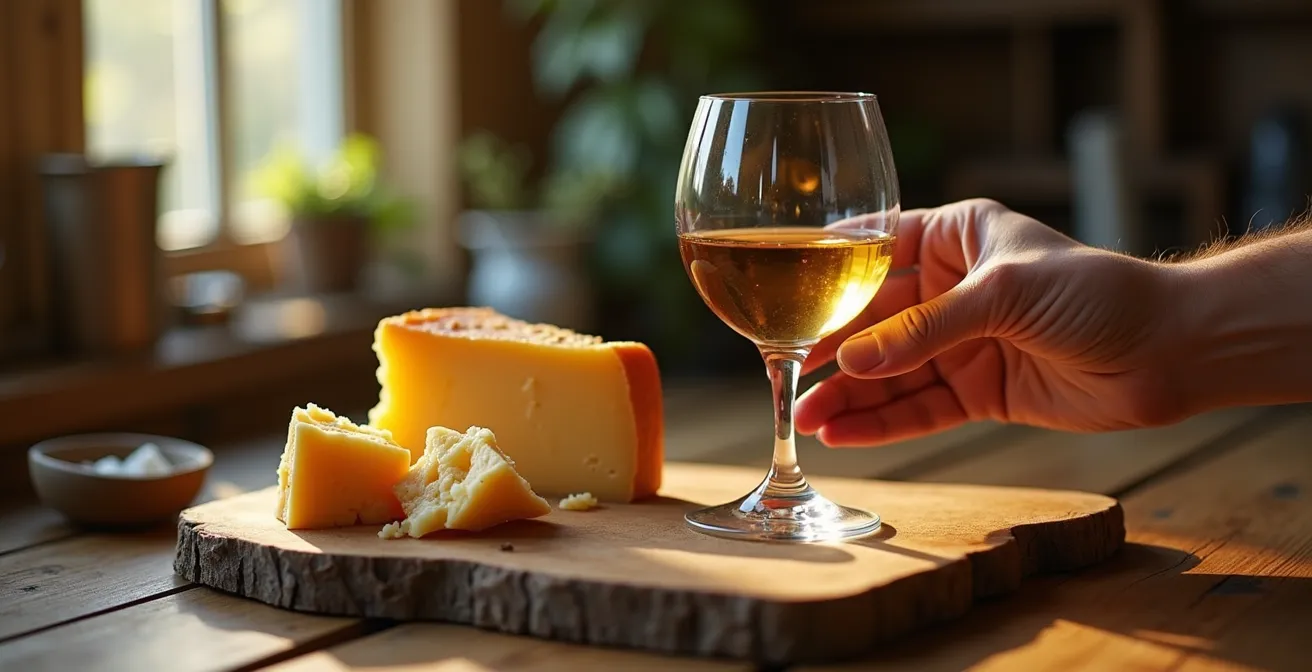
The secret lies in matching the intensity of the wine with the age of the cheese. A young, 12-month-old Comté is milky, nutty, and relatively subtle. It calls for a lighter, more aromatic orange wine. Think of a skin-contact Pinot Gris from Alsace or a Sauvignon Blanc from the Loire. These wines have bright acidity and floral notes that will complement the cheese without overpowering it.
However, an aged, 24- or 36-month-old Comté is a different beast entirely. It’s deeply savoury, crystalline with age, and bursting with notes of roasted nuts, brown butter, and broth. This powerful cheese demands an equally powerful wine. Look for a more robust, tannic orange wine, perhaps from the Jura (made with Savagnin) or Italy (Ribolla Gialla). These wines have the structure and oxidative, nutty complexity to stand up to the aged Comté, creating a conversation between equals where both the cheese and wine are elevated. The tannins in the wine cut through the fat of the cheese, cleansing the palate for the next bite.
So next time you’re at a Parisian cheese shop, don’t just ask for Comté; ask for a specific age. Then, take it to a wine bar and ask for an orange wine to match. It’s a simple, deeply satisfying exercise in terroir and taste.
Natural Wine Lists: How to Order Something That Doesn’t Taste Like Cider?
You’ve done the work: you can spot a flaw, you understand the importance of temperature, and you’ve chosen your bar. Now you face the final boss: the wine list, a chalkboard scribble of unfamiliar names and regions. This is where the fear of ordering a “cider-like” or overly funky wine is most acute. The generic advice to “talk to the sommelier” is correct, but useless if you don’t have the words. This is where your “translation key” becomes a practical tool.
Your goal is to communicate a preference for structure and cleanliness without insulting the winemaker or the sommelier. You are not asking for a conventional wine; you are asking for a specific style of natural wine. The magic lies in using the right French terminology, which signals to the sommelier that you’re an engaged and curious drinker, not a difficult customer. This is a strategy used by insiders to get exactly what they want.
The Magic Words That Work with Parisian Sommeliers
As detailed in an exploration of Parisian wine bars, navigating a natural-leaning menu is an art. At places like La Buvette, owner Camille Fourmont is an expert at guiding customers. The key is using specific, positive descriptive words. Asking for something “un vin droit” (a straight wine) signals you want precision, good acidity, and minimal ‘funk’. Requesting a wine that is “gouleyant” (easy-drinking or gluggable) is perfect for reds, indicating you’d like something fruity, fresh, and low in tannin, like a good Beaujolais. These terms are respectful and, as the experts at Punch confirm, they help you state a preference for cleaner styles without offending the sommelier’s expertise.
Other useful terms include “tendu” (tense, for a white with high acidity and minerality) or “sur le fruit” (on the fruit, for a wine where fruit character is the star). Conversely, if you want to be clear about what you *don’t* want, you can say you’re looking for something with “pas trop de volatilité” (not too much volatile acidity). This is a precise and knowledgeable way to say “nothing that smells like vinegar.”
By using this language, you transform the interaction. You are no longer a passive recipient of whatever is poured; you are an active participant in a conversation, using your newfound knowledge to guide the expert towards a bottle you will truly love.
Chinatown 13th vs Belleville: Which District Has the Best Pho?
The quest for authenticity in Paris isn’t limited to wine. Just as a connoisseur of Vietnamese cuisine knows the subtle differences between neighborhoods, a budding natural wine enthusiast must learn to navigate different terroirs and philosophies. Before we return to wine, let’s take a brief but relevant detour into another of Paris’s great sensory debates: where to find the best bowl of pho.
The city’s two main hubs for Vietnamese food, the 13th arrondissement’s Chinatown and the vibrant Belleville neighborhood, offer two distinct approaches to this classic dish. The 13th is home to the old guard, with institutions like Pho 14 and Le Kok serving deeply traditional, southern-style pho. The broths are rich, clear, and simmered for hours, the recipes honed over decades. It’s the benchmark, the “classic” expression that purists often seek. You go here for consistency and a taste of history.
Belleville, by contrast, represents a more modern, eclectic scene. While you’ll still find excellent traditional pho, the neighborhood is also home to newer spots that might play with the formula, offering different cuts of meat or more creative garnishes. The energy is more dynamic, a melting pot of cultures that is reflected in the food. You might go to Belleville for a pho that surprises you, that offers a slightly different perspective on the classic. It is less about a single “best” and more about finding a version that suits a particular mood.
This same discernment—knowing whether you’re in the mood for the ‘classic’ 13th or the ‘creative’ Belleville—is the key to choosing a natural wine. Are you seeking a clean, precise, and traditional expression (a “vin droit”), or are you ready for something more experimental and wild? Knowing your own palate is the first step.
Key Takeaways
- Trust Your Palate: Don’t dismiss your classic wine knowledge. Use it to identify structure, acid, and balance, even in natural wines.
- Learn the Language of Funk: Distinguish between “good funk” (earth, leather) that adds complexity and clear flaws (vinegar, mouse) that make a wine undrinkable.
- Temperature is Non-Negotiable: Natural wine is a living product. Store all bottles cool, and always refrigerate an open bottle, even red.
- Use the “Magic Words”: Communicate with sommeliers using specific French terms like “droit” (straight/clean) or “gouleyant” (easy-drinking) to get what you want.
How to Get a Table at a Popular Parisian Bistro Without a Reservation?
You’ve braved the wine list and found a bottle that speaks to you. But in Paris, the challenge is often getting the table in the first place. Navigating the city’s bustling bistro and wine bar scene without a reservation requires its own set of insider strategies, especially for popular spots like Septime La Cave, La Buvette, or Clamato.
First and foremost, timing is everything. Parisians dine late. Most bistros don’t get busy until 8:30 PM. Your best bet is to arrive either very early, right at opening (usually 7:00 or 7:30 PM), or to try your luck for a second seating, after 9:30 PM. Showing up at the peak hour of 8:00 PM is almost a guaranteed failure. Second, be flexible. Be willing to sit “au comptoir” (at the bar). It’s often the best seat in the house, offering a front-row view of the action and a more direct line to the bartender or sommelier. Many places keep bar seats open specifically for walk-ins.
Third, go in small groups. A party of two has a much higher chance of being squeezed in than a group of four or more. Finally, always have a backup plan. If you’re trying for a famous spot in the 11th arrondissement, have two or three other nearby bars mapped out. The beauty of Paris is that for every “impossible” table, there’s a fantastic, lesser-known gem just around the corner waiting to be discovered. This strategy turns potential disappointment into an opportunity for exploration.
With your table secured, you can now confidently turn your attention back to the carte des vins, ready to apply your new knowledge. The final step is to put it all into practice and begin your own Parisian wine adventure.