
In summary:
- Adopt a consultant’s mindset: audit menus, queues, and products for clear signals of quality versus tourist-focused traps.
- Apply the “Two-Street Rule”: walk at least two blocks off the main avenue to find authentic, better-value dining.
- Identify true exclusivity: differentiate between mass-market items and genuinely store-exclusive products or experiences.
- Use official sources for tickets (monuments, exhibitions) to bypass secondary queues and avoid inflated prices.
The Champs-Élysées. The name itself evokes images of Parisian glamour, luxury shopping, and triumphant arches. Millions are drawn to its splendor, but beneath the glittering facade lies a minefield of tourist traps, overpriced goods, and sophisticated scams. Many guides will offer generic warnings: watch your wallet, avoid street artists, and expect high prices. This is basic knowledge, but it’s purely defensive. It leaves you feeling anxious, not empowered.
The real challenge isn’t just avoiding the bad, but actively finding the good. The common advice doesn’t teach you the methodology to distinguish a genuine artisanal product from an industrial fake, or a charming bistro from a predatory tourist restaurant. It doesn’t explain the underlying economics of a two-hour queue for a handbag or the strategies to access cultural gems hidden in plain sight. This is where we shift from a tourist’s mindset to that of a professional auditor.
This guide provides a different perspective. Forget vague warnings. We will equip you with a consultant’s framework for vigilance and quality assessment. You will learn to read the subtle signals that separate authenticity from artifice. We’ll analyze everything from the font on a menu to the inventory in a flagship store, transforming your visit from a gamble into a calculated, rewarding experience. It’s time to trade vulnerability for savvy and walk the world’s most beautiful avenue with the confidence of an insider.
This article provides a detailed framework for navigating the most famous avenue in the world. Discover how to apply a critical eye to everything from dining and shopping to cultural outings, ensuring your Parisian experience is memorable for all the right reasons.
Summary: A Consultant’s Field Guide to the Champs-Élysées
- The 50€ Pizza: How to Spot a Predatory Menu on the Avenue?
- Louis Vuitton Queue: What Time to Arrive to Avoid Waiting 2 Hours?
- What Can You Buy at the PSG Store That Isn’t Sold Online?
- Paris Respire: When Can You Walk in the Middle of the Avenue?
- The Underpass: How to Cross to the Arc de Triomphe Safely?
- The “Artisanal” Jam Scam: How to Spot Industrial Sugar Bombs in Montmartre?
- The Hidden Tea Salon in the Petit Palais: How to Skip the Line?
- How to Secure Tickets for Sold-Out Blockbuster Exhibitions in Paris?
The 50€ Pizza: How to Spot a Predatory Menu on the Avenue?
The first rule of tactical dining in a high-density tourist area is to recognize that most restaurants on the main thoroughfare are not selling food; they are selling convenience and a view. Their business model relies on a constant stream of unsuspecting visitors, not repeat local customers. This means quality is often secondary to turnover. To avoid a culinary and financial disaster, you must learn to audit a restaurant’s signals before you even sit down. Look for aggressive “pushers” on the sidewalk trying to lure you in, or menus with glossy photos and exclusively English translations – these are major red flags.
A legitimate French establishment is legally required to display its prices clearly, including the crucial phrase ‘prix nets, service compris’ (prices net, service included). Any ambiguity here is a warning. Instead of falling for the first convenient terrace, apply the “Two-Street Rule”: walk at least two blocks away from the main avenue. This simple act of detour is often all it takes to find authentic, family-run bistros where the focus is on quality ingredients and local clientele. This is where you’ll find the Paris you were looking for.
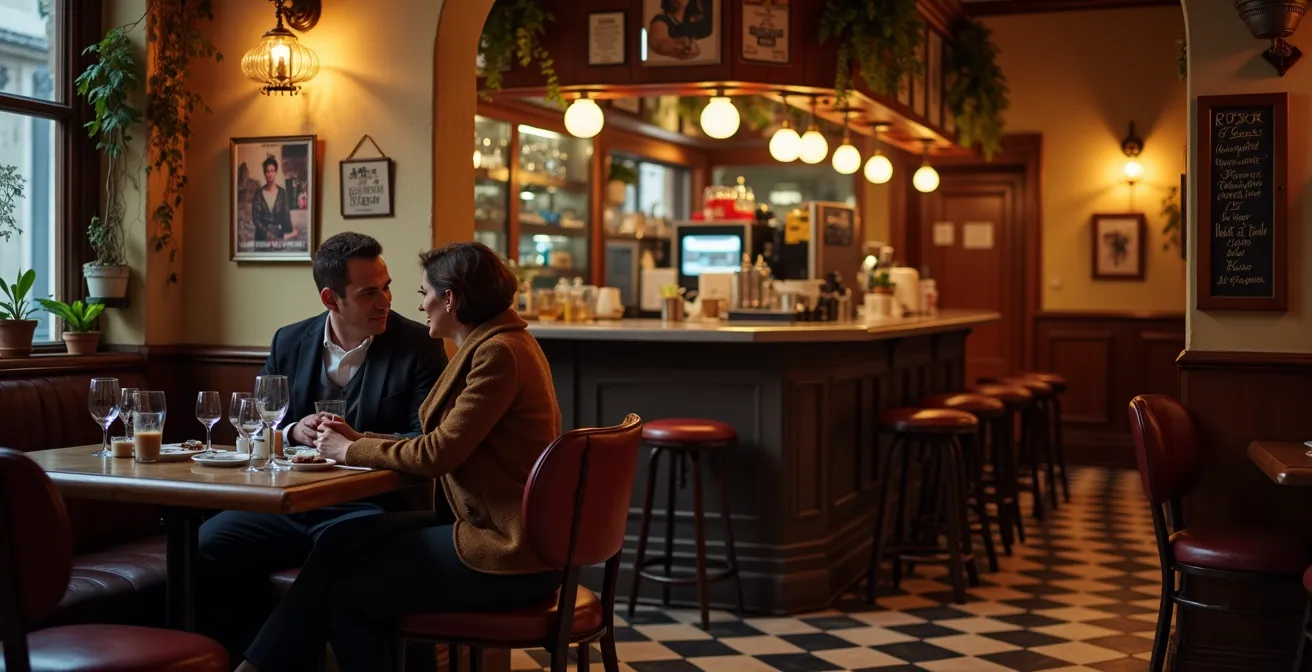
The atmosphere in the image above—warm, intimate, and unpretentious—is the reward for applying this simple filter. When you do find a promising spot, perform one final check: ask for ‘une carafe d’eau’ (a carafe of tap water). It’s free and a standard request. If the waiter pushes for expensive bottled water, you have your final confirmation that you’re in a place designed to extract maximum cash from tourists.
Your Checklist: Avoiding Tourist Trap Restaurants
- Sidewalk Pushers: Does the restaurant employ staff on the street to beckon you in? Legitimate places don’t need to beg.
- Menu Signals: Is the menu a laminated book with photos and only in English? This is a strong sign it’s not for locals.
- Price Transparency: Does the displayed menu clearly state ‘prix nets, service compris’? This is a legal requirement.
- The “Two-Street Rule”: Have you walked at least two blocks away from the main avenue? This is your best filter for authenticity.
- Water Test: When you order, do they accept your request for ‘une carafe d’eau’ or push bottled water? This reveals their priorities.
Louis Vuitton Queue: What Time to Arrive to Avoid Waiting 2 Hours?
The infamous queue outside luxury flagships on the Champs-Élysées isn’t just a line; it’s a meticulously managed part of the brand experience and a direct consequence of the area’s brutal real estate economics. Understanding this changes your strategy from one of passive waiting to active planning. With an average rent of €11,414 per square meter per year, every inch of these stores is a high-cost asset. The queue, visible to thousands of passersby, acts as a powerful marketing tool, signaling immense demand and exclusivity. They have little incentive to eliminate it entirely.
Therefore, “beating the queue” is not about finding a secret entrance, but about strategic timing. The goal is to avoid peak tourist traffic. Your best window is on a weekday morning, precisely at opening time (usually 10 AM) or even 15 minutes before. This allows you to be among the first cohort of customers admitted. The second, albeit less reliable, window is the “pre-closing lull” between 6:30 PM and 7:30 PM, when daytime shoppers have left and evening crowds have not yet arrived. Avoid weekends, public holidays, and the entire 1 PM to 5 PM period at all costs.
Consider the alternative: book a private appointment. Many luxury houses offer this service through their website or by calling the store directly. While it requires advance planning and often a stated purchase interest, it is the only guaranteed way to have a zero-wait, personalized experience. It transforms the transaction from a frustrating wait into an exclusive service, which is the ultimate luxury you’re paying for. Your time is valuable; treat it as such.
What Can You Buy at the PSG Store That Isn’t Sold Online?
The Paris Saint-Germain flagship on the Champs-Élysées is more than a retail outlet; it’s a brand embassy. While the online store offers a vast range of products, the physical store’s value proposition lies in exclusivity and experience. A savvy shopper understands that the goal isn’t to buy something you could have shipped to your home, but to acquire something that serves as a tangible marker of your visit. The key is to know what to look for.
The primary categories of in-store exclusives are customization, limited editions, and memorabilia. The online store offers standard name and number printing on jerseys, but the flagship often provides special character sets or unique patch placements unavailable elsewhere. More importantly, the store serves as the launchpad for collaborations and “Paris” branded lines that may either be store-exclusive or released there weeks before they appear online, if at all. This is where the real value lies for a collector.
However, the pinnacle of exclusivity is the memorabilia. The official stores are the only places to acquire jerseys worn by players during official matches, each authenticated and carrying the story of a specific game. This is a fundamentally different class of product from a replica. The following table breaks down the crucial differences between what you can get by clicking a mouse versus walking through the door.
| Feature | Flagship Store Only | Online Available |
|---|---|---|
| Jersey Customization | Special characters, unique patch placements | Standard name/number only |
| Limited Editions | Store-exclusive ‘Paris’ branded lines | Standard PSG collections |
| Collaborations | Pre-releases, exclusive colorways | General release items only |
| Memorabilia | Match-worn authenticated jerseys | Replica items only |
Paris Respire: When Can You Walk in the Middle of the Avenue?
One of the most magical transformations of the Champs-Élysées occurs on the first Sunday of every month. Through the “Paris Respire” (Paris Breathes) initiative, the entire avenue is closed to traffic and handed over to pedestrians. This is not just a traffic closure; it’s a city-wide festival, a rare opportunity to experience the grand boulevard’s scale and architecture without the noise and danger of cars. It’s a must-do if your visit aligns, but enjoying it requires a bit of strategic planning to avoid being overwhelmed by the crowds who have the same idea.

The key to a successful Paris Respire experience is to treat it like a park, not a shopping street. While some stores remain open, the real joy comes from the freedom of movement. Arrive either early in the morning (around 10 AM) to see the avenue as it wakes up, or in the late afternoon (after 4 PM) as the crowds begin to thin. The midday peak can be as congested as a busy traffic day, defeating the purpose.
Navigating the event also requires some forethought. The surrounding metro stations, particularly Charles de Gaulle–Étoile and Franklin D. Roosevelt, become incredibly crowded. A savvy approach is to exit one or two stops before or after your intended spot and enjoy a short walk. This allows you to bypass the worst of the human traffic jams. To make the most of the day, embrace the local spirit with these practical tips:
- Verify the Date: Always check the official Mairie de Paris website before you go. The schedule can change for major public events or protests.
- Pack Accordingly: Bring a small blanket, snacks, and water. Finding a spot to sit and soak in the atmosphere is part of the experience.
- Explore Beyond: The Champs-Élysées is just one of several “Paris Respire” zones. Consider visiting the car-free areas in Le Marais or along the Canal Saint-Martin for a different, often more local, vibe.
The Underpass: How to Cross to the Arc de Triomphe Safely?
The Place Charles de Gaulle, formerly Place de l’Étoile, is one of the world’s most chaotic roundabouts. Attempting to cross it on foot is not just discouraged; it is lethally dangerous. The only sanctioned and safe way to reach the Arc de Triomphe is via the pedestrian underpass (“le passage souterrain”). However, this underpass presents its own set of challenges that require vigilance. It is a critical chokepoint for the more than 7 million tourists who visit the Champs-Élysées annually, making it a prime location for pickpockets and disorienting crowds.
Your first objective is situational awareness. The entrances to the underpass, located on the north and south sides of the avenue, are often crowded. Move with purpose and keep your valuables secured and out of sight. Once inside, you will encounter the first of two potential queues. The first is for the ticket booth. The single most effective action you can take is to buy your ticket online in advance from the official Centre des monuments nationaux website. This allows you to completely bypass this initial bottleneck and the associated risks.
After the security check, you will face the second queue: the one for the stairs or the elevator. Note that the elevator is strictly reserved for visitors with reduced mobility, pregnant individuals, or those with young children in strollers. If you qualify, do not hesitate to speak to the staff at the entrance; they will guide you. For everyone else, the 284-step climb is part of the experience. The key is patience. The queue moves steadily, and being aware of your surroundings is more important than saving thirty seconds. Treat the underpass not as a simple tunnel, but as a controlled access point that demands your full attention.
The “Artisanal” Jam Scam: How to Spot Industrial Sugar Bombs in Montmartre?
While not on the Champs-Élysées itself, the principles of spotting fakes extend to popular nearby areas like Montmartre, where the “artisanal” scam is rampant. You see a charming stall selling what appears to be homemade jam (confiture), but you’re often just buying a repackaged industrial product at a 500% markup. As a quality consultant, your job is to read the signals of true craftsmanship versus deceptive marketing. A genuine artisan is proud of their work and is legally bound by different rules.
The first and most powerful signal is the legal term ‘Fabrication Artisanale’. In France, to use this label, a producer must be registered as an artisan, implying a significant portion of the work is done by hand. The generic term ‘Made in France’ means almost nothing; a product can be mixed from foreign ingredients and bottled in a French factory and still qualify. You must actively look for ‘Fabrication Artisanale’ or the name and address of the specific confiturier (jam maker). A lack of a specific, verifiable producer is a huge red flag.

Next, audit the product itself. An artisanal jam will have a shorter shelf life, often indicated by a handwritten batch number and expiry date (usually less than a year). The ingredient list should be short and start with fruit (e.g., ‘Abricots, sucre…’), not sugar (‘Sucre, abricots…’). If you want to be certain, bypass the street stalls and visit a respected specialist like La Chambre aux Confitures or a high-end grocer like Maison Plisson. Your audit should follow these steps:
- Look for the Label: Prioritize ‘Fabrication Artisanale’ over any other claim.
- Check the Producer: A real artisan will have their name and address on the jar.
– Read the Ingredients: Fruit must be the first ingredient, not sugar. – Inspect the Dates: Look for handwritten batch numbers and a short expiry date.
The Hidden Tea Salon in the Petit Palais: How to Skip the Line?
Directly opposite the grandeur of the Grand Palais sits its stunning sibling, the Petit Palais. While crowds queue for hours and pay hefty fees for temporary exhibitions next door, a savvy strategist knows the Petit Palais holds a secret: its permanent collection and enchanting interior garden are completely free to enter, with no ticket required. The long lines you see are only for its temporary, paid exhibitions. You can simply walk past the queue, through the main entrance, and into the building.
This is the ultimate “value-per-square-meter” play. Inside, nestled within a beautiful peristyle garden, is ‘Le Jardin du Petit Palais’, a café that is arguably one of the best deals in the entire district. While tourists pay exorbitant prices for a mediocre espresso on a noisy Champs-Élysées terrace, you can enjoy a coffee or a light lunch in the tranquil garden of a historic art museum for a fraction of the cost. The contrast is not just about price; it’s about the quality of the experience.
This isn’t just a minor saving; it’s a fundamental shift in value. You are trading a loud, crowded, and overpriced experience for one that is quiet, beautiful, and culturally enriching. The table below illustrates the stark difference in what your money buys. It’s a clear demonstration of how a little insider knowledge can completely transform your afternoon.
| Item | Petit Palais Garden Café | Champs-Élysées Average | Savings |
|---|---|---|---|
| Espresso | €3 | €8 | €5 |
| Cappuccino | €4.50 | €10 | €5.50 |
| Lunch Menu | €18 | €35-50 | €17-32 |
| Setting | Historic palace garden | Street terrace | Priceless |
Key takeaways
- Always apply the “Two-Street Rule” for dining: authenticity is found just off the main tourist path.
- Audit for signals of authenticity, such as the “Fabrication Artisanale” label, over vague marketing terms.
- Your time is a currency; use online pre-booking for monuments and exhibitions to bypass queues and minimize risk.
How to Secure Tickets for Sold-Out Blockbuster Exhibitions in Paris?
The final layer of a savvy Parisian strategy is securing access to high-demand cultural events. Blockbuster exhibitions at museums like the Louvre, Musée d’Orsay, or Fondation Louis Vuitton often sell out weeks in advance. Relying on luck is not a strategy. However, a combination of digital vigilance and understanding the system’s loopholes can often yield results. Your primary goal is to avoid the unofficial, and often illegal, scalpers that prey on desperate tourists near museum entrances.
First, utilize the official, legal resale channels. France has sanctioned fan-to-fan platforms like Zepass or Reelax Tickets, where people can sell their tickets at face value. This is your safest and most ethical option. Second, master the “early morning drop.” Many museums release a small number of returned or held-back tickets on their websites each morning, typically between 8 AM and 9 AM Paris time. This requires persistence but can be highly effective. For frequent visitors, a membership card like the ‘Carte Blanche’ at the Musée d’Orsay can be cost-effective, offering unlimited, queue-free access to all exhibitions for a year.
Finally, think outside the standard timetable. Many museums offer late-night openings, or ‘nocturnes’ (e.g., until 9:45 PM at the Louvre on Fridays), which often have better availability and a more relaxed atmosphere. If all else fails, booking a spot with a licensed guided tour company can be a last resort. While more expensive, they often have pre-allocated ticket blocks, providing guaranteed access. As a final, crucial reminder from the experts:
Many attractions in Paris are closed on Mondays or Tuesdays, as well as on public holidays such as Christmas and New Year
– Tripadvisor Paris Guide, Tourist Traps to Avoid in Paris
Now that you are equipped with this consultant’s framework, you can apply this methodology of auditing, verifying, and seeking value to any travel destination. Start today by planning your next cultural outing not as a tourist, but as a strategist.