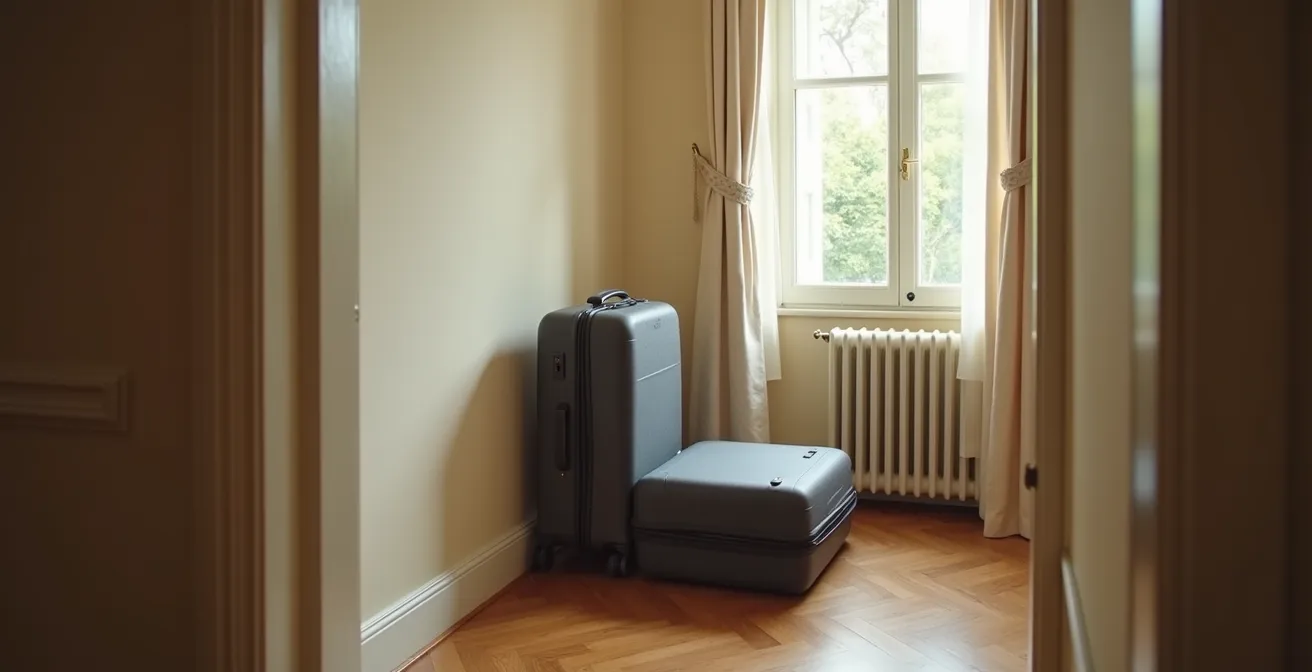
The frustration with small Parisian hotel rooms stems from a misunderstanding of their design logic, not just their size.
- Star ratings and price do not reliably guarantee more space due to strict building codes and historical constraints.
- Features like glass bathroom walls and limited A/C are intentional trade-offs for light, cost, and energy management, not oversights.
Recommendation: Shift from seeking more space to understanding the existing space. By learning to decode the room’s layout and systems, you can strategically manage your luggage and comfort, turning spatial limitations into a functional asset.
The moment of truth for many North American travelers in Paris isn’t standing before the Eiffel Tower; it’s opening their hotel room door. The initial shock of seeing a room that feels barely larger than a walk-in closet, especially when you’re wrestling with two large suitcases, is a shared rite of passage. The immediate question is often, “How can they call this a room?” followed by, “Where will my luggage go?” This spatial culture shock is rooted in deep historical and architectural realities. Most Parisian hotels, particularly in central districts, are housed in 19th-century Haussmannian buildings, where grand facades hide a maze of subdivided apartments and compact service quarters never intended for modern tourism’s spatial demands.
The common advice—”pack light” or “just be out all day”—is unhelpful. You have your luggage, and you need a functional base to rest and recharge. As a hotel interior architect, I propose a different approach. The key isn’t to fight the room’s dimensions but to understand its language. These spaces are exercises in extreme efficiency, where every design choice is a calculated trade-off. A glass wall isn’t just a quirky trend; it’s a tool to borrow light and create an illusion of depth. The limited breakfast selection is a bet on the convenience it offers your tight schedule. Mastering your 12m² Parisian room isn’t about finding more square footage; it’s about developing spatial literacy.
This guide will walk you through the functional logic of these compact spaces. We will decode the common features that perplex foreign visitors, from confusing air conditioning systems to the real meaning of a “4th floor” rental. By understanding *why* these rooms are the way they are, you can learn to work with them, not against them, ensuring your Parisian stay is memorable for its charm, not its confinement.
Summary: A Strategic Guide to Your Parisian Accommodation
- The Glass Wall Trend: Does Your Room Have a Real Bathroom Door?
- 18€ for Croissants: Is the Hotel Breakfast Worth the Price?
- Air Conditioning: Why You Must Check This Filter Even in June?
- Double Glazing: How to Spot a Quiet Room on a Busy Street?
- 3 Stars vs 4 Stars: Does It Guarantee a Bigger Room?
- How to Verify If Your “4th Floor” Rental Has an Elevator Before Booking?
- The Heat Wave Risk: Why You Should Avoid the “Chambre de Bonne” in August?
- Rent or Hotel: What to Choose for a Stay in the Marais Under 200€/Night?
The Glass Wall Trend: Does Your Room Have a Real Bathroom Door?
One of the most jarring trends in modern Parisian hotels is the ambiguous bathroom enclosure. You might find a frosted glass pane, a sliding “barn door” that doesn’t fully seal, or a transparent wall separating the shower from the bedroom. From an architect’s perspective, this is not a flaw but a deliberate, if controversial, design choice. In a 12m² footprint, a traditional opaque wall and hinged door create a “box within a box,” which visually shrinks the room and blocks the flow of natural light. A glass partition, however, allows light from the bathroom window (if present) to reach the bedroom and vice-versa, making the entire space feel larger and more open. It’s a functional trade-off: visual privacy is sacrificed for the perception of volume and brightness.
As Lauren Imburgia of the Gettys Group Bespoke Interiors Studio explains, the challenge is always maximizing a compact area:
Hotel bathrooms are often compact, requiring designers to maximize functionality without sacrificing aesthetics. Balancing the need for amenities, like a shower or bathtub, with the limited square footage can be tricky.
– Lauren Imburgia, Gettys Group Bespoke Interiors Studio
If privacy is a non-negotiable, you must become vigilant during booking. Scrutinize photos for solid doors and seams around the bathroom entrance. If the pictures are unclear, email the hotel directly and ask: “Does the bathroom have a solid, fully closing door?” This simple question avoids an awkward and uncomfortable surprise on arrival. For surviving with your luggage, a room with an open-plan bathroom can sometimes offer a small advantage, as the continuous flooring allows you to slide a suitcase partially into the bathroom’s circulation space when not in use.
18€ for Croissants: Is the Hotel Breakfast Worth the Price?
The sticker shock of an €18 hotel breakfast, which often consists of items you could get for a third of the price at a local boulangerie, is a common grievance. However, judging it solely on food cost is a mistake. You are not paying for croissants and coffee; you are paying for time and convenience, two of the most valuable commodities on a trip to Paris. A quick five-minute trip down to the lobby saves you the 20-30 minutes required to get dressed, find a nearby café, wait in line, and return. For days with an early museum reservation, a train to catch, or a guided tour, that saved half-hour is invaluable.
A study found that convenience often wins out, showing that 73% of travelers who initially skipped the hotel breakfast to save money ended up purchasing it when faced with the reality of an early morning departure. The decision framework shouldn’t be “Is it good value?” but “What is my time worth today?” On a relaxed day with no fixed schedule, exploring a local café is a wonderful, authentic experience. On a packed day, the hotel breakfast is a strategic investment in a stress-free start.
This comparative table breaks down the real cost-benefit analysis beyond just the price tag.
| Option | Average Cost | What’s Included | Time Required | Pros | Cons |
|---|---|---|---|---|---|
| 3-Star Hotel Buffet | €15-18 | Continental: croissants, bread, jam, coffee, juice, yogurt | 0 min travel | Convenient, no wait | Often industrial quality |
| 4-Star Hotel Buffet | €22-28 | Full buffet with hot items, cheeses, fruits | 0 min travel | Wide variety, quality | Expensive for daily use |
| Local Café Formule | €7-9 | Coffee, croissant, orange juice | 5-10 min walk | Authentic, fresh, affordable | Limited variety, may queue |
| Boulangerie Takeaway | €4-6 | Pastry + coffee to go | 5-15 min walk | Best quality/price ratio | No seating, weather dependent |
Air Conditioning: Why You Must Check This Filter Even in June?
For a North American visitor, air conditioning is a standard utility. In Paris, it’s a luxury with complex rules. Many tourists are baffled to find their hotel AC non-functional or locked, even as temperatures climb in May or June. This is often because many Parisian buildings operate on centralized, two-pipe systems that are switched from heating to cooling mode on a fixed, building-wide schedule (e.g., on July 1st), regardless of the actual weather. Furthermore, you must learn the difference between true `climatisation` (refrigerated cooling) and `air rafraîchi` (a simple fan system that circulates uncooled air), a distinction many hotels blur in their descriptions.
Beyond system-level issues, the effectiveness of your unit depends on its maintenance. In a small, potentially stuffy room, airflow is critical. A clogged filter not only reduces cooling efficiency but also circulates dust and allergens. Upon arrival, it’s wise to perform a quick visual check. Most wall-mounted units have a front panel that clips open easily. Slide out the mesh filter and inspect it.

If you find a thick layer of dust, as seen in the image, don’t hesitate to call reception and request that it be cleaned. A clean filter can dramatically improve the air quality and cooling power in your 12m² space, making it a much more comfortable sanctuary after a long day of walking. This small act of due diligence is a key part of taking control of your environment.
Double Glazing: How to Spot a Quiet Room on a Busy Street?
Paris is a vibrant, bustling city, which also means it can be incredibly noisy. The charming street-side café below your window at 1 p.m. becomes a source of loud chatter at 1 a.m. Your room’s primary defense against this urban soundtrack is its windows. Modern double (or even triple) glazing is a technological marvel, capable of turning a cacophony into a muted hum. High-performance windows can reduce street noise by 35-40 decibels, the difference between a restless night and a peaceful sleep. Most renovated hotels will advertise this feature, but you can’t always take it for granted.
The best strategy is proactive reconnaissance before you book. Use Google Street View as an architectural intelligence tool to assess a hotel’s potential noise sources. A room facing a narrow, cobbled street with a bus stop and a glass recycling bin is a recipe for auditory disaster. Conversely, a room facing an inner courtyard (`côté cour`) will almost always be quieter than one facing the street (`côté rue`), even with inferior windows. When booking, don’t be afraid to email the hotel and specifically request a quiet room facing the courtyard. This simple request signals that you are a savvy traveler and often results in a better room assignment.
Your Pre-Booking Noise Audit: A Street View Checklist
- Transport Hubs: Check for bus stops or metro entrances within 50 meters. The braking and acceleration of buses create significant low-frequency noise.
- Nightlife: Look for café terraces, bars, or clubs directly below or adjacent. These can be noisy until 2 a.m., especially in summer.
- Waste Management: Identify any nearby glass recycling bins (the large, bell-shaped containers). These are used at all hours and create loud crashes.
- Street Surface: Note if the street is cobblestoned. The sound of wheeled suitcases and delivery carts is amplified tenfold on cobblestones compared to asphalt.
- Pedestrian Proximity: Assess the width of the sidewalks. Narrow sidewalks mean conversations on the street happen just feet from your window.
3 Stars vs 4 Stars: Does It Guarantee a Bigger Room?
For many travelers, the hotel star rating system seems like a straightforward hierarchy of quality and, by extension, size. It’s a common assumption that upgrading from a 3-star to a 4-star hotel will guarantee a significant increase in space. This is a dangerous and often expensive misconception. While there are official minimum size requirements in France, they are smaller than you might think and come with caveats. The regulations are precise: 3-star rooms require a minimum of 13.5m² and 4-stars need 16m², and crucially, this area *includes the bathroom*. The actual “living space” can be much smaller.
This means the upgrade from 3 to 4 stars might only yield an extra 2.5 square meters—the size of a small closet. This is hardly enough room for a second large suitcase. To make matters more complex, historic buildings are often granted exceptions. As one industry report notes, the rules are not always rigid.
Many luxury and boutique 4-star hotels in France have rooms as small as 13 square meters, as rules allow for a ‘tolerance’ of a further 10% reduction on the room size, including the bathroom.
– Industry source, CoStar Hotel Industry Report
The star rating is a better indicator of services (24-hour reception, multilingual staff, quality of amenities) than of raw square footage. Instead of relying on stars, look for hotels that list the room size in m² on their booking page—a sign of transparency. Then, use an online converter to translate that into square feet to align it with your North American spatial expectations. A 16m² room is only 172 square feet. Knowing this beforehand is key to managing your expectations.
How to Verify If Your “4th Floor” Rental Has an Elevator Before Booking?
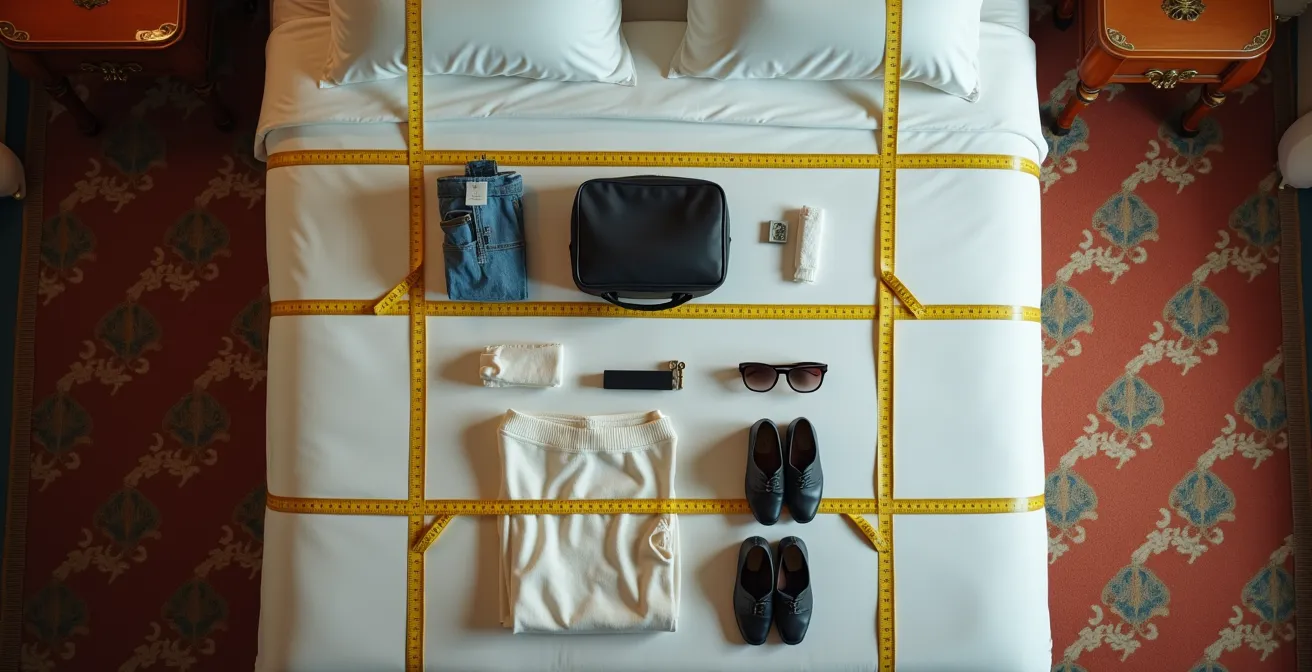
When booking a vacation rental, the presence of an elevator (`ascenseur`) can seem like a simple yes/no question. In Paris, it’s a multi-layered investigation. The first trap is cultural translation: in France, the ground floor is the `rez-de-chaussée` (RC). The “1st floor” (`1er étage`) is the floor above that. This means a listing for the “4ème étage” is actually on the 5th floor by North American counting. Hauling two large suitcases up five flights of winding stairs is a trip-ruining experience.
Even if an elevator is listed, your work isn’t done. Many elevators in historic Haussmannian buildings are tiny, retrofitted into old service shafts. They are often just large enough for one person and a backpack. A standard large suitcase will not fit. You must ask the host for the interior dimensions of the cabin. Furthermore, as one traveler’s experience highlights, you must confirm the elevator goes all the way up.
A traveler booking a ‘3rd floor apartment with elevator’ in the Marais discovered upon arrival that the antique elevator only went to the 2nd floor, requiring them to carry luggage up a narrow spiral staircase for the final floor. The host claimed this was ‘standard for historic buildings’ but hadn’t disclosed it. Always ask specifically if the elevator reaches your exact floor.
– Real Guest Experience
Before booking any rental above the 1st floor, send a message to the host with a list of precise questions. Don’t just ask, “Is there an elevator?” Ask: “Does the elevator go directly to the apartment floor?” “What are the cabin’s dimensions in cm?” and “Does it require a special key or have limited operating hours?” Getting these details in writing through the platform’s messaging system provides a record in case of a dispute.
Key takeaways
- Hotel star ratings in Paris are a better guide to services and amenities than to room size.
- The “convenience cost” of a hotel breakfast can be a worthwhile investment on days with tight schedules.
- Proactively investigating noise sources, AC systems, and elevator access *before* booking is more effective than dealing with problems upon arrival.
The Heat Wave Risk: Why You Should Avoid the “Chambre de Bonne” in August?
The `chambre de bonne`, or former maid’s room, is often romanticized in rental listings as a “charming attic studio.” These rooms are typically located on the top floor (6th or 7th `étage`) of Haussmannian buildings, directly under the iconic Parisian zinc roofs. While they can offer great views and lower prices, they are a significant gamble during the summer, particularly in August. Zinc is a highly conductive metal, and on a sunny day, it turns the rooms beneath into convection ovens. These spaces can be 8-12°C hotter than the street below, with indoor temperatures soaring past 40°C (104°F) during a heatwave.
Most of these rooms lack any form of real air conditioning, making them dangerously uninhabitable. During a recent Parisian heatwave, data showed a 40% increase in heat-related medical calls from tourists, many of whom were staying in these top-floor rentals. Sleeping becomes impossible, and the room ceases to be a refuge, forcing occupants to seek relief in city cooling centers or air-conditioned museums.
Be wary of listings that use coded language. Phrases like “cozy attic,” “artist’s loft,” or “bohemian nest” on a high floor, especially when paired with photos of slanted ceilings and a suspiciously low price for a prime neighborhood, are major red flags. If the listing doesn’t explicitly mention `climatisation`, assume it doesn’t have it. Opting for a slightly more expensive room on a lower floor in a hotel with guaranteed AC is a far safer and more comfortable choice for a summer visit.
Rent or Hotel: What to Choose for a Stay in the Marais Under 200€/Night?
The Marais is one of Paris’s most desirable neighborhoods, but the choice between a hotel and an Airbnb at a sub-€200 price point is a classic dilemma. On the surface, a rental seems to offer better value, promising more space for your money. However, this is where you must synthesize all your newfound spatial and logistical knowledge. A rental might offer 25m² compared to a hotel’s 15m², but that extra space often comes without critical amenities like air conditioning, a 24/7 reception for support, or free luggage storage—all significant factors for a comfortable stay.
As one frequent business traveler concluded after several trips, the all-in cost and convenience of a hotel often outweigh the perceived benefits of a rental.
After trying both options over 6 trips, I now exclusively book hotels in the Marais. My Airbnb nightmare: the host’s ‘self check-in’ failed, leaving me locked out for 3 hours with luggage. The hotel alternative had 24/7 desk support, free luggage storage that let me explore on my last day, and though smaller, the AC made summer nights bearable. The €200 hotel rate seemed expensive until I added up all the Airbnb extras: cleaning fee, service fee, city tax, and luggage storage at Nannybag – total came to €245.
– Business Traveler’s Marais Comparison
This decision requires a holistic view. A hotel provides a predictable, service-oriented ecosystem. A rental offers a more “local” experience but transfers the responsibility for logistics, security, and comfort entirely to you. The following table provides a clear comparison of the factors at play for this specific scenario.
| Factor | 3-Star Hotel | Airbnb Rental | Winner |
|---|---|---|---|
| Actual Space | 14-16m² with AC | 20-25m² usually no AC | Rental (if no heatwave) |
| Location Within Marais | Usually main streets | Often better located in quiet streets | Rental |
| Hidden Costs | €3 city tax included | +€2.5 city tax +€40-60 cleaning fee | Hotel |
| Luggage Storage | Free before/after checkout | €20-30 for external service | Hotel |
| Emergency Support | 24/7 reception desk | Host may be unreachable | Hotel |
| Check-in Flexibility | Usually 24/7 | Often strict time windows | Hotel |
| Breakfast Option | €15-18 buffet available | DIY, nearest café 5-10 min walk | Hotel |
| Daily Cleaning | Included | Not included (€30+ if requested) | Hotel |
By applying this architectural and logistical filter to your search, you move beyond being a passive tourist to become an active, informed traveler, fully prepared to select the accommodation that best fits your actual needs.
Frequently Asked Questions About Paris Hotel Rooms
What’s the difference between ‘climatisation’ and ‘air rafraîchi’ in French hotels?
True ‘climatisation’ means real air conditioning that can cool a room to a set temperature, typically 5-8°C below outside temperature. ‘Air rafraîchi’ is just a fan system that circulates air without actual cooling capacity – essentially a glorified fan that won’t help during a heatwave.
Why is my hotel AC locked in June even though it’s 28°C outside?
Many French hotels operate on centralized seasonal systems that switch between heating and cooling modes based on calendar dates rather than actual temperature. The system often remains in ‘heating mode’ until July 1st regardless of weather. Ask reception to override the setting for your room.
How can I tell if a hotel has real AC from the photos?
Look for wall-mounted split units with a remote control visible – these are real AC. Avoid rooms showing only ceiling fans, portable units on wheels, or small window units which are ineffective for cooling an entire room during French summer heat waves.