Feeling like an outsider at Place Vendôme isn’t about your budget; it’s about not knowing the rules of the game.
- The square is a social theater where history, art, and commerce perform together. Understanding this performance is the key to confidence.
- Small gestures of etiquette and knowledge of hidden stories are more valuable than a high credit limit for feeling at ease.
Recommendation: Instead of window shopping, focus on one specific mission: find the spot where Chopin died, identify the oldest decorative motif on a building, or have a single coffee at a legendary hotel bar.
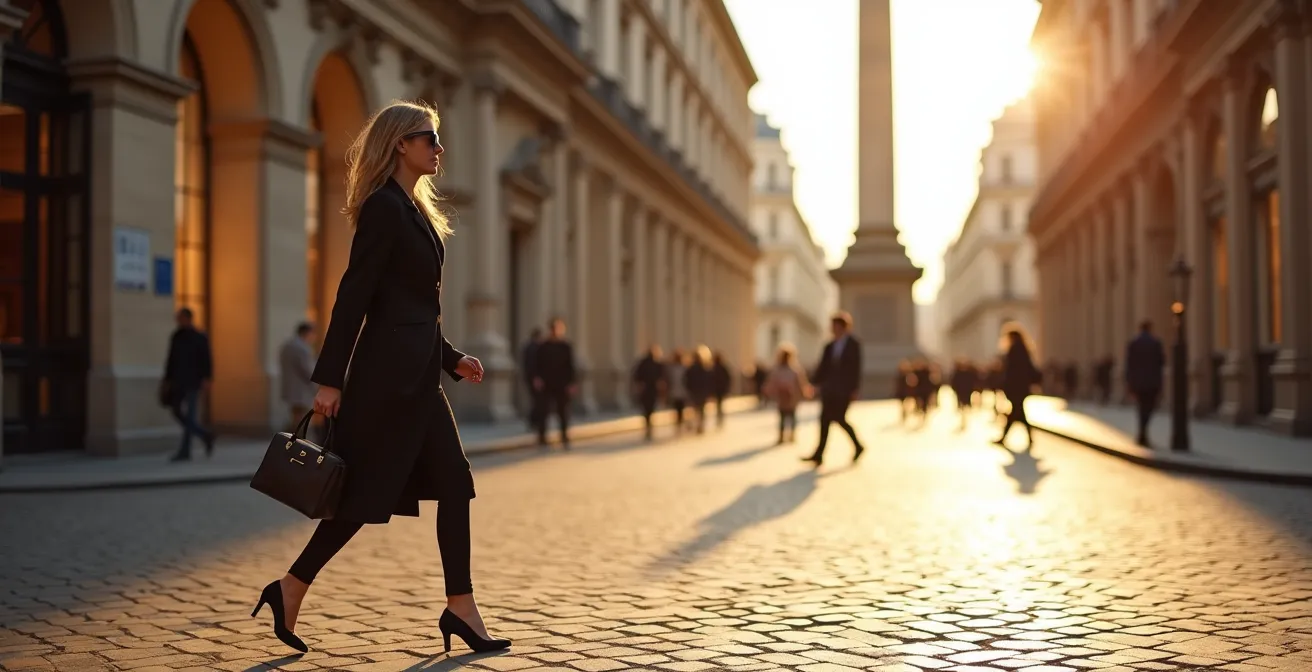
The moment you step onto Place Vendôme, the atmosphere shifts. The roar of Paris fades into a reverent hush, the air feels heavier, and the uniformed doormen standing like sentinels outside gleaming boutiques seem to track your every move. For many, this octagonal stage of global luxury is deeply intimidating. The common advice—”just be confident”—is meaningless when you feel you don’t belong. You are an observer, separated from the action by an invisible wall of extreme wealth.
But what if the key to breaking down that wall wasn’t a platinum credit card, but a piece of knowledge? What if you could see the square not as a collection of inaccessible shops, but as a living museum, a social theater rich with hidden stories and unspoken rules? True belonging here comes not from what you can afford to buy, but from what you can see and understand. It’s about transforming from a nervous tourist into an informed observer.
This guide is your anthropological key. We will decode the silent language of Place Vendôme, from the political battles waged over its central column to the subtle etiquette of getting the perfect photo. By the end, you won’t just walk through the square; you’ll know how to read it, appreciate its nuances, and move through it with the quiet confidence of someone who is truly in the know.
To help you navigate this unique Parisian space, this article breaks down the essential codes and stories that bring Place Vendôme to life. Discover the secrets behind its landmarks, learn the etiquette of its luxury houses, and find ways to experience its exclusive atmosphere without needing a reservation.
Summary: A Confident Observer’s Guide to Place Vendôme
- Napoleon’s Statue: Why Was the Vendôme Column Destroyed and Rebuilt?
- The Ritz Entrance: How to Get a Photo Without Annoying the Doormen?
- Patek or Rolex: Which Boutique Has the Best Museum-Like Display?
- Number 12:How to trace the Footsteps of Monet and Renoir Beyond the Museums?
- Christmas Trees: Why Vendôme Has the Most Elegant Decorations in Paris?
- Place de la Concorde: Where Exactly Did Louis XVI Die?
- The Man Bag: Why French Men Carry Leather Bags and You Should Too?
- How to Enjoy the Ritz or Crillon Atmosphere Without Booking a Room?
Napoleon’s Statue: Why Was the Vendôme Column Destroyed and Rebuilt?
The column at the heart of Place Vendôme is not just a monument; it’s a political barometer of France itself, repeatedly torn down and rebuilt to suit the regime of the day. Its story is one of violent ideological struggle, far from the serene luxury that surrounds it today. The original statue of Napoleon as a Roman Caesar, installed in 1810, was melted down after his fall. It was replaced by symbols of the restored monarchy, only for Napoleon to return in a different uniform under a later king. The column itself, made from the bronze of 1,200 captured enemy cannons, was a potent symbol of imperialism.
This symbolism became so inflammatory that during the Paris Commune of 1871, it was toppled by revolutionaries, an event championed by the painter Gustave Courbet. He saw it as a monument to “war and conquest.” After the Commune was crushed, the new government sought to reassert its authority and teach Courbet a lesson. An official report confirmed the French government sent Gustave Courbet a bill for 323,000 francs to rebuild the column, a crushing sum that financially ruined him. The column you see today, with a replica of the original Napoleon-as-Caesar statue, is a testament to this turbulent cycle of creation, destruction, and politically charged reconstruction. It has hosted five different statues, each reflecting a seismic shift in French power.
To appreciate it as an informed observer, stand at the corner of Rue de la Paix. From there, you can follow the spiral narrative of the 425 bronze plates, which depict Napoleon’s Austerlitz campaign. It’s a story told in melted cannons, a raw display of power that forms the historic core of this polished square.
The Ritz Entrance: How to Get a Photo Without Annoying the Doormen?
The entrance to the Hôtel Ritz is one of the most iconic and intimidating doorways in Paris. The goal is to capture its legendary facade without feeling like an intrusive tourist or, worse, disrupting the flow of high-profile guests. The secret lies not in being invisible, but in acknowledging the human element: the doormen. They are the gatekeepers of this exclusive world, and showing them respect is the first cultural code to master. A simple, confident “Bonjour, Monsieur” accompanied by a nod as you approach changes everything. It signals that you understand and respect the local etiquette, immediately distinguishing you from the average tourist.
Once you’ve established this subtle rapport, positioning is key. The best spot for a photograph is not directly in front of the entrance, which can cause obstruction. Instead, position yourself across the street, near the Ministry of Justice. This vantage point allows you to capture the full facade, the famous blue awning, and the general ambiance without getting in the way. The ideal time for this is a weekday afternoon, between 3 and 4 PM, when guest traffic is typically lighter.
Remember that the Ritz is more than a hotel; it’s a piece of cultural history, immortalized by figures like Ernest Hemingway, who famously said, “When in Paris the only reason not to stay at the Ritz is if you can’t afford it.” By approaching it with respect and a plan, you are not just taking a photo; you are paying homage to a legend.
Patek or Rolex: Which Boutique Has the Best Museum-Like Display?
On Place Vendôme, watch boutiques are not mere stores; they are temples to micro-mechanics and cultural identity. Choosing between Patek Philippe and Rolex is less a matter of timekeeping and more a choice between two distinct philosophies of luxury. Your visit should be approached as a museum tour, and each brand caters to a different curatorial taste. Patek Philippe represents the discreet, old-world heritage of the French “bon chic, bon genre” (BCBG) elite. Rolex projects a more modern, visible statement of success and adventure.
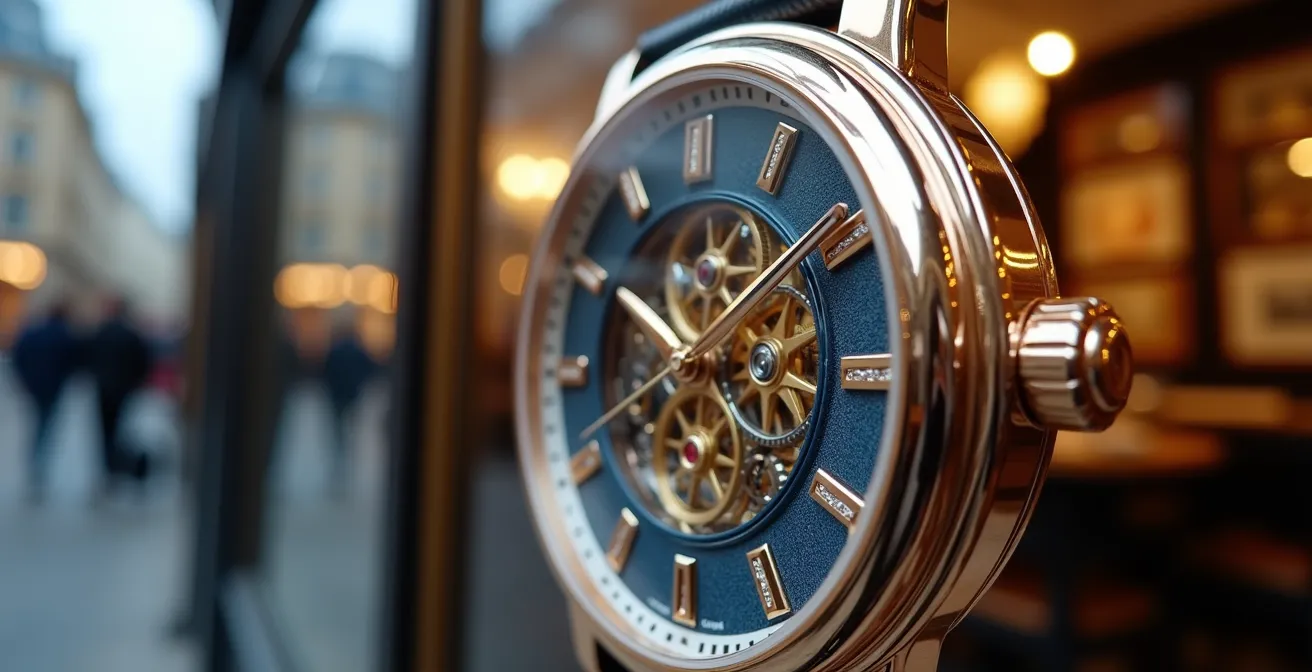
This cultural positioning is reflected in their boutique displays. The Patek Philippe salon, the largest in the world, feels like a private museum where you are encouraged to be curious. The focus is on horological art, with displays centered on incredibly intricate Dome Table Clocks and enamel masterpieces. The staff often responds positively to genuine interest, and asking to see a specific piece is not out of place. Rolex, by contrast, offers a multi-story flagship that feels like a Hall of Fame dedicated to exploration and achievement. Its displays are focused on its “Explorer” models and the history of their use on expeditions to Everest and the Mariana Trench.
The choice of which to visit depends on what you want to observe: the quiet artistry of generational wealth or the bold chronicle of modern ambition. This table breaks down their cultural positioning:
| Aspect | Patek Philippe | Rolex |
|---|---|---|
| Cultural Identity | BCBG (bon chic, bon genre) old-world heritage | Visible statement of contemporary success |
| Boutique Size | Largest Patek salon in the world | Multi-story flagship with exploration theme |
| Display Focus | Dome Table Clocks & enamel masterpieces | Explorer models (Everest, Mariana Trench) |
| Visitor Experience | Treated as public museum, ask to see special pieces | Hall of Fame atmosphere with adventure history |
Number 12:How to trace the Footsteps of Monet and Renoir Beyond the Museums?
Place Vendôme is not just a stage for jewelers; it has also been a home, a studio, and even a deathbed for some of history’s greatest artists. The severe, elegant facades and the unique quality of light created by its octagonal shape fascinated the Impressionists. They were obsessed with capturing fleeting moments and changing light, and this architectural space provided a perfect, dynamic subject. To trace their footsteps, you must learn to see the square as they did: as a canvas of light and shadow.
The history of the square is deeply intertwined with the arts. Most poignantly, it was at No. 12 Place Vendôme where the composer Frédéric Chopin died in 1849, his body later interred at Père Lachaise cemetery but his heart returned to his native Warsaw. This address adds a layer of tragic romanticism to the otherwise commercial space. To connect with this artistic past, you can embark on a short Impressionist walking tour starting from the square. Begin by simply observing how Mansart’s octagonal design creates constantly shifting light conditions, especially in the early morning or late afternoon.
From there, a five-minute walk takes you to the Boulevard des Capucines, the site of the very first Impressionist exhibition in 1874, where Monet’s “Impression, Sunrise” gave the movement its name. A further ten-minute walk leads to the Tuileries Garden, a frequent subject for Monet and Pissarro. By following this path, you are no longer just a visitor to Place Vendôme; you are an active participant in its artistic history, seeing the world through the eyes of masters who were captivated by the very light you are standing in.
Christmas Trees: Why Vendôme Has the Most Elegant Decorations in Paris?
During the holiday season, Place Vendôme transforms into what is arguably the most elegant Christmas display in Paris. This is not by accident, nor is it a municipal project run by the city. The breathtaking forest of perfectly uniform, glittering fir trees is the result of a highly coordinated effort by the “Comité Vendôme,” an exclusive association composed of all the luxury *Maisons* on the square. This collective effort is a prime example of the “social theater” of Place Vendôme, where the brands work together to create a unified statement of taste and luxury.
The decorations are a shared investment in upholding the square’s image as the global epicenter of refinement. Each year, a single, unified theme is chosen, and every boutique contributes to its execution. This is a powerful marketing tool disguised as festive decoration. Past themes, such as ‘The Starry Night,’ have directly referenced the celestial jewelry collections of member brands like Chanel, whose ‘Comète’ collection is iconic. The decorations are not just beautiful; they are a physical manifestation of the brands’ narrative and identity, reinforcing their shared commitment to a specific vision of elegance.
To best experience this holiday magic, visit on a weekday evening just after dusk, when the crowds are smaller and the transition from twilight to full darkness creates a magical atmosphere. Position yourself at the entrance from Rue de Castiglione for the most impressive overall vista. Then, walk the entire octagon to appreciate how each boutique interprets the annual theme in its window displays, creating a harmonious yet distinct visual symphony.
Place de la Concorde: Where Exactly Did Louis XVI Die?
While Place Vendôme is the heart of Parisian luxury, a short walk away lies its historical counterpoint: Place de la Concorde, a space defined by revolutionary bloodshed. Standing in the center of its bustling traffic, it’s difficult to imagine this as the site of the Reign of Terror’s most infamous executions. The guillotine that took the lives of King Louis XVI, Marie Antoinette, and thousands of others was not located where the grand obelisk stands today. To find the precise location is to connect with the chilling reality of Paris’s history.
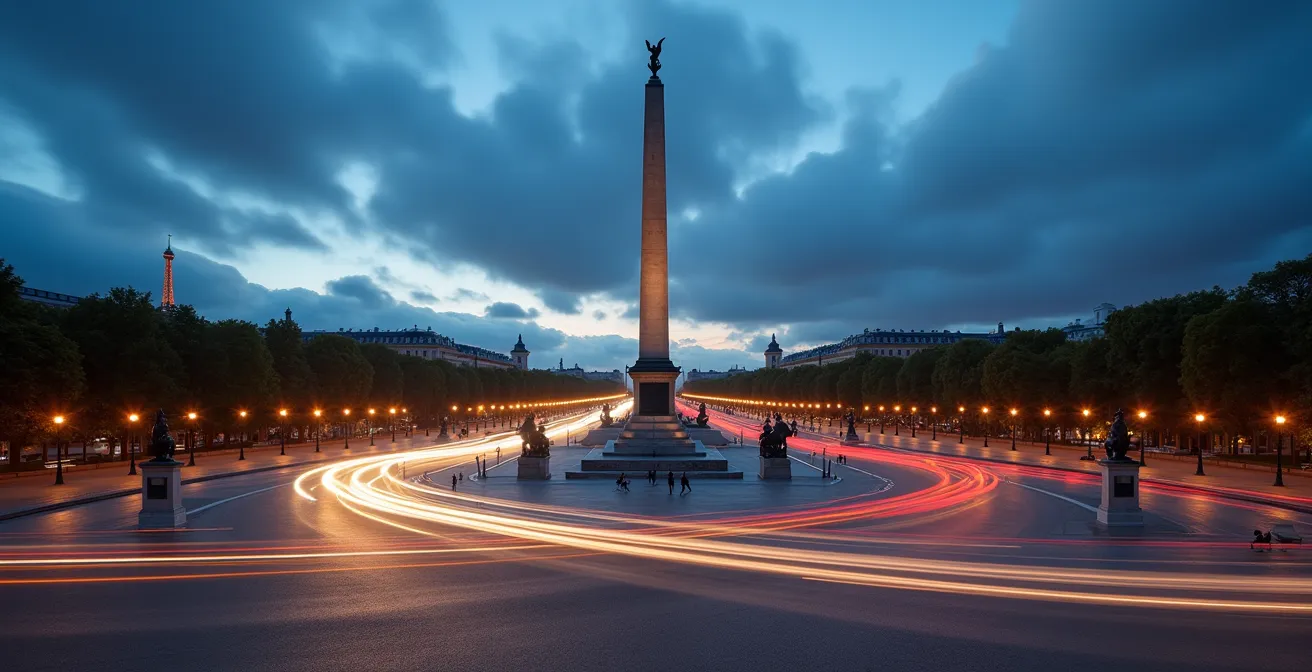
Historical records and engravings confirm that for the execution of Louis XVI on January 21, 1793, the guillotine was erected on the western side of the square. It was positioned closer to the entrance of the Tuileries Garden, near the pedestal of a statue that had been torn down. A report clarifies that the guillotine stood not in the center but on the west side of Place de la Concorde, near the modern-day Rue de Rivoli. Standing in that spot today, looking back at the obelisk with the flow of modern traffic, creates a powerful and unsettling juxtaposition of past and present. The area that is now an entryway for tourists was once the final stage for a king.
This knowledge transforms your perception of the area. The opulence of the nearby Rue de Rivoli and the grandeur of the Place de la Concorde are built upon a ground soaked in the blood of revolution. Understanding this history provides a crucial, sobering context to the luxury of Place Vendôme, reminding you that Paris’s elegance is inextricably linked to its violent and dramatic past.
The Man Bag: Why French Men Carry Leather Bags and You Should Too?
Observing the locals is a key part of anthropological study, and in Paris, you’ll quickly notice that stylish men of a certain age and status almost universally carry a leather bag, or *sacoche*. This is not a fleeting fashion trend; it’s a deep-seated cultural practice rooted in a specific philosophy of life. As one cultural analysis notes, “French men are less concerned with transient trends and more with investing in timeless, quality objects that get better with age.” The man bag is not about logos or showing off; it’s a practical tool for the urban wanderer, the *flâneur*.
The *flâneur* is a classic Parisian archetype: an individual who strolls through the city simply to experience it, to observe, and to think. The bag is his essential toolkit. It’s an emblem of a life that values intellectual curiosity and preparedness for a day of urban exploration. Adopting this accessory, and more importantly, its philosophy, is a powerful way to shift your mindset from “tourist” to “observer.” It gives you a purpose and a role. You are not just aimlessly walking; you are equipped for discovery.
To embrace this identity, the contents of the bag are as important as the bag itself. It’s about carrying items that facilitate observation and reflection, not just consumption. Choosing a bag from a heritage *maroquinier* (leather goods maker) like Goyard or Moynat, known for their craftsmanship rather than loud branding, is the first step. The goal is to carry a piece that develops a rich patina over time, a sign of a life well-lived.
Your Flâneur’s Toolkit: A Checklist for the Parisian Man Bag
- Select heritage: Choose a bag from a heritage *maroquinier* like Goyard, Faure Le Page, or Moynat, prioritizing craftsmanship over flashy logos.
- Pack for wandering: Ensure you have a notebook, a quality pen for café journaling, a compact camera, and a bottle of water.
- Embrace patina: Opt for high-quality, aged leather that will develop character over time, reflecting sophistication.
- Carry culture: Include a small book, preferably French literature or philosophy, to read during moments of pause.
- Be prepared: The bag should be practical, holding everything needed for a full day of urban exploration and observation.
Key Takeaways
- Place Vendôme is a performance: Treat it as a cultural theater, not just a shopping destination, to feel more like a participant than an audience member.
- Knowledge is your key to access: Understanding the history of the Column or the etiquette of the Ritz gives you more confidence than any designer label.
- Observe with purpose: Adopt the mindset of a *flâneur* or an art historian to transform a simple walk into a curated, meaningful experience.
How to Enjoy the Ritz or Crillon Atmosphere Without Booking a Room?
The ultimate feeling of “belonging” on Place Vendôme is to step inside one of its legendary palace hotels, like the Ritz or the nearby Hôtel de Crillon. The good news is that you don’t need a room key to do so. These institutions are masters of hospitality and welcome non-resident guests to their bars and lounges, provided you understand the codes of conduct. This is the most accessible way to immerse yourself in the atmosphere of ultimate luxury for the price of a single drink.
The most famous option is the Bar Hemingway at the Ritz, a tiny, 25-seat sanctuary that feels like stepping back in time. There are no reservations; you simply show up. Headed for decades by Colin Field, often called the world’s greatest bartender, it is a place of legend. As one visitor noted, it’s a bar where “ladies’ drinks arrive with a rose” and the only music is “the sound of ice cubes and conversation.” Be prepared for the price tag: a report states that cocktails at the famous Bar Hemingway are priced at 30-34 EUR, served with complimentary fine nuts and olives. For a quieter, and perhaps more accessible experience, consider the Salon Proust for afternoon tea, which offers a serene atmosphere.
The key to entry is your attire. A smart casual dress code is strictly enforced. For men, this means a collared shirt or a smart sweater and proper trousers; for women, an elegant dress, skirt, or trousers. No shorts, t-shirts, or athletic wear will be permitted. By dressing the part, you signal your respect for the establishment. Visiting mid-afternoon on a weekday (3-4 PM) is often the best time for a more relaxed experience. Having one perfectly made cocktail or coffee in one of these historic bars is the ultimate act of the informed observer, allowing you to soak in the ambiance and truly feel a part of this exclusive world.
Your journey into this world begins not with a grand purchase, but with a single, well-chosen experience. Order a coffee at Salon Proust, or seek out the legendary martini at Bar Hemingway. This is your invitation to step onto the stage of Place Vendôme and find your place within its story.