
The €100 “skip the line” fee at Versailles isn’t a cost; it’s an investment in your most valuable travel asset: high-quality, crowd-free time.
- True VIP access grants entry to exclusive areas that are physically inaccessible to regular ticket holders, not just a shorter queue.
- For multi-stop days, a private chauffeur becomes more cost-effective than Uber after your fourth cross-Paris journey, factoring in wait times and surge pricing.
Recommendation: Shift your mindset from “cost” to “Return on Investment.” Calculate the “friction cost” of the standard option—the stress, wasted time, and decision fatigue. The value of a seamless, exclusive experience often far exceeds the premium price tag.
The quintessential Parisian luxury dilemma often crystallizes in a single question: is the premium experience worth the price? You stand before the golden gates of Versailles, with a two-hour queue snaking under the sun, and a “VIP Access” offer promising instant entry for a crisp €100 surcharge. The common advice whispers about “saving time,” but for a discerning traveler with a high budget and limited hours, this is a superficial analysis. This isn’t just about skipping a line; it’s about a strategic investment in the quality of your experience.
The real question is one of Return on Investment (ROI). We often analyze the cost of Michelin-starred meals or private chauffeurs, but rarely do we apply a rigorous audit framework to these decisions. The true value isn’t just in what you gain, but in what you avoid: the “friction cost” of crowds, delays, and logistical stress. This is the difference between simply seeing Paris and truly experiencing it on your own terms. It requires a shift in perspective from a simple tourist to a strategic travel auditor.
This analysis moves beyond the platitudes. We will deconstruct the value proposition of Paris’s most coveted premium services. We’ll establish a framework to calculate the break-even point for a private driver, quantify the tangible difference between one and three Michelin stars, and define precisely what “exclusivity” means at Versailles. It’s time to stop asking if it’s worth it, and start calculating the specific ROI of your luxury choices.
This guide provides an analytical framework for the discerning traveler. By breaking down the value of each premium service, from private access at Versailles to the nuances of Michelin dining, you will be equipped to make strategic investments in your travel experience, ensuring every euro spent delivers a maximum return in quality, exclusivity, and personal enjoyment.
Table of Contents: A Luxury Auditor’s Analysis of Parisian Premium Services
- King’s Private Apartments: What Do You See That Regular Tourists Don’t?
- The Opera Garnier After Closing: How to Book a Phantom Tour?
- Uber vs Private Chauffeur: When Does the Daily Rate Make Sense?
- Gratuity Etiquette: How Much to Tip a Private Guide in Paris?
- The Limits of Customization: What Can a VIP Guide NOT Do?
- Carte Blanche vs Single Entry: When Does the Annual Pass Pay Off for a Tourist?
- 1 Star vs 3 Stars: Is the Price Difference Justified by the Food or the Service?
- How to Experience a 3-Star Michelin Restaurant Without Going Bankrupt?
King’s Private Apartments: What Do You See That Regular Tourists Don’t?
The primary value of a VIP tour at Versailles is not simply bypassing the queue; it’s gaining access to a fundamentally different palace. While the general public flows through the grand State Apartments, a VIP experience grants entry into the King’s Private Apartments, spaces that remain entirely closed to regular ticket holders. This is not about convenience; it’s about true exclusivity. These rooms are the historical heart of the monarchy, where real power was wielded away from the public performance of the court.
To quantify the value, consider what this access unlocks. You are not just seeing more; you are seeing what is historically most significant. According to the official Château de Versailles website, only guided tours access the private apartments, making this the only legitimate way to experience the palace in its entirety. The ROI is measured in the profound difference between viewing the public facade and understanding the private life of the monarchy.
The tangible assets you gain access to include:
- The King’s Private Bedchamber: See the actual sleeping quarters of Louis XV and Louis XVI, complete with original 18th-century furnishings that are too delicate for mass exposure.
- The Council Chamber: Stand in the intimate room where critical state decisions, like France’s involvement in the American Revolution, were made.
- The Private Dining Room: Experience the ‘petit couvert’ space, a glimpse into the king’s informal life, far from the ritualized public meals.
- The Clock Cabinet: Marvel at the intricate Passemant astronomical clock, a mechanical wonder that has been functioning for over 250 years.
- The Secret Staircase: Use the hidden passages the king himself used to navigate the palace discreetly, offering a tangible connection to the building’s secret life.
The Opera Garnier After Closing: How to Book a Phantom Tour?
For many iconic monuments, the ultimate luxury is not just skipping the line, but experiencing the space in its intended state: empty. The Palais Garnier, with its daytime crowds, can feel more like a bustling train station than a temple of art. The most valuable commodity here is silence. After-hours tours transform the experience from a simple visit into a private, atmospheric immersion.
These exclusive tours are not typically advertised on the main ticketing websites. The key is to book through official, licensed partners who have negotiated special access. The most prominent example is Cultival, the official partner for exclusive tours at several Parisian monuments. Their ‘Phantom of the Opera’ themed tours are a case study in creating value. For a premium, a small group of around 20 visitors can explore the opera house after it has closed to the public. This includes guaranteed access to Box 5 (the Phantom’s box) and backstage areas that are often restricted during the day due to rehearsals or technical preparations.
Analyzing the options reveals a clear tiering of value. The standard visit offers access, while the premium options offer a curated experience.
| Tour Type | Access Level | Price Range | Availability |
|---|---|---|---|
| Standard Day Visit | Public areas only | €15 | Daily |
| Guided Architecture Tour | Public areas + select salons | €22-25 | 3x weekly |
| After-Hours Phantom Tour | Full access including Box 5 | €65-85 | 2-3x monthly |
| Private Event Access | Customizable areas | €150+ | By request |
The table clearly shows that the price premium for an after-hours tour directly correlates with a massive increase in access level and a dramatic reduction in visitor density. This is the definition of a high-ROI luxury experience.
Uber vs Private Chauffeur: When Does the Daily Rate Make Sense?
The choice between on-demand services like Uber and a dedicated private chauffeur (VTC) is a classic luxury travel calculation. At first glance, the VTC’s daily rate seems prohibitively expensive. However, a proper audit reveals a clear break-even point where the VTC becomes not only more convenient but also more economical. The key is to move beyond per-trip cost and analyze the total “friction cost” of transportation over a full day.
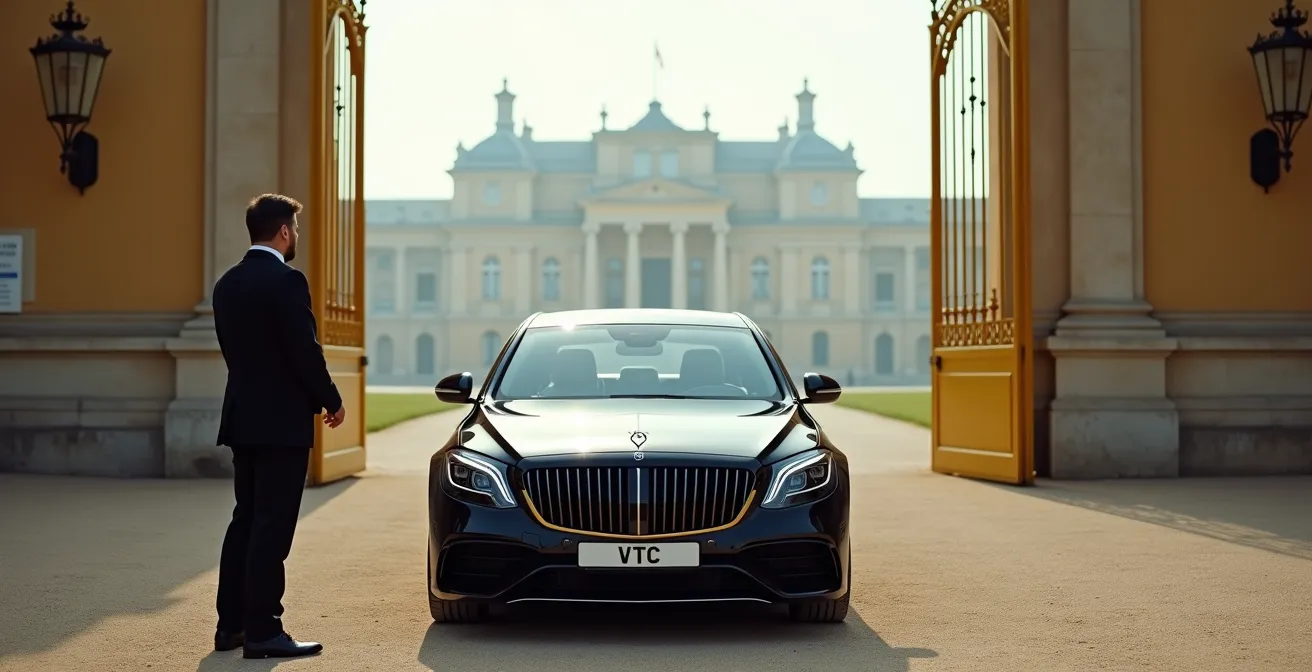
According to current Paris transport data, a single round trip from central Paris to Versailles can cost €100-€120 with Uber during peak or even moderate demand, while a VTC daily rate for 8 hours averages €350-€450. The math seems simple until you factor in multiple stops. A day involving a trip to Versailles, a museum in the Marais, a shopping stop on Rue Saint-Honoré, and dinner in Saint-Germain-des-Prés can easily involve 4-5 separate Uber journeys. At this point, the VTC’s fixed cost becomes competitive.
The true ROI, however, comes from eliminating friction. A VTC provides a secure place for shopping bags, a guaranteed climate-controlled environment, and zero time spent waiting or trying to find a driver in a busy area. This “waiting time” alone is a hidden cost in on-demand services. The decision requires a quick but thorough audit of your planned itinerary.
Your Break-Even Point: A VTC Decision Checklist
- Calculate Total Planned Trips: If your itinerary involves more than 4-5 cross-Paris journeys, the VTC daily rate becomes financially competitive.
- Factor in Surge Pricing Risk: During strikes, major events, or even rain, Uber rates can surge 2-3x. A VTC’s rate is fixed, providing cost certainty.
- Value Your Waiting Time: A VTC includes unlimited waiting. With Uber, this can accrue significant costs (approximately €40-€50/hour) if you have multiple stops.
- Consider Luggage and Shopping: A VTC acts as a secure mobile base, eliminating the need to return to your hotel to drop off purchases—a significant time saver.
- Account for Group Size: A standard VTC sedan maintains a fixed rate for up to 4 passengers, which can be cheaper than ordering a larger Uber XL for a group.
Gratuity Etiquette: How Much to Tip a Private Guide in Paris?
Tipping is one of the most culturally sensitive aspects of travel, and France’s rules are often misunderstood. The fundamental principle is that service is always included in the bill (“service compris”). This applies to restaurants, taxis, and tour guides. Unlike in the United States, a tip is never obligatory and is not a part of a guide’s expected income.
However, the analytical traveler should distinguish between standard service and exceptional service. For a private guide who has gone above and beyond—securing a last-minute reservation, adapting the tour perfectly to your interests, or providing unparalleled historical insight—a gratuity is a recognized and appreciated gesture. It is a financial acknowledgment of service that has exceeded the contractual agreement. The French Tourism Board provides clear guidelines on this distinction.
As the French Tourism Board clarifies in its Official Guidelines for International Visitors:
Tipping is not mandatory in France as service is included, but for exceptional private guide service, a gratuity of 5-10% is appreciated
– French Tourism Board, Official Guidelines for International Visitors
The key takeaway for the luxury auditor is that a tip should be a conscious decision based on a performance review, not an automatic habit. A 5-10% gratuity on the total tour cost is a generous and appropriate benchmark for a guide who has delivered outstanding value. For a €500 private tour, this would be a €25-€50 tip. Always prepare this in cash (euros), as most independent guides are not equipped to process credit card tips. It’s a small but significant detail in maintaining a smooth and respectful relationship with high-level service providers.
The Limits of Customization: What Can a VIP Guide NOT Do?
A core part of a value audit is understanding the limitations of a service. The term “VIP” can create an illusion of absolute power, but in a city of ancient monuments and strict national regulations, even the best guide has boundaries. Recognizing these limits is crucial for setting realistic expectations and maximizing the genuine value of the service you’ve paid for.
The most significant limitation is security. No guide, regardless of their connections or the tour’s price tag, can bypass mandatory security protocols at national museums like Versailles or the Louvre. A concrete example of this is the security screening at Versailles, which follows airport-style protocols. All visitors, including those on the most exclusive private tours, must pass through metal detectors and have their bags checked. While a VIP ticket gets you past the ticket queue, you will still face a security line. During peak season, this can still mean a 10-15 minute wait, a fact that’s essential for precise time management.
A professional guide’s value lies in their historical expertise and logistical efficiency, not in bending the rules. Understanding their constraints is key to a successful collaboration. Here are the realistic limitations:
- Security is Non-Negotiable: Guides cannot override decisions made by museum security personnel, including sudden room closures for safety or official reasons.
- Restoration is a Hard Stop: Access to areas marked ‘en travaux’ (under restoration) is strictly forbidden to everyone for safety and conservation reasons.
- Logical Routes are Paramount: While there is flexibility, efficient tours of large palaces like Versailles require a logical progression. A guide cannot magically transport you from one end of the palace to the other without traversing the space.
- Guides are Not Concierges: Their expertise is art and history, not personal shopping, running errands, or booking non-tour-related activities.
- Spontaneity Has a Cost: Making major, spontaneous changes to a carefully planned itinerary (e.g., “let’s go to the Louvre instead!”) negates the time-saving benefit you’ve paid for.
Carte Blanche vs Single Entry: When Does the Annual Pass Pay Off for a Tourist?
For any traveler planning to visit Versailles or other Parisian museums more than once, the question of a pass versus single tickets arises. The audit here is a straightforward financial calculation: identifying the break-even point. Paris offers several options, but for the Versailles-focused traveler, the main contenders are the single entry ticket, the Paris Museum Pass, and the official “Carte Blanche” annual pass from the Château de Versailles.
The Paris Museum Pass is designed for short-term, multi-museum tourism. The Carte Blanche, however, is an annual pass specifically for Versailles and its associated properties. It’s often overlooked by tourists, but for those on longer stays (two weeks or more) or who plan return visits within a year, it can offer superior value, especially the “Duo” option which allows you to bring a guest each time.
A direct comparison of the cost and benefits reveals the ideal use case for each pass. The analysis is not just about the number of visits, but the duration of the stay and the composition of your group.
| Pass Type | Price | Duration | Break-Even Point | Best For |
|---|---|---|---|---|
| Single Entry | €20 | 1 day | N/A | One-time visitors |
| Paris Museum Pass | €62 (2 days) | 2-6 days | 3 museums | Short stays (2-6 days) |
| Carte Blanche Solo | €65 | 1 year | 4 visits | Long stays (2+ weeks) or repeat visitors |
| Carte Blanche Duo | €105 | 1 year | 3 couple visits | Couples staying 2+ weeks |
The data is clear: for a solo traveler staying for an extended period and planning to visit the main palace, the Trianons, and the gardens on separate days, the Carte Blanche pays for itself on the fourth visit. For a couple, the “Duo” pass is even more compelling, reaching its break-even point on the third joint visit. This pass also grants discounts at museum shops and restaurants, adding to its overall ROI. It’s a strategic purchase for the dedicated Versailles enthusiast.
1 Star vs 3 Stars: Is the Price Difference Justified by the Food or the Service?
The leap from a one-star to a three-star Michelin restaurant often involves a price increase of 200-300%. A common assumption is that this premium pays for better service, a more luxurious dining room, or a more prestigious location. This is a fundamental misunderstanding of the Michelin system. The extra cost is almost entirely an investment in one thing: the plate.
As the official Michelin Guide criteria explicitly state, the stars are the sole indicator of the quality of the food. Service, decor, and ambiance are rated separately using a system of “fork and spoon” symbols. A restaurant can have impeccable service and still only earn one star if the food doesn’t reach the highest echelons of creativity, consistency, and quality.
Michelin stars are awarded solely for the quality of food on the plate. Service and comfort are rated separately by fork and spoon symbols
– Guide Michelin France, Official Michelin Guide Criteria
So where does the money go? It goes into a higher “service density” in the kitchen and on the floor. According to French culinary industry standards, 3-star restaurants typically employ 2-3 staff members per diner, compared to a ratio of 0.5-1 per diner at one-star establishments. This massive difference in labor is what makes the three-star experience possible.
Investment in Culinary Excellence: The Real Cost Breakdown
A typical 3-star Michelin restaurant in Paris may have only 20-30 seats (“covers”) but employ a team of 25-35 staff. The kitchen brigade alone includes highly specialized roles impossible at a one-star level, such as a dedicated sauce chef (saucier), a pastry team of 4-5 specialists, and even a full-time forager for sourcing specific local ingredients. Furthermore, ingredient costs can reach 35-40% of the menu price due to the use of extremely rare and perishable products like white Alba truffles, Brittany blue lobster, or specific micro-herbs that a one-star budget cannot sustain.
The price difference, therefore, is not for “better” service in the sense of politeness, but for a level of complexity, precision, and ingredient sourcing that is exponentially more expensive to produce. You are paying for a larger, more specialized team of artisans dedicated to your meal.
Key takeaways
- The true value of a premium service is measured in exclusivity and the elimination of “friction costs” (stress, waiting, logistics), not just convenience.
- Conduct a “value audit” before purchasing: identify the break-even point for services like private drivers or annual passes.
- Time is a quantifiable asset. The ROI of skipping a two-hour line is two extra hours to experience something else, a high-value trade.
How to Experience a 3-Star Michelin Restaurant Without Going Bankrupt?
The conclusion of a luxury audit is not always to spend less, but to spend smarter. Experiencing the pinnacle of culinary art at a three-star Michelin restaurant doesn’t have to mean financial ruin. For the strategic diner, there are several “hacks” that allow access to the same kitchen, the same chef, and the same culinary DNA at a fraction of the flagship dinner price. This is about finding the highest value entry point into a luxury ecosystem.
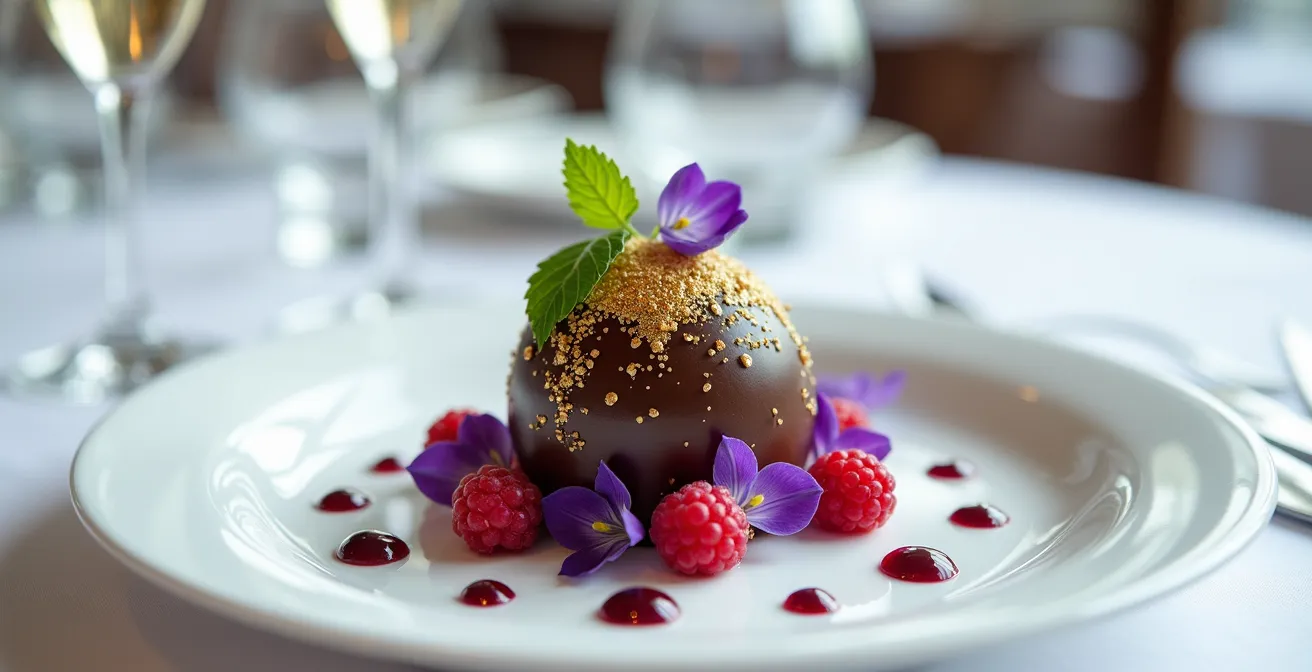
The most common and effective strategy is to book for lunch. The “menu déjeuner” (lunch menu) is a Parisian institution, even at the highest level. It’s an opportunity for the restaurant to fill tables during a slower service and for diners to experience the cuisine at a price that can be 40-50% less than the equivalent dinner menu. The quality, ingredients, and execution remain at the three-star level; only the price and perhaps the number of courses are reduced.
Beyond the lunch menu, several other avenues exist for the resourceful foodie. The goal is to find alternative formats that the restaurant offers to maximize its assets. Here are the most effective strategies:
- Book the ‘Menu Déjeuner’: The lunch service is the single best value proposition, typically offering a 40-50% reduction compared to dinner for the same level of quality.
- Reserve the Chef’s Counter or Kitchen Table: Some restaurants offer a specific tasting menu for these seats, which can sometimes be priced differently and provides a unique, immersive experience.
- Visit the Chef’s ‘Bistronomy’ Restaurant: Many three-star chefs own a second, more casual “bistro” or wine bar. This is where you’ll find the same culinary DNA and commitment to ingredients at roughly 30% of the flagship’s price.
- Try the Bar/Lounge Option: If the restaurant has a bar or lounge area, it’s often possible to order à la carte. Enjoying an exceptional glass of wine and one of the signature desserts can provide a taste of the three-star magic for under €100.
Now, apply this auditor’s framework to your own travel planning. Stop asking vaguely ‘is it worth it?’ and start asking specific, analytical questions. Calculate your personal ROI, account for the hidden friction costs, and make strategic investments in a seamless, exclusive, and truly luxurious experience. Your time is the ultimate luxury; spend it wisely.
Frequently Asked Questions About Gratuity Etiquette: How Much to Tip a Private Guide in Paris?
Should I tip if the tour was just okay?
No tip is expected for standard service in France. Only tip for service that exceeded expectations.
Can I tip by credit card?
Most independent guides in France cannot process credit card tips. Always carry cash in euros for gratuities.
Is there a difference between tipping employees vs independent guides?
Yes, independent guides who own their business appreciate tips more as they don’t receive a base salary, while employed guides often have company policies about gratuities.