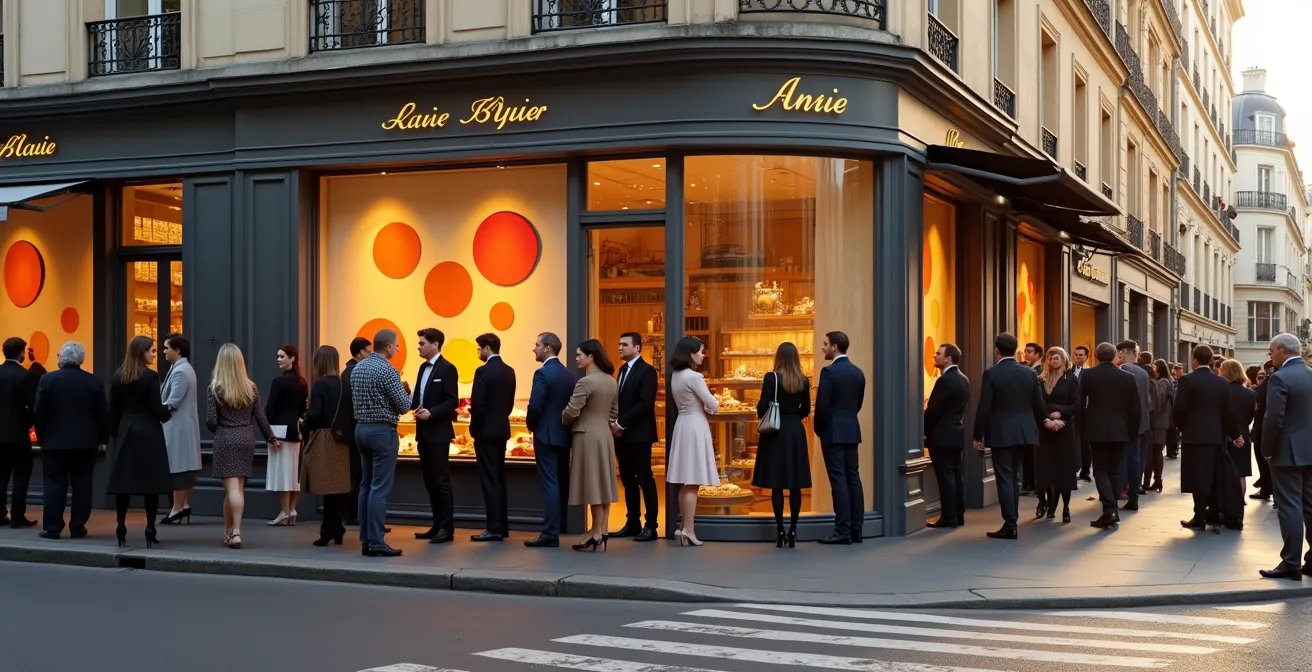
The Cédric Grolet phenomenon is less about a single pastry and more about a masterclass in luxury marketing, manufactured scarcity, and social currency.
- The high price reflects a full “experience ecosystem”—including brand prestige and location—not just ingredients and labor.
- The queue itself is a deliberate feature, designed to build desire and provide “proof of effort” that enhances the purchase’s value on social media.
Recommendation: Before joining the line, calculate the opportunity cost. Consider what other, potentially more authentic, Parisian culinary experiences you could discover in that same timeframe.
That perfect, glistening fruit sculpture. You’ve seen it on Instagram, cradled in a pristine white box, with the Paris skyline blurred in the background. It’s the work of Cédric Grolet, a pastry chef elevated to rockstar status, and getting your hands on one of his creations has become a modern pilgrimage for foodies. The journey involves a significant investment of time, often a two-hour queue snaking through the heart of Paris, and a not-insignificant sum of money. The conventional wisdom is that he’s a genius, the pastries are edible art, and the experience is simply part of the magic.
But let’s be pragmatic. When you’re a food lover in Paris, your most valuable assets are time and appetite. Is dedicating half a day to a single pastry the best use of them? The cult of celebrity pastry has created an economy where the queue itself is part of the product. Many will tell you the wait is worth it, that the price is justified by the unparalleled quality. This article, however, takes a different approach. We will dissect the true cost of that viral pastry—not just in euros, but in time, effort, and opportunity cost.
The real question isn’t just “is it tasty?” but “what is the value proposition?” To answer this, we need to go beyond the hype and analyze the intricate system of luxury branding, manufactured scarcity, and consumer psychology at play. This guide will explore the practical realities of indulging in Parisian haute pâtisserie, from the logistical challenge of transporting your prize to understanding the economics behind its price tag. We will weigh the celebrity-endorsed experience against the city’s countless other hidden gems to help you make an informed decision: join the queue or forge your own delicious path?
This analysis breaks down the key facets of Paris’s high-end pastry scene, providing a pragmatic framework to evaluate where your time and money are best spent. Explore the sections below to navigate the world of celebrity chefs, palace hotels, and the quest for the perfect croissant.
Contents: Decoding the Parisian Pastry Hype
- How to Carry a Saint-Honoré on the Metro Without Destroying It?
- Beyond Pierre Hermé: Which Rising Pastry Chef in the 11th Is the New Genius?
- Ispahan vs Plaisir Sucré: Which Hermé Classic Should You Try First?
- Ritz Escoffier vs Le Cordon Bleu: Which Workshop is Best for Amateurs?
- Why Does a Single Eclair Cost 12€ in a Palace Hotel Shop?
- Tea Time at Le Meurice: How Far in Advance Must You Reserve for Cédric Grolet?
- Louis Vuitton Queue: What Time to Arrive to Avoid Waiting 2 Hours?
- How to Identify the “Best Butter Croissant” Winner in Your Neighborhood?
How to Carry a Saint-Honoré on the Metro Without Destroying It?
You’ve done it. You survived the queue, made the payment, and now hold the coveted box. The challenge, however, is far from over. Navigating the Parisian metro with a delicate, expensive pastry is a high-stakes game of its own. Imagine getting on a packed train during rush hour while holding a box of fragile creations. The very real risk of your beautiful Saint-Honoré becoming a tragic, sugary mess highlights a practical friction point often overlooked in glossy reviews. This is the unglamorous aftermath of the luxury purchase.
Top Parisian patisseries are aware of this issue. Many, like Pierre Hermé and Christophe Michalak, have invested heavily in protective packaging innovation, with reinforced boxes and individual compartments becoming standard for their most fragile items. This is a tacit acknowledgment that the customer journey doesn’t end at the cash register. Yet, even the best box is no match for the unpredictable jostle of public transport. A successful transit requires strategy.
To protect your investment, certain tactics are essential. Think like a seasoned Parisian commuter who happens to be carrying a priceless artifact. Here are some expert tips for the journey home:
- Avoid peak hours: The metro is most crowded between 8-10 am and 5-8 pm. Plan your pastry pilgrimage outside these windows.
- Wait for the next train: Don’t squeeze onto a full carriage. One or two trains later, you might find a significantly emptier one.
- Claim your space: Head to the back cars, which are often lighter on passengers. Hold the box either above your waist or securely below, minimizing its footprint.
- Position yourself wisely: Stand near the doors for a quick exit, but stay out of the direct flow of people entering and leaving.
Beyond Pierre Hermé: Which Rising Pastry Chef in the 11th Is the New Genius?
While the world queues for Cédric Grolet, a question arises for the discerning foodie: what is the opportunity cost? The time spent waiting for an established star could be spent discovering the *next* one. Paris, particularly in artist–friendly arrondissements like the 11th, is a crucible of culinary talent. Beyond the palace hotels and grand avenues, a new generation of artisans is quietly redefining the boundaries of pâtisserie, often without the multi-hour queues.
These chefs are the spiritual successors to innovators like Pierre Hermé, who broke the mold, but they are writing their own rules. The focus is on intense flavor, impeccable sourcing, and a more intimate, neighborhood-focused approach. They may not have the global recognition of Grolet, a status cemented by a following of over 13 million on Instagram, but their work is where the future of French pastry is being forged. The thrill of discovery—stumbling upon a small boutique with a visionary chef—is an experience that can’t be replicated in a heavily managed queue.
The current trend of hyper-realistic fruit pastries, championed by Grolet, is part of a larger movement. As noted industry expert Franck Lacroix observed, “Trompe-l’œil pastry will invade shop windows of the 2020s, just as revisited éclairs did 10 years ago.” This suggests that while Grolet’s style is dominant now, it’s part of a cycle. The true genius might be the chef who is already working on what comes after trompe-l’œil, perhaps in a small workshop in the 11th or 12th arrondissement, selling their creations to a small but devoted local clientele.
Ispahan vs Plaisir Sucré: Which Hermé Classic Should You Try First?
Before Cédric Grolet became a global phenomenon, Pierre Hermé was the architect of modern pastry. Understanding his iconic creations provides an essential baseline for evaluating today’s trends. For a newcomer to Hermé’s universe, the choice often boils down to two legendary pastries: the Ispahan and the Plaisir Sucré. Each represents a different facet of his genius and revolutionized French pastry in its own way. The Ispahan, with its audacious combination of rose, lychee, and raspberry, normalized floral and exotic notes that were once considered radical. It’s a statement piece, a test of your palate’s adventurousness.
In contrast, the Plaisir Sucré is a masterclass in refinement. It takes classic, comforting flavors—chocolate and hazelnut—and elevates them through an extraordinary command of texture. With its delicate layers of dacquoise, praline crunch, and ganache, it represents the ultimate sophistication of familiar tastes. Choosing between them is less about which is “better” and more about what kind of experience you seek. Do you want to be challenged by the new, or comforted by the perfect execution of the classic? This very question is at the heart of appreciating haute pâtisserie.
The following table breaks down the core characteristics of these two titans of the pastry world, helping you decide where to begin your journey.
| Aspect | Ispahan | Plaisir Sucré |
|---|---|---|
| Flavor Profile | Rose, lychee, raspberry – adventurous | Chocolate, hazelnut – classic |
| Texture | Light, delicate macaron base | Multiple crispy and creamy layers |
| Best Paired With | Delicate tea in salon de thé | Bitter espresso at zinc counter |
| Innovation Impact | Normalized floral notes in French pastry | Ultimate refinement of classic flavors |
Ritz Escoffier vs Le Cordon Bleu: Which Workshop is Best for Amateurs?
For some foodies, the ultimate luxury isn’t just eating a perfect pastry, but understanding how to create it. This desire has fueled a boom in high-end pastry workshops for amateurs. In Paris, two names stand out: the Ritz Escoffier school, housed within the legendary palace hotel, and Le Cordon Bleu, the historic institution synonymous with French culinary technique. Choosing between them is a question of philosophy. Le Cordon Bleu focuses on mastering the foundational, traditional techniques of French pâtisserie. It’s about precision, process, and earning a formal certificate.
The Ritz Escoffier, by contrast, offers an experience steeped in palace-style luxury. The classes are smaller, the environment is more opulent, and the focus is often on presentation and the “art de la table.” You’re not just learning a recipe; you’re learning the Ritz’s interpretation of it. This mirrors the choice a consumer makes: do you value traditional, proven skill, or the prestige and narrative of a luxury brand? In recent years, a third option has emerged: online masterclasses from chefs like Cédric Grolet himself. As PastryClass notes, “When The World’s Best Pastry Chef Cédric Grolet makes pastry, he integrates memories, emotions, and feelings into the process,” offering a glimpse into the artist’s mind without leaving home.
The decision depends entirely on your personal goals. Are you seeking technical mastery, a taste of luxury, or direct access to a star’s philosophy? Each path offers a different kind of value.
| School | Philosophy | Class Size | Take-Home Value |
|---|---|---|---|
| Le Cordon Bleu | Master traditional French technique | 15-20 students | Formal certificate |
| Ritz Escoffier | Palace-style luxury presentation | 8-12 students | Luxury skills & prestige |
| Online Masterclasses | Learn from world champions at home | Unlimited | Lifetime access to techniques |
Why Does a Single Eclair Cost 12€ in a Palace Hotel Shop?
The sticker shock is a common rite of passage. You enter a gleaming pastry shop inside a Parisian palace hotel, point to a perfect éclair, and are informed the price is 12€, or even more. At Le Meurice, a single Cédric Grolet creation can reach €17 for a single trompe-l’œil fruit pastry. The immediate question is: why? The answer is complex and lies at the heart of the “experience ecosystem” that defines luxury brands. The price is not just for the ingredients—flour, butter, sugar, and chocolate—however high their quality.
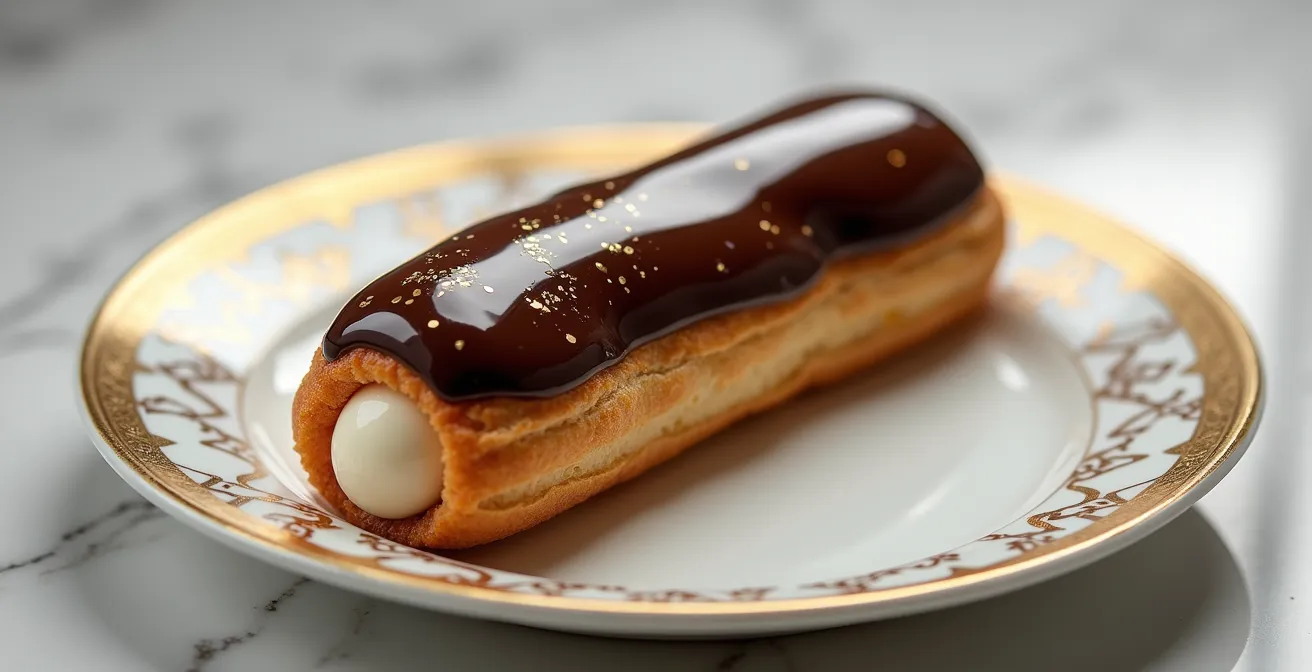
You are paying for a bundle of tangible and intangible assets. These include: the immense cost of prime real estate on Place Vendôme or Rue de Rivoli; the salaries of a large, highly skilled kitchen brigade; the marketing budget required to maintain a global brand; and the signature of a celebrity chef. Crucially, the price also reflects the prestige of the “Palace” designation itself, a coveted label awarded by the French government tourism body, Atout France, which signifies the highest echelon of luxury.
This premium is quantifiable. As one analysis points out, you can often find creations of similar complexity and quality from talented chefs outside the palace hotel system for half the price. An article from Worldcrunch notes that for similar trompe-l’œil creations, one can expect to pay around 7.50 euros a piece, explicitly stating this is “half the price of the original.” That 50% “palace tax” covers the immersive luxury experience: the uniformed doorman, the opulent decor, the perfectly branded packaging. You are not just buying a pastry; you are buying a small, edible slice of a very exclusive world. For many, that is a price worth paying.
Tea Time at Le Meurice: How Far in Advance Must You Reserve for Cédric Grolet?
If the queue at Cédric Grolet’s boutique on Avenue de l’Opéra represents one form of manufactured scarcity, the reservation book for his tea time at Le Meurice hotel represents another, more sophisticated version. Here, the barrier to entry isn’t your willingness to stand in the rain, but your ability to plan weeks, or even months, in advance. Securing a coveted weekend slot for this famous afternoon tea is notoriously difficult, turning the act of booking into a competitive sport for food tourists.
This scarcity is not an accident; it’s a core component of the product’s appeal. The difficulty of obtaining a reservation enhances its perceived value. When you finally sit down in the opulent Salon Dalí, you’re not just there for the pastries; you’re celebrating a victory in planning and persistence. The boutique itself reinforces this principle, as it’s famously open from noon until sold out daily—a phrase designed to create urgency and reinforce the idea that demand always outstrips supply. It transforms a simple purchase into a time-sensitive mission.
For those determined to win the reservation game, insiders have developed a set of strategies. It’s not just about booking early; it’s about understanding the system and knowing where to look for opportunities. Success requires a dedicated approach:
- Book Far in Advance: For a prime weekend spot, you should be looking to book at least 4-6 weeks ahead of your desired date.
- Hunt for Cancellations: Call the hotel on Tuesday mornings. This is when they often process weekend cancellations, potentially opening up last-minute slots.
- Be Flexible: Consider an off-peak weekday afternoon. Your chances of securing a table are significantly higher.
- Go Solo: The pastry bar counter sometimes has availability for single diners who are willing to be flexible.
- Use Click & Collect: If your heart is set on a specific pastry rather than the full tea experience, the online pre-order system is your best bet to guarantee you get what you want without the uncertainty.
Louis Vuitton Queue: What Time to Arrive to Avoid Waiting 2 Hours?
The long line outside Cédric Grolet’s Opéra boutique is not a phenomenon unique to the world of pastry. It’s a hallmark of modern luxury, seen just as frequently outside Louis Vuitton on the Champs-Élysées or Hermès on Rue du Faubourg Saint-Honoré. This parallel is crucial. It firmly places the celebrity pastry experience within the broader context of luxury goods consumption. The question is no longer just about food; it’s about brand affiliation, status signaling, and a shared consumer psychology.
The queue itself has become an integral part of the marketing. As one observer noted about Grolet’s boutique, where entry is only via advance booking despite a long line outside, the system is designed to showcase demand. The visible queue serves as a powerful, real-time advertisement. It creates a “proof of effort” that elevates the purchase from a simple transaction to a triumphant achievement. Waiting for two hours becomes a badge of honor, a story to tell, and—most importantly—content to be shared. The act of waiting and the eventual prize are intrinsically linked in the narrative the consumer builds for their social media audience.
This sentiment is perfectly captured in the candid reactions seen online. In a viral review, one user summed up the internal conflict of the luxury consumer perfectly:
These pastries are a work of art, but man, that price tag is a bit of a shocker! Worth every euro or just for the ‘Gram?
– Jack’s Dining Room, TikTok review
This question, “Worth every euro or just for the ‘Gram?”, gets to the heart of the matter. The value of the pastry is no longer measured solely by its taste but by its “social currency”—its value as a shareable online moment. In this economy, the queue is not a bug; it is a feature that amplifies the story.
Key Takeaways
- A pastry’s price in a palace hotel is an “experience tax” that includes brand prestige, opulent location, and celebrity chef endorsement.
- Queues for luxury goods, including pastries, are often a deliberate marketing tool to increase perceived value through “proof of effort” and manufactured scarcity.
- True Parisian quality often exists outside the hype, identifiable in neighborhood boulangeries that have earned official, peer-reviewed accolades.
–
How to Identify the “Best Butter Croissant” Winner in Your Neighborhood?
After dissecting the hype, the queues, and the complex economics of celebrity pastry, let’s return to a foundational truth: Paris’s deepest culinary magic often lies in its simplest pleasures. The ultimate counter-narrative to the two-hour queue for a 17€ pastry is the 1.50€ croissant from a local artisan—a croissant so perfect it can redefine your morning. The pragmatic foodie’s greatest skill is not the patience to wait in line, but the knowledge to identify this unhyped excellence. And in Paris, there is a system for that.
Each year, the “Concours du Meilleur Croissant au Beurre” (Competition for the Best Butter Croissant) designates the top artisans in the city. Winners proudly display a plaque in their window. Finding these bakeries is like a treasure hunt for connoisseurs, a way to bypass marketing and rely on peer-reviewed quality. Learning to spot a superior croissant, however, is a skill you can develop yourself. It involves engaging all your senses and looking for a few key indicators of true craftsmanship, from its color to its scent to its internal structure. True quality is rarely a secret, it’s written in the product itself.
Forget the hype and learn to be your own critic. By mastering the signs of a high-quality product, you empower yourself to find excellence anywhere, turning every Parisian neighborhood into a potential source of culinary discovery. The satisfaction of finding your own “best croissant” far outweighs the fleeting social currency of a celebrity-endorsed pastry.
Your Action Plan: Parisian Croissant Connoisseur’s Checklist
- Visual Appeal (Dorure): Look for a glossy, golden-brown exterior. This indicates proper egg wash and baking temperature, promising a crisp shell.
- Flakiness (Feuilletage): Inspect the outside for distinct, visible layers. This is the hallmark of expertly laminated dough (tourage).
- Buttery Aroma: A great croissant should release a rich, intoxicating scent of high-quality butter when broken. The secret often lies in using a specific butter with 84% butterfat, known as beurre de tourage.
- Honeycomb Interior (Alvéolage): The inside should not be doughy or dense. Look for an open, airy structure with large, irregular holes, like a honeycomb.
- Spot the Winner: Keep an eye out for the official “Concours du Meilleur Croissant” winner’s plaque on the bakery’s window. It’s a certified mark of quality.
Empower yourself with this knowledge and start your own culinary exploration. The next time you’re in Paris, instead of automatically joining the longest queue, take a walk through a new neighborhood with this checklist in mind. The discovery of your own perfect, un-hyped croissant will be a more satisfying souvenir than any viral pastry.