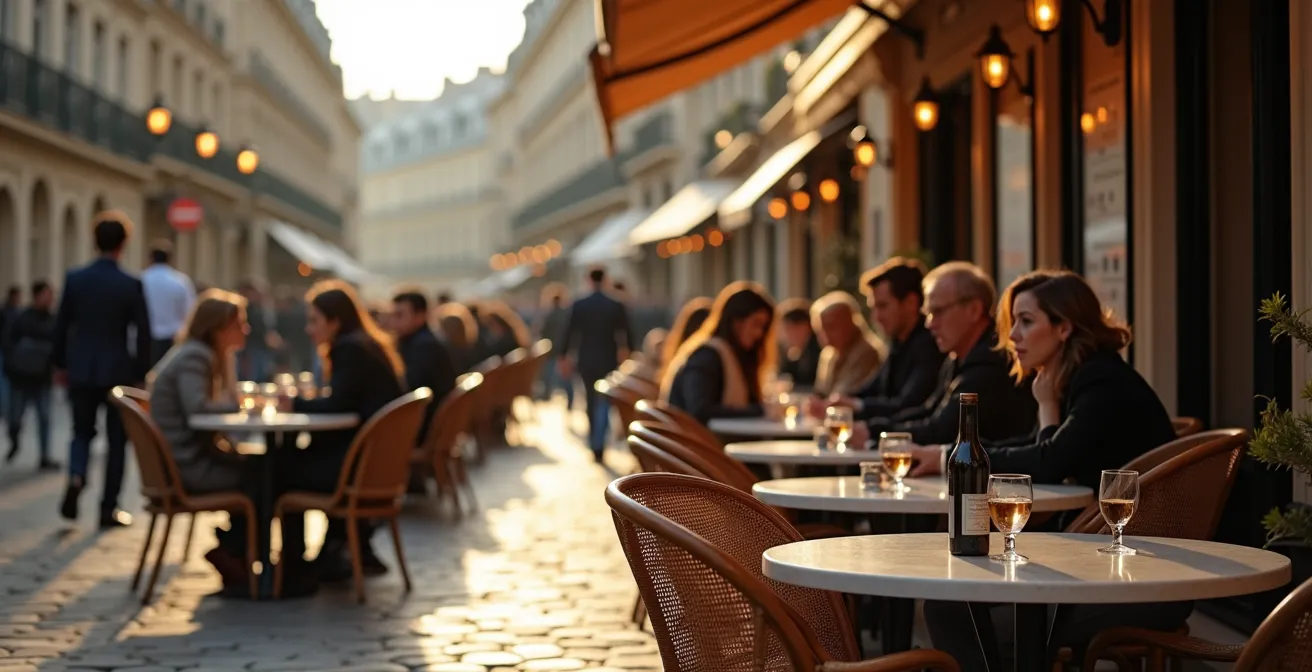
Contrary to popular belief, lingering at a Parisian café isn’t about ordering more drinks. It’s about understanding the unspoken social contract of the terrace. This guide decodes the cultural theatre of the café, revealing how to “pay your rent” with a single coffee by performing your role as a thoughtful observer, not just a customer. Master these nuances, and you’ll earn your two-hour stay without spending another cent.
The scene is a familiar one for any solo traveler in Paris. You’ve found the perfect wicker chair on a sun-dappled terrace. You order a single café crème, place your book on the marble-topped table, and settle in for the city’s greatest spectator sport: people-watching. But soon, an unspoken anxiety creeps in. How long is too long? Will the waiter glare at you? Should you order another overpriced coffee just to justify your existence? The common advice—avoid peak hours, look busy—only scratches the surface.
These tips miss the fundamental point. A Parisian café terrace is not merely a business; it’s a public stage, a living diorama of city life. Your presence is part of the performance. The key to lingering guilt-free isn’t about following a rigid set of rules, but about understanding the role you play in this social theatre. It’s about grasping the concept of “spatial currency,” where your €4 espresso isn’t just for a drink, but for the rental of a front-row seat to the spectacle of Paris.
This guide moves beyond the platitudes to offer a sociologist’s view of the terrace. We will deconstruct the unspoken codes, from the economic logic of your seat’s location to the choreography of the supposedly “grumpy” waiter. By understanding the why behind the what, you can transform from a nervous tourist into a confident flâneur, mastering the art of performative contemplation and making that single coffee your ticket to an afternoon of Parisian immersion.
To help you navigate this unique environment, this article breaks down the essential elements of the Parisian café experience. From the practicalities of finding a comfortable spot to the cultural nuances of service and history, each section provides a key to unlocking the art of lingering.
Contents: The Art of the Single Coffee: How to Linger on a Parisian Terrace for Hours
- The Terrace Smoke: How to Find a Non-Smoking Spot Outside?
- Counter vs Terrace: Why Does Your Coffee Cost 2€ More Outside?
- The Grumpy Waiter: Is He Rude or Just Efficient?
- Les Deux Magots or Café de Flore: Which One Has More Authentic History?
- Books on Terraces: Is It Weird to Read a Kindle at Café de Flore?
- The Sunny Side: Which Side of the Street gets Sun at 5 PM?
- Can You Drink Alcohol in Public Parks After 9 PM?
- How to Plan Your Walking Tour to Hit the Best Bistro Exactly at Noon?
The Terrace Smoke: How to Find a Non-Smoking Spot Outside?
Before you can settle in, you must navigate the first and most pervasive element of the Parisian terrace: the cigarette smoke. France’s relationship with smoking is more public than in many other Western countries, and the café terrace is its traditional heartland. With data showing that around 24% of French adults were daily smokers in recent years, finding a smoke-free bubble can feel like a challenge. The 2007 Évin law banned smoking inside restaurants and cafés, effectively pushing the entire smoking population out onto the terraces you wish to occupy.
However, the law offers some loopholes for the determined non-smoker. Fully enclosed and covered terraces are legally considered “indoor” spaces and must be smoke-free. Semi-enclosed spaces often fall into a grey area, but the more enclosed they are, the more likely they are to be non-smoking. Your best strategy is a combination of legal knowledge and tactical observation. Don’t be shy about asking staff, “Avez-vous une zone non-fumeur en terrasse?” (Do you have a non-smoking area on the terrace?). While not always available, the question itself signals your preference.
Ultimately, your greatest tool is situational awareness. Arriving early, before the post-lunch or pre-dinner crowds, gives you more choice. Assessing the wind direction is a classic, if slightly dramatic, maneuver that can save you from a face full of smoke. Choosing a seat upwind from a table of smokers is a small but powerful act of self-preservation in the social theatre of the terrace.
Your Checklist: Securing a Smoke-Free Terrace Spot
- Check for Signage: Look for “terrasse non-fumeur” signs at the entrance. If there are none, ask the staff directly: “Avez-vous une zone non-fumeur?”
- Assess the Wind: Before you sit, quickly check the wind’s direction. Watch how smoke from other tables is drifting or use a light napkin to see the airflow. Choose a table upwind.
- Opt for Enclosures: Prioritize terraces that are fully enclosed by glass or plastic walls. According to the Évin law, these are typically mandated to be smoke-free.
- Arrive Early: Get there before the peak times (12:00 PM for lunch, 7:00 PM for dinner). A less crowded terrace means less smoke concentration and more seating options.
- Research Progressive Zones: Some areas are ahead of the curve. Cafés in cities like Strasbourg have begun voluntarily banning terrace smoking, a trend that may slowly appear in certain Parisian arrondissements.
Counter vs Terrace: Why Does Your Coffee Cost 2€ More Outside?
The moment you receive l’addition (the bill), the economic reality of the Parisian café becomes clear. The espresso you paid €1.50 for yesterday while standing at the bar (au comptoir) suddenly costs €4.00 on the terrace (en terrasse). This isn’t a scam; it’s the core principle of what we can call spatial currency. You are not just buying a coffee; you are renting a specific piece of real estate with a specific social value. The café explicitly prices the experience, and French law requires this pricing to be transparent.
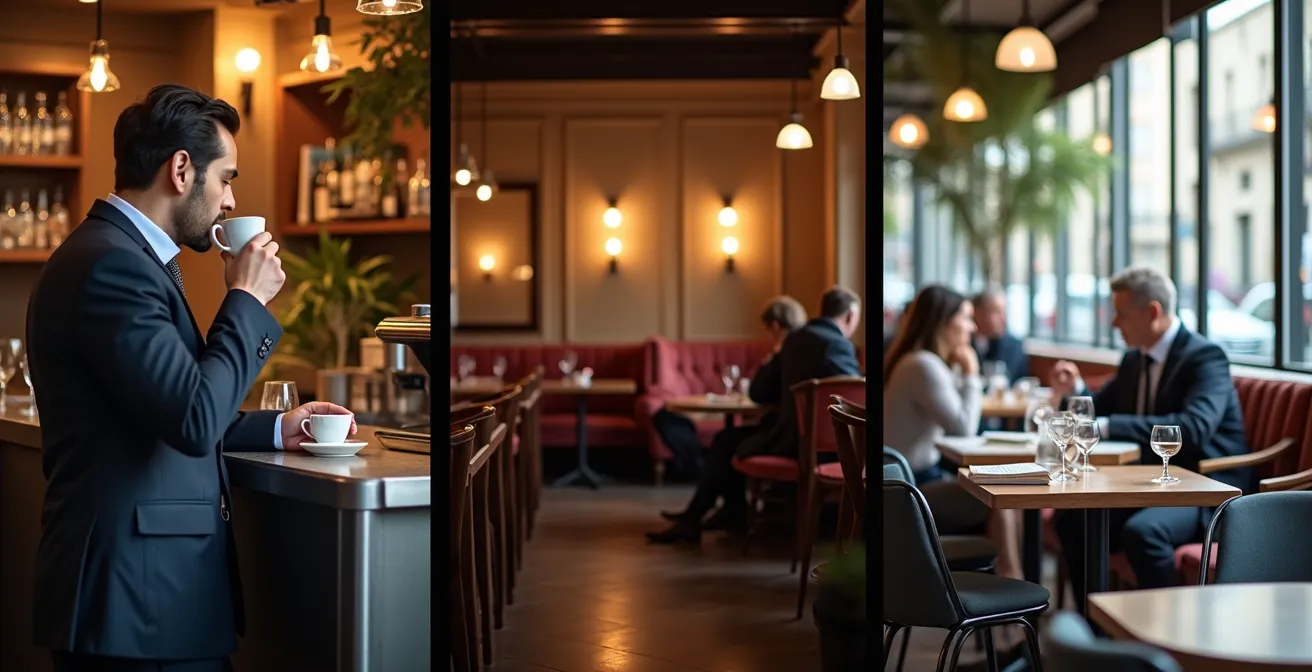
The “obligation d’affichage des prix” mandates that every café displays its prices for the three distinct zones of service. Each zone represents a different social contract:
- Au Comptoir (At the Counter): This is the cheapest and fastest option. It’s purely transactional. You stand, drink your coffee quickly, and leave. You are paying for the liquid and minimal service.
- En Salle (Inside): The price increases. You now have a table, a comfortable seat, and shelter from the elements. You are paying for comfort and privacy.
- En Terrasse (On the Terrace): This is the premium experience. You are paying for the view, the sun, and a front-row seat at the “social theatre” of the street. This price includes the implicit permission to linger and people-watch.
This system is the bedrock of your right to linger. By paying the terrace price, you have fulfilled your side of the bargain. The higher cost includes the 15% “service compris” (service included) by law, which is why tipping is optional and reserved for exceptional service. It’s a transparent acknowledgment that the value lies not in the coffee, but in the space and time you occupy. This pricing structure is what gives you the right to sit for two hours with a single cup.
The Grumpy Waiter: Is He Rude or Just Efficient?
The Parisian waiter, or garçon de café, is a figure of legend, often stereotyped as grumpy, aloof, and dismissive. For the solo traveler, this perceived attitude can be a major source of anxiety. Are they mad that you’ve only ordered one coffee? Do they want you to leave? The answer, almost always, is no. What is often misinterpreted as rudeness is, in fact, a highly codified form of professional efficiency. It is a choreography of non-intrusion.
Unlike service cultures that prioritize overt friendliness and constant check-ins, the French waiter’s role is defined by precision and discretion. They are masters of a respected trade, not aspiring actors or your new best friend. Their job is to take your order correctly, deliver it promptly, and then disappear. They leave you alone because, in French culture, giving a patron space and privacy is the highest form of good service. Constantly interrupting your conversation or your reading to ask “how everything is” would be considered intrusive and unprofessional.
This is central to the “flâneur’s compact.” The waiter grants you autonomy over your rented space. In return, the responsibility is on you to signal your needs. A subtle nod, eye contact, or a polite “Excusez-moi” as they pass is all that’s required. Frantically waving, snapping your fingers, or shouting “Garçon!” is a violation of this unspoken contract. When you are ready for the bill, you must signal for it by saying “L’addition, s’il vous plaît.” They will not bring it proactively, as that would imply they are rushing you out. The waiter’s seeming indifference is, in reality, a sign of respect for your right to linger.
Les Deux Magots or Café de Flore: Which One Has More Authentic History?
Nowhere is the café as a social theatre more apparent than at the legendary establishments of Saint-Germain-des-Prés: Les Deux Magots and Café de Flore. Tourists flock here seeking “authenticity,” hoping to soak up the historical vibes of Hemingway, Sartre, and Simone de Beauvoir. But trying to determine which has “more” authentic history misses the point of the modern Parisian café experience. The history is the backdrop, the set design for the play that unfolds daily.
Both cafés have an impeccable historical pedigree. Les Deux Magots was the cradle of Surrealism in the 1920s and a favorite of American writers. Café de Flore, just next door, became the headquarters of Existentialism, where Sartre famously held court and wrote much of his work. Both continue to honor this legacy with their own literary prizes. However, their modern “vibe” and the “show” they offer for people-watching are distinct.
To help you choose your stage, here’s a comparison of what you’re paying for at each:
| Aspect | Les Deux Magots | Café de Flore |
|---|---|---|
| Literary Heritage | Birthplace of Surrealism, Hemingway’s haunt | Existentialism hub, Sartre’s office |
| Modern Vibe | More tourist-oriented, classic scenes | Fashion/artsy crowd, still intellectual |
| Annual Prize | Prix des Deux Magots (since 1933) | Prix de Flore (since 1994) |
| Best For People-Watching | International tourists, classic scenes | Fashion week crowds, local artists |
As one local cultural guide notes, the real question is not about the ghosts of the past. It’s about the performance of the present.
Authenticity now lies in the people-watching itself, not the history. The history is a backdrop. The real question is which ‘show’ you want to watch.
– Local Paris cultural guide, in an analysis of modern Parisian café culture
Books on Terraces: Is It Weird to Read a Kindle at Café de Flore?
Now that you’ve chosen your stage and understand the staff’s role, you must consider your own performance. Bringing a book to a café is a time-honored tradition, the classic prop for the thoughtful observer. It signals to the world—and more importantly, to the waiter—that you are engaged in a legitimate activity: performative contemplation. You are not loitering; you are thinking, reading, or creating. But in the 21st century, is a Kindle as acceptable as a dog-eared paperback?
Absolutely. The spirit of intellectualism that defined places like Café de Flore and Les Deux Magots has simply evolved. A Kindle, an e-reader, or even a newspaper is the modern equivalent of the intellectual’s notebook. It continues the tradition of using the café as an external office or reading room.
Case Study: The Modern Tools of Literary Legacy
Café de Flore was where Jean-Paul Sartre wrote much of ‘Being and Nothingness’ and Simone de Beauvoir held court. These spaces were the intellectual headquarters of 20th-century Paris. Today, reading on a Kindle there is a direct continuation of this legacy; it’s the modern notebook. The crucial distinction lies in the device’s function. A Kindle signals leisure, reading, and contemplation, which are welcomed activities. A laptop, on the other hand, often suggests work, spreadsheets, and video calls. This can be seen as “commercializing” the contemplative space and is sometimes less accepted, especially at historic or traditional cafés. The classic “newspaper maneuver”—buying a copy of Le Monde or Le Figaro to read over coffee—remains a highly respected and traditional way to justify a long, leisurely stay.
The key is the nature of the activity. Reading, writing in a journal, or sketching are all quiet, contemplative acts that add to the café’s intellectual and creative ambiance. They signal that you appreciate the space for its intended purpose. In contrast, taking loud phone calls, spreading out work documents, or having a video conference violates the unspoken social contract. You are no longer a thoughtful audience member but a disruptive actor on the wrong stage.
The Sunny Side: Which Side of the Street gets Sun at 5 PM?
For the advanced practitioner of terrace-sitting, simply finding a seat is not enough. The goal is to optimize the experience. In a city as densely built as Paris, the sun is a precious, fleeting commodity, and securing a sun-drenched table for the 5 PM apéro is a strategic victory. This requires a basic understanding of urban geography and the movement of the sun across the Haussmannian boulevards.
The city’s general North-South and East-West grid provides a predictable pattern. For the coveted late afternoon and golden hour sun (from 3 PM onwards), you need to position yourself on the correct side of a North-South running street. As a general rule, an urban planning analysis of Paris shows that the eastern sides of these streets receive the optimal light as the sun moves into the west. On East-West streets, the north-side terraces will get sun for most of the day. This simple knowledge can transform your search for the perfect spot.
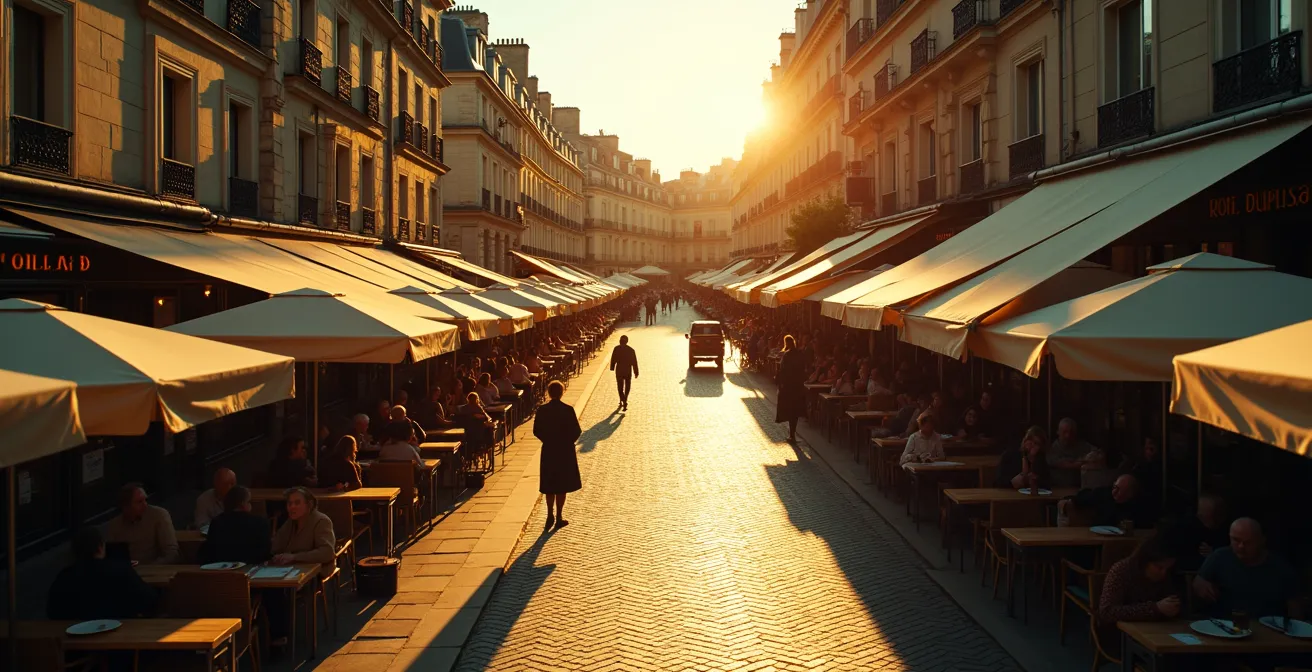
You can also use modern technology to your advantage. Before leaving your apartment, use the 3D view in Google Maps and drag the time slider to 5 PM to see exactly where the shadows will fall. Apps like Sun Surveyor provide real-time sun path tracking for your specific location. In the Marais, this means seeking out the west-facing terraces on Rue de Bretagne. In Saint-Germain, the eastern side of Rue de Buci is a prime target. Arriving by 4:30 PM is crucial to claim these premium sunlit spots before the after-work rush begins.
Can You Drink Alcohol in Public Parks After 9 PM?
The social theatre of Paris extends beyond the café terrace. Understanding the rules of public space is crucial, especially when it comes to the beloved tradition of the evening pique-nique. The question of whether you can drink a bottle of wine in a public park is a classic example of the gap between French law and French social practice. The official answer is often no, but the practical answer is “it depends on how you do it.”
French regulations on alcohol in public spaces operate through a system of local decrees called arrêtés préfectoraux. These rules can vary significantly from one park or district to another. For example, in Paris, alcohol consumption is frequently banned in prominent locations like the Champ de Mars after 4 PM or along the banks of the Seine after 9 PM during certain periods. However, the enforcement of these rules is key.
The Art of the ‘Pique-nique Discret’
The enforcement of public alcohol bans typically focuses on preventing public disorder—loud noise, disruptive behavior, and obvious intoxication—rather than punishing a quiet couple sharing a bottle of rosé. The French approach emphasizes subtlety and respect for public space. This is the “pique-nique discret” technique. Wine is poured into non-descript cups, the bottle is kept in a bag rather than displayed on the blanket, and conversation levels are kept low. By behaving discreetly and respectfully, you are unlikely to be bothered. The Canal Saint-Martin, for instance, has a long-standing tolerance for evening picnics, representing a different social contract than the more formal, monitored parks. The ultimate rule is to clean up completely; leaving no trace is the most important part of the unspoken agreement.
This illustrates a core aspect of French culture: rules are often seen as a framework, and intelligent, respectful navigation within that framework is expected. It’s another form of social performance, where demonstrating discretion and respect for others is your ticket to enjoying the space.
Key takeaways
- Your terrace coffee price is “rent” for a seat at the social theatre of the street; lingering is expected.
- The “grumpy” waiter isn’t rude; their efficiency and discretion are signs of professional, non-intrusive service.
- “Performative contemplation” (reading, writing) is a key social signal that legitimizes your long stay.
How to Plan Your Walking Tour to Hit the Best Bistro Exactly at Noon?
The final act in our Parisian social theatre is mastering the timing of your entrance, particularly for the sacred ritual of lunch. Many tourists make the mistake of planning to arrive at a bistro at 12:00 PM sharp, only to find it empty or just beginning to stir. While noon marks the official start, the real rhythm of French lunch service is slightly delayed. Understanding this can mean the difference between an awkward, solitary meal and a vibrant, authentic experience.
The golden window for arriving for lunch is between 12:15 PM and 12:45 PM. According to traditional French dining customs, 12:30 PM is when service truly kicks off. Arriving slightly before this—say, at 12:25 PM—is the perfect strategy. You beat the crush of local office workers who flood in at 12:30, securing a good table while still being part of the bustling atmosphere. Using Google Maps’ “Arrive by” feature is an excellent tool for timing your walk perfectly.
To find the best spots, look for the tell-tale signs of an authentic bistro. A handwritten chalk menu board, or ardoise, is a near-guarantee that the menu is fresh daily and caters to a local clientele. These places, often found in abundance in the 9th and 11th arrondissements, are where you’ll find the best value formule déjeuner (set lunch menu). Follow the locals, especially those carrying a newspaper; they are the most reliable guides to the best lunchtime stages in the city.
Mastering the Parisian terrace, park, or bistro is not a science; it’s an art form. It’s about observing, understanding the unspoken choreography, and playing your part with confidence and grace. It’s about realizing that your presence contributes to the vibrant tapestry of the city.
Now that you are equipped with the cultural codes, the next logical step is to put them into practice. Choose a café, order your single coffee, and begin your performance as a seasoned observer of Parisian life.
Frequently Asked Questions About Parisian Café Culture
Why don’t French waiters smile or chat?
French waiters are professionals in a respected trade, valuing precision and efficiency over forced friendliness. They see their role as providing expert service, not entertainment.
How do I get a waiter’s attention politely?
Make gentle eye contact and give a subtle nod or slightly raised hand. Never snap fingers or shout ‘Garçon!’ – instead, say ‘Excusez-moi’ when they pass by.
Why does my waiter seem to ignore me after taking my order?
This is intentional – they’re giving you privacy to enjoy your time. In France, constant check-ins are considered intrusive. You’ll need to signal when you want the bill.