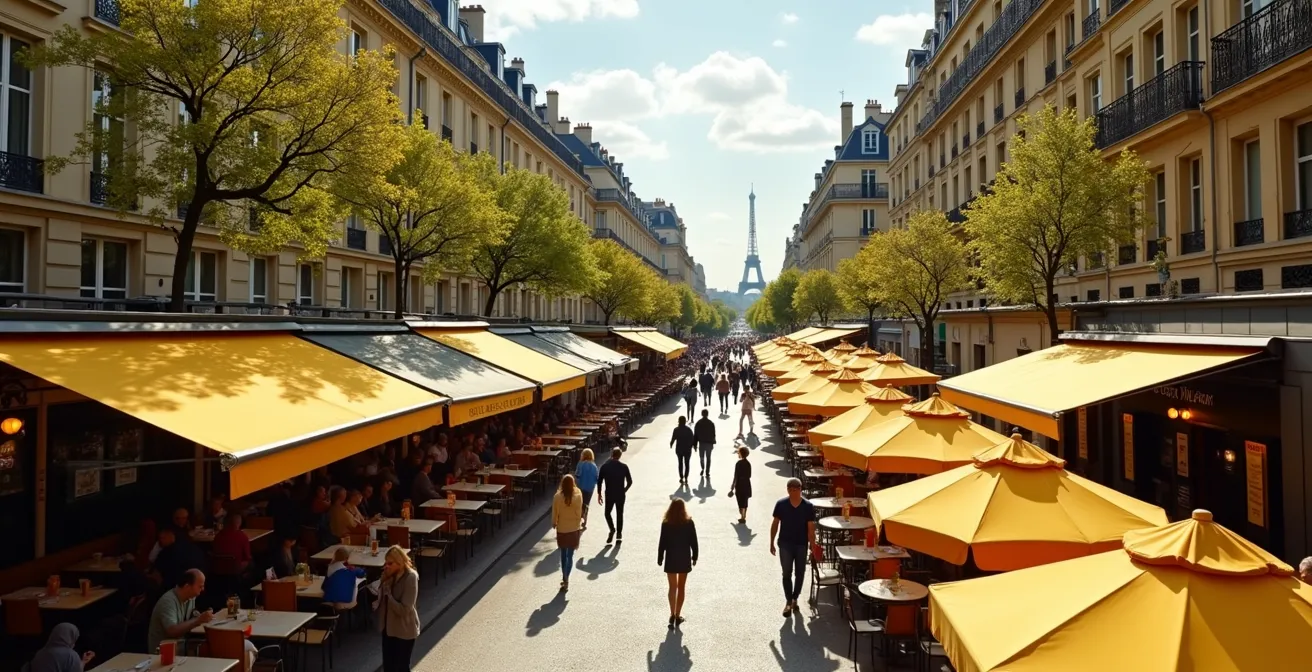
The secret to a perfect Paris day isn’t where you go, but when you eat; true itinerary architects build their schedule around the meal.
- Reverse-engineer your itinerary from your lunch spot, not towards it, treating the bistro as a logistical anchor.
- Master Parisian dining mechanics like ‘service continu’ and tiered pricing to navigate the city like a local.
Recommendation: Start with the “Monument-to-Bistro Strategic Pairings” table in this guide to build your first culinary-anchored day.
The classic Parisian nightmare isn’t getting lost in the Louvre; it’s being ravenously hungry at 1 PM, surrounded by charming streets, yet utterly incapable of finding a decent, available bistro. You wander aimlessly, growing increasingly frustrated, until you finally capitulate and sit at the first tourist trap with an English menu and a surly waiter. You’ve wasted an hour, your feet ache, and your perfect Parisian lunch has devolved into a plate of mediocre steak-frites.
Most travel advice offers generic solutions: “book in advance” or “eat where the locals eat.” But this advice fails the organized traveler because it misses the fundamental point. The problem isn’t a lack of good restaurants; it’s a lack of a sound logistical strategy. What if the key wasn’t to fit a meal into your sightseeing plan, but to architect your entire day’s itinerary around the meal itself? This is the principle of the Culinary Anchor.
This guide rejects aimless wandering. It provides a strategic framework for planning your Paris walking tours by treating your noon bistro reservation as the fixed, unmovable center of your universe. By understanding the underlying cultural and logistical mechanics of Parisian dining and then reverse-engineering your morning’s activities, you can eliminate stress, save precious time, and ensure you arrive at your chosen table relaxed, on time, and ready for a truly memorable meal.
To become a true itinerary architect, you first need to understand the rules of the game. The following sections break down the essential, often-unspoken, codes of Parisian bistro culture, providing the foundational knowledge you’ll need before we assemble the master plan.
Summary: Architecting Your Perfect Parisian Food Day
- Eating at 4 PM: Which Top Bistros Won’t Turn You Away?
- Why Coffee Costs 1.20€ at the Counter and 2.50€ at the Table?
- High Chairs and Crayons: Do Trendy Neo-Bistros Welcome Toddlers?
- The “Pipi Room” Code: Can You Use a Bistro Toilet Without Buying a Coffee?
- Coworking Friendly: Which Bistros Allow Laptops During Lunch Rush?
- Sequence Your Visit: Which Monument to Start With to Save 2 Hours?
- The Lunch Deal: Which Starred Restaurants Offer Menus Under 60€?
- How to Get a Table at a Popular Parisian Bistro Without a Reservation?
Eating at 4 PM: Which Top Bistros Won’t Turn You Away?
One of the most jarring realities for visitors in Paris is the sacred lunch window, typically from 12:00 PM to 2:30 PM. Arrive at 3:00 PM, and you’re likely to be met with a polite but firm “la cuisine est fermée” (the kitchen is closed). This rigid schedule is the enemy of the flexible tourist. The solution lies in understanding a key French term: “service continu” or “non-stop service.” Establishments offering this are your strategic allies for off-peak dining.
These are often traditional brasseries, which by nature were designed for longer service hours, rather than traditional bistros which operate on a more restaurant-like schedule. Targeting these venues is essential for anyone whose itinerary doesn’t conform to the strict French lunch hour. Tourist-heavy areas like Le Marais, Saint-Germain-des-Prés, or the streets surrounding major landmarks are more likely to have establishments catering to international dining patterns. For example, the vibrant Marais district has adapted significantly, with many places along Rue des Rosiers and near the Place des Vosges serving food throughout the afternoon.
However, all-day service doesn’t have to mean lower quality. A crucial sign to look for is the “Fait Maison” (homemade) logo on the menu, a government-regulated label indicating that the majority of the dishes are cooked from raw ingredients on-site. Finding a brasserie with both “service continu” and “Fait Maison” is the holy grail for a high-quality meal at 4 PM. This knowledge allows you to plan a late museum visit without the looming stress of a city-wide kitchen shutdown.
Mastering this aspect of Parisian time management transforms you from a frantic tourist into a savvy planner who eats well on their own schedule.
Why Coffee Costs 1.20€ at the Counter and 2.50€ at the Table?
This isn’t a tourist scam; it’s a fundamental transaction in the Parisian economy of space and time. The price difference between “au comptoir” (at the counter) and “en salle” (at a table) reflects exactly what you are purchasing. At the counter, you’re buying a product: a quick shot of espresso. It’s a fleeting, five-minute act of consumption. When you choose to sit, you’re renting a service and a slice of Parisian real estate. You’re paying for the waiter’s time, the comfort of the chair, and the unwritten social license to linger.
This pricing structure is a transparent code. It allows the café to serve both the hurried local grabbing a quick “café” on their way to work and the contemplative tourist who wants to people-watch for an hour. Understanding this system is crucial for the itinerary architect. Need a quick caffeine hit between museum sprints? Stand at the bar. Want to rest your feet and map out your next move? The extra euro is your rent for that privilege. An expert puts this dynamic into perfect perspective.
Standing at the bar is a transient, 5-minute act. Sitting down buys you the right to linger, people-watch, and use the restroom without social stigma.
– Chef Tris, Eat Like The French – Paris Food Tours Guide
This logic applies across different types of coffee, each with its own tiered pricing. The following table breaks down the common options, giving you the vocabulary and the strategic cost-benefit analysis for your next coffee break.
| Coffee Type | Description | Counter Price (avg) | Table Price (avg) | Best For |
|---|---|---|---|---|
| Un café | Single espresso shot | 1.20€ | 2.50€ | Quick morning boost |
| Une noisette | Espresso with spot of milk | 1.40€ | 3.00€ | Softer than straight espresso |
| Un crème | Espresso with steamed milk | 1.80€ | 3.50€ | Breakfast companion |
| Un allongé | Longer espresso with water | 1.30€ | 2.80€ | American-style preference |
Embracing this system allows you to use Paris’s cafés not just for refreshment, but as strategic pit-stops tailored to your specific needs of the moment: speed or rest.
High Chairs and Crayons: Do Trendy Neo-Bistros Welcome Toddlers?
Paris has a reputation for being less-than-accommodating to young children, especially in its chic dining establishments. While you may not find a changing table in every restroom, the city is far more family-friendly than stereotypes suggest, provided you plan strategically. The key is to distinguish between the different types of eateries. A cramped, trendy neo-bistro in the 11th arrondissement at 9 PM is a different universe from a spacious brasserie in a residential neighborhood at noon.
Larger, traditional brasseries are generally a safer bet. Their larger layouts can more easily accommodate strollers, and their bustling, slightly louder atmosphere is more forgiving of a child’s presence. Neo-bistros, prized for their intimate settings and innovative cuisine, can be trickier. Space is often at a premium, and the clientele is typically seeking a quieter, more adult-focused experience. The best approach is to call ahead. A simple question, “Les enfants sont-ils les bienvenus?” (Are children welcome?), clarifies the situation immediately.
Knowing a few key phrases can make all the difference, signaling to the staff that you are a considerate and prepared parent. Being able to ask “Avez-vous une chaise haute?” (Do you have a high chair?) or “Pouvons-nous laisser la poussette ici?” (Can we leave the stroller here?) smooths the way for a positive experience. Aiming for an earlier lunch, around 12:00 PM, also helps, as you’ll be seated before the main rush, giving you more space and a more relaxed staff.
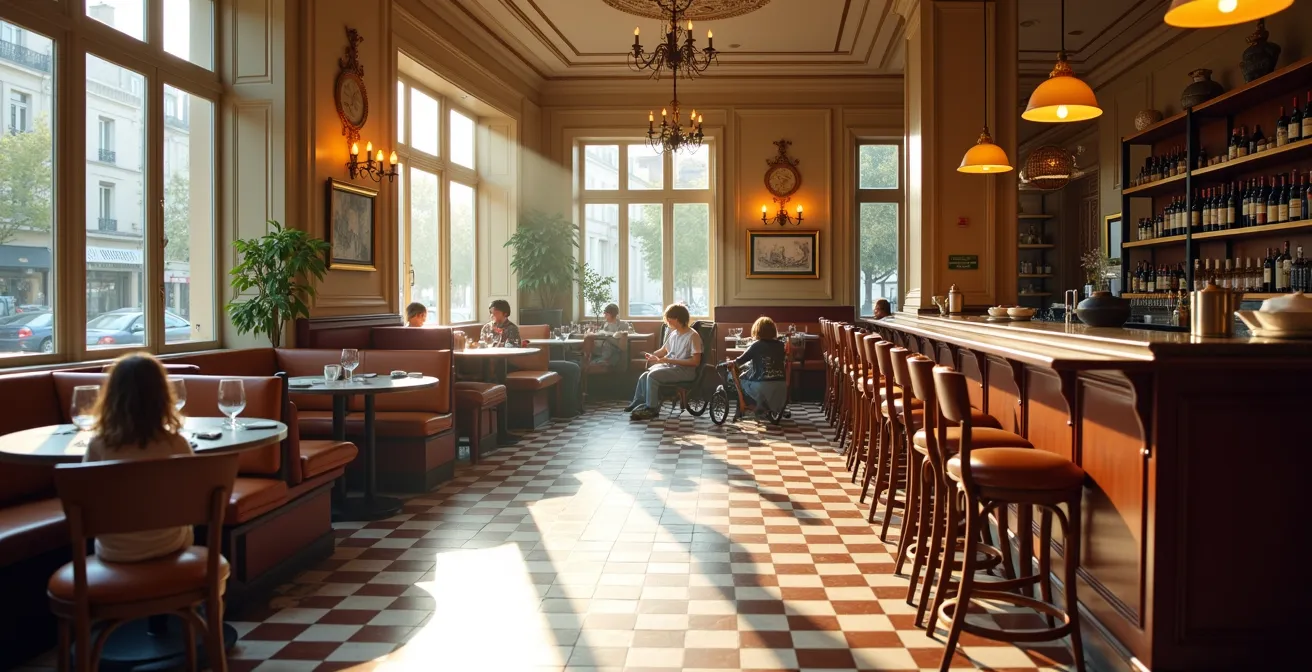
Ultimately, a successful family meal in Paris is a matter of alignment. By matching the type of establishment, the time of day, and your expectations, you can absolutely enjoy the city’s culinary scene with toddlers in tow. Choosing a classic brasserie with ample space, as depicted, is often the most reliable strategy for a stress-free meal.
This forethought not only ensures your family’s comfort but also shows respect for the establishment’s culture, paving the way for a warm welcome.
The “Pipi Room” Code: Can You Use a Bistro Toilet Without Buying a Coffee?
The short, socially-correct answer is no. A bistro’s restroom (“les toilettes”) is considered a facility for paying customers. Walking in off the street and using the toilet without a purchase is a significant social faux pas. It’s seen as taking advantage of a private business’s amenities. However, as with most unwritten rules in Paris, there is a coded and universally accepted way to gain access: buy something. Anything.
The most efficient method is the quick espresso at the counter. It’s the minimum viable transaction. An official-looking study isn’t needed to know that the universally accepted ‘pass’ for toilet access is a quick coffee at the counter for about €1.20. This small purchase transforms you from a freeloader into a customer, earning you the right to request the key or code for the “pipi room.” Attempting to use the facilities without this transaction will, at best, result in an awkward refusal and, at worst, a stern lecture from the proprietor.
However, the savviest itinerary architect has a better plan. Instead of being forced into transactional coffees, you can build strategic restroom breaks into your walking route. Major Parisian department stores like Galeries Lafayette, Printemps, and Le Bon Marché are your best friends. These “grands magasins” offer clean, free, and accessible facilities, typically located on their upper floors. For example, when visiting the Opéra Garnier, a five-minute detour to the nearby Galeries Lafayette or Printemps solves the problem elegantly and free of charge. This turns a potential point of stress into a seamless part of your day’s architecture, preserving your dignity and your euros for coffee you actually want to drink.
By integrating these “bio-breaks” into your plan, you maintain momentum and avoid the awkwardness of negotiating for basic needs.
Coworking Friendly: Which Bistros Allow Laptops During Lunch Rush?
Attempting to open a laptop in a Parisian bistro during the lunch rush (12:00 PM – 2:30 PM) is the quickest way to become a waiter’s least favorite person. This peak time is all about “le coup de feu” (the rush), and every table is valuable real estate for turning over dining customers. A laptop user is seen as a camper, occupying a two or four-person table for the price of a single coffee, blocking revenue. During these hours, it’s not just impolite; it’s a direct challenge to the bistro’s business model. Many places will politely ask you to put the laptop away.
However, Paris is not hostile to remote work; it’s simply a matter of timing and location. The golden window for laptop work is “le creux” (the lull) between 2:30 PM and 6:00 PM. After the lunch service ends and before the evening apéro crowd arrives, many cafés are happy to have a quiet customer. To find the right spot, look for establishments that identify as a “Salon de Thé.” This signage suggests a more relaxed, lingering atmosphere compared to a fast-paced bistro focused on meals.

The physical environment also offers clues. Visible power outlets along the walls, a Wi-Fi sticker in the window, or seeing other patrons already working are all green lights. Conversely, a prominent “Menu du Jour” blackboard signals a focus on rapid meal service, making it a poor choice for a work session. The image above captures the ideal scenario: a quiet afternoon, a simple coffee, and an atmosphere conducive to productivity without disrupting the cafe’s flow.
Action Plan: Identifying Laptop-Friendly Cafés
- Scan for Signals: Look for Wi-Fi stickers or passwords written on boards near the entrance.
- Power Up: Check for visible power outlets along walls or under tables before you order.
- Observe the Crowd: See if other patrons are already working on laptops. This is the strongest indicator of acceptance.
- Avoid Meal-Focus: Steer clear of places with prominent ‘Menu du Jour’ blackboards, which indicate a focus on fast turnover.
- Target the Right Type: Look for establishments with ‘Salon de Thé’ (Tea Room) signage, suggesting a more relaxed, lingering atmosphere.
- Time it Right: Visit during ‘le creux’ (the lull) between 2:30 PM and 6:00 PM for the highest likelihood of a warm welcome.
This strategic approach ensures you find a welcoming space while respecting the unwritten rules of Parisian café culture.
Sequence Your Visit: Which Monument to Start With to Save 2 Hours?
This is where all the foundational knowledge pays off. This is the core of the Culinary Anchor strategy. Instead of asking, “What should we see before lunch?”, the architect asks, “Our bistro is in Le Marais at 12:30 PM; what is the most efficient and enjoyable way to use our morning to arrive there?” This simple flip in perspective, from monument-first to food-first, is the secret to a perfectly paced day. It eliminates the “what’s near us?” scramble and replaces it with a purposeful, pre-planned journey.
The process is simple: first, you secure your lunch reservation. This is your anchor. Second, you use its location to dictate your morning’s primary activity. Your chosen monument should be one that allows for a logical, pleasant, and time-efficient path *to* your restaurant, not away from it. This reverse-engineering saves you from backtracking across the city, saving up to two hours of travel and transition time.
For example, if your coveted table is in Saint-Germain, starting your day at the Eiffel Tower is a logistical masterpiece. A 30-minute stroll along the Seine is a beautiful part of the experience, leading you directly to your destination. Conversely, starting at Sacré-Cœur would be a strategic disaster, involving a long and disconnected Metro ride. The goal is to create a seamless narrative for your morning, where the final scene is arriving, stress-free, at your bistro.
This table provides a blueprint for this reverse-engineered approach. It’s not just a list of pairings; it’s a strategic guide to architecting your perfect Parisian morning, ensuring your cultural intake is perfectly sequenced with your culinary destination. According to a strategic guide from a Paris tour company, these pairings are optimized for timing and enjoyment.
| Morning Monument | Target Bistro Area | Walking Time | Metro Alternative | Lunch Timing |
|---|---|---|---|---|
| Louvre (9 AM start) | Le Marais bistros | 25 min via Tuileries | Line 1: 8 min | Perfect 12 PM arrival |
| Eiffel Tower (8:30 AM) | Saint-Germain | 30 min along Seine | Line 6: 12 min | 12:15 PM arrival |
| Sacré-Coeur (9:30 AM) | Montmartre bistros | 5 min downhill | No need | 11:45 AM early lunch |
| Notre-Dame area (10 AM) | Latin Quarter | 10 min walk | No need | 12 PM arrival |
By adopting this food-first methodology, you transform your trip from a series of disconnected events into a cohesive and delicious experience.
The Lunch Deal: Which Starred Restaurants Offer Menus Under 60€?
The idea of dining at a Michelin-starred restaurant in Paris often evokes images of triple-digit bills. However, the savvy itinerary architect knows the secret to accessing this world of culinary excellence for a fraction of the price: the “menu déjeuner” (lunch menu). Many of the city’s most acclaimed chefs offer set lunch menus on weekdays, providing a gateway to high-end dining without the extravagant cost. It’s a strategy that allows them to fill tables during a slower service and build a relationship with future dinner patrons.
Your target is not just any starred restaurant, but also those recognized with a “Bib Gourmand” by the Michelin guide. This distinction specifically highlights establishments offering exceptional value. In France, this often means you can find a remarkable three-course meal; the Michelin Bib Gourmand distinction highlights exceptional value restaurants typically priced at under €40. For starred restaurants, a lunch menu under €60 is a common and highly sought-after offering.
Securing these deals requires a specific booking strategy. These lunch slots are often more competitive than dinner reservations and may not be advertised on online booking platforms. A direct phone call to the restaurant, specifically requesting the “menu déjeuner,” is the most effective method. Be prepared for a fixed, no-choice menu—this is the trade-off for the accessible price. Booking two to three weeks in advance is highly recommended, especially for the most popular establishments. By planning ahead, you can anchor your day’s itinerary with a truly exceptional meal that delivers far more value than its price suggests.
This level of planning elevates a simple lunch into a highlight of your trip, proving that haute cuisine in Paris can be accessible.
Key Takeaways
- The Culinary Anchor Principle: Always plan your day’s logistics by starting with your meal reservation and working backward, not the other way around.
- Master the Mechanics: Understand concepts like “service continu” and tiered café pricing to navigate Paris efficiently and avoid common tourist frustrations.
- Reverse-Engineer Your Itinerary: Use the “Monument-to-Bistro” pairings as a blueprint to create a seamless, stress-free flow from sightseeing to dining.
How to Get a Table at a Popular Parisian Bistro Without a Reservation?
Even the most meticulous planner can face a situation where a reservation is impossible or a plan falls through. In these moments, simply “showing up” at a popular bistro and hoping for the best is a low-percentage strategy. The Parisian system has its own set of backdoors and contingency plans for the determined diner. The first rule is to avoid the peak times of 12:30 PM for lunch and 8:30 PM for dinner. Your best shot is to arrive at the very beginning of service (12:00 PM sharp) or toward the very end (around 2:00 PM).
A more proactive approach is what one expert suggests. Instead of arriving unannounced, it’s better to plan ahead, even if just slightly. As one Paris food tour expert advises:
Advise against just showing up. Instead, call the restaurant 30 minutes before you plan to arrive (e.g., at 11:30 AM for lunch) to check for last-minute cancellations.
– Paris Food Tours Expert, Original Food Tours Paris Guide
This small gesture shows respect and allows the restaurant to manage its seating efficiently, dramatically increasing your chances. However, the most advanced strategy is the “sister restaurant” hack. Many famous, fully-booked restaurants in Paris are run by chefs who also operate more casual, no-reservation wine bars or takeaway counters nearby. For example, when the celebrated bistro Frenchie is booked months in advance, savvy diners head to the nearby Frenchie Bar à Vins, which operates on a first-come, first-served basis. It offers a similar culinary DNA and quality in a more spontaneous format. Identifying these sister establishments is a pro-level move that provides a brilliant Plan B for your Culinary Anchor.
Your final step as a travel itinerary architect is to integrate these strategies. Begin crafting your next Parisian journey not with a list of museums, but with a single, perfect bistro reservation, and let the entire, delicious day unfold from there.