In summary:
- Paris offers profound spiritual experiences for English speakers beyond just famous churches, including active monasteries and quiet chapels.
- Authentic connection involves understanding French customs, such as the etiquette for lighting candles and the importance of donations.
- You can access living traditions like Gregorian chants and find dedicated silent zones for personal meditation across the city.
- Even with Notre-Dame’s reconstruction, its spiritual life continues in a temporary home, and other sites like the Grand Mosque offer universal contemplative spaces.
Welcome to Paris. For many English-speaking visitors and expatriates, finding a spiritual home in this bustling city can feel like a daunting task. You might know the famous cathedrals as landmarks, but how do you find a welcoming community for worship? The search often leads to a short list of well-known American churches, which are wonderful, but they only scratch the surface of the city’s deep spiritual reservoir. You might feel like you’re missing out on the authentic, centuries-old traditions that beat at the heart of Paris.
The key isn’t just finding a directory of services; it’s about learning how to access the city’s living spiritual life. This means understanding the cultural etiquette of worship in France, knowing where to find ancient practices still thriving today, and discovering spaces that offer true contemplative solace. This guide is designed to be your companion in that journey. We’ll move beyond simple listings to explore how you can genuinely connect with a faith community, whether through a traditional mass, the resonant power of a choir, or a moment of quiet reflection in a sacred garden. It’s about transforming your visit from that of a spectator to a participant in the spiritual tapestry of Paris.
This article will guide you through the most significant and accessible places for English speakers, detailing not just the ‘where’ but the ‘how’ of experiencing them fully. From world-renowned pilgrimage sites to hidden havens of silence, you’ll discover the opportunities for worship, reflection, and community that await you.
Summary: A Guide to English-Speaking Worship and Spiritual Discovery in Paris
- The Miraculous Medal Chapel: Why It Attracts 2 Million Pilgrims a Year?
- Gregorian Chants: Which Monastery in Paris Still Practices This Tradition Openly?
- Candles and Offerings: How to Properly Light a Candle in a French Catholic Church?
- The Grand Mosque of Paris: How to Visit the Gardens and Tea Room Respectfully?
- Silence Zones: Which Churches Strictly Prohibit Guided Tours for Meditation?
- Saint-Sulpice or Saint-Eustache: Which Church Offers a Similar Choir Experience?
- Where to See the Ghost of the Tuileries Red Man?
- How to Experience the Magic of Notre-Dame While It Is Under Reconstruction?
The Miraculous Medal Chapel: Why It Attracts 2 Million Pilgrims a Year?
Tucked away from the noise of the grand boulevards, the Chapel of our Lady of the Miraculous Medal on Rue du Bac is not just a church; it’s one of the world’s most cherished pilgrimage sites. Its fame comes from the Marian apparitions to Saint Catherine Labouré in 1830, which led to the creation of the Miraculous Medal. For English-speaking visitors, it offers a profound sense of peace and a direct connection to a global faith tradition. The chapel’s power lies in its intimacy and the tangible sense of devotion that fills the air, attracting over 2 million pilgrims yearly.
The experience is made accessible to international visitors, with multilingual resources available to explain the story of the apparitions. Here, you can see the incorrupt body of St. Catherine Labouré herself, displayed in a glass casket to the right of the main altar, adding a powerful physical dimension to the spiritual narrative. For a quieter and more contemplative visit, weekday mornings are ideal, allowing you to avoid the larger crowds that gather on weekends. The journey is simple, with the Sèvres-Babylone metro station just a short walk away, making this a truly accessible haven of spiritual integration in the heart of Paris.
To make the most of your pilgrimage, English-language pamphlets are available at the entrance, and you can often find video presentations about the apparitions in English upon request. After your moment of prayer, you can visit the Espace Médailles shop to purchase medals, which the staff can help you get blessed. This transforms a simple souvenir into a meaningful sacramental.
Gregorian Chants: Which Monastery in Paris Still Practices This Tradition Openly?
For those seeking to experience a truly ancient and living tradition, the sound of Gregorian chant offers a direct conduit to centuries of monastic prayer. While many churches feature classical music, the authentic, daily practice of chant is a rarer treasure. In Paris, the most prominent home for this tradition is the Church of Saint-Gervais-Saint-Protais in the Marais district. It is here that the Monastic Fraternities of Jerusalem have their base, integrating this ancient musical form into public services.
This community is unique in its mission to live a monastic life in the “desert of the city.” They open their Liturgy of the Hours to all visitors, offering a remarkable opportunity for spiritual integration. The most moving services include Vespers (evening prayer) at 6 p.m. and Lauds (morning prayer) daily. The 11 a.m. Sunday mass is particularly powerful, as it is fully animated by the community’s chants, filling the historic Gothic space with ethereal, contemplative sound. This is not a performance for tourists but an authentic act of worship, allowing you to participate in a timeless spiritual practice.
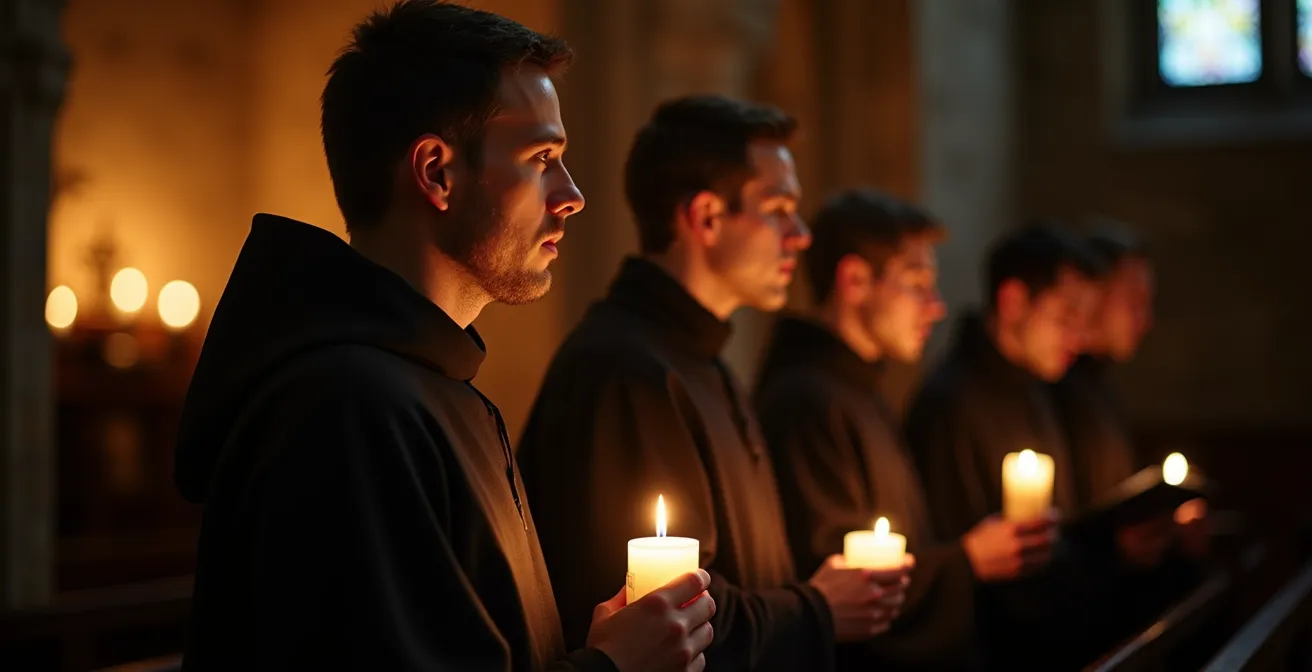
As you sit in the ancient choir stalls, the chants wash over you, creating a space for meditation that transcends language. According to a case study on Parisian churches, the experience at Saint-Gervais is particularly moving because it connects visitors to the ancient practice of chant within a vibrant, active community. You are not merely an observer; you are invited into a sacred rhythm of prayer that has echoed through the city for generations.
Candles and Offerings: How to Properly Light a Candle in a French Catholic Church?
Lighting a candle in a French church is a small but deeply meaningful act of prayer, a silent message of hope, remembrance, or gratitude. For many visitors, it’s a way to participate in the church’s spiritual life without needing to know the language. However, there is a cultural etiquette to this practice that enhances its significance. In France, where the 1905 law on the Separation of the Churches and the State means that most church buildings are state-owned, these small donations are vital. Your offering in the ‘tronc’ (offering box) directly supports the church’s ‘vie matérielle’—its material life, covering costs like heating and lighting.
As noted in analyses of the Catholic Church in France, this practice is a cornerstone of the laity’s support for its 45,000 church buildings. You will often find candle stands near side chapels dedicated to popular saints like Saint Thérèse of Lisieux or Saint Anthony of Padua. The act is simple: you make a small donation (typically 1-2€ is suggested), choose a candle, and use a lit taper to light your own before placing it securely in the stand. This moment is an invitation to silent prayer and reflection, connecting you to the countless souls who have performed the same ritual over centuries.
Your Action Plan: Lighting a Candle with Respect and Intention
- Locate the ‘tronc’ (offering box), usually found near the candle stands in side chapels.
- Make a donation of 1-2€, a suggested amount that helps maintain the church.
- Choose your candle; smaller ‘veilleuses’ in racks are common, but larger individual candles may be available.
- Use a long, lit taper provided nearby to light your own candle’s wick. Avoid using lighters or matches.
- Place your candle securely in an empty spot on the stand.
- Take a moment for your personal, silent prayer or intention.
- For fire safety, be sure to properly extinguish the lighting taper in the designated pot of sand.
The Grand Mosque of Paris: How to Visit the Gardens and Tea Room Respectfully?
Spiritual solace in Paris is not limited to Christian traditions. The Grande Mosquée de Paris, with its stunning Hispano-Moorish architecture, offers a unique and welcoming space for contemplation to people of all faiths. Built in the 1920s to honor the North African Muslim soldiers who died for France in World War I, the mosque is a powerful symbol of gratitude and intercultural connection. While the main prayer hall is reserved for Muslim worship, the mosque was designed with public areas meant for universal enjoyment and reflection.
The key to a respectful visit is understanding the distinction between its public and private spaces. The highlight for non-Muslim visitors is the Andalusian-style garden. In Islamic tradition, gardens are a representation of paradise, and this tranquil space with its mosaics, fountains, and fragrant flora is designed to inspire peace and meditation. It is a ‘universal contemplative space’ where quiet reflection is encouraged. After wandering the gardens, a visit to the adjacent tea room (salon de thé) is a must. Here, you can enjoy traditional mint tea and North African pastries in a vibrant, social atmosphere. A simple ‘Bonjour’ upon entering is always appreciated.
To help visitors navigate the space, it’s useful to understand the different areas and their access rules. The following table breaks down what is available to the general public.
| Area | Access | Best Time to Visit | Etiquette |
|---|---|---|---|
| Gardens & Patios | Open to all visitors | Weekday mornings | Quiet contemplation encouraged |
| Tea Room | Public (entrance fee) | Afternoons | Greet with ‘Bonjour’ |
| Prayer Hall | Muslims only | N/A | Not accessible to tourists |
| Boutique | Open to all | During opening hours | Browse respectfully |
Silence Zones: Which Churches Strictly Prohibit Guided Tours for Meditation?
In a city as popular as Paris, finding true silence can be a spiritual quest in itself. While grand churches are often filled with the chatter of tour groups, many actively preserve spaces for quiet prayer and meditation. These “zones de silence et de recueillement” are havens for those seeking to escape the noise and connect with the divine in peace. These are not just quiet corners but often entire churches or designated chapels where speaking is forbidden and contemplation is the sole purpose.
Several historic churches are known for prioritizing worship over tourism. Saint-Julien-le-Pauvre, one of Paris’s oldest churches, maintains strict silence zones, its ancient stones creating a profound sense of tranquility. Similarly, Église Saint-Séverin in the Latin Quarter has a smaller tourist footprint and is home to an active contemplative community, making it a reliable sanctuary. Even within the bustling Sacré-Cœur Basilica in Montmartre, you can find the Chapel of the Blessed Sacrament, a designated silent prayer area. It’s here that a remarkable, uninterrupted tradition of prayer has been maintained, where silent night adoration has taken place every night since 1885.
To find these spaces, look for signs reading “Zone de silence” and respect them as you would a library. Visiting during early morning hours, typically before 9 a.m., will almost always guarantee maximum tranquility. The most important piece of cultural etiquette is to remember that these are primarily ‘lieux de culte’ (places of worship). By entering with a spirit of reverence, you will be warmly, if silently, welcomed.
Saint-Sulpice or Saint-Eustache: Which Church Offers a Similar Choir Experience?
For many, the sacred music of a grand choir and organ is the pinnacle of the spiritual experience. With Notre-Dame’s music program temporarily relocated, many visitors seek a similar auditory and spiritual grandeur elsewhere. Two magnificent Parisian churches, Saint-Sulpice and Saint-Eustache, stand out as primary contenders, though they offer distinct experiences. Saint-Sulpice, second in size only to Notre-Dame, is famed for its grand, formal, and classical musical tradition, anchored by its world-renowned Cavaillé-Coll organ. Attending a service or one of the free Sunday afternoon organ recitals here is an experience that attracts music connoisseurs from around the globe.
Saint-Eustache, located near Les Halles, offers a different but equally powerful atmosphere. It boasts the largest pipe organ in France and is known for a musical style that blends classical with more contemporary pieces, reflecting its reputation as the ‘heart of Paris.’ Its audience is often more diverse, and its concert program is robust. The choice between them depends on your preference: the sophisticated, classical vastness of Saint-Sulpice or the more accessible, blended Gothic-Renaissance acoustics of Saint-Eustache.
This comparative table, based on information from A Catholic’s Guide to Paris, can help you decide which musical pilgrimage suits you best.
| Aspect | Saint-Sulpice | Saint-Eustache |
|---|---|---|
| Musical Style | Grand, formal, classical | Mix of classical and contemporary |
| Famous For | Cavaillé-Coll organ, world-renowned | Largest pipe organ in France |
| Audience | Music connoisseurs | More accessible, diverse crowd |
| Free Concerts | Sunday afternoons | Regular recitals and concerts |
| Acoustics | Classical vastness | Gothic-Renaissance blend |
| Atmosphere | Formal, sophisticated | ‘Heart of Paris’ feel, Les Halles roots |
Where to See the Ghost of the Tuileries Red Man?
Parisian spirituality is layered with history, myth, and folklore that coexist with formal religion. One of its most enduring legends is that of the ‘Homme Rouge des Tuileries’ (the Red Man of the Tuileries). This phantom is not a typical ghost but a spiritual portent, said to have appeared to French royalty, including Marie Antoinette and Napoleon, just before major calamities. The legend embodies themes of impermanence, the fall of power, and the turbulent spiritual history of the nation. The Tuileries Palace, where he was said to appear, was burned down during the Paris Commune in 1871.
Today, you cannot see the ghost, but you can connect with its story in a contemplative way. The Jardin des Tuileries, which now stands on the site of the former palace, serves as a powerful space for meditation on these themes. Walking through these formal gardens, you can reflect on the rise and fall of empires and the transient nature of temporal power. This folklore offers a different kind of spiritual solace—one rooted in history, myth, and the collective memory of the city. The story of the Homme Rouge is a reminder that spiritual narratives are woven into the very stones and soil of Paris.
For those interested in a deeper, mystical exploration of Paris, the legend can serve as the starting point for a unique walking meditation.
- Begin at the Jardin des Tuileries for a meditation on the themes of impermanence and power.
- Walk to the Tour Saint-Jacques, a Gothic tower connected to the famous alchemist Nicolas Flamel.
- Continue into Le Marais to see Nicolas Flamel’s historic house, the oldest in Paris.
- Reflect at the Place de la Concorde, the site of the guillotine, on themes of revolution and transformation.
- End your walk at Sainte-Chapelle for a final contemplation on the contrast between spiritual and temporal power.
Key takeaways
- Paris offers deep spiritual life for English speakers that goes far beyond the main tourist-centric churches.
- Authentic, living traditions like Gregorian chants and perpetual adoration are accessible to respectful visitors.
- Understanding and observing local French cultural etiquette, such as donation practices and silence zones, greatly enhances the spiritual experience.
How to Experience the Magic of Notre-Dame While It Is Under Reconstruction?
The fire at Notre-Dame de Paris in 2019 was felt as a wound by the entire world. While the cathedral itself has been undergoing a painstaking restoration, its spiritual life—its very soul—was never extinguished. For those seeking to connect with the “magic” of Notre-Dame, the key is to understand that its community is a living one. During the reconstruction, the cathedral’s entire chapter, choir, and liturgical community found a temporary home at the nearby Church of Saint-Germain-l’Auxerrois.
This beautiful medieval church, located next to the Louvre, now hosts the official masses and services of the Notre-Dame community. Attending a service here is the most authentic way to experience the cathedral’s living tradition and pray with its congregation. You can hear the renowned choir and feel the unbroken continuity of worship that has defined Notre-Dame for over 800 years. The reconstruction itself, dubbed the ‘chantier du siècle’ (project of the century), has become a spiritual experience in its own right, a global symbol of resilience, hope, and solidarity that you can witness from the outside.
The future is bright, and the collective effort has borne fruit, with the cathedral having reopened in December 2024. The return of worship to the island is a moment of immense joy and spiritual significance for the city and the world. Experiencing Notre-Dame today is about embracing both its resilient, active spirit at Saint-Germain-l’Auxerrois and celebrating its glorious rebirth on the Île de la Cité.
Now that you know where to find these spiritual havens, the next step is to participate. We encourage you to visit one of these communities, attend a service, or simply spend a moment in quiet contemplation to truly connect with the spiritual heart of Paris.