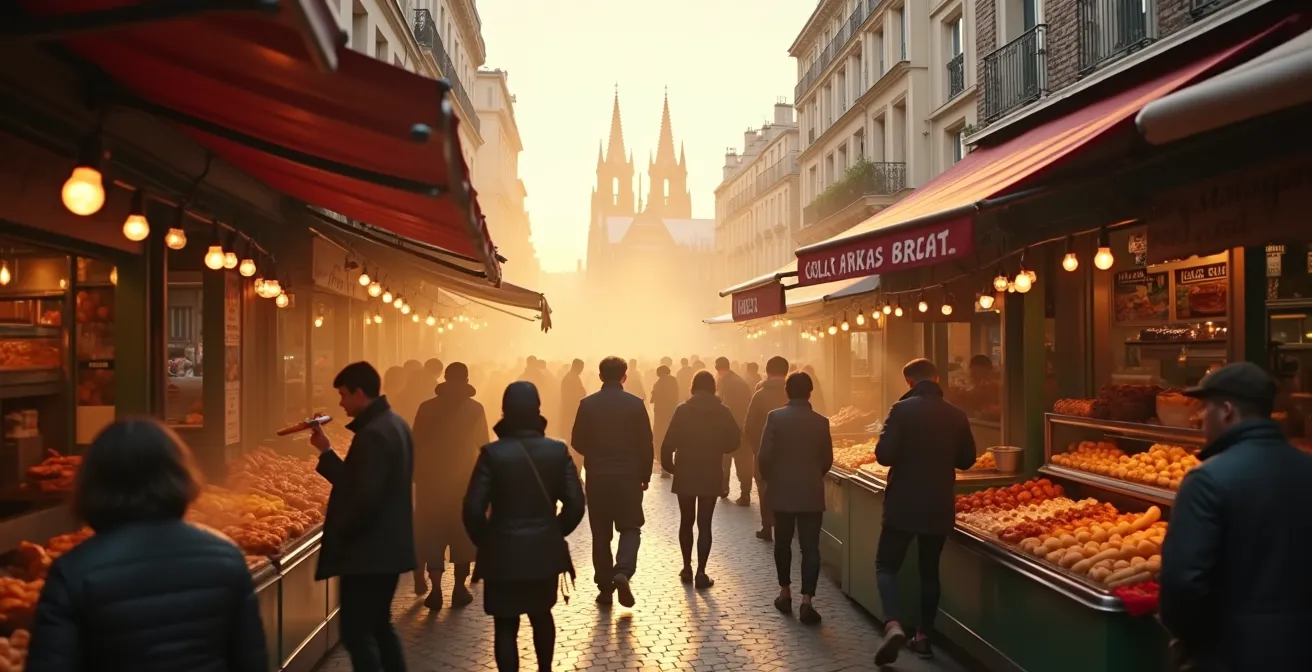
Belleville and Ménilmontant offer Paris’s best value for adventurous foodies not because they are just “cheap,” but because they are living food ecosystems designed to serve locals, not tourists.
- Unlike gentrified areas, these neighborhoods maintain authentic, immigrant-run eateries with prices 30-40% lower than in trendier spots.
- The experience goes beyond restaurants, incorporating vibrant markets, specialist shops, and unique local culture.
Recommendation: Skip the curated food tours and use this guide’s framework to explore the area’s culinary network yourself for a more authentic and affordable experience.
So, you want to eat well in Paris without burning a hole in your wallet? Most guides will point you to the Latin Quarter for a cheap crêpe or a generic “formule” lunch. You might hear about hunting for deals in Montmartre, dodging tourist traps for a semi-decent meal. But what if I told you the real heart of budget-friendly, explosive-flavor-foodie Paris lies elsewhere, in the rolling hills of the city’s northeast?
Welcome to Belleville and Ménilmontant. These neighborhoods are often described with buzzwords like “gritty,” “up-and-coming,” or “the new Brooklyn.” But that misses the point entirely. Their magic isn’t about being trendy; it’s about being real. This isn’t a curated experience. It’s a vibrant, multicultural, working-class part of Paris where the food scene has evolved to serve the people who live here—from Vietnamese and Chinese communities to North and West African families. The result is a dense, interconnected food ecosystem of incredible quality and unbeatable value.
But here’s the secret the other guides won’t tell you: the key isn’t knowing a list of three “best” restaurants. The key is understanding how to read the neighborhood itself. It’s about knowing why the pho here has a different soul than in the 13th, why the park view is better than Montmartre’s, and how a trip to the cemetery can become a culinary journey. This guide will give you that culinary GPS, turning you from a tourist into a true explorer.
Before we dive deep into Belleville’s unique ecosystem, it’s helpful to see what budget food exploration looks like in other parts of the city. The following video offers a vibrant tour of cheap street food stalls near the famous Saint-Germain-des-Prés, providing a great point of comparison for the different flavors and prices you’ll find across Paris.
In this guide, we’ll break down the fabric of these neighborhoods piece by piece. We’ll compare culinary rivals, uncover hidden villages, and give you the tools to eat, drink, and explore like a true local. Get ready to discover a side of Paris you never knew existed.
Summary: Your Culinary Guide to Belleville and Ménilmontant
- Chinatown 13th vs Belleville: Which District Has the Best Pho?
- Parc de Belleville: Why This View Rivals Montmartre Without the Tourists?
- La Campagne à Paris: How to Find This Secret Micro-Neighborhood in the 20th?
- The Gambetta Vibe: Is It Safe and Interesting for Families?
- Père Lachaise: How to Find Jim Morrison’s Grave Without Getting Lost?
- Electric or Mechanical Vélib’: Which One to Choose for Climbing to Belleville?
- Behind the Basilica: Why Rue de l’Abreuvoir Is Prettier Than the Front Steps?
- Is the Canal Saint-Martin the New Seine for Young Travelers?
Chinatown 13th vs Belleville: Which District Has the Best Pho?
The great Parisian pho debate often pits the 13th arrondissement’s established Chinatown against the vibrant, chaotic Belleville. While the 13th boasts a higher concentration of Vietnamese restaurants, Belleville wins on what I call “value density” and authentic grit. It’s not just about the soup; it’s about the entire food ecosystem. In Belleville, the Vietnamese quarter is a living network where family-run pho joints are flanked by delis (traiteurs) selling fresh spring rolls for a euro or two and banh mi stalls crafting sandwiches for under €6. It’s a system built for locals, not just for restaurant-goers.
This ecosystem keeps prices fiercely competitive. As the Culinary Backstreets food tour notes, pho prices in Belleville are often 20% lower than in the more tourist-focused 13th. The style is also different, often reflecting the Northern Vietnamese tradition with clearer, more rustic broths compared to the sweeter, richer Southern style more common in the 13th. You trade a bit of polish for a lot of soul—and shorter queues.
This comparative table from food bloggers, who analyzed the cost of food in Paris, helps break down the real-world differences for a budget foodie.
| Factor | Belleville | 13th Arrondissement |
|---|---|---|
| Average Bowl Price | €8-10 | €10-12 |
| Broth Style | Northern (rustic, clearer) | Southern (sweeter, richer) |
| Queue Time | 5-10 min | 15-20 min |
| Garnish Freshness | ★★★★☆ | ★★★★★ |
| Authentic Grit | ★★★★★ | ★★★☆☆ |
| Food Ecosystem | Excellent banh mi nearby | More variety of Vietnamese |
Ultimately, while the 13th offers more variety, Belleville provides a more integrated and budget-friendly experience. You don’t just go for pho; you immerse yourself in a neighborhood where every corner offers another delicious, affordable discovery.
Parc de Belleville: Why This View Rivals Montmartre Without the Tourists?
Everyone flocks to the Sacré-Cœur for a panoramic view of Paris. They fight through crowds, sidestep street performers, and pay premium prices for a mediocre crêpe. But locals know the best sunset spot is Parc de Belleville. Perched 108 meters high, this terraced park offers a breathtaking, unobstructed view of the city skyline—from the Eiffel Tower to Montparnasse—without the tourist circus. It’s a place where Parisians actually hang out, relax, and enjoy their city.
The real magic for a budget foodie isn’t just the view, but the opportunity it presents: the ultimate Parisian apéro-picnic. The park is the final destination in a local food scavenger hunt. You’re not a passive consumer; you’re an active participant in the neighborhood’s food ecosystem. You gather your supplies from the area’s best artisans, creating a feast for a fraction of what a restaurant meal would cost. This is the essence of experiencing Belleville like a local.
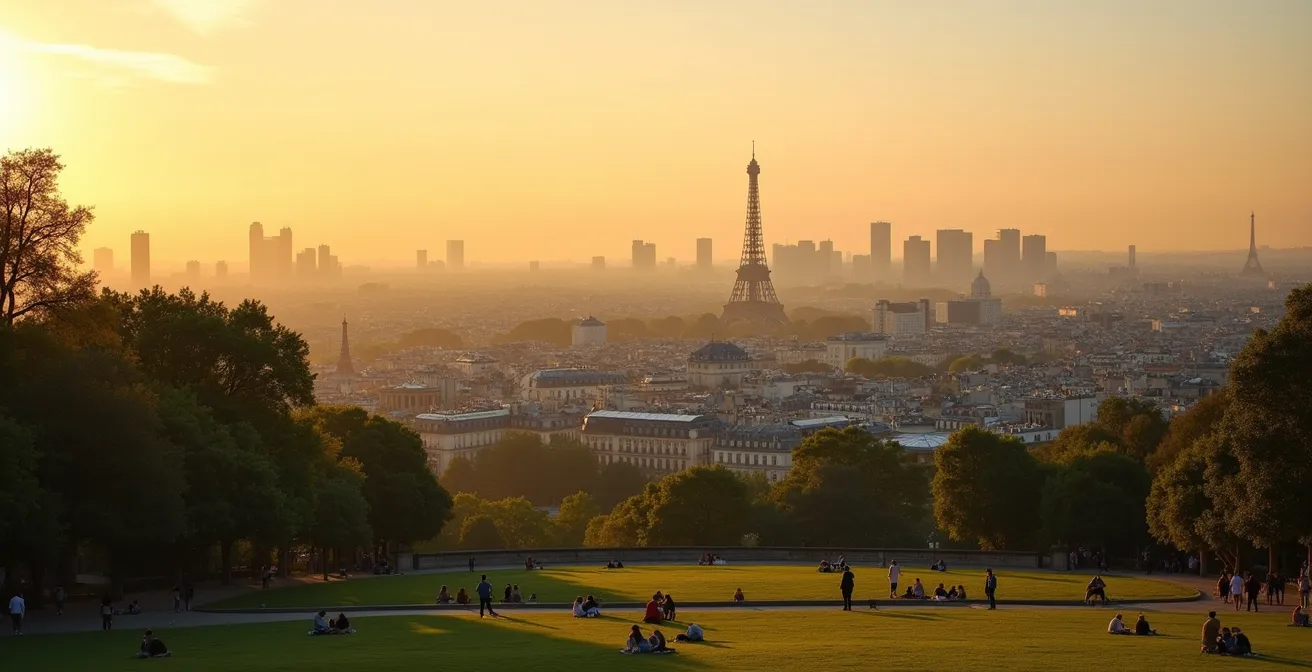
As you can see, the cascading terraces provide perfect, grassy spots to lay down a blanket and watch the city lights twinkle on. Instead of feeling like you’re at a tourist attraction, you feel like you’re part of the city itself. Here’s how to build that perfect, affordable picnic.
Your Action Plan: The Ultimate Belleville Apéro-Picnic for Under €20
- Stop 1: Buy a fresh baguette tradition at the award-winning Au 140 bakery for about €1.20.
- Stop 2: Select a delicious cheese at Fromagerie Beaufils on Rue de Belleville for €6-8.
- Stop 3: Grab a bottle of “vin de soif” (an easy-drinking wine) from a local caviste for €5-7.
- Stop 4: Pick up some seasonal fruit at the bustling Marché de Belleville (Tuesdays/Fridays) for €2-3.
- Stop 5: Head to the upper terrace of Parc de Belleville before sunset and enjoy the view.
La Campagne à Paris: How to Find This Secret Micro-Neighborhood in the 20th?
Tucked away near Porte de Bagnolet, a short walk from the Gambetta metro station, lies one of Paris’s most charming and unexpected secrets: La Campagne à Paris (“The Countryside in Paris”). This micro-neighborhood is a tiny, car-free village of 92 houses with individual gardens, cobblestone streets, and a silence that feels miles away from the city’s hustle. It’s a surreal and beautiful pocket of tranquility that most tourists—and even many Parisians—never find.
Finding it is part of the adventure. From Place Gambetta, you walk down Rue du Surmelin, then look for the steep staircase leading up to Rue Jules Siegfried. As you climb, the city noise fades, replaced by the chirping of birds. The neighborhood was originally built in 1907 as cooperative housing for quarry workers, and it retains a strong, self-contained village atmosphere. There are no shops or cafés here, which is key to its charm and also a crucial tip for the visiting foodie.
From Quarry Workers to Hidden Gem
The history of La Campagne à Paris is tied to the nearby Carrières d’Amérique. This unique housing project provided workers with homes and gardens, a radical idea at the time. Its isolation from commercial streets has preserved its character. For the modern explorer, this means planning is key. After wandering the peaceful streets, the real foodie move is to walk 10 minutes towards Porte de Bagnolet, where you’ll find some of Paris’s most authentic and affordable Senegalese restaurants, with hearty mains like thieboudienne (fish and rice) or mafé (peanut stew) for around €8-12. This completes the off-the-beaten-path experience perfectly.
This two-part journey—first the peaceful, hidden village, then a dive into the vibrant West African culinary scene—is the kind of unique, layered experience that defines the 20th arrondissement. It’s about discovering the unexpected connections between history, architecture, and food.
The Gambetta Vibe: Is It Safe and Interesting for Families?
The area around Gambetta, which serves as the southern gateway to Ménilmontant and Belleville, often gets a reputation for being “gritty,” which can make families hesitate. But this perception is outdated. The Gambetta vibe is less about grit and more about genuine, unpretentious neighborhood life. It’s one of the most family-oriented parts of eastern Paris, and yes, it is perfectly safe and incredibly interesting for those traveling with children.
Forget abstract feelings; let’s look at the data. Unlike central Paris, which is increasingly populated by temporary residents and tourists, this is where real Parisian families live. In fact, a recent analysis shows that over 30% of its households include children, which is significantly higher than the Parisian average of 19%. This demographic reality shapes the entire neighborhood, from its parks and playgrounds to its food scene.
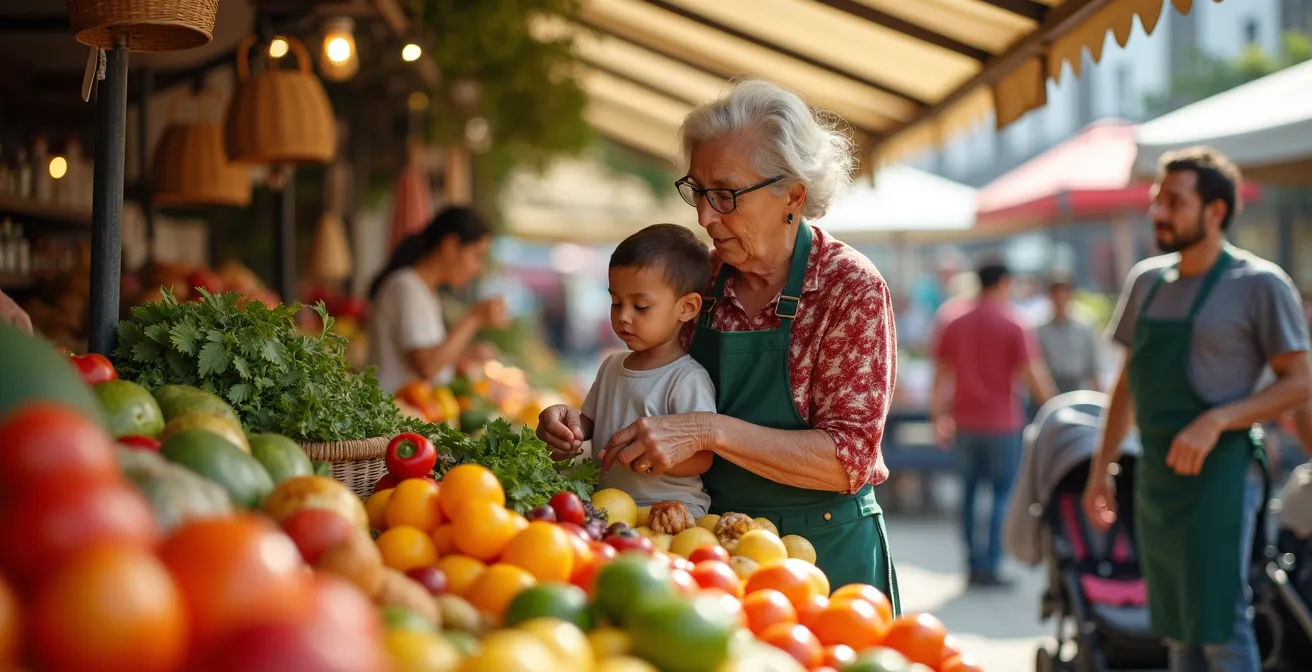
Nowhere is this family-friendly, food-centric vibe more apparent than at the Marché Belgrand. Held on Wednesday and Saturday mornings, this isn’t a tourist market; it’s a bustling hub where local families do their weekly shopping. Here, you can grab a whole rotisserie chicken with potatoes for around €12 (enough to feed a family of four), local cheeses for €3-5, and seasonal produce that is often 30% cheaper than in more central areas. The market even has a playground nearby at Square Édouard Vaillant, making it the perfect stop for a family outing.
Père Lachaise: How to Find Jim Morrison’s Grave Without Getting Lost?
Père Lachaise is more than just a cemetery; it’s a 44-hectare park, a sculpture garden, and a pilgrimage site for music and literature fans. The top request is always, “How do I find Jim Morrison’s grave?” It’s notoriously tricky to locate in the vast labyrinth of tombs. His grave is in Division 6. The easiest way is to enter through the main entrance on Boulevard de Ménilmontant and grab a free map, or simply follow the subtle trail of other searchers. But a true foodie explorer plans their visit around a more important question: where to eat before and after?
My advice is to build a “Foodie’s Entry & Exit Strategy.” If you’re going in the morning, enter via the Gambetta gate (Metro Gambetta, line 3). Fuel up with a croissant from Boulangerie Julien, a fantastic local bakery right by the metro exit. After you’ve paid your respects to Morrison, Oscar Wilde, and Edith Piaf, exit via the Philippe Auguste gate. This positions you perfectly for lunch in the lively bistros of the Roquette neighborhood or to head back up towards Ménilmontant.
An evening visit offers another strategy: enter via the Père Lachaise gate (Metro Père Lachaise, line 2) an hour or two before closing. Then, exit at Gambetta as the sun sets, just in time for an apéro at a classic spot like Le Vieux Belleville, where you can get a glass of wine and soak in the local atmosphere. It transforms a simple sightseeing trip into a full-fledged cultural and culinary experience.
Père Lachaise isn’t just about dead celebrities – it’s a green lung where Belleville locals actually picnic on sunny days, especially near the less-visited upper sections.
– Local Paris Guide, Culinary Backstreets Paris Food Tours
Electric or Mechanical Vélib’: Which One to Choose for Climbing to Belleville?
Exploring Belleville and Ménilmontant on a Vélib’ (Paris’s bike-share system) is a fantastic way to cover ground and make spontaneous discoveries. But there’s one crucial factor to consider: the hills. This area is steep. Rue de Belleville and Rue de Ménilmontant are two of the most challenging climbs in the city. In fact, the challenging topography includes a 5.5% average gradient on Rue de Belleville, making the choice between a classic green (mechanical) Vélib’ and a blue (electric) one a serious strategic decision for any foodie.
The mechanical Vélib’ is cheaper and offers a great workout, giving you the perfect justification for an extra pain au chocolat. The slow, demanding pace forces you to notice details you’d otherwise miss: a hidden courtyard, a tiny épicerie, a new piece of street art. It’s the flâneur’s choice—for those with time and strong legs.
The electric Vélib’, on the other hand, is the efficient food crawler’s best friend. It turns the grueling 15-minute climb up Rue de Ménilmontant into a breezy 5-minute ride. You’ll save time and energy, allowing you to hit more spots on your culinary checklist. It costs a bit more, but the ability to zip from a couscous joint in Ménilmontant to a wine bar in Belleville is priceless. Here’s how the two options stack up in the great foodie dilemma.
| Factor | Mechanical Vélib’ | Electric Vélib’ |
|---|---|---|
| Cost per 30 min | €1 | €2 |
| Calories burned to Belleville | 150-200 | 50-75 |
| Time to climb Rue de Ménilmontant | 12-15 min | 5-7 min |
| Pastry justification | Earned a pain au chocolat | Maybe a macaron |
| Discovery potential | High (forced slow pace) | Medium (faster transit) |
| Best for | Flâneurs with time | Efficient food crawlers |
So, what’s the verdict? If your goal is to maximize your eating tour, spend the extra euro on an electric bike. If the journey is as important as the destination, embrace the burn with a mechanical one.
Behind the Basilica: Why Rue de l’Abreuvoir Is Prettier Than the Front Steps?
To truly understand the value proposition of Belleville, it helps to compare it to its famous cousin, Montmartre. Rue de l’Abreuvoir in Montmartre is arguably one of Paris’s prettiest streets, an Instagram-famous lane of ivy-clad houses leading to the pink La Maison Rose café. It’s beautiful, but it’s also a perfect example of what I call the “prettiness premium.” It’s a stage set for tourists, and you pay a heavy tax for the privilege of being on it.
The numbers don’t lie. Price comparisons reveal that you’ll pay a steep premium for the picturesque setting. For instance, data from travel budget breakdowns shows that a coffee on Rue de l’Abreuvoir costs 150% more than in a typical Belleville café, soaring to €5-7 versus a local-friendly €2-3. This premium applies to everything from a glass of wine to a simple lunch. In Montmartre, you’re paying for the photo opportunity as much as for the food.
Belleville offers a different kind of beauty: the beauty of creation, not just consumption. The neighborhood’s famous street art hub, Rue Dénoyez, might be messier and more chaotic than Rue de l’Abreuvoir, but it’s alive. It’s a constantly evolving outdoor gallery where art is made in front of you. This reflects a fundamental difference in philosophy, as one local guide aptly puts it.
Rue de l’Abreuvoir attracts tourists posing for photos. Belleville’s Rue Dénoyez attracts artists actually creating the art – that’s the difference between consuming and participating in culture.
– Street Art Tour Guide, Street Art Tour Paris Belleville Guide
Choosing Belleville over Montmartre isn’t about shunning beauty. It’s about choosing active, living culture over a static, preserved image. It’s about participation over observation—and getting far more value for your euro.
Key takeaways
- Belleville’s value comes from its vibrant, local-serving food ecosystem, not just cheap prices.
- The area offers a complete experience beyond food, including stunning city views, hidden historical gems, and a thriving arts scene.
- Compared to gentrified “hipster” areas like Canal Saint-Martin, Belleville provides a more authentic and significantly more affordable alternative for food and drink.
Is the Canal Saint-Martin the New Seine for Young Travelers?
For the last decade, the Canal Saint-Martin has been the undisputed king of cool for young travelers and Parisians. Its picturesque iron footbridges, waterside picnics, and hip boutiques made it the place to be. But the very popularity that made it famous has also led to its downfall as a budget-friendly destination. The Canal has become a victim of its own success, a fully gentrified zone where a “hipster tax” is applied to everything.
Belleville, in contrast, remains in a dynamic, more authentic state of transformation. While new, trendier spots like the Cave de Belleville wine bar are opening, they coexist with the long-standing immigrant-run businesses that form the neighborhood’s backbone. This creates a fascinating blend of old and new, and crucially, it keeps prices in check. The food culture here still serves its actual residents—a community where, according to recent sociological studies, 40% of the population is foreign-born, compared to just 15% around the Canal. This demographic reality ensures authenticity and affordability.
The price difference is stark. You’re not just saving a few cents; you’re often paying 30-40% less for a superior or more authentic product. Let’s look at the “Hipster Tax” in black and white.
| Item | Canal Saint-Martin | Belleville | Savings |
|---|---|---|---|
| Craft Beer (pint) | €8-10 | €5-7 | 35% |
| Pizza/Casual Meal | €15-20 | €10-14 | 30% |
| Coffee | €4-5 | €2-3 | 40% |
| Wine Glass | €7-9 | €4-6 | 35% |
| Brunch | €25-35 | €15-20 | 40% |
While the Canal offers a performative dining scene, Belleville offers a genuine one. It’s the difference between a place that looks cool and a place that *is* cool, without having to try so hard. For the adventurous, budget-conscious traveler, the choice is clear. The real vibe has moved uphill.
So, lace up your comfortable shoes, bring your appetite, and get ready to explore. Your adventure into Paris’s most authentic food ecosystem starts now.