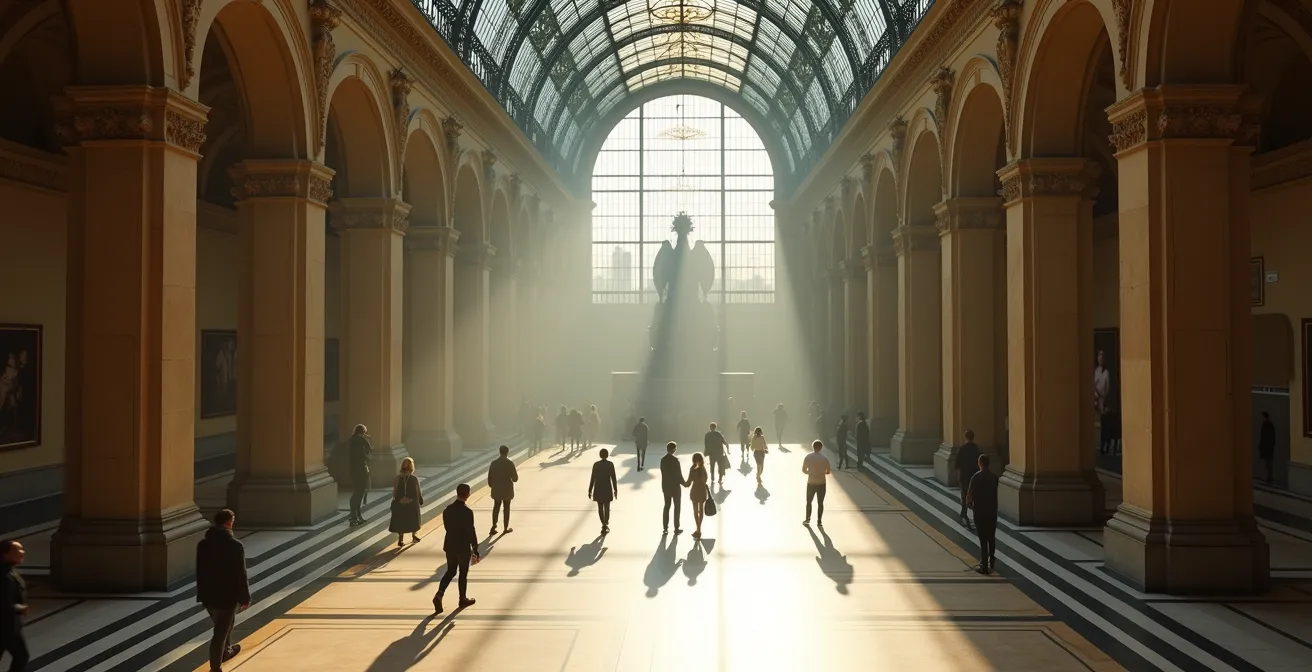
Choosing between the Louvre and Orsay isn’t about collection size; it’s about choosing your desired experience: a comprehensive but potentially exhausting ‘checklist’ at the Louvre, or a cohesive and emotionally resonant journey at Orsay.
- The Louvre’s vastness often leads to “checklist fatigue,” where you see everything but appreciate little.
- Orsay offers a focused narrative, immersing you in the revolutionary story of Impressionism within an inspiring architectural gem.
Recommendation: For a first visit where time is limited, prioritize the Musée d’Orsay for a more manageable, memorable, and deeply engaging art experience.
The classic Parisian dilemma for any art-loving first-time visitor: with only enough time for one grand museum, should it be the monumental Louvre or the magnificent Musée d’Orsay? The conventional advice is simple: the Louvre is for world history and the Mona Lisa; Orsay is for Impressionism and its more manageable scale. While true, this misses the fundamental point. The decision shouldn’t be based on a list of artworks, but on the kind of experience you wish to have.
Trying to “conquer” the Louvre’s 800,000 square feet and 35,000 displayed objects often results in what we can call “checklist fatigue.” You rush from the Venus de Milo to the Winged Victory, ticking off masterpieces without time for genuine connection. The Musée d’Orsay, by contrast, is not just smaller; it’s more narratively cohesive. It invites you into a specific, transformative story—the birth of modern art—within the breathtaking setting of a former Belle Époque train station. Recent visitor surveys reveal that 75% of museum-goers can leave feeling they missed key artworks due to poor planning. This guide is designed to prevent that.
This article re-frames the choice. It’s a strategic guide to prioritizing atmospheric immersion and artistic empathy over an encyclopedic overview. We will explore how to master the Orsay experience, from tactical navigation to finding quiet moments, ensuring your visit is not just seen, but deeply felt. We will delve into specific strategies that transform a simple museum trip into a highlight of your time in Paris.
To help you craft the perfect visit, this guide breaks down the essential strategies for making the most of the Musée d’Orsay and its surroundings. You’ll find practical advice on everything from capturing the perfect photo to discovering art beyond the museum walls.
Summary: Mastering Your Musée d’Orsay Visit
- Clock Face Photo: How to Get the Shot Without Waiting 20 Minutes?
- Top Floor First: Why Starting with the Impressionists Is the Best Strategy?
- Thursday Evenings at Orsay: Is It Really Less Crowded Than Mornings?
- Orsay and l’Orangerie: Is the Combined Ticket Worth the Fatigue?
- The Restaurant vs The Café: Where to Eat Inside Without a Reservation?
- Why Visiting l’Orangerie on a Cloudy Day Enhances the Water Lilies Experience?
- The “Quiet Hours”: When is the Rodin Museum Most Peaceful?
- How to trace the Footsteps of Monet and Renoir Beyond the Museums?
Clock Face Photo: How to Get the Shot Without Waiting 20 Minutes?
The iconic photograph through the giant clock face, with the silhouette of Montmartre in the distance, is a quintessential Orsay memory. However, it’s also a major bottleneck. The key to capturing this shot without a frustrating wait is strategy, not luck. Photos without flash are permitted, so the main challenge is the crowd. Most visitors head for the North-West clock on the 5th floor, which is partially obstructed by the Café Campana. This is a mistake.
Your target should be the eastern clock, also on the 5th floor, which offers a clearer view and often has a shorter line. The best light is often in the late afternoon, as the setting sun can cast a beautiful glow, but this is also a busy time. For a people-free shot, the best tactic is to be one of the first people in the museum. Arrive at least 20 minutes before opening to clear security, and head straight to the 5th floor. As photographer Richard Davis noted after spending ten minutes waiting for a clear view, being first in line is the only way to get a few moments to compose a wider shot.
A few other tips can make all the difference:
- Use the Terrace: In summer, the 5th-floor terrace sometimes opens, providing alternative angles of the clock from the outside.
- Play with Angles: Instead of a straight-on shot, try a profile or a low angle to frame the view differently and crop out other visitors.
- Be Patient, Then Quick: Watch the flow of people. There are often brief lulls between groups. Be ready to take your shot in that 10-second window.
Top Floor First: Why Starting with the Impressionists Is the Best Strategy?
The conventional way to visit a museum is to start on the ground floor and work your way up. At Orsay, this is a strategic error. The museum’s crown jewels—the unparalleled collection of Impressionist and Post-Impressionist masterpieces—are housed under the magnificent glass-and-iron barrel vault of the 5th floor. By starting here, you accomplish two critical goals: you see the most popular works before the biggest crowds arrive, and you experience them in the best possible conditions.
The 5th floor is bathed in glorious natural light from the original station skylights, an effect the Impressionists themselves would have adored. Seeing Monet’s poppies or Renoir’s dancers illuminated by soft daylight, rather than artificial light, is a transformative experience. This “reverse-order” visit prioritizes experiential quality. You begin with an emotional high, connecting with the most famous works while you are still fresh and full of energy, avoiding the “museum fatigue” that sets in after an hour or two.
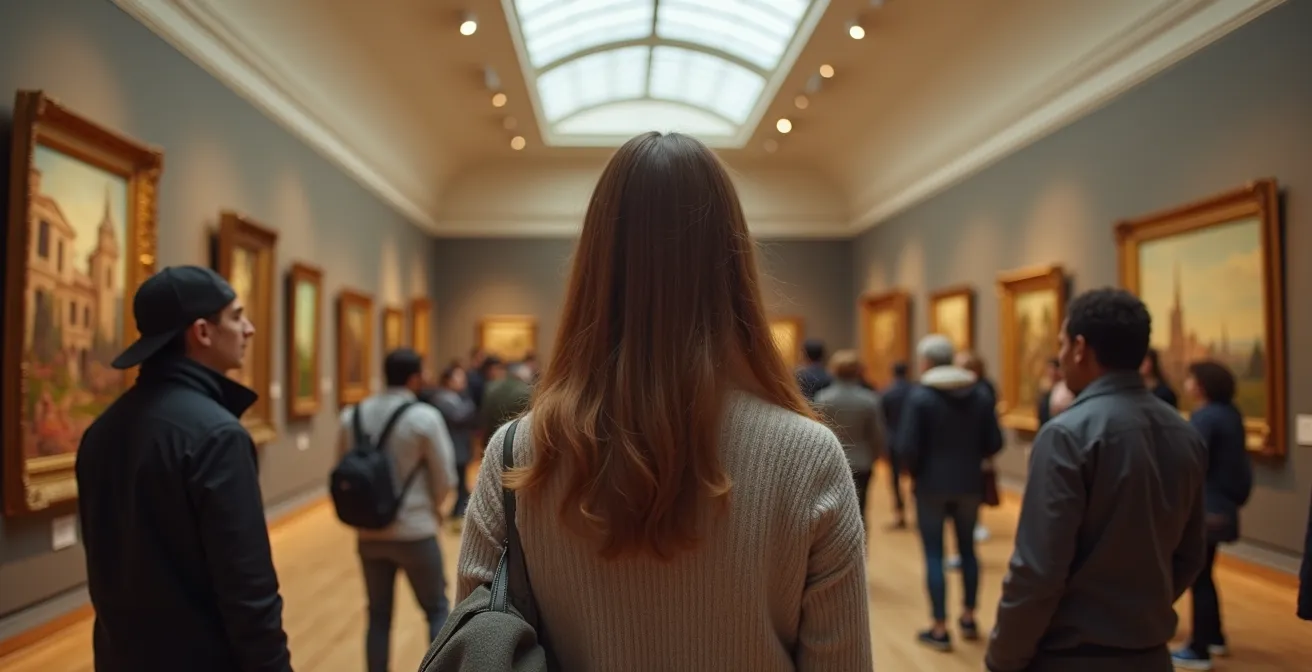
This strategy allows for a more relaxed “experiential pacing” for the rest of your visit. After your breathtaking immersion in Impressionism, you can descend at a leisurely pace through the Post-Impressionist works of Van Gogh and Gauguin, then explore the decorative arts and sculpture on the lower floors as your energy naturally wanes. This turns your visit from a chronological lesson into an emotional journey, starting with the climax.
Your 2-Hour Impressionist Immersion Plan
- Entry & Ascent: Upon entry, ignore the ground floor and head directly to the escalators near Gallery 29 to ascend straight to the 5th floor.
- Priority Artworks: View Monet’s ‘Poppies’ and Renoir’s ‘Dance at Le Moulin de la Galette’ first, as these areas become the most congested.
- Clock Photo Break: After about 90 minutes with the Impressionists, take your clock face photo as the crowds may have shifted and the light is softer.
- Logical Descent: Work your way down, using the building’s central aisle as your main artery to transition between floors and collections.
- Final Contemplation: End your visit on the ground floor amidst the grand sculptures, a calming finish after the vibrant colors upstairs.
Thursday Evenings at Orsay: Is It Really Less Crowded Than Mornings?
For decades, the savvy traveler’s trick was to visit Orsay during its late-night opening on Thursdays, which runs until 9:45 PM. The assumption has always been that these evening hours are quieter. However, the reality is more nuanced. While you may avoid the morning rush of tour groups and school trips, you’ll be joining a different crowd: Parisians enjoying a post-work cultural outing and couples on date night. The overall visitor numbers may not be significantly lower, especially in the popular Impressionist galleries.
The real advantage of a Thursday evening visit is the change in atmosphere and visitor demographic. The experience feels more local and less tourist-centric. It’s a chance to see the museum in a different light, both literally and figuratively. Furthermore, data shows how visitor profiles can shift; for instance, during the Paris Olympics, the museum saw a 34% share of visitors aged 26-45, indicating a younger, more dynamic audience. The evening hours attract a similar, working-age crowd.
The strategic benefit is that while the 5th floor remains popular, the crowds thin out dramatically in other sections. After 3 PM, and especially after 7 PM, the ground floor sculpture halls and the middle-floor Art Nouveau collections become wonderfully peaceful. This offers a golden opportunity for quiet contemplation of these often-overlooked treasures. So, is it less crowded? Not necessarily everywhere. Is it a better, more relaxed experience in certain areas? Absolutely.
Orsay and l’Orangerie: Is the Combined Ticket Worth the Fatigue?
The Musée de l’Orangerie, home to Monet’s monumental Water Lilies (Nymphéas), is Orsay’s smaller sibling, located a pleasant 10-minute walk away across the Seine through the Tuileries Garden. A combined ticket offers access to both, but is it a good idea to visit both on the same day? For a first-time visitor, the answer is almost always no. While tempting, it invites the very “checklist fatigue” you chose Orsay to avoid.
The Orangerie is an intimate, meditative space designed for quiet immersion. Rushing there after several hours at Orsay will diminish the profound impact of Monet’s masterpiece. The true value of the combined ticket lies in its flexibility. It is typically valid for several months, allowing you to visit the two museums on separate days. This is the best strategy: start a day fresh at the Orangerie for a tranquil, focused experience, and dedicate another day entirely to the narrative journey of Orsay.
A smart tactic is to buy your combined ticket at the Orangerie, which rarely has lines, allowing you to skip the often-long ticket queue at Orsay on a different day. The walk between them through the Tuileries Garden can then serve as a wonderful palate cleanser. The combination is powerful, but only when you give each museum the time and energy it deserves.
To help you decide, this comparison highlights the distinct character of each museum. As this useful visitor experience breakdown shows, they offer very different visits.
| Aspect | Musée d’Orsay | Musée de l’Orangerie |
|---|---|---|
| Size | 3,000+ artworks displayed | Intimate collection focused on Water Lilies |
| Visit Duration | 2-4 hours typical | 1-2 hours typical |
| Queue Times | 60-90 minutes peak | Rarely has lines |
| Best Feature | Comprehensive Impressionist collection | Monet’s immersive Water Lilies rooms |
| Distance Apart | Pleasant 10-minute walk through Tuileries | |
The Restaurant vs The Café: Where to Eat Inside Without a Reservation?
A break for lunch or a coffee is an essential part of a well-paced museum visit, and Orsay offers two excellent but very different options. Choosing the right one depends on your budget, timing, and whether you’re seeking a quick pause or a grander dining experience. Most visitors assume the main restaurant is inaccessible without a reservation, but this isn’t always true.
The main Restaurant, on the second floor, is a spectacle in itself. A gloriously preserved dining room from the original 1900s Hôtel d’Orsay, it features glittering chandeliers and painted ceilings. While it seems intimidating, walk-in tables are often available right at its 11:45 AM opening or after 2:30 PM when the main lunch rush has passed. For a fixed price, it offers a surprisingly affordable taste of old-world glamour. In contrast, the Café Campana on the 5th floor is a more modern, casual affair designed by the Brazilian Campana brothers. Its primary draw is its location: right behind the main clock face and adjacent to the Impressionist galleries.
The strategic choice is the Café Campana. Even just ordering a coffee or a pastry secures you a table. This allows you to take a strategic pause right after viewing the Impressionist collection, resting your feet while still being immersed in the station’s unique architecture. It’s the perfect way to recharge before descending to the lower floors, turning a simple break into an integral part of the museum’s atmospheric immersion.
Why Visiting l’Orangerie on a Cloudy Day Enhances the Water Lilies Experience?
A rainy or overcast day in Paris can seem like a disappointment, but if you plan to visit the Musée de l’Orangerie, it’s a stroke of meteorological luck. While sunshine might seem ideal, the best way to experience Monet’s monumental Water Lilies is under the soft, diffused light of a cloudy sky. This isn’t just a romantic notion; it’s based on the physics of light and the specific design of the museum.
The two oval rooms that house the eight massive canvases were designed by Monet himself to have large skylights. On a bright, sunny day, direct sunlight can create glare on the paintings’ surfaces and cast harsh shadows in the room. This can break the immersive, all-encompassing spell Monet intended to create. An overcast sky, however, turns the entire Parisian sky into a giant natural diffuser.
This phenomenon creates the perfect viewing conditions. As a museum lighting specialist explained in a professional guide, the effect is transformative:
The ‘Softbox Effect’ of Parisian clouds acts as a giant natural diffuser, creating soft, even light inside the oval rooms.
– Museum lighting specialist, Professional photography guide for museums
This even, shadowless light allows the subtle nuances of color and texture in Monet’s brushwork to emerge. The water’s surface appears deeper, the reflections more ethereal, and the feeling of being completely enveloped by the lily pond is intensified. So, if you see clouds in the forecast, don’t despair—it’s the perfect day to lose yourself in Monet’s masterpiece.
Key takeaways
- Prioritize experience over checklists; Orsay offers a cohesive narrative journey.
- Start on the 5th floor at Orsay to see Impressionist works in natural light before the crowds.
- Use a combined Orsay-Orangerie ticket on separate days to avoid museum fatigue.
- Visit l’Orangerie on a cloudy day to experience Monet’s Water Lilies in perfect, diffused light.
The ‘Quiet Hours’: When is the Rodin Museum Most Peaceful?
For visitors who have chosen Orsay for its manageable scale and now find themselves captivated by the idea of an even more intimate art experience, the Musée Rodin offers the perfect next step. A short Métro ride away, this museum, set in the elegant 18th-century Hôtel Biron and its enchanting garden, is dedicated to the works of a single artist. It represents the ultimate in narrative cohesion and is a haven of tranquility compared to the city’s larger institutions.
But even in this peaceful setting, timing is everything. To experience the gardens and sculptures in near-solitude, you must know the “quiet hours.” The most magical time is often the last hour before closing on a weekday, when the low sun casts long shadows across the garden, illuminating sculptures like “The Thinker” and “The Gates of Hell” with a dramatic, golden light. Another prime window is during the classic French lunch break, roughly from 12:30 PM to 2:00 PM, when local visitor numbers dip.
For truly empty rooms inside the Hôtel Biron, the best bet is a Tuesday or Thursday morning at 10 AM opening, especially during the off-season from November to February. A final pro tip: buy your tickets online and use the less-known back entrance on the rue de Varenne. By starting your visit in the garden and working your way towards the main house, you move against the typical visitor flow, ensuring a more personal and contemplative encounter with Rodin’s powerful work.
How to trace the Footsteps of Monet and Renoir Beyond the Museums?
After immersing yourself in the world of the Impressionists at Orsay, the experience doesn’t have to end. Paris and its surroundings are a living museum, offering countless opportunities to walk in the very footsteps of the artists you’ve just admired. Tracing their paths from the city studios to the sun-dappled gardens of the countryside adds a powerful layer of context and brings their art to life. This has become an increasingly popular pilgrimage for art lovers, with some related exhibitions drawing huge crowds.
The most iconic journey is, of course, to Monet’s house and gardens at Giverny. A direct train from Gare Saint-Lazare (a station Monet himself painted) takes you to Vernon, a short shuttle ride from the famous water lily pond. Here, you can see the real-life inspiration for the masterpieces at the Orangerie. But there are many other, less-crowded options easily accessible from Paris for a day trip:
- Auvers-sur-Oise: Take the RER C line directly from the Musée d’Orsay station to this charming village where Vincent van Gogh spent his final days, painting over 70 works. You can visit his room at the Auberge Ravoux and see the church and wheat fields from his final, passionate canvases.
- Île de Chatou: Another RER trip takes you to the setting of Renoir’s famous “Luncheon of the Boating Party,” the Maison Fournaise, which now houses a museum and restaurant.
- Montmartre Walk: Dedicate a few hours to a self-guided walk through Montmartre, exploring the addresses where artists like Renoir, Van Gogh, and Toulouse-Lautrec lived and worked, and visiting the Musée de Montmartre to see a recreation of a period studio.
Ultimately, the choice to visit Orsay is a choice to engage with art on a personal, emotional level. By applying these strategies, you are not just planning a museum visit; you are designing an unforgettable experience, ensuring your time in Paris is filled with beauty and connection, not just checklists and crowds.