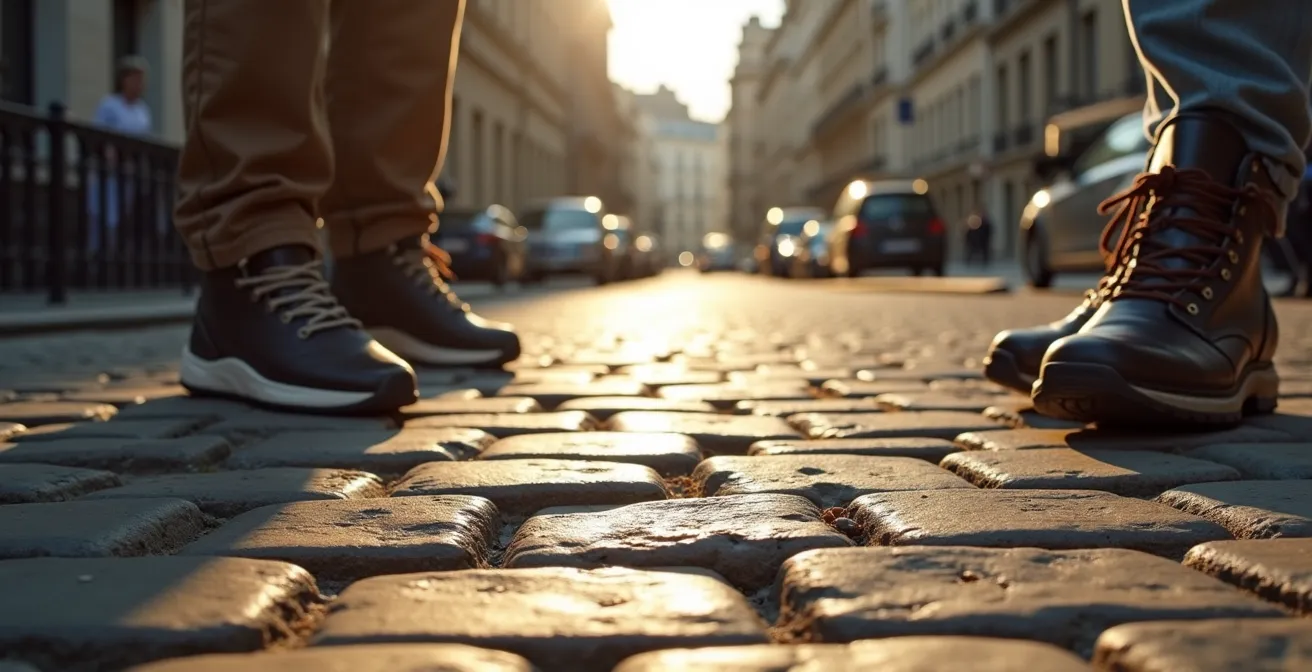
The romantic vision of wandering through Paris often clashes with the painful reality of its historic cobblestone streets. As a local physiotherapist, I can tell you that avoiding injury isn’t about “comfort” alone; it’s about understanding the biomechanics of walking on uneven terrain. This guide moves beyond generic advice to explain how the right shoe technology—from sole grip to torsional support—is your most critical tool for a pain-free exploration of districts like Montmartre and the Marais.
The image of Paris is one of effortless style, wandering through charming, ancient streets with a croissant in hand. The reality, for many visitors, is foot pain, twisted ankles, and sore knees by day two. As a physiotherapist living and walking in the 18th arrondissement, I see the physical toll that Paris takes on the unprepared. The city’s beauty is built on a foundation of historic, uneven, and often slippery cobblestones that can be treacherous.
Common travel advice tells you to “wear comfortable shoes,” a platitude that is dangerously simplistic. It fails to address the specific challenges of Parisian terrain. The real issue isn’t just about avoiding blisters; it’s about preventing the sprains, strains, and falls that I treat in my practice every week. The problem lies in the disconnect between fashionable footwear and the functional demands of walking 15,000 steps on Lutetian limestone.
But what if the key wasn’t just comfort, but a specific kind of biomechanical engineering designed for urban trekking? This is where my perspective as a health professional comes in. The secret to a successful visit isn’t just choosing a flat shoe over a heel; it’s about understanding the interaction between your shoe’s sole, your body’s proprioception, and the ancient stones beneath your feet. It’s about preventing injury before it happens.
This guide will deconstruct the choices you face, from footwear to navigation, through the lens of injury prevention. We will analyze the best shoe types for different Parisian pavements, offer strategies for navigating steep areas without strain, and even consider how your accommodation choice can impact your physical well-being. Think of this as your prescription for a pain-free Parisian adventure.
To help you plan your journey with both comfort and safety in mind, this article is structured to address the most pressing practical questions. Below is a summary of the key topics we will cover to ensure your feet are as happy as you are while exploring the city.
Summary: A Physiotherapist’s Guide to Walking in Paris
- Sneakers vs Boots: What to Wear for a 10km Walk on Parisian Pavés?
- How to Navigate the Latin Quarter with a Stroller Without Getting Stuck?
- Where to Find the Last Authentic Medieval Streets in the 4th Arrondissement?
- The Rain Danger on Cobblestones That Sends 100 Tourists to the ER Annually
- How to Cross Montmartre Without Climbing More Than 50 Stairs?
- Sneakers vs Leather: Can You Wear Running Shoes to a Restaurant?
- Funicular vs Stairs: Is the Metro Ticket Worth Saving Your Breath?
- Rent or Hotel: What to Choose for a Stay in the Marais Under 200€/Night?
Sneakers vs Boots: What to Wear for a 10km Walk on Parisian Pavés?
The debate between sneakers and boots for a day of Parisian exploration goes beyond aesthetics; it’s a question of engineering. While sneakers are a popular choice, accounting for a significant portion of the footwear market in France, not all are created equal. The key lies in two features: torsional rigidity (the shoe’s resistance to twisting) and outsole grip. A flimsy, overly flexible sneaker offers poor support on uneven cobblestones, forcing the small muscles in your feet and ankles to overcompensate, leading to fatigue and potential sprains. A good walking boot or a structured trail-running shoe provides the necessary stability.
The second, and perhaps most critical, factor is traction, especially on wet surfaces. Parisian limestone pavés become notoriously slick in the rain. Your shoe’s ability to grip this surface is paramount for safety. This is where the material and pattern of the outsole become crucial.
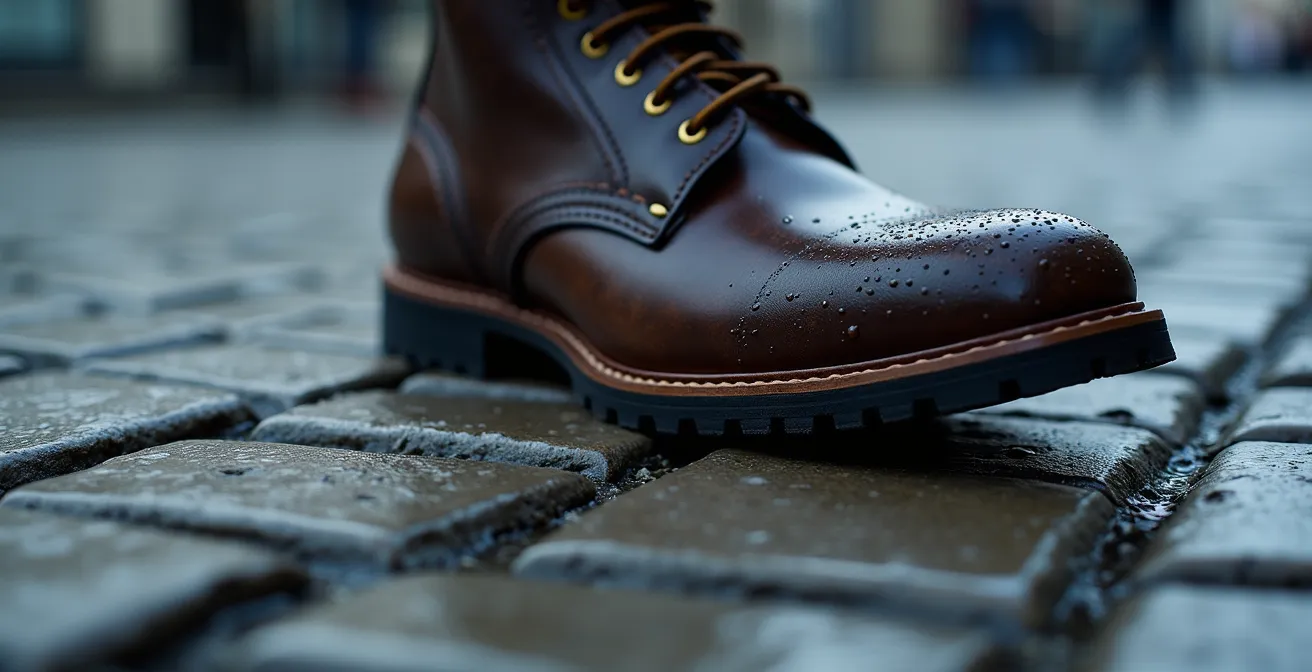
As the image above illustrates, the contact between the sole and the stone is where safety is determined. Deep, multi-directional lugs provide channels for water to disperse and allow the rubber to make solid contact with the stone. A flat-soled fashion sneaker, by contrast, can easily hydroplane. When selecting footwear, look for soles that advertise superior wet-weather grip, as this single feature can be the difference between a confident stride and a dangerous fall.
The data on shoe performance confirms this. A detailed analysis of shoe traction on wet surfaces shows a vast difference between standard shoes and those engineered for grip. Prioritizing a shoe with a high-traction rubber compound is a clinical decision, not a stylistic one.
| Shoe Type | Wet Traction Score | Best For |
|---|---|---|
| ASICS with Hybrid ASICSGRIP | 0.84 (78.7% grippier than average) | Long-distance walking on wet pavements |
| PUMA with Pumagrip | 0.65 (35.4% grippier) | All-weather conditions |
| Standard sneakers | 0.47 (baseline) | Dry conditions only |
How to Navigate the Latin Quarter with a Stroller Without Getting Stuck?
Navigating Paris’s historic districts with a stroller presents a unique set of physical challenges. The Latin Quarter, with its charming but narrow medieval streets and kerbs that are anything but standard, can quickly turn a pleasant walk into a logistical nightmare. From a physiotherapy standpoint, repeatedly lifting and maneuvering a heavy stroller over obstacles puts significant strain on the back, shoulders, and wrists. The key is to plan your route strategically to minimize these physical stressors.
Instead of tackling the narrowest passages, stick to flatter, wider boulevards that run through the area. A well-planned route can make all the difference:
- Start at an accessible station like Saint-Michel Notre-Dame (RER B/C), which has elevator access.
- Prioritize using Boulevard Saint-Germain for its wider, smoother sidewalks.
- Consciously avoid notorious bottlenecks like the Rue de la Huchette, whose medieval width is completely impractical for strollers.
- For steeper sections, don’t hesitate to use the Montmartrobus (Bus Line 40), which accepts standard transport passes and saves you a significant physical effort.
- Plan rest stops at ground-floor cafés that have space to park a stroller, allowing you to rest without hassle.
However, the most effective solution I observe among Parisian parents is forgoing the stroller altogether in these historic areas. Opting for a baby carrier (porte-bébé) is a game-changer. This approach has profound biomechanical benefits: it keeps your center of gravity stable, eliminates the awkward lifting and pushing motions, and keeps your hands free for balance on uneven steps or crowded streets. It allows you to move with the flow of pedestrian traffic rather than against it, making the experience safer and far less physically taxing.
Where to Find the Last Authentic Medieval Streets in the 4th Arrondissement?
For those seeking to connect with the city’s deep history, the 4th arrondissement (the Marais) offers some of the last remaining glimpses of medieval Paris. However, walking these streets requires a conscious adjustment in your gait and full attention. The “authentic” cobblestones, or pavé du roi, are not the neatly arranged blocks of modern pedestrian zones; they are often rounded, uneven, and spaced irregularly. Walking on such surfaces constantly challenges your proprioception—your body’s sense of its position in space. Without supportive footwear, your ankles are at high risk of rolling.
Finding these gems requires knowing where to look, as they are tucked away from the main thoroughfares. For an immersive experience, focus on this walking route:
- Rue des Barres: Features authentic medieval cobblestones that demand sturdy, supportive shoes. Notice how you have to slow down and watch your step.
- Rue François Miron: Look closely at the pavement near numbers 11 and 13 to see the original, highly uneven ‘pavé du roi’.
- Rue de l’Abreuvoir (in Montmartre, but similar in style): Often cited as one of Paris’s oldest streets, its character gives a feel for what medieval paths were like.
- Secret Passages: Explore the courtyards of the Hôtel de Sully to find hidden passages that are only discoverable on foot.
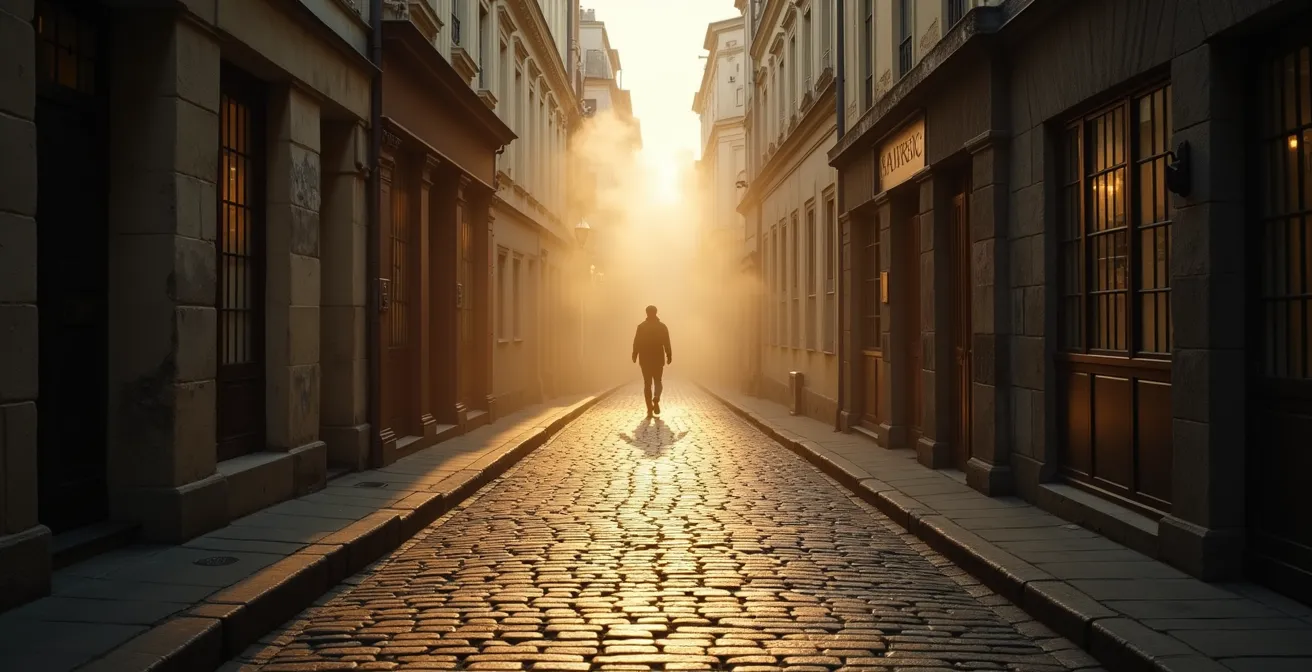
To truly appreciate these streets, visit in the early morning. The low light casts long shadows, highlighting the texture and irregularities of the ancient stone, and the quiet atmosphere allows you to focus on the experience of walking through history. It’s a sensory experience, but one that your feet and ankles must be prepared for. These are not streets for rushing; they are for mindful, careful strolling.
The Rain Danger on Cobblestones That Sends 100 Tourists to the ER Annually
The title of this section is not hyperbole; it’s a clinical reality. A sudden Parisian shower transforms polished limestone cobblestones into surfaces as slick as ice. The high number of tourists treated for falls each year is a testament to this danger. Workplace safety statistics show that over 55% of slip incidents are caused by wet or uneven surfaces, a figure that is directly applicable to the tourist experience in Paris. The combination of an unfamiliar, uneven surface (the cobblestones) with a slippery contaminant (rainwater) is a recipe for disaster, leading to everything from fractures to head injuries.
The specific stone used in much of historic Paris, Lutetian limestone, is particularly treacherous when wet due to its low porosity. Water sits on the surface rather than being absorbed, creating a thin, invisible film that dramatically reduces friction. When walking on these surfaces, you must change your gait: take shorter steps, keep your center of gravity directly over your feet, and avoid sudden turns. Most importantly, wear shoes with a soft rubber sole that features deep, multi-directional treads. This is non-negotiable for rainy days.
Being prepared for a fall, even if you take precautions, is a practical measure. Knowing what to do immediately after an incident can prevent further injury and ensure you get help quickly. Every visitor should have a basic emergency plan in mind.
Your Parisian Rainy Day Emergency Checklist
- Emergency Number: Know that the number for SAMU (French emergency medical services) is 15. Store it in your phone.
- Key Phrases: Learn two essential phrases: “Je suis tombé(e)” (I fell) and “J’ai besoin d’aide” (I need help).
- Locate a Pharmacy: Identify the nearest ‘pharmacie’ (marked by a green cross sign) for basic first aid supplies like disinfectant and bandages.
- Check Your Footwear: Before you even go out, ensure your shoes have rubber outsoles with deep treads. If they don’t, they are not safe for a rainy day in Paris.
- Adjust Your Gait: Consciously take shorter, flatter steps on slippery surfaces to maintain your balance and keep your center of gravity stable.
How to Cross Montmartre Without Climbing More Than 50 Stairs?
Montmartre is a hill. This simple geographical fact is the source of both its charm and its physical challenge. For many visitors, especially those with mobility issues, knee problems, or simply those trying to conserve energy for a long day, the endless flights of stairs can be a significant barrier. From a physiotherapy perspective, repeated stair climbing puts immense pressure on the knee joints (patellofemoral joint) and requires strong quadriceps and gluteal muscles. If you’re not conditioned for it, you risk pain and inflammation. Fortunately, there are strategic ways to experience the summit without the strain.
The first and most obvious solution is the Montmartre Funicular. This is not a tourist gimmick; it’s a piece of public transportation integrated into the RATP network. If you have a Navigo or Paris Visite pass, the ride is included. It eliminates the daunting 197-step climb to the Sacré-Cœur, saving your joints from a significant workout.
The second, more scenic option is to approach the Butte Montmartre from its gentler “back” slope. This route replaces steep stairs with a gradual, manageable incline:
- Take Metro Line 12 to the Lamarck-Caulaincourt station. The exit here places you on the northern side of the hill.
- Follow Rue Lamarck as it winds gently upward. This street offers a lovely, less crowded walk through a more residential part of the neighborhood.
- Turn onto Rue du Mont-Cenis to continue the gradual ascent toward the top.
- If even this gentle slope is too much, the Montmartrobus (Bus Line 40) is your best friend. It snakes its way all over the hill, and you can hop on and off using a standard transport ticket.
A final tip: the Abbesses Metro station has a notoriously deep spiral staircase. Always use the elevator to avoid an unnecessary and grueling climb before you even start your walk.
Sneakers vs Leather: Can You Wear Running Shoes to a Restaurant?
After a long day of walking, the question of appropriate evening footwear becomes pressing. Many travelers worry that their practical walking shoes will be out of place in a Parisian restaurant. This fear is partly justified, but the rules are more nuanced than a simple “no sneakers” policy. The type of establishment is the most important factor. In Paris, there is an unspoken hierarchy of dining, and the dress code follows suit.
The key is not necessarily the *type* of shoe, but its *condition* and how it’s styled. A dirty, scuffed pair of running shoes will look out of place anywhere, but a clean, minimalist, and stylish sneaker can be perfectly acceptable in many settings. As a general rule, the more gastronomic and upscale the restaurant, the more formal the footwear expectation. The traditional Parisian principle is simple and elegant, as one etiquette expert puts it:
The condition of the shoe is more important than the type.
– French dining etiquette principle
This means a pristine pair of leather sneakers might be more acceptable than a pair of worn-out leather dress shoes. To avoid any social awkwardness, it helps to understand the different tiers of Parisian dining and their corresponding footwear expectations.
| Restaurant Type | Acceptable Footwear | Key Rule |
|---|---|---|
| Bistrot de quartier | Any clean shoe acceptable | Condition matters more than style |
| Brasserie/Néo-bistrot | Stylish minimalist sneakers OK | Pair with smart trousers or dress |
| Restaurant gastronomique | Leather shoes non-negotiable | No sneakers regardless of brand |
Funicular vs Stairs: Is the Metro Ticket Worth Saving Your Breath?
The choice between taking the Montmartre funicular and climbing the 197 stairs to the Sacré-Cœur is more than a matter of convenience; it’s a clear cost-benefit analysis for your body. The climb is steep and demanding. For the price of a single metro ticket (or free with a pass), you can save your knees and ankles from significant stress, preserving your energy for exploring the charming streets at the top. The benefit is quantifiable: the funicular journey to Montmartre’s highest point takes a mere 90 seconds to climb 130 meters, an ascent that would take a fit person several minutes of strenuous effort via the stairs.
From a clinical perspective, I always advise my clients with any history of joint pain, cardiovascular issues, or low fitness levels to take the funicular without a second thought. The risk of aggravating an old injury or causing a new strain is simply not worth the perceived “authentic” experience of the climb. There are plenty of other, less intense stairs to climb in Montmartre if you wish to.
Furthermore, choosing the funicular doesn’t mean you’re missing out on a piece of Paris. In fact, you’re participating in its history. Opened in 1900, the funicular is a piece of Belle Époque engineering. The original system was powered by a water-counterbalance mechanism, a testament to the ingenuity of the era. Riding it connects you to over a century of Parisian life and the city’s long history of blending technology with its challenging topography. It’s not a shortcut; it’s a smart, historic, and physically responsible way to reach the summit.
Key Takeaways
- Prioritize shoes with rigid soles and high-traction rubber for stability and safety on uneven, wet cobblestones.
- Forgo strollers in medieval districts like the Latin Quarter; a baby carrier is a safer, more practical, and biomechanically sound alternative.
- Plan your route in hilly areas like Montmartre to use the funicular or gentler back-slope paths to avoid knee and ankle strain.
Rent or Hotel: What to Choose for a Stay in the Marais Under 200€/Night?
Your choice of accommodation in a walking-heavy district like the Marais has a direct impact on your physical recovery. After walking over 15,000 steps, the final leg of your journey back to your room matters immensely. As one travel expert wisely noted, “The ‘last 100 meters’ of your day matter most.” This is where the difference between a hotel and a rental apartment becomes a crucial part of your well-being plan.
Hotels are often located on larger, more accessible boulevards and almost always feature an elevator. This means that at the end of an exhausting day, you can collapse in the lobby and be whisked up to your room. In contrast, charming rental apartments are frequently situated on narrow, pedestrian-only streets and are often on the 3rd or 4th floor of a building with no elevator (sans ascenseur). That final, multi-flight climb can be excruciating on tired legs and may even feel like the hardest part of your day.
However, a rental apartment offers a key recovery tool a hotel room lacks: a kitchen. The ability to prepare a simple meal means you don’t have to go out again. More importantly, it gives you a space to prepare a proper foot soak with Epsom salts—a simple but incredibly effective way to reduce muscle soreness and inflammation. The choice involves a trade-off between end-of-day accessibility and at-home recovery amenities.
| Factor | Hotel | Rental Apartment |
|---|---|---|
| Location | Larger boulevards, more accessible | Narrow cobbled streets, more authentic |
| After long walks | Lobby to rest, elevator access | Often 4th floor without elevator |
| Daily comfort | Concierge, daily cleaning | Kitchen for foot soaking, living like local |
| Noise level | Potentially louder (boulevard traffic) | Quieter but less accessible |
Ultimately, a successful trip to Paris is one where you return home with fond memories, not stress fractures or sprained ankles. By applying a little foresight and treating your footwear and navigation choices with the seriousness they deserve, you can ensure your body is able to keep up with your spirit of adventure. Plan your footwear as meticulously as you plan your museum visits; your feet will thank you.