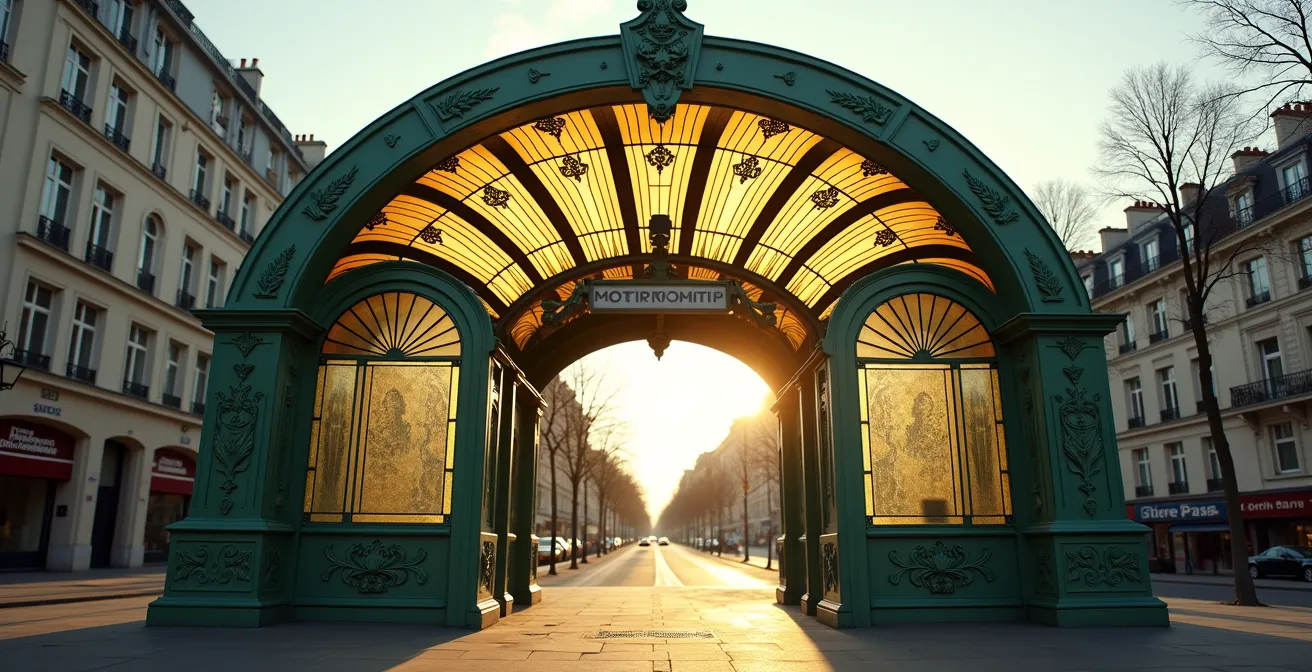
Distinguishing Parisian architectural styles goes far beyond a simple ‘curves vs. lines’ checklist; it’s about learning to read how each style converses with the city’s rigid Haussmannian template.
- Art Nouveau is a floral, organic rebellion against Haussmann’s uniformity, using nature-inspired “whiplash” lines.
- Art Deco represents a return to geometric order, but with a modern, streamlined, and often luxurious twist that differs from 19th-century classicism.
Recommendation: Start by identifying the ‘rules’ of a Haussmannian building’s balcony, and then look for the exceptions—this is the key to spotting the stylistic rebellions and evolutions that define Paris.
Walking through Paris can feel like navigating a living museum, yet for many, the city’s architectural styles blur into a single, beautiful but indistinct category of “old and ornate.” You might recognize a famous Guimard metro entrance, but can you tell why it’s quintessentially Art Nouveau? Or distinguish a 1930s Art Deco apartment building in the 16th arrondissement from its 1860s Haussmannian neighbor? The common advice to look for “curves in Art Nouveau” and “straight lines in Art Deco” is a start, but it misses the entire story written on the city’s stone facades.
The secret to truly understanding Parisian architecture isn’t memorizing landmarks. It’s learning to see the city as an architectural dialogue. The dominant voice in this conversation is Baron Haussmann, whose mid-19th-century renovation created a vast, uniform canvas of cream-colored stone buildings. Every major style that followed—especially Art Nouveau and Art Deco—was a direct reaction to this template. They were either a rebellion against its rigidity or an evolution of its principles.
But what if the key to unlocking these styles wasn’t in their most famous examples, but in the everyday details? The placement of a balcony, the shape of a window, the decoration on a facade, or even a window that isn’t real at all. This guide is not just another checklist. It’s a new way of seeing. We will teach you to read the Haussmannian “canvas” and then identify the stylistic signatures of Art Nouveau’s rebellion and Art Deco’s refinement, turning every Parisian street into a legible chapter of design history.
This article will guide you through the key visual clues hidden in plain sight, from iconic public works to discreet private residences. By exploring specific examples, you will learn to identify the underlying philosophies of each style and develop an architect’s eye for detail.
Summary: Decoding the Architectural Styles of Paris
- Where to Find the Most Intact Guimard Metro Entrance in Paris?
- Le Corbusier in Paris: Is the Villa La Roche Worth the Trek to the 16th?
- The Samaritaine Glass Facade: Why Did It Cause Such a Scandal Among Purists?
- How to Peek into Historic Courtyards Without Being Chased by a Concierge?
- The Two Last Medieval Timber Houses: Where Are They Hiding in the Marais?
- Haussmann vs Post-Haussmann: Which Style Defines the 16th Arrondissement?
- Blocked Windows: Why Do Some Buildings Have Fake Windows Painted On?
- How to Identify a True Haussmannian Building by Looking at the Balconies?
Where to Find the Most Intact Guimard Metro Entrance in Paris?
Hector Guimard’s Art Nouveau metro entrances are iconic symbols of Paris, yet many are replicas or have been altered. Of the original 141 entrances designed at the turn of the 20th century, official records show that only 86 of the original 141 entrances survive in some form today. For the true architecture enthusiast, finding the most complete and authentic example is a pilgrimage. The undisputed crown jewel is the entrance at Porte Dauphine (Line 2). It is one of the very few remaining “covered” entrances, known as an *édicule* type B, featuring a distinctive fan-shaped glass awning that resembles a dragonfly or bat wing.
Unlike the more common open-air entrances with their “METROPOLITAIN” signs framed by two serpentine lampposts, Porte Dauphine’s structure is a complete architectural statement. It encapsulates the core of Art Nouveau: the rejection of industrial uniformity in favor of organic, nature-inspired forms. The cast iron structure is not merely functional; it twists and flows like plant stems, while the amber-colored glass panels cast a warm, dappled light. It’s a total work of art designed to transform the mundane act of entering the subway into a beautiful experience. But spotting a true Guimard requires a trained eye, as modern replicas can be convincing.
Your Action Plan: Identifying Authentic vs. Replica Guimard Entrances
- Patina Check: Examine the cast iron for a weathered patina. Authentic pieces from the early 1900s show uneven aging patterns and subtle variations in their green color, whereas modern replicas like the one at Châtelet (installed in 2000) have sharper edges and a more uniform, flat coloring.
- Glass Panel Inspection: Look closely at the glass panels, especially at Porte Dauphine. Original glass from the period often has slight imperfections, bubbles, or waves, which are absent in perfectly smooth modern reproductions.
- Heritage Plaque Search: Look for the small, discreet RATP heritage plaques. In 1978, many of the surviving original entrances were officially classified as historical monuments and were marked with these plaques.
- Lavastone Details: At covered entrances like Porte Dauphine, observe the lavastone panels at the base. The original structures feature unique decorative patterns, often with daisy motifs, that are precisely detailed.
- Contextual Comparison: Compare the entrance to its surroundings. An original entrance on a street lined with period-correct buildings often feels more integrated and historically consistent than a replica placed in a more modern context.
Le Corbusier in Paris: Is the Villa La Roche Worth the Trek to the 16th?
For architecture students, the name Le Corbusier is synonymous with Modernism. While Paris is dominated by older styles, it also holds treasures from the 20th century’s most influential architect. A prime example is the Villa La Roche, tucked away in a quiet cul-de-sac in the 16th arrondissement. The question for any design lover is: is it worth the journey away from the city center? The answer is a resounding yes, precisely because it offers an experience fundamentally different from any other Parisian museum or monument.
This is not a site for passive viewing of decorative arts; it is an immersive lesson in architectural theory. The Villa La Roche (1923-1925), now home to the Fondation Le Corbusier, is a physical manifesto of his “Five Points of a New Architecture.” Unlike the crowded Louvre, the villa allows for an intimate exploration of these revolutionary concepts. You can walk up the interior ramp, a key element of his ‘architectural promenade,’ and experience the fluid transition between spaces. You can observe the ribbon windows that flood the interior with light and frame the landscape, and see how pilotis (reinforced concrete columns) lift the bulk of the structure off the ground, creating a sense of lightness.
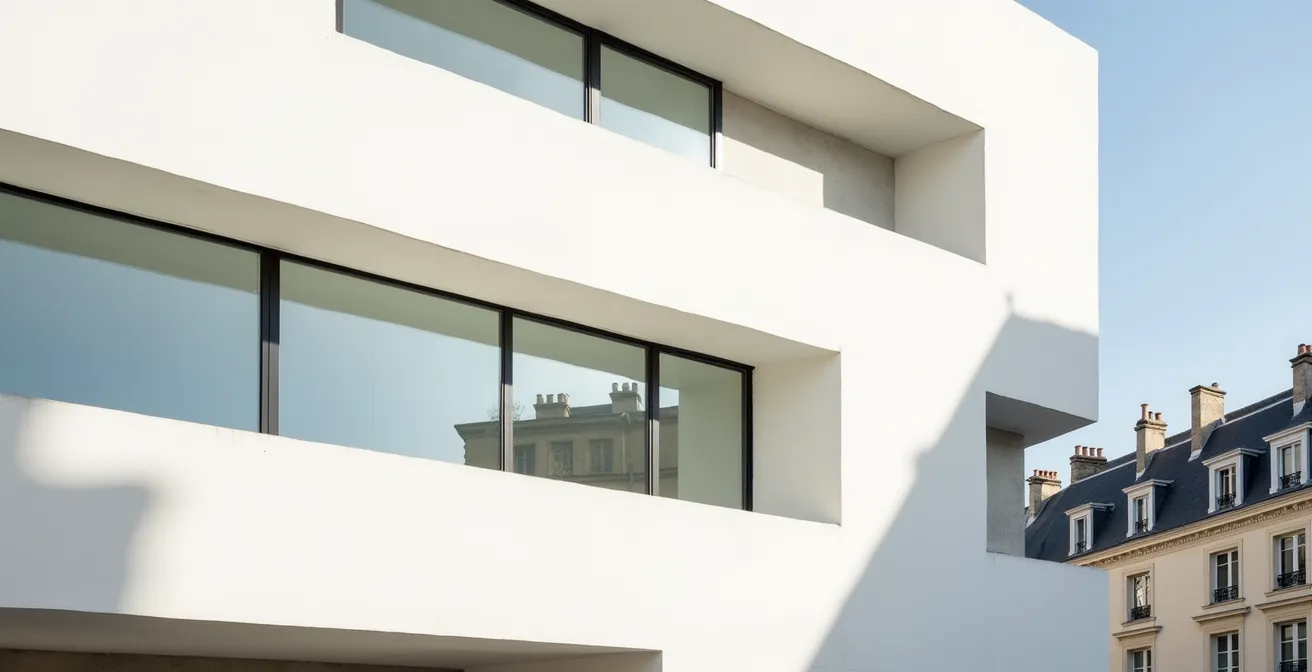
As this image shows, the building’s stark white, geometric facade stands in radical contrast to the surrounding Haussmannian and Post-Haussmannian buildings. This visual shock is part of the experience. Visiting the Villa La Roche is not just about seeing a building; it’s about understanding a turning point in architectural history, where ornament was stripped away in favor of pure form and function. For anyone confused by the transition from Art Deco to Modernism, this pilgrimage provides the essential, tangible answer.
The Samaritaine Glass Facade: Why Did It Cause Such a Scandal Among Purists?
The 2021 reopening of La Samaritaine department store was one of the most talked-about architectural events in recent Parisian history. While the restoration of its original Art Nouveau and Art Deco interiors was widely praised, the new addition on the Rue de Rivoli side—a monumental, undulating glass facade designed by the Japanese firm SANAA—ignited a fierce debate. The controversy perfectly illustrates the central tension in Parisian urban planning: should Paris be preserved as a 19th-century museum, or should it evolve with contemporary architecture?
The “scandal” was not about the quality of the new design itself, but about its relationship with the rigorously uniform Haussmannian streetscape of the Rue de Rivoli. Heritage purists, including the influential association SOS Paris, argued that the wavy, translucent facade was a “sacrilege” that broke the street’s perfect alignment and visual rhythm. They saw it as an intrusion of globalized, “starchitect” trends into a historically protected fabric. On the other hand, the project’s proponents argued that the ethereal, rippling glass was a poetic and necessary adaptation, reflecting the sky and bringing a much-needed sense of lightness and modernity to the massive building. They saw it as a respectful dialogue, not a disruption.
This public clash of architectural philosophies highlights how deeply Parisians care about their city’s visual identity. The debate wasn’t just about a building; it was about the very soul of Paris, a conflict embodied in the final design. As one analysis put it:
The Samaritaine represents the perfect physical embodiment of Paris’s ongoing cultural conflict: should the city become denser or be turned into a museum?
– Urban Planning Analysis, Contemporary Paris Architecture Debates
The table below breaks down the core arguments that fueled this architectural controversy.
| Heritage Purists Position | SANAA Architects Vision |
|---|---|
| Maintain strict Haussmannian alignment on Rue de Rivoli | Create undulating glass facade for modern retail needs |
| Preserve historical urban fabric unchanged | Integrate contemporary architecture with historic elements |
| Priority: Visual continuity of 19th century streetscape | Priority: Functional adaptation for 21st century commerce |
| Support from SOS Paris heritage association | Support from city planning modernizers |
How to Peek into Historic Courtyards Without Being Chased by a Concierge?
Some of Paris’s greatest architectural treasures are not on the street, but hidden behind massive wooden doors. The city’s historic courtyards (*cours*) offer a secret, tranquil world of cobblestones, climbing ivy, and centuries-old facades. For the design lover, these spaces reveal the true, lived-in history of a building. However, these are often private residential spaces, fiercely guarded by the legendary Parisian concierge. So, how does one explore these spaces respectfully and successfully?
The key is a blend of timing, confidence, and impeccable manners. The stereotypical image of a scolding concierge is not entirely unfounded; their job is to protect the residents’ privacy and security. Approaching the situation with the right etiquette can transform a potential confrontation into a pleasant encounter. The single most powerful tool in your arsenal is a simple, polite greeting. A warm “Bonjour, madame/monsieur” upon entering or making eye contact is not just a courtesy; it’s a signal of respect that can open doors—literally. Walk with purpose, as if you belong there or are visiting a specific business located within the courtyard (many do host small ateliers or offices). Hesitation is what marks you as an outsider and attracts scrutiny.
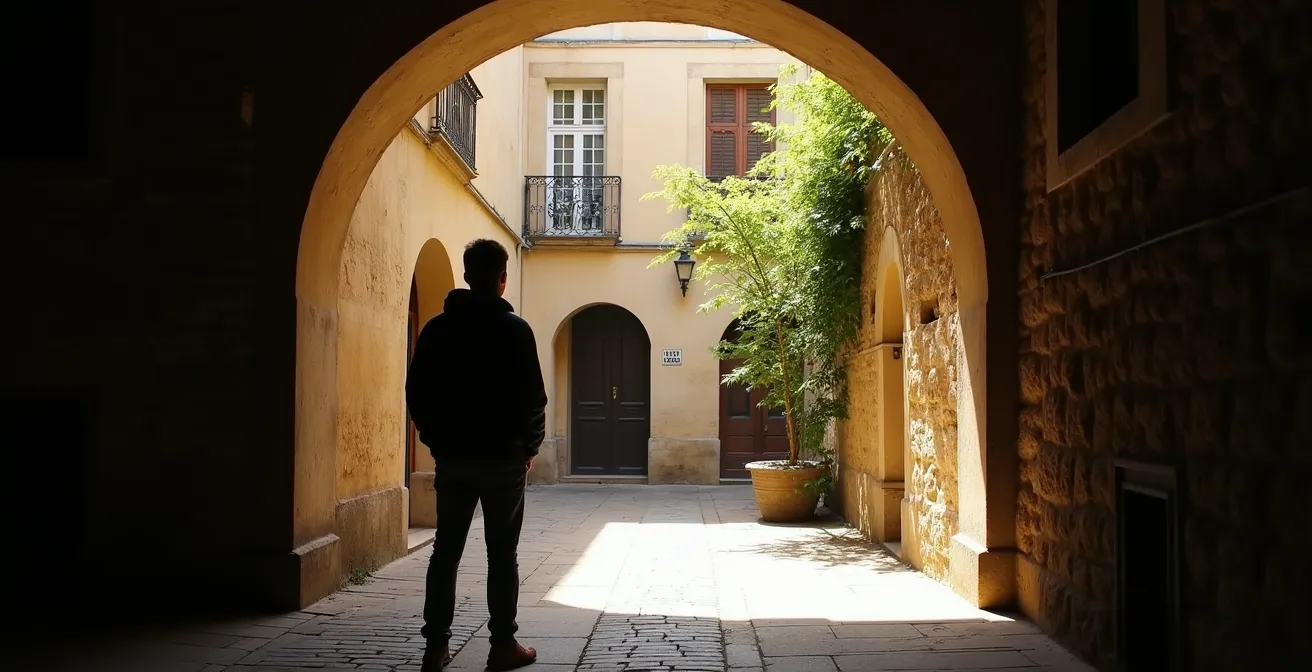
Once inside, your conduct is paramount. This is someone’s home, not a public park. Be discreet, keep your voice low, and never photograph residents, their windows, or personal items like laundry. Focus your camera on architectural details. If questioned, be honest and polite: explain that you are an architecture student admiring the beautiful building. Here are a few practical tips for a successful courtyard exploration:
- Visit during weekday business hours (9am-6pm) when doors are more likely to be propped open for deliveries and commercial activity provides a legitimate reason for foot traffic.
- Avoid trying to tailgate residents through coded doors; this is a major breach of etiquette. Look for doors that are already open.
- In areas like the Marais, some courtyards are part of historic “passages” that are public rights of way. Learning the magic phrase, “Je cherche le passage” (I’m looking for the passageway), can be a legitimate reason for entry.
The Two Last Medieval Timber Houses: Where Are They Hiding in the Marais?
While Paris is defined by its grand 19th-century stone avenues, a few rare survivors from the medieval era still stand, offering a glimpse into a vastly different city. For centuries, Paris was a city of narrow streets and timber-framed houses. Today, only two are believed to remain. For a long time, the house at 3 rue Volta was celebrated as the oldest in Paris, dating back to the 14th century. However, as one historical study points out, recent research suggests it was more likely built in the 17th century. This revision confirms that the true oldest house in Paris is the one built by the famous alchemist Nicolas Flamel at 51 rue de Montmorency, in the heart of the Marais.
Built in 1407, the Flamel house is a precious architectural artifact. Its facade showcases classic medieval construction techniques, including an exposed timber frame (*colombages*) and “jettying,” where the upper floors project out over the street below. This feature was a clever way to gain extra living space while being taxed only on the ground-floor footprint, but it was banned by a 1667 royal edict after the Great Fire of London proved how quickly flames could jump across narrow, overhanging streets. The survival of this house is astonishing, considering that urban renewal and fire prevention laws led to the demolition of almost all others. Indeed, records show that only 2 timber-framed houses remain from over 3,000 that once existed in medieval Paris.
Finding these houses requires knowing where to look. While the Nicolas Flamel house is now a restaurant and easy to spot, the second surviving example, at 11-13 rue François Miron, also in the Marais, is equally compelling. Though heavily restored, these two adjoining houses retain their tall, narrow proportions and visible timber skeletons, standing in stark contrast to the massive stone buildings surrounding them. They are not just old; they are witnesses to a forgotten version of Paris, a city of wood and plaster before it became a city of stone.
Haussmann vs Post-Haussmann: Which Style Defines the 16th Arrondissement?
The 16th arrondissement is often seen as the epitome of bourgeois Parisian architecture, but its character is more complex than a single style. It is, in fact, the perfect place to learn the difference between the strict, uniform Haussmannian style and the more exuberant Post-Haussmannian period that followed. While both are built on the same principles of stone construction and apartment living, the subtle shifts in decoration, form, and philosophy are clear once you know what to look for.
The classic Haussmannian period (roughly 1853-1870) was defined by rigid rules to create visual harmony. Facades were flat, ornamentation was restrained and repetitive, and a strict building height and roof angle were enforced. The goal was a cohesive, monumental urban landscape. The Post-Haussmannian era (c. 1880-1920s), however, saw architects begin to chafe against these restrictions. Enabled by less stringent planning laws and a desire for more individual expression, they started to play with the facade. Bow windows bulge out, breaking the flat plane. Ornamentation becomes more elaborate and varied, often incorporating early Art Nouveau influences like floral motifs and curving lines. Rooflines become more dynamic with decorative dormers and varied heights.
This evolution from rigid uniformity to decorative freedom is beautifully illustrated in the architecture of the 16th. A walk down a grand artery like Avenue Foch or Avenue Victor Hugo reveals this dialogue between the two styles. You’ll see buildings that adhere strictly to the Haussmannian template right next to ones that take liberties with projecting windows and lavish stone carvings. As one architectural guide to the area notes, this period saw a shift where organic motifs began to challenge rigid geometry. The following table provides a clear visual guide to spotting the differences.
| Feature | Haussmann (1850s-1870s) | Post-Haussmann (1880s-1920s) |
|---|---|---|
| Facade Treatment | Flat, uniform stone surface | Bow windows, varied textures |
| Balconies | Continuous on 2nd and 5th floors only | Individual balconies on multiple floors |
| Ornamentation | Restrained, repetitive motifs | Elaborate stonework, Art Nouveau influences |
| Roofline | Uniform 45-degree mansard | Varied heights and decorative dormers |
| Example Streets | Boulevard Haussmann, Rue de Rivoli | Avenue Victor Hugo, Avenue Foch sections |
Blocked Windows: Why Do Some Buildings Have Fake Windows Painted On?
As you wander through Paris, you might notice an architectural oddity: a window that looks real from a distance but, upon closer inspection, is completely flat and painted onto the wall. These are not just whimsical decorations; they are “fiscal fossils” left over from a peculiar piece of French history. The culprit was the ‘door and window tax’ (*impôt sur les portes et fenêtres*), a property tax in effect from 1798 all the way to 1926. As a detailed analysis on the tax’s architectural legacy explains, the amount of tax a property owner paid was calculated based on the number of visible doors and windows on their building.
To reduce their tax burden, many owners simply bricked up unnecessary windows. However, this created a new problem: it ruined the perfect symmetry of the Haussmannian facade, a core tenet of Parisian aesthetics. The solution was brilliant and deceptive: they hired artists to paint *trompe-l’œil* (trick of the eye) windows in the place of the blocked-up ones. These painted fakes maintained the building’s visual harmony and rhythmic pattern, satisfying both the taxman and the demands of architectural beauty. You can find excellent examples of this on the grand buildings surrounding Place Vendôme, where several ‘windows’ are nothing more than skillfully applied paint.
Once you know this story, you’ll start seeing these phantom windows all over the city. Spotting them becomes a fun architectural game. Here are some clues to look for:
- Unrealistic Shadows: The painted shadows around the frame don’t match the direction of the actual sunlight.
- Lack of Depth: Real windows have a recess (the reveal). Fake windows are perfectly flat against the wall.
- No Reflections: Painted “glass” panes don’t reflect the sky or surrounding buildings.
- Perfect Curtains: If the *trompe-l’œil* includes curtains, they are suspiciously perfect and never move.
- Signs of Fading: You can often spot faint brush strokes or areas where the paint has faded or peeled over time.
Key Takeaways
- The Haussmannian building is the “canvas”: To understand Parisian styles, you must first learn the strict rules of Haussmann’s design, which acts as the baseline for everything that followed.
- Styles are a reaction: Art Nouveau was a deliberate, organic rebellion against Haussmann’s rigidity, while Art Deco was a streamlined, geometric refinement of its principles for a new, modern age.
- Clues are in the details: The real secrets to identifying styles are not just in famous landmarks, but in the everyday details of balconies, windows, and rooflines on residential streets.
How to Identify a True Haussmannian Building by Looking at the Balconies?
We’ve established the Haussmannian building as the foundational “canvas” of Paris. But how do you identify a true, textbook example from the Second Empire period with certainty? The most reliable and immediate clue lies in the balconies. A strict set of unspoken rules governed their placement, creating a visual rhythm that is the ultimate signature of the style. The fundamental rule is simple: a classic Haussmannian building must have continuous, running balconies on only two floors: the second and the fifth. This “2-and-5 rule” is so consistent that some architectural historians claim 100% of true Haussmannian buildings feature this specific balcony arrangement.
This was not an arbitrary aesthetic choice; it was a direct reflection of 19th-century social hierarchy. The second floor was known as the *étage noble* or “noble floor.” In the age before elevators, it was the most desirable apartment, high enough to be away from the street’s noise and grime, but low enough to avoid a long climb. This floor was reserved for the wealthiest residents, and its status was advertised by a grand, often ornate, running balcony. The fifth floor also had a running balcony, though typically with simpler ironwork, which provided aesthetic balance to the facade. The floors in between (third and fourth) were for the merely well-off and usually had only individual window balconies, if any. The top floor, under the mansard roof, contained the small *chambres de bonne* (maid’s rooms), which had no balconies at all.
The ironwork (*garde-corps*) of these balconies also tells a story. On the noble second floor, the wrought iron often featured complex, opulent designs with volutes, acanthus leaves, and medallions. The fifth-floor ironwork was more restrained, often using simple geometric patterns. By simply looking at a building’s balconies—their placement, continuity, and the complexity of their ironwork—you can read its social history and confirm its Haussmannian identity. This is the baseline from which all other styles deviate.
Now that you can read the foundational language of Parisian architecture, the city transforms from a beautiful backdrop into an interactive text. Every street becomes an opportunity to test your knowledge, to spot the rebellion of an Art Nouveau curve, the confident geometry of an Art Deco facade, or the historical ghost of a tax-dodging window. The next time you walk through Paris, look up and start reading.