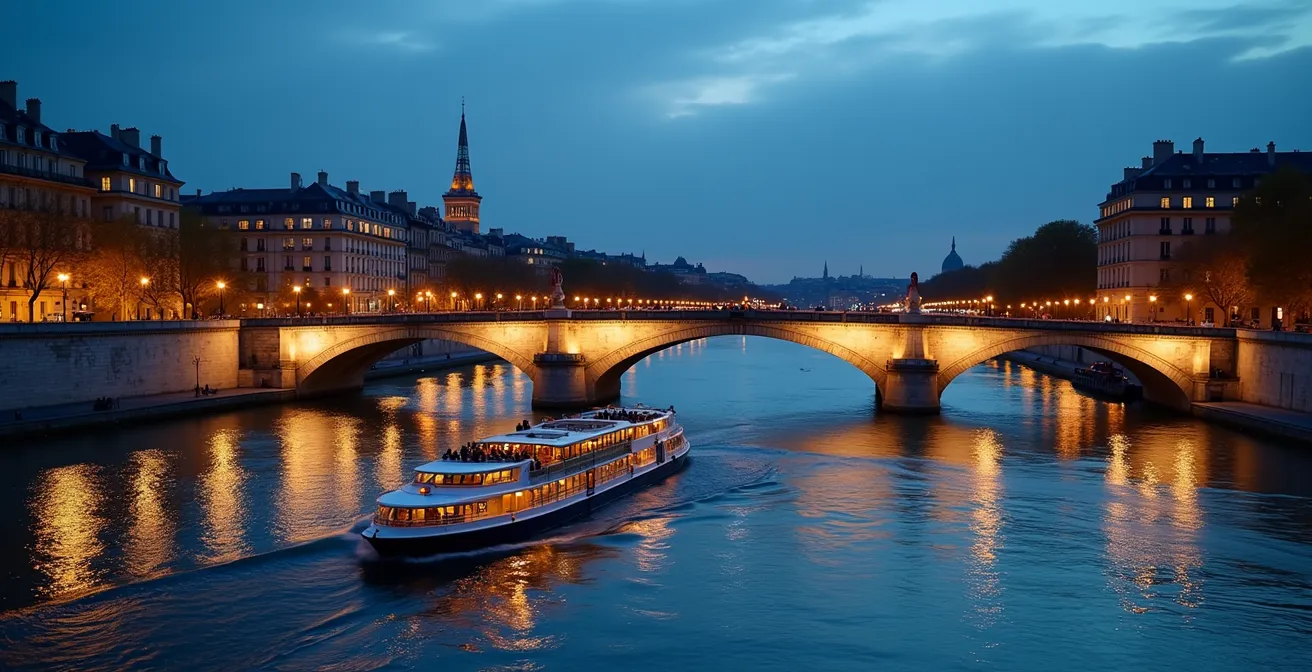
Choosing between Batobus and Bateaux-Mouches is a strategic itinerary decision, not just a simple preference.
- Bateaux-Mouches offer a curated, one-off cinematic experience with commentary, ideal for a dedicated sightseeing event.
- Batobus provides flexible, scenic transport that transforms travel time into a continuous sightseeing opportunity, maximizing the experiential value of your day.
Recommendation: Use Batobus for multi-stop sightseeing days to optimize your itinerary, and book a Bateaux-Mouches cruise for a dedicated romantic evening or a deep historical dive.
The Seine is the lifeblood of Paris, and experiencing the city from its waters is non-negotiable for any visitor. Yet, a common point of confusion arises at the riverbank: should you board a Batobus or a Bateaux-Mouches? Most guides offer a simple distinction: one is a “water bus,” the other a “tour boat.” This explanation, while true, is superficial. It fails to address the core of the traveler’s dilemma, which is not about a mode of transport, but about the strategic optimization of their precious time in Paris.
The common advice to simply “choose based on your preference” overlooks the logistical implications of each choice. The decision impacts the flow of your entire day, the quality of your photographs, and the overall value you extract from your journey between landmarks. This isn’t merely about seeing the Eiffel Tower from the water; it’s about deciding if that view should be part of a structured narrative or a flexible link in your self-guided adventure.
This guide abandons the simplistic “bus vs. tour” dichotomy. Instead, we will approach this as a logistics expert would, analyzing the strategic trade-offs of each option. We will dissect specific use-case scenarios, from the pure efficiency of getting from the Eiffel Tower to Notre-Dame to the art of selecting a dinner cruise that isn’t a culinary tourist trap. Forget preference; it’s time to make the optimal choice for your Parisian itinerary.
This in-depth comparison will explore every facet of the river experience, providing you with the data and context needed to deploy these services like a seasoned Parisian. We will analyze timing, views, and specific purposes to ensure your time on the Seine is not just pleasant, but perfectly integrated into your travel strategy.
Summary: A Strategic Guide to Paris River Cruises
- Day vs Night Cruise: Why the 9 PM Slot Is Superior for Romance?
- Pont Alexandre III vs Pont Neuf: Which Bridge Tells the Better Story?
- Dinner Cruises: How to Avoid the Frozen Food Tourist Trap Boats?
- Is the Batobus Faster Than the Metro for Getting from Eiffel Tower to Notre-Dame?
- The Zouave Statue: How Parisians Check the River Level With One Glance?
- Marin d’Eau Douce: Do You Need a License to Rent a Boat on the Canal?
- The Climbing Wall: Where Exactly is the Kids’ Zone Near Pont des Invalides?
- Which Seine Bridge Offers the Most “Cinematic” View for Your Portfolio?
Day vs Night Cruise: Why the 9 PM Slot Is Superior for Romance?
Choosing between a day and night cruise is a classic Parisian dilemma, but a logistical analysis reveals optimal slots for specific goals. For photographers, the “golden hour” between 5 PM and 7 PM is unmatched. In fact, photography experts have measured that lighting quality is 3x better during these hours compared to the harsh glare of midday. This is the time for capturing postcard-perfect shots of monuments bathed in warm, soft light. However, for pure romance, the strategic choice is the 9 PM departure slot, which offers a different kind of magic.
A 9 PM cruise is not just a trip in the dark; it’s an orchestrated experience with the city’s lights. This time slot is perfectly engineered to coincide with the nightly “sparkle” of the Eiffel Tower. By positioning yourself on the upper deck around 9 PM, you witness one of Paris’s most iconic light shows from a unique, moving vantage point. It’s a shared, memorable moment that a daytime cruise simply cannot replicate. This timing also aligns perfectly with the Parisian dining rhythm. A cruise ending around 10:15 PM allows for a late, leisurely dinner, fully embracing the local culture rather than rushing for an early tourist-centric meal.
To execute this perfectly, check the precise sunset times for the month of your visit, as they vary significantly from 8:30 PM in September to nearly 10:00 PM in June. Booking an 8:30 PM departure can be a masterstroke, allowing you to experience the breathtaking “blue hour”—the transition from twilight to night—before the main event at the Eiffel Tower. This transforms the cruise from a simple tour into a carefully timed, multi-act performance of light.
Pont Alexandre III vs Pont Neuf: Which Bridge Tells the Better Story?
From the water, every Parisian bridge is a landmark, but the Pont Alexandre III and the Pont Neuf tell two fundamentally different stories about Paris. Choosing a “better” story depends on what aspect of the city you want to connect with: its official, grandiose history or its lively, human-centric past. The Pont Alexandre III is a spectacle of diplomatic optimism. Built for the 1900 Exposition Universelle, it’s a monument to the Franco-Russian Alliance, adorned with opulent gold statues, cherubs, and winged horses. It represents Paris at its most formal—a city of grand gestures and international prestige, now serving as a backdrop for luxury fashion shoots.
In stark contrast, the Pont Neuf, despite its name meaning “New Bridge,” is the city’s oldest standing bridge. Its story is that of the people. As the first bridge in Paris built without houses, it became the city’s original open-air social network. Completed in 1607, it was a place where merchants, performers, and citizens from all walks of life mingled. Its 384 unique carved faces, or mascarons, are not gods or allegories but caricatures of 16th-century Parisians, each telling a small, personal story. It was and remains a true crossroads of everyday Parisian life.
To make the distinction clear, this table breaks down their core identities.
| Aspect | Pont Alexandre III | Pont Neuf |
|---|---|---|
| Story Type | Official, Diplomatic Paris | The People’s Paris |
| Historical Role | Symbol of Franco-Russian Alliance (1900) | First open-air social hub (1607) |
| Modern Usage | Luxury fashion shoots backdrop | Everyday Parisian crossroads |
| Key Features | Gold statues, Belle Époque optimism | 384 mascarons, oldest standing bridge |
Ultimately, a cruise on the Seine offers both. The Bateaux-Mouches commentary will highlight the official history of Pont Alexandre III, while the simple act of passing under the Pont Neuf connects you to over 400 years of Parisian public life.
Dinner Cruises: How to Avoid the Frozen Food Tourist Trap Boats?
A dinner cruise on the Seine can be the pinnacle of a romantic Parisian evening or a deeply disappointing and overpriced meal. The difference lies in the kitchen logistics. Many boats operate as little more than floating restaurants with spectacular views, but their food is prepared off-site by a catering service (service traiteur) and simply reheated on board. This is the hallmark of a tourist trap. The key to an authentic culinary experience is finding a boat with a real, functioning kitchen and its own team of chefs.
High-quality operators pride themselves on this distinction. They will prominently feature phrases like “cuisine préparée à bord” (kitchen on board) or mention their own chefs (“nos propres chefs”) on their websites. As the official Bateaux Mouches website states, this is a mark of quality:
All our dishes are cooked by our own chefs using seasonal products in our boats’ modern kitchens
– Bateaux Mouches Official, Bateaux Mouches Website
Another major red flag is a long, sprawling menu that remains the same year-round. A quality kitchen works with fresh, seasonal ingredients, resulting in a short, focused menu with three or four options per course. If you see a multi-cuisine menu offering everything from Italian pasta to French classics, you are likely looking at a frozen food operation. For a truly gourmet experience, the visual presentation is also a clue.
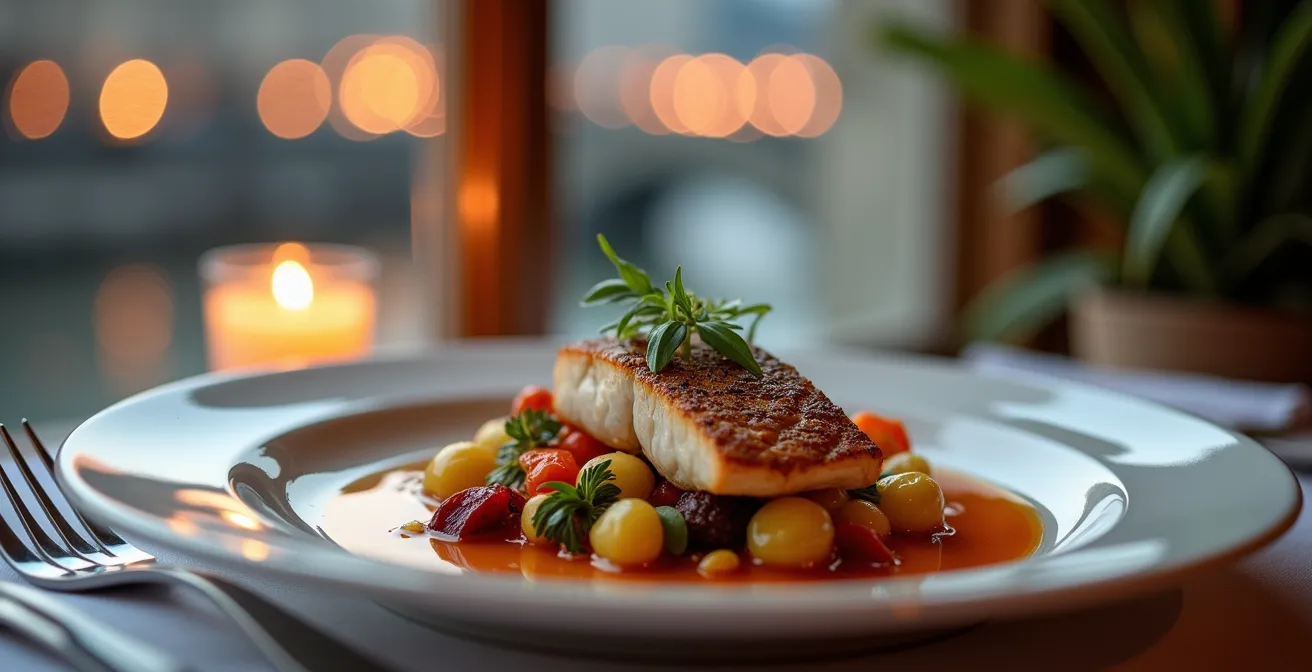
The plating on a quality cruise will reflect the care and artistry of an on-board kitchen, as seen above, a stark contrast to mass-catered meals. If you’re unsure, a hybrid strategy is an excellent alternative: purchase gourmet items from a high-end food hall like Fauchon or a local fromagerie, enjoy a riverside picnic, and then board a sightseeing-only cruise for the views.
Your Checklist for Spotting a Quality Dinner Cruise
- Look for ‘cuisine préparée à bord’ (kitchen on board) vs ‘service traiteur’ (catered service) on websites.
- Check for short, seasonal menus (maximum 3-4 options per course) as a sign of freshness.
- Avoid boats with multi-cuisine or year-round “classic” menus, a major red flag for frozen food.
- Verify if the company explicitly mentions their own chefs (‘nos propres chefs’) in their descriptions.
- Consider the hybrid option: a gourmet picnic before a sightseeing-only cruise for guaranteed quality.
Is the Batobus Faster Than the Metro for Getting from Eiffel Tower to Notre-Dame?
In a pure, point-to-point race, the Metro is undeniably faster. But framing the question around speed alone misses the entire point of the Batobus and the concept of “value per minute” in travel. A logistics-focused analysis shows that while the Metro’s pure travel time is shorter, the total journey experience is vastly different. The Metro is efficient but sterile—a journey through underground tunnels with significant walking time to and from subterranean stations.
The Batobus, while slower, transforms transit time into sightseeing value. It embodies the French philosophy of flânerie—the art of leisurely, mindful strolling. Every minute of the journey is spent gliding past iconic monuments, turning what would be “dead time” on the Metro into a productive and enjoyable part of your tour. Furthermore, Batobus is the city’s only hop-on-hop-off river service, making it a strategic tool for a day of flexible sightseeing along the river.
Let’s break down the real-world time investment for a trip from the Eiffel Tower to Notre-Dame, based on an objective transit time comparison.
| Factor | Batobus | Metro (Line 6 + 4) |
|---|---|---|
| Pure Travel Time | 25-30 minutes | 15-18 minutes |
| Walking to/from stops | 3-5 minutes (riverside docks) | 8-10 minutes (underground access) |
| Average Wait Time | 10-20 minutes (40-min frequency) | 3-5 minutes (peak hours) |
| Total Journey Time | 38-55 minutes | 26-33 minutes |
| Value per Minute | Scenic views entire journey | Underground tunnels only |
| Strike-proof? | Yes (independent operator) | No (affected by grèves) |
The data is clear: the Metro will save you approximately 15-20 minutes. However, the Batobus journey provides 30 minutes of continuous, high-quality scenic views you would otherwise miss. Another crucial factor for any seasoned Paris traveler is its reliability. As an independent operator, the Batobus is immune to the frequent public transport strikes (grèves) that can paralyze the Metro, making it a surprisingly dependable option.
The Zouave Statue: How Parisians Check the River Level With One Glance?
On the upstream pillar of the Pont de l’Alma, a stone soldier stands perpetual watch. This is the Zouave, a statue that has become far more than a military tribute; it is the unofficial, and most famous, flood gauge for the Seine. For generations, Parisians have used the Zouave to measure the river’s mood with a simple glance. The system is an informal but surprisingly precise local tradition, a piece of living history that connects modern Paris to its centuries-old relationship with the river.
The statue provides a clear, visual scale for the water level. During normal times, the water flows well below the statue’s feet. However, as the river rises, the Zouave’s body becomes the benchmark. As local Parisians know, when water reaches the Zouave’s feet, the Seine is officially at flood level and riverside walkways begin to close. If the water reaches his knees, navigation on the Seine is halted for all traffic, including the Batobus and Bateaux-Mouches. This practical use cemented the statue’s fame, especially after the great flood of 1910 when the water surged to the Zouave’s shoulders, a historic high-water mark still remembered today.
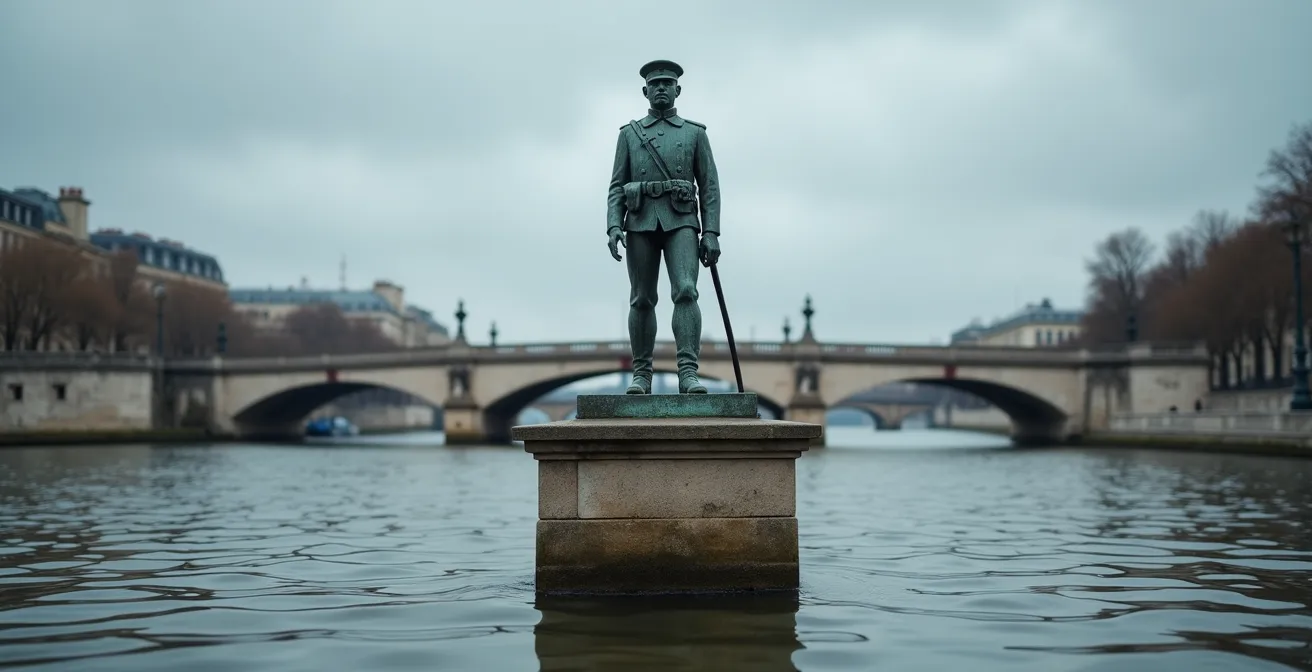
When on a river cruise, pointing out the Zouave on the Right Bank side of the Pont de l’Alma is a classic insider move. It shows an understanding of the city that goes beyond the famous monuments, tapping into the practical folklore that makes Paris so rich. The water level at its base tells a dynamic story of the river’s power and the city’s resilience.
Marin d’Eau Douce: Do You Need a License to Rent a Boat on the Canal?
While the Seine is the domain of large tour boats, Paris’s charming canal network offers a more intimate and autonomous boating experience. Services like Marin d’Eau Douce allow you to become your own captain for a day. A common question is whether you need a boating license for this, and the answer is a liberating no. The electric boats available for rent are specifically designed to be “bateaux électriques sans permis” (electric boats without a permit).
This is possible because their motors have a low power output (under 6 horsepower) and their speed is capped at a gentle 6 km/h. This makes them safe and easy to operate for complete beginners after a brief instruction. Navigation on the canals, like the Canal de l’Ourcq or Canal Saint-Martin, follows simple rules: always give way to the large commercial barges (péniches) and respect the speed limit. This allows you to explore a different side of Paris at your own pace, far from the crowds on the Seine.
The experience is less about seeing famous monuments and more about participating in authentic Parisian leisure. You can navigate through the modern Parc de la Villette, passing the Géode and the Cité des Sciences, or venture into the less-touristy Pantin area. A popular local activity, especially on sunny weekends, is to take a picnic and a bottle of rosé on board, transforming the canal into a floating dining room. Due to its popularity with locals, it’s highly recommended to book your boat online in advance to avoid disappointment.
The Climbing Wall: Where Exactly is the Kids’ Zone Near Pont des Invalides?
For families traveling with children, finding engaging, kid-friendly activities is a top priority. The banks of the Seine offer a fantastic, and often overlooked, playground. Tucked away on the Left Bank (Rive Gauche) is a dedicated kids’ zone that provides a perfect break from museum visits. The area’s official name is the Jardin de l’Archipel des Berges de Seine Niki de Saint Phalle, a key piece of the larger Parc Rives de Seine, which is itself a UNESCO World Heritage site.
To find it, you need to head to the stretch of pedestrianized riverbank located precisely between the Pont des Invalides and the Pont de l’Alma. This is where the fun is concentrated. The zone is designed to delight children with a variety of free activities. The main attractions include a small climbing wall, a via ferrata-style course perfectly sized for kids, and large ground surfaces designated for chalk drawing. Often, you’ll also find organized games like a “Twister géant” (Giant Twister) and other interactive installations, especially on weekends and during school holidays.
From a logistical standpoint, this area is a strategic win for parents. Its location makes it an easy stop between sightseeing at the Eiffel Tower and the Musée d’Orsay. For a perfect family afternoon, you can combine an hour of play at the Jardin de l’Archipel with a snack from one of the nearby riverside cafés, many of which are located on converted barges (péniches). This turns a simple rest stop into a fun and memorable part of your Parisian adventure.
Key takeaways
- Define Your Goal First: Choose Batobus for flexible, multi-stop transport and Bateaux-Mouches for a single, curated, and immersive tour experience.
- Analyze the “Value per Minute”: The Metro is faster, but the Batobus turns travel time into valuable, scenic sightseeing time, offering a better experiential return.
- Check the Kitchen for Dinner Cruises: Prioritize boats that advertise “cuisine préparée à bord” (kitchen on board) and short, seasonal menus to avoid frozen food traps.
Which Seine Bridge Offers the Most “Cinematic” View for Your Portfolio?
For photographers, Paris is an endless portfolio of opportunities, but capturing a truly “cinematic” shot requires more than just pointing a camera at a landmark. It requires understanding light, composition, and atmosphere. While every bridge has its charm, the Pont de Bir-Hakeim stands out for its unique cinematic quality. Famous for its appearance in the film ‘Inception’, this bridge offers a graphic, structured, and industrial aesthetic reminiscent of the French ‘Nouvelle Vague’ cinema. Its two-level design, with the metro passing on the upper viaduct, creates incredible opportunities for dynamic compositions with layers and movement.
The metal framework of the bridge creates powerful geometric shadows, especially during the golden hour. The key to a great shot here is timing and patience—waiting for a train to pass overhead as the light hits the structure just right. For a different aesthetic, the now lock-free Pont des Arts offers clean, uncluttered frames of the Île de la Cité, making it ideal for sunrise shoots when the crowds are gone. Meanwhile, the modern, wavy design of the Passerelle Léopold-Sédar-Senghor is perfect for photographers seeking abstract architectural shots.
To elevate your photos, you need to think like a professional. Use a tripod for long exposures, especially during the “blue hour” (the twilight transition), to capture stunning silhouettes and smooth out the water’s surface, creating beautiful light trails from passing boats. In fact, the wake from a Bateaux-Mouches can be used intentionally as a dynamic leading line to draw the viewer’s eye into your composition. The best light is often found in the spring, which offers longer post-sunset shooting hours, giving you more time to work with the magical Parisian twilight.
Frequently Asked Questions about Boating in Paris
Do I need a license to rent an electric boat on Canal de l’Ourcq?
No, a license is not required for electric boats without a permit (‘bateaux électriques sans permis’) due to their low power (under 6 hp) and a controlled speed limit of 6 km/h. This makes them accessible to everyone after a short briefing.
What are the navigation rules on Parisian canals?
The main rules are to respect the speed limit, which is typically 6 km/h, and to always give way to large commercial barges, known as ‘péniches’. Additionally, be aware that certain areas near locks may be off-limits to recreational boaters.
When should I book a canal boat rental?
It is highly recommended to book online and in advance, especially if you plan to go on a sunny weekend. These boats are very popular with Parisians for their traditional ‘pique-nique’ on the water, often complete with wine and snacks.