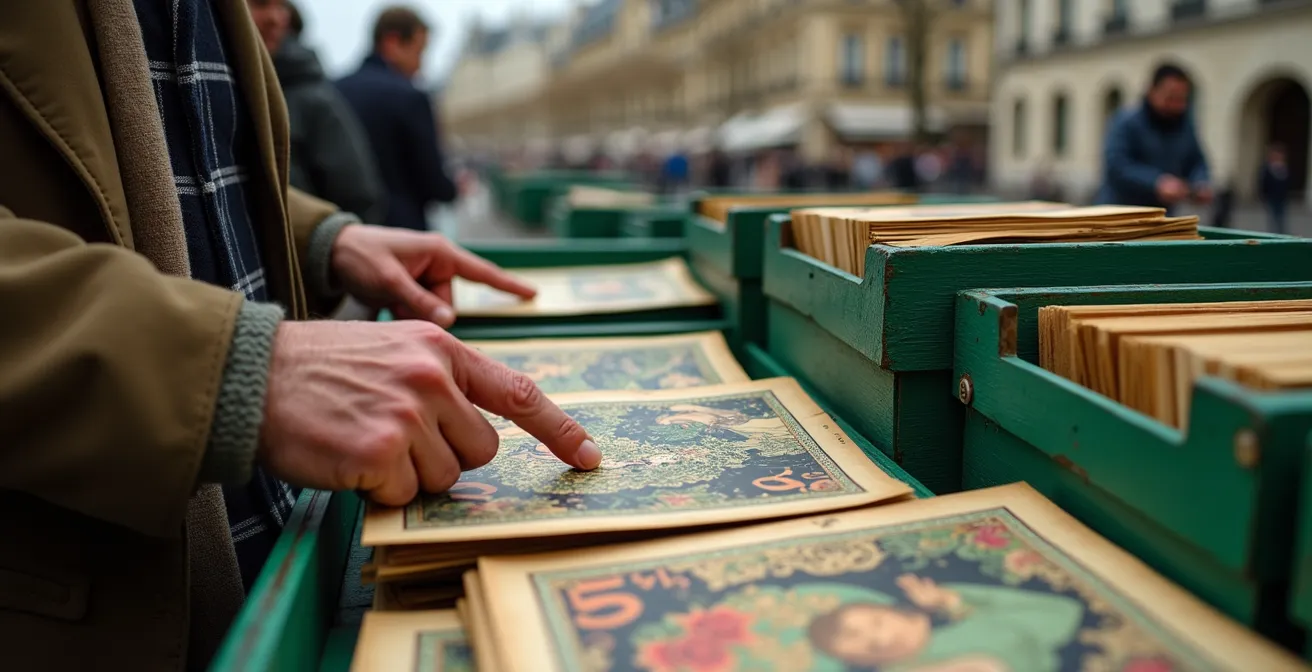
The real value of a bouquiniste’s poster lies not in its image, but in its paper’s testimony and the story of its creation.
- Authentication is a science: Use a loupe to check for the random grain of vintage lithography, not the uniform dots of modern offset printing.
- Location is key: Serious collectors head to the Left Bank (Rive Gauche) for specialists in fine art prints, antique engravings, and academic works.
Recommendation: Treat your purchase as an act of cultural custodianship, not just a transaction, to ensure you bring home a true piece of Paris.
The allure is undeniable. Strolling along the Seine, you see the iconic green boxes of the bouquinistes, a treasure trove of history under the Parisian sky. The dream is to find that perfect vintage poster, a tangible piece of the city’s soul to take home. But with that dream comes a nagging fear: what if the charming print of a Belle Époque advertisement is just a modern, worthless photocopy? What if the “aged” paper is nothing but a tea-stained fake designed to fool tourists?
Many guides will tell you of the bouquinistes’ charm, advising you to “look for signs of age” or “negotiate politely.” This advice is not wrong, but it is dangerously incomplete. It scratches the surface, leaving you vulnerable to the common souvenir traps. True authentication is a skill, a methodology that separates a casual shopper from a discerning collector. It requires more than a glance; it demands an understanding of the object itself.
This guide changes the paradigm. We will not treat this as a shopping trip, but as an apprenticeship in collecting. My goal is to give you the protective mindset and the expert tools of a paper dealer. You will learn to read the paper’s testimony—its texture, its marks, its very fiber—and to develop a curator’s eye for spotting a specialist among generalists. This is about more than avoiding a reprint; it’s about honoring a tradition and ensuring the piece of history you acquire is genuine.
We will navigate the unwritten rules of etiquette, understand the rhythm of their business, and identify the geographical heart of serious collecting. Most importantly, you will learn the physical tests to distinguish a high-quality original from a cheap poster. By the end, you’ll be equipped to make a purchase with confidence, transforming a simple souvenir hunt into a meaningful act of cultural preservation.
This article provides a structured path to becoming a more discerning buyer on the quays of Paris. Explore the sections below to master the art of acquiring a genuine vintage print, from understanding the people to authenticating the paper.
Summary: A Collector’s Guide to the Bouquinistes
- Haggling Etiquette: Is It Rude to Negotiate with a Bouquiniste?
- Rainy Days: Why You Won’t Find Many Bouquinistes Open in November?
- Amazon vs Bouquinistes: Why Buying Here Supports UNESCO Heritage?
- Stamps or Comics: Which Bank Has the Best Specialists?
- The “Green Boxes”: Why Are They All Painted the Same Shade of Green?
- Prints vs Originals: Where to Start Your Collection Under 500€?
- The Souvenir Trap: How to Distinguish a High-Quality Print from a Cheap Poster?
- How to Experience the Existentialist Vibe of Saint-Germain Without Paying 10€ for Coffee?
Haggling Etiquette: Is It Rude to Negotiate with a Bouquiniste?
Approaching a bouquiniste is not like walking into a standard retail shop. These are independent experts, often with decades of experience, and the first rule is to show respect for their craft. Aggressive haggling is considered deeply rude and will likely end the conversation immediately. The goal is not to “win” a negotiation but to engage in a respectful discussion about a piece you genuinely appreciate. A lowball offer, such as asking for 50% off, is seen as an insult to their expertise and the value they place on their collection.
The correct approach is subtle and begins with demonstrating authentic interest. Take your time. Examine the piece, ask questions about its history, its artist, or its printing method. This shows you value the item for more than its price. If you decide to discuss the price, use polite French phrases. Instead of a demanding “How much?” or “I’ll give you X,” a simple, respectful “Quel serait votre meilleur prix?” (What would be your best price?) opens the door for a modest discount. A reduction of 10-15% is often considered reasonable. Another effective strategy is to bundle several items together and ask for a collective price, which gives the seller more room to offer a better deal.
It’s also crucial to understand their economic context. These are not large corporations; they are small business owners whose income is directly affected by foot traffic and tourism. As Laurent, a young bouquiniste on Quai Voltaire, notes, sales can be heavily dependent on foreign visitors. During slower periods, they may be more open to negotiation. However, sometimes the most respectful action is to simply pay the asking price. It’s an acknowledgment of their expertise, the time spent curating their collection, and your shared role in preserving these paper treasures. The transaction should feel like a partnership, not a battle.
Rainy Days: Why You Won’t Find Many Bouquinistes Open in November?
The primary enemy of a bouquiniste is not a tough negotiator, but the Parisian weather. Paper and water are mortal foes. A sudden downpour can ruin centuries-old books and delicate prints in an instant. Consequently, you will find the quays sparsely populated on rainy, humid, or excessively windy days. November, with its characteristic damp chill, is a particularly quiet month for them. The sellers’ first priority is the preservation of their stock, so they will not risk opening if the weather is threatening.
Their presence is also governed by city regulations. To maintain their coveted spot on the Seine, a regulation in Paris stipulates that bouquinistes must be open a minimum number of days. While the rule has some flexibility, it’s generally understood that they must be present at least four days a week, weather permitting. This is why you’ll find the highest concentration of open boxes on warm, dry days, especially from Wednesday through the weekend, when both local and tourist traffic is at its peak. Planning your visit for a sunny afternoon gives you the best chance of seeing the full, vibrant lineup of stalls.
But what if your trip to Paris is met with relentless rain? Don’t despair. The city offers several fantastic indoor alternatives for your vintage print hunt. These covered locations provide shelter for both you and the precious paper goods you seek:
- Visit Passage Verdeau in the 9th arrondissement, a charming covered arcade known for its antique shops, many of which specialize in vintage posters and prints.
- Explore the sprawling Marché aux Puces de Saint-Ouen, the famous flea market. Many of its stalls are covered, hosting dealers with extensive collections of antique books and posters.
- On weekends, check out the Marché du Livre Ancien et d’Occasion at Parc Georges Brassens, a dedicated old book market with large covered pavilions.
- For authenticated, high-end pieces, browse the art galleries on the Rue de Seine in Saint-Germain-des-Prés. Prices are higher, but the experience is entirely weatherproof.
Amazon vs Bouquinistes: Why Buying Here Supports UNESCO Heritage?
In an age of one-click ordering and global marketplaces, choosing to buy from a bouquiniste is a deliberate act of cultural preservation. It is a stand against the homogenization of commerce and a vote in favor of human expertise and tradition. Every euro spent on the quays of the Seine does more than purchase an object; it helps sustain a living ecosystem of knowledge that has been passed down for centuries. This is not just a romantic notion; it is a formally recognized fact.
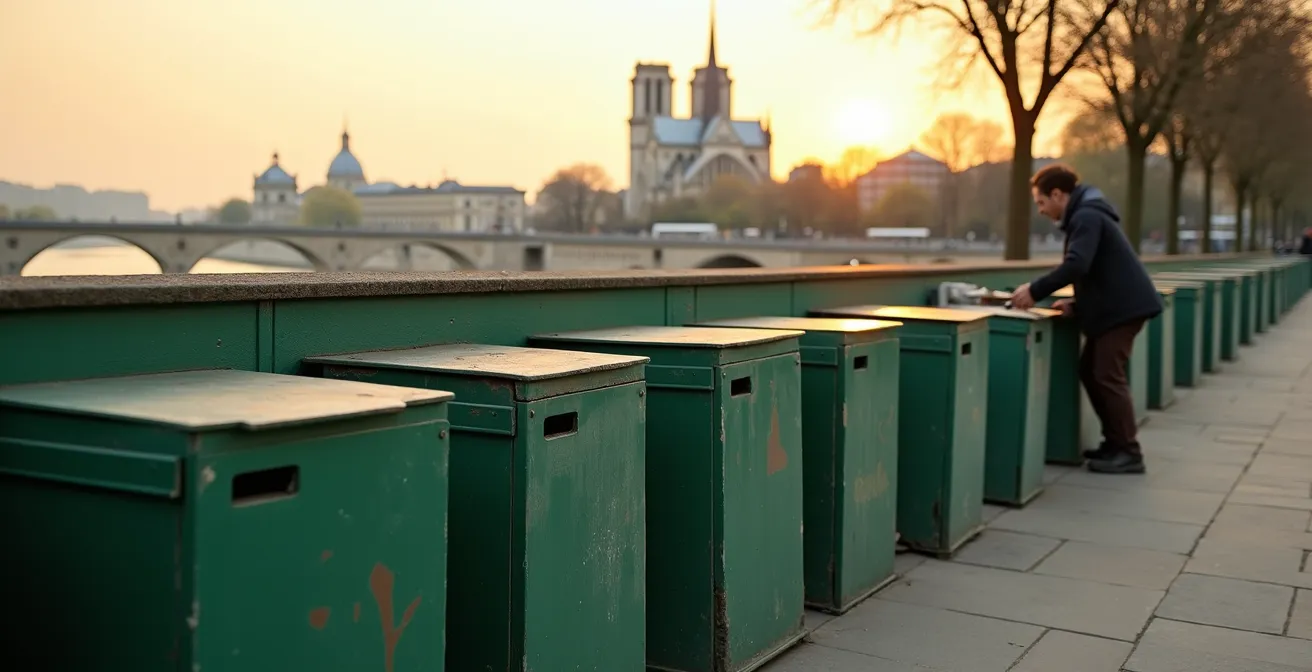
The unique trade and cultural significance of the bouquinistes were officially acknowledged when they were added to the list of France’s intangible cultural heritage in 2019, a precursor to full UNESCO recognition. This status celebrates not just the items they sell, but the skills, knowledge, and social practices that define their profession. Buying from them directly contributes to the survival of this heritage, ensuring that the “largest open-air bookshop in the world” continues to enchant future generations.
The threat from mass-market online retailers is real and existential for these small traders. As Jérôme Callais, President of the Bouquiniste Cultural Association, explained in an interview with France 24, their reliance on foot traffic, especially from international visitors, is immense. Speaking of the period after the Covid lockdown, he noted the fragility of their model:
We had a few local people who we hadn’t seen before come see us just after the lockdown ended. But our level of dependency is extreme because practically half our customers are foreign visitors.
– Jérôme Callais, President of the Bouquiniste Cultural Association
Your purchase is a direct lifeline. It validates their expertise, supports a local artisan, and reinforces the value of a commercial model based on passion and personal connection rather than algorithms. It is a cultural transaction as much as a financial one.
Stamps or Comics: Which Bank Has the Best Specialists?
Not all stretches of the Seine are created equal. A common mistake for first-time visitors is to assume that the offerings of the bouquinistes are homogenous. In reality, there is an unwritten geographical specialization that separates the casual browser from the serious collector. The key is understanding the historical and cultural divide between the Right Bank (Rive Droite) and the Left Bank (Rive Gauche). Knowing where to look dramatically increases your chances of finding authentic, high-quality pieces rather than tourist-oriented trinkets.
The Left Bank has traditionally been the intellectual and artistic heart of Paris. Home to the Sorbonne, the École des Beaux-Arts, and countless publishing houses, it has always catered to students, academics, and artists. The bouquinistes in this area reflect that heritage. Here, you are more likely to find specialists—dealers who focus on specific genres like antique engravings, original art prints, rare academic texts, or first-edition literature. Guillaume’s stand on the Quai de Conti is a perfect example, representing this tradition of specialization with a coherent, curated collection rather than a random assortment. If you are a serious collector, the Left Bank is your primary hunting ground.
Conversely, the Right Bank is historically the center of commerce and government. The bouquinistes here, particularly those near major tourist hubs like the Louvre and Notre-Dame (before the fire), tend to have more generalist offerings. You will find more souvenirs, modern reprints of famous posters, and general-interest books. While it’s still possible to find treasures, the signal-to-noise ratio is much lower for a collector seeking specific, authenticated items.
This table breaks down the traditional specializations to help you focus your search:
| Location | Traditional Specialization | Best For | Key Areas |
|---|---|---|---|
| Left Bank (Rive Gauche) | Fine art prints, antique engravings, academic books | Serious collectors seeking original prints | Quai Malaquais, Quai de Conti (near École des Beaux-Arts) |
| Right Bank (Rive Droite) | Generalist offerings, tourist-oriented items | Casual browsers, souvenir hunters | Near Louvre and Hôtel de Ville |
The “Green Boxes”: Why Are They All Painted the Same Shade of Green?
The 900-odd “boîtes” that line the Seine are as iconic to the Parisian landscape as the Eiffel Tower or the Arc de Triomphe. Their uniform appearance is no accident; it is the result of strict municipal regulations designed to create a harmonious and recognizable aesthetic along the river. The specific color, a deep, resonant green, is officially known as “vert wagon” or “wagon green.”
This particular shade has a historical connection to the city’s past. As Pierre of the French Moments blog notes, the color is a direct reference to the dark green paint used on the first carriages of the Paris Métro and old train cars. It evokes a sense of turn-of-the-century industry and transport, tying the bouquinistes’ boxes to another quintessential element of Parisian heritage.
The ‘vert wagon paint’ colour of the boxes refers to the dark green of old train carriages.
– Pierre, French Moments
Beyond the color, the boxes themselves are subject to precise rules regarding their dimensions. This ensures that no single stall can dominate the quayside, maintaining a level playing field and a consistent visual line. A 1993 by-law, famously signed by then-mayor Jacques Chirac, codified these requirements. Among other rules, it states that the upper edge of an opened box lid must not exceed 2.1 meters (about 6.9 feet) from the ground. Each bouquiniste is entitled to a 10-meter stretch of the parapet, which can accommodate four of these standard-sized boxes.
This strict regulation is what creates the beautiful, uninterrupted ribbon of green that stretches for over three kilometers along the river. It transforms what could be a chaotic jumble of individual stalls into a unified, visually poetic installation. The green boxes are not just containers for books and prints; they are a regulated, curated part of the city’s architectural and cultural identity, a deliberate design choice that has become a beloved symbol of Paris.
Prints vs Originals: Where to Start Your Collection Under 500€?
Starting a collection of original prints can seem daunting, with prices for famous artists quickly running into the thousands. However, the bouquinistes offer a fantastic entry point for the budding collector with a modest budget. The key is to shift your focus from famous names to quality, condition, and historical interest. For under 500€, and often for less than 100€, you can acquire genuine pieces of art history if you know what to look for.
Instead of chasing after a Picasso or Matisse print (which, at this price, would almost certainly be a modern reproduction), look for original works from less-known but historically significant sources. For instance, original lithographs from Belle Époque satirical magazines like ‘L’Assiette au Beurre’ are vibrant, artistically significant, and can often be found for under 100€. These are not reproductions; they are the actual pages from publications over a century old, created by talented artists of the day.
Another excellent area for new collectors is original eaux-fortes (etchings). Many 19th and early 20th-century artists created beautiful etchings of Parisian scenes. While the artists may not be household names, the works are original, hand-pulled prints that capture a moment in the city’s life. When starting out, prioritize a piece in excellent condition over one by a more famous artist in poor condition. A pristine print by a lesser-known artist is a far better investment and a more beautiful object. A crucial detail to look for is the ‘planche’ mark—the faint indentation in the paper left by the edge of the copper printing plate, a tell-tale sign of an authentic etching or engraving.
To find the best prices, consider venturing beyond the most tourist-heavy quays. Markets like the Marché du Livre Ancien at Parc Georges Brassens or the annual Paname Bouquine festival often have knowledgeable dealers with more accessible pricing. Your first-timer’s checklist should be:
- Focus on original prints from historical magazines or lesser-known 19th-century artists.
- Look for a visible ‘planche’ mark (plate indentation) as a sign of authenticity.
- Prioritize excellent paper condition over a famous artist’s name to maximize value.
- Explore specialized markets beyond the central Seine area for better prices.
Key Takeaways
- The Loupe Test is your non-negotiable first step to authentication; modern dots mean a modern print.
- Geographic specialization is real: head to the Left Bank (Quai Malaquais, Quai de Conti) for serious collecting of fine art prints.
- Every purchase is a cultural transaction that helps preserve a living UNESCO-recognized heritage.
The Souvenir Trap: How to Distinguish a High-Quality Print from a Cheap Poster?
This is the most critical skill a collector must develop. The difference between a 10€ souvenir poster and a 100€ original vintage print lies in a series of physical clues that the paper and ink themselves provide. A seller might tell you a story, but the object tells the truth. To avoid the souvenir trap, you must learn to read this physical evidence. This requires more than a quick glance; it requires a tool and a methodology. Your single most important investment is a small jeweler’s loupe or a powerful magnifying glass. It will reveal secrets invisible to the naked eye.
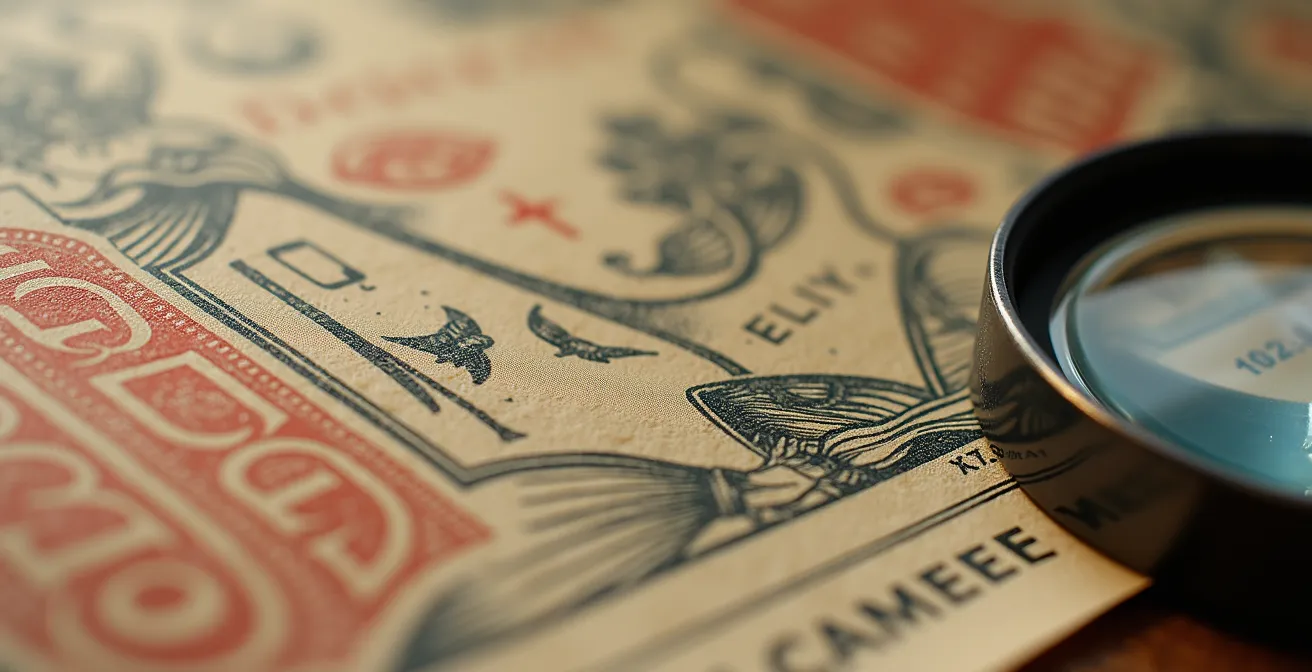
The first thing to examine is the printing pattern. Modern offset printing, used for cheap posters, creates a uniform, mechanical pattern of CMYK (cyan, magenta, yellow, black) dots arranged in a rosette. Under magnification, this looks like a perfect, soulless grid. Vintage printing methods, like stone lithography, are completely different. A lithograph is created from a drawing on stone, resulting in a random, fluid grain pattern. Under a loupe, it looks more like the texture of a drawing, with no repeating dot structure. This test alone can disqualify 90% of fakes.
Next, examine the paper itself. Authentic old paper often has ‘laid lines’ (vergeures), a faint grid-like pattern from the wire mesh used in handmade paper manufacturing. Hold the print up to a light source to see them. Also, look for signs of natural aging. Real foxing (piqûres) consists of random, small brown spots caused by mold or iron particles in the paper over decades. Artificial aging often looks like a uniform, flat brown wash, like a tea stain. Finally, search the bottom margin of the print for the printer’s mark. Authentic French vintage posters from the great era of printmaking will often bear the name of the legendary printing house that made them, such as ‘Imp. Mourlot, Paris’ (for Mourlot Printing House, Paris).
Your Authentication Checklist: The Loupe Test
- Check the Printing Method: Use a magnifying glass. Do you see uniform CMYK dots (modern) or a random, fluid grain pattern (vintage lithograph)?
- Examine the Paper Texture: Hold the paper to the light. Can you see faint ‘laid lines’ (vergeures), a sign of older, handmade paper?
- Assess the Aging: Look for authentic foxing (piqûres), which are random brown spots. Be wary of uniform, tea-stain-like coloring, which indicates artificial aging.
- Find the Printer’s Mark: Inspect the bottom edge for a credit to the original printer, such as ‘Imp. Mourlot, Paris’ or a similar authentic mark.
- Feel for the Plate Mark: For etchings and engravings, run your finger along the edge of the image. You may feel the slight indentation from the printing plate, a key sign of an original.
How to Experience the Existentialist Vibe of Saint-Germain Without Paying 10€ for Coffee?
The spirit of Saint-Germain-des-Prés—the world of Sartre, de Beauvoir, and Camus—is not found in an overpriced coffee at a tourist-packed café. It’s found in the act of intellectual discovery, in the quiet contemplation of ideas, and in the simple pleasure of a book. You can immerse yourself in this atmosphere for the price of a cheap paperback from a bouquiniste. The act of ‘chiner’ (treasure hunting) among the stalls is, in itself, an existential act of finding personal meaning in a world of chaotic choice, as Paris Unlocked editor Courtney Traub suggests.
The true experience is a walking meditation, a journey that connects the literary past with the tangible present. Start your pilgrimage on the Left Bank quays, the intellectual appetizer to the main course of Saint-Germain. Peruse the boxes on the Quai Malaquais or Quai de Conti. Here, you are not just shopping; you are engaging with the very currency of the existentialists: books. Find a well-loved, inexpensive paperback of Sartre’s Nausea, Camus’s The Stranger, or de Beauvoir’s The Second Sex. This 2€ to 5€ purchase is your ticket to an authentic experience.
With your new treasure in hand, you can begin your free walking tour:
- Start at the bouquinistes on Quai Malaquais or Quai de Conti to find your book.
- Walk past the famous cafés, Les Deux Magots and Café de Flore. Don’t go in. Absorb their history from the outside, imagining the philosophical debates that raged within.
- Wander through the narrow, atmospheric streets like Rue de Buci or Rue de Seine, soaking in the neighborhood’s authentic energy.
- End your journey in the tranquil Jardin du Luxembourg. Find a chair, open your new (old) book, and engage with the ideas in the same park where so many great thinkers found their inspiration.
This experience—the hunt, the walk, the quiet reading—connects you to the spirit of the place far more deeply than a 10€ coffee ever could. It is an act of participation, not consumption.
The act of ‘chiner’ (treasure hunting) among the bouquinistes’ stalls connects to the existentialist theme of finding personal meaning in a chaotic world.
– Courtney Traub, Paris Unlocked
Armed with this knowledge, you are no longer just a tourist but a guardian of history, an apprentice collector. You have the tools to look past the charming facade and read the true story written on the paper itself. Go forth and start your collection with confidence, knowing you are preserving a small but vital piece of Paris.