In summary:
- Stop dragging kids through museums. Instead, frame your visits as a chronological “time travel” adventure.
- Focus on one historical era per visit, using targeted activities to turn kids into “Artifact Detectives.”
- Use the “One Era per Hour” rule, followed by a planned, fun break, to prevent museum burnout.
- Connect historical sites by treating them as “time portals,” revealing the layers of history hidden in modern Paris.
The dreaded “museum glaze.” You’ve seen it: the moment your child’s initial curiosity about Paris museums fades into a glassy-eyed stare of pure boredom. Parents often try the usual tactics: pre-visit history books, promises of ice cream, or a desperate rush to see the “famous stuff” like the Mona Lisa. The result is almost always the same: exhaustion, frustration, and a feeling that a precious opportunity to connect with history has been lost. We try to show them the wonders of Ancient Egypt or the French Revolution, but we end up just showing them an endless series of rooms and display cases.
But what if the problem isn’t the history, but the way we present it? What if, instead of a dry tour, you could offer them an adventure? The secret to engaging children in the rich history of Paris isn’t about seeing more things; it’s about connecting those things into a compelling story. This guide abandons the traditional “top 10” list. Instead, it offers a new framework: the “Time Travel” itinerary. This approach treats each museum and historical site not as a destination, but as a “time portal” to a specific era. Your role shifts from tour guide to Chief Time-Travel Officer.
By focusing on a chronological narrative, from the pharaohs in the Louvre to the echoes of the guillotine on the Place de la Concorde, you’ll transform a passive viewing experience into an active quest. We will explore how to use specific artifacts as mission objectives, how to strategically manage energy with the “One Era per Hour” rule, and how to reveal the hidden layers of history that exist all over Paris. Get ready to turn your family trip into an unforgettable journey through time.
This article provides a complete, step-by-step chronological plan for your family’s historical adventure in Paris. Below, you’ll find a guide to each “time portal,” packed with tips and activities to keep your young explorers engaged.
Summary: Your Guide to Time-Traveling Through Paris
- The 3 Egyptian Artifacts That Will Fascinate a 10-Year-Old (Not Just Mummies)
- Roman Paris: Where to Find the Ruins of Lutetia for Free?
- Nintendo 3DS Guide at the Louvre: Is It Worth the Extra 5€ for Families?
- The “One Era per Hour” Rule: How to Prevent Museum Burnout in Children?
- Cluny Museum: Why the Lady and the Unicorn Is the Best Intro to the Middle Ages?
- Marie-Antoinette’s Cell: Is the Augmented Reality Tablet Worth the Entry Fee?
- Place de la Concorde: Where Exactly Did Louis XVI Die?
- How to Keep Kids Entertained in the Tuileries Without Spending a Fortune?
The 3 Egyptian Artifacts That Will Fascinate a 10-Year-Old (Not Just Mummies)
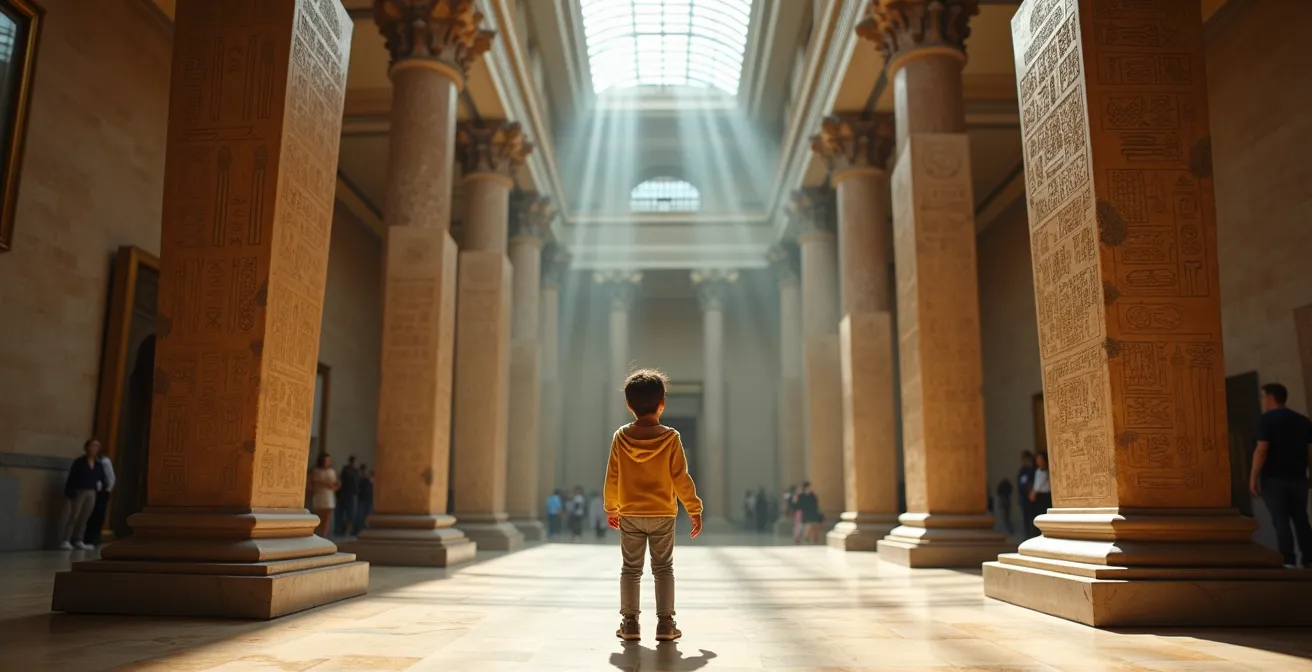
Your time-traveling journey begins at the Louvre, but not with a chaotic dash to the Mona Lisa. Your first destination is much further back in time: Ancient Egypt. The key is to bypass the overwhelming crowds and transform this wing into a treasure hunt. While the Louvre’s collection includes over 55,000 Egyptian objects, you only need to focus on a few key “artifacts” to capture a child’s imagination. Forget trying to explain every dynasty; instead, turn your kids into Artifact Detectives on a mission.
Their first target: the Seated Scribe. This isn’t just another statue. Challenge them to walk around it and see how its mesmerizing rock crystal eyes seem to follow them. This small detail makes the past feel alive and personal. Next, lead them to the magnificent Zodiac of Dendera, a 2,000-year-old celestial map carved in stone. Turn it into a game: “Can you find the symbol for Leo the lion or Scorpio the scorpion?” This connects an ancient artifact directly to their own lives. Finally, instead of focusing on the large sarcophagi, have them hunt for the tiny servant figurines called shabtis, tasked with working for the deceased in the afterlife. It becomes a fun counting game that also teaches a core concept of Egyptian belief.
By focusing on these interactive and visually engaging pieces, you reframe the museum visit from a passive lecture into an active quest. Your child isn’t just looking at old things; they are solving mysteries and finding clues left behind by a long-lost civilization.
Roman Paris: Where to Find the Ruins of Lutetia for Free?
After your journey through ancient Egypt, your next time portal takes you to the era of the Roman Empire. Many visitors don’t realize that before it was Paris, this city was a Roman town called Lutetia. This is a perfect opportunity to introduce the concept of history layers—the idea that the modern city is built directly on top of older ones. And the best place to witness this is the Arènes de Lutèce, a real Roman amphitheater hidden in the Latin Quarter, completely free to visit.
As you enter, explain that this very spot was a bustling center of Roman life in the 1st century AD. It was a massive structure, one of the largest in all of Gaul. To help them grasp the scale, tell them that historians estimate this Roman theatre could once seat 15,000 spectators—enough to hold a huge portion of the entire city’s population. Imagine the gladiatorial contests and theatrical performances that took place right where you are standing!
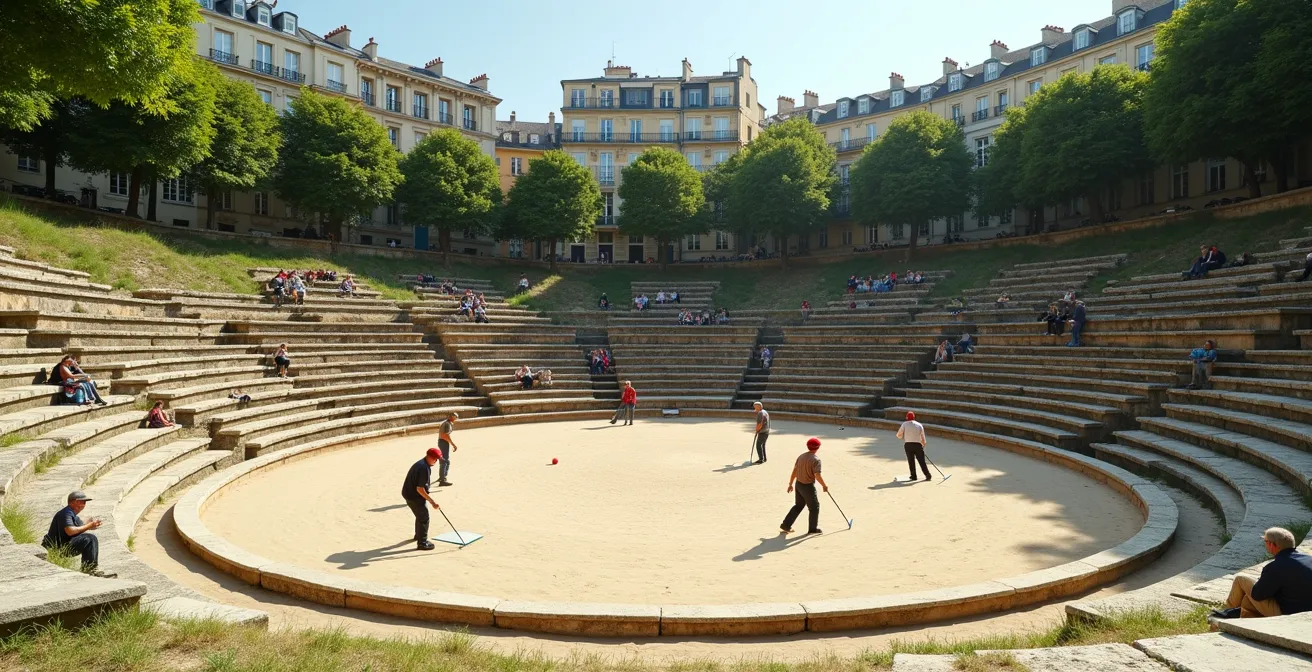
The real magic of the Arènes is seeing the past and present collide. Today, the sandy arena floor is used by local Parisians for playing pétanque. This striking contrast is a powerful, visual lesson. Your kids can see elderly men in berets playing a traditional French game on the same ground where gladiators once fought. It shows them that history isn’t just in a museum; it’s a living part of the city, right under their feet.
Nintendo 3DS Guide at the Louvre: Is It Worth the Extra 5€ for Families?
Navigating a colossal time portal like the Louvre requires a good map. But for a family with kids, the standard museum leaflet can feel inadequate. This brings up a common dilemma: should you invest in the official audio guide? Specifically, the Louvre offers a unique tool: a Nintendo 3DS pre-loaded with a guided tour for an extra 5€. Is this a worthy investment for your time-traveling family or just an expensive gimmick?
The answer lies in understanding what it offers beyond a simple paper map. The Nintendo guide isn’t just audio commentary; it’s a fully interactive experience. It includes GPS location tracking that shows you exactly where you are, 3D models of key artworks, and high-resolution images you can zoom into. Most importantly for families, it features a special “Family Trail” that avoids overly violent or emotional scenes and focuses on stories that resonate with younger visitors. It essentially gamifies the museum experience.
As one parent noted after a visit with their young children:
We went with our two boys (4 and 6), and we rented both of them a 3DS audio guide. They loved it! It made the visit possible. They begged us to go back again and spend the whole day! How many 4 and 6 year olds say that?
While a free leaflet gives you the basics, the 5€ for the Nintendo guide buys you engagement and independence. It empowers kids to lead the way, transforming them from passive followers into active explorers of the museum. For a time-travel mission, having a dedicated, kid-friendly device can be the difference between a quick retreat and a full day of discovery.
| Feature | Nintendo 3DS Guide (5€) | Free Louvre Leaflet |
|---|---|---|
| Audio Commentary | 30+ hours in multiple languages | None |
| Kid-Friendly Routes | Special family trail avoiding emotional scenes | General masterpieces route |
| Interactive Elements | 3D models, GPS location tracking | Static map only |
| Duration Options | 40-90 minute curated tours | Self-paced |
| Educational Value | Detailed explanations at child level | Brief descriptions |
The “One Era per Hour” Rule: How to Prevent Museum Burnout in Children?
The single greatest threat to any family time-travel mission is burnout. No matter how exciting the artifacts, a child’s stamina is finite. The secret to a successful multi-stop itinerary is not just what you see, but how you pace the journey. This is where you implement the most important strategy in your toolkit: the “One Era per Hour” rule. This simple but powerful guideline acts as your official Burnout Prevention Protocol.
The rule is straightforward: you dedicate a maximum of one hour to each historical period. When the hour is up, your “time travel” to that era is over, no matter what you haven’t seen. This creates a sense of urgency and focus. More importantly, it guarantees a break. This isn’t just an aimless pause; it’s a planned “portal jump” to a completely different, non-museum activity. After exploring the dense halls of the Louvre’s Egyptian wing, don’t just move on to the next gallery. Exit the museum entirely.

This strategic break is essential for resetting a child’s mind and body. A great option is heading to the adjacent Tuileries Garden to rent a vintage toy sailboat at the Grand Bassin. This simple, classic Parisian activity provides a complete sensory shift from the enclosed museum space. Other options include grabbing an artisanal ice cream from Berthillon after exploring Île de la Cité, or finding a local boulangerie for a pain au chocolat energy boost. By making the breaks as much a part of the adventure as the museums themselves, you ensure your young explorers have the energy to be excited for the next chapter in their journey through time.
Action Plan: Implementing the “One Era per Hour” Rule
- Define the ‘Era’: Before entering, clearly state the time period you’re about to explore (e.g., “We are now in Roman Gaul!”).
- Set a Timer: Use your phone for 60 minutes. When it rings, the ‘time travel’ to that era is over, no matter what you haven’t seen.
- Plan the ‘Portal Jump’: Have your transition activity ready. Know which ice cream shop or park you’re heading to next for your strategic break.
- Collect a Souvenir: Buy one postcard or take one specific photo that represents the era. This solidifies the memory of the “trip.”
- Review the Journey: During the break, ask “What was the coolest thing we saw in [Era Name]?” This reinforces learning in a low-pressure way.
Cluny Museum: Why the Lady and the Unicorn Is the Best Intro to the Middle Ages?
Your next time portal jumps forward to the Middle Ages. For this era, you’ll head to the Musée de Cluny, Paris’s National Museum of the Middle Ages. Your mission here is to find one of the world’s greatest medieval treasures: the series of six tapestries known as The Lady and the Unicorn. These monumental works of art are the perfect entry point into the medieval world for children because they tell a story not just with pictures, but with mystery and sensation.
Begin by building the mystique. As the Musée de Cluny itself notes, the history of these masterpieces adds to their allure.
These tapestries were hidden and forgotten, then rediscovered in the 19th century.
– Musée de Cluny, Official Museum History
This story of loss and rediscovery turns them from simple wall hangings into a lost treasure. Once inside the dedicated, dimly lit room, the experience becomes immersive. The sheer size and detail are captivating. But to make it truly engaging for a child, turn the viewing into a sensory game. Five of the tapestries depict the five senses: Sight, Hearing, Smell, Touch, and Taste. The sixth, “À Mon Seul Désir” (To My Sole Desire), is more enigmatic and often interpreted as representing the heart or free will.
You can create an “Artifact Detective” activity around this theme:
- Sight: In the “Sight” tapestry, the lady holds a mirror. Ask your child what the unicorn sees in its reflection.
- Hearing: While looking at the “Hearing” tapestry, ask everyone to be silent for a moment and listen to the sounds of the museum around them.
- Smell: In the “Smell” tapestry, the lady weaves a crown of flowers. Ask your kids to imagine the scents of a medieval garden.
- Touch: As you observe the “Touch” tapestry, have them feel the different textures of their own clothes.
- À Mon Seul Désir: For the final, mysterious tapestry, ask your child: “If you had one sole desire for this trip to Paris, what would it be?”
This approach connects a 500-year-old artwork to a child’s direct, personal experience, making the Middle Ages feel immediate and tangible.
Marie-Antoinette’s Cell: Is the Augmented Reality Tablet Worth the Entry Fee?
Jumping forward to one of the most dramatic periods in French history, your next time portal leads to the Conciergerie. This foreboding medieval palace-turned-prison on the Île de la Cité was the final stop for thousands during the French Revolution, including its most famous prisoner, Marie-Antoinette. Visiting her cell can be an intense experience, and the key question for families is whether the “HistoPad,” an augmented reality (AR) tablet included with admission, enhances or detracts from the visit.
The HistoPad is a powerful tool for visualizing the “history layers” of this complex building. It allows you to point the tablet at the empty stone rooms and see them transformed on screen, showing them as they were in different eras. You can see the grand hall of the medieval palace and then, with a tap, see it as a crowded revolutionary prison. For Marie-Antoinette’s cell, it reconstructs the sparse, guarded conditions of her final days. This technology is highly competitive for the Parisian context, with similar experiences at sites like the Château de Chambord costing more.
Naturally, parents may have concerns. Will an AR tablet “gamify” a place of historical trauma? The experience is designed with a respectful tone, using the technology to explain the Reign of Terror rather than turn it into entertainment. Another common question is its appropriateness for younger children. The content does include discussions of executions, so it’s wise for parents of children under 10 to preview the scenes and provide context about the French Revolution. The AR is incredibly effective at showing the building’s transformation from palace to prison, directly supporting the “time travel” theme by peeling back the layers of time within a single space.
Place de la Concorde: Where Exactly Did Louis XVI Die?
From the prison to the place of execution, the next stop on your revolutionary tour is just a short walk away: the vast Place de la Concorde. Today, with its grand Egyptian obelisk, beautiful fountains, and swirling traffic, it’s hard to imagine this square as the grim stage for the French Revolution’s most public spectacles. In the 1790s, this was the Place de la Révolution, and it was here that the guillotine was erected.
The critical question to pose to your young time travelers is: “Where exactly did it happen?” The guillotine, responsible for the execution of King Louis XVI, Marie-Antoinette, and over a thousand others, stood slightly west of the square’s center, near the entrance to the Tuileries Garden, close to where the statue of a horseman from Brest now stands. Standing on that spot can be a profound experience, prompting a conversation about justice, power, and how societies change.
This leads to the next logical question: why is there a 3,300-year-old Egyptian obelisk in the middle of it all? This is another powerful lesson in “history layers” and how memory is shaped. After the turmoil of the Revolution and subsequent political shifts, France in the 1830s sought a way to reunify the nation. The obelisk, a gift from Egypt, was chosen specifically because it was a politically neutral monument. By placing this ancient, non-French artifact on the very spot so deeply associated with the bloody divisions of the Revolution, the government aimed to “erase” the square’s traumatic past and give Paris a new, unified focal point. It is a monument placed to make people forget what happened beneath it.
Key takeaways
- The “Time Travel” framework turns museum visits into a chronological story, which is more engaging for kids than random sightseeing.
- Focusing on a few key “mission” artifacts in each museum prevents overwhelm and encourages active looking.
- The “One Era per Hour” rule, combined with planned non-museum breaks, is the most effective strategy to prevent child burnout and maintain enthusiasm.
How to Keep Kids Entertained in the Tuileries Without Spending a Fortune?
Every good time-travel story needs moments of rest and simple joy. After delving into the intense history of the Revolution, the Tuileries Garden offers the perfect “decompression zone.” While it’s a historic site in its own right (created by Catherine de’ Medici in 1564), you can treat it as a modern-day playground that offers a wealth of low-cost and free entertainment options. This is where your family recharges before their next leap through time.
One of the most iconic and affordable activities is renting a vintage sailboat for a few euros to push around the Grand Bassin Rond. It’s a simple pleasure that has delighted Parisian children for generations. For a dose of traditional culture, you can catch a performance at the Théâtre de Guignol, where classic puppet shows have entertained children since the 19th century. This isn’t just a show; it’s a piece of living history itself.
Beyond these small-cost activities, the garden is a giant free playground. You can organize a “sculpture safari” to find famous works like Rodin’s “The Kiss” or simply count all the animal statues. There are also two enclosed playgrounds with slides and climbing structures perfect for burning off energy. Finally, you can embrace the artistic spirit of Paris by bringing sketchbooks and pencils. Find a bench near a statue and encourage your kids to draw what they see, just like the many art students who frequent the garden. This final stop isn’t just a break; it’s proof that a historical journey can and should be filled with fun.
By weaving these chapters together—from the sacred rites of Egypt to the simple joy of a toy boat on a pond—you don’t just show your children Paris. You give them a story they can walk through, a timeline they can feel, and an adventure that makes history their own.