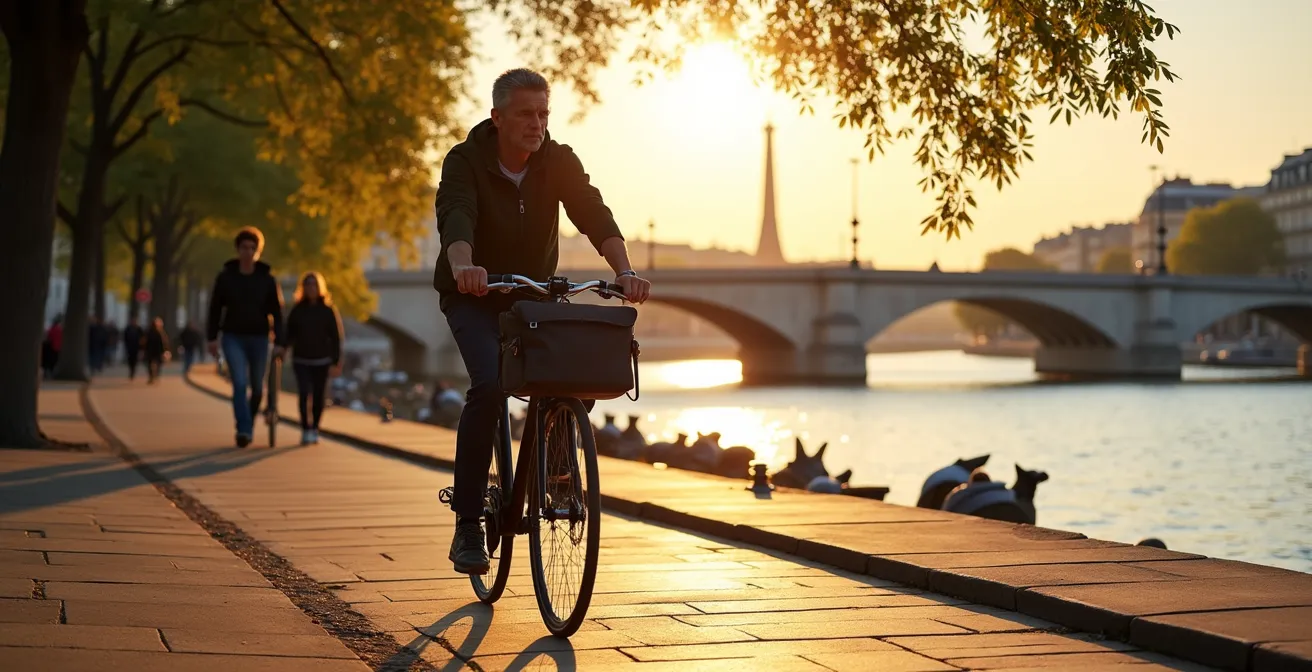
The key to a collision-free ride on the Seine isn’t just slowing down, but mastering ‘predictive defensive cycling’.
- Anticipate the unpredictable movements of tourists, children, and runners who view the quays as a leisure space, not a traffic lane.
- Identify and manage ‘friction zones’—areas around playgrounds, food stalls, and benches where conflicts are most likely to occur.
Recommendation: Shift your mindset from simply following rules to actively reading the environment. This strategy transforms a potentially chaotic ride into a relaxing and genuinely Parisian experience.
The image is iconic: cycling along the Seine, with Notre-Dame or the Louvre drifting past, the water sparkling beside you. The reality, however, is often less poetic. For many cyclists, the car-free Rives de Seine can feel like a chaotic obstacle course, a jumble of meandering tourists, unpredictable children, speeding runners, and sprawling picnics. The frustration is palpable. You have a dedicated space, yet a peaceful, fluid ride seems impossible, turning a dream outing into a stressful series of near-misses and constant braking.
Common advice often falls short. “Ring your bell,” they say, but this can sound aggressive and often just causes pedestrians to scatter unpredictably. “Just go slow,” is another platitude, but crawling along defeats the purpose of cycling and doesn’t solve the core issue of unpredictable human behaviour. These tips treat the symptom, not the cause. The problem isn’t a lack of rules; it’s a fundamental misunderstanding of how this unique shared space functions.
But what if the solution wasn’t about enforcing your right of way, but about developing a new skill? This guide introduces a strategy of predictive defensive cycling. It’s a mindset shift focused on anticipating the actions of others before they happen. Instead of just reacting to a child chasing a pigeon, you’ll learn to spot the conditions that make it likely. You will learn to read the environment like a safety instructor, identifying zones of high risk and understanding the psychology of a pedestrian in a leisure area.
This article will break down the specific challenges of the Seine’s banks, from crowded hotspots like Paris Plages to specific infrastructure like workout stations. We will provide concrete strategies for navigating each area, helping you reclaim the joy of one of the world’s most beautiful urban bike rides.
To help you navigate these different environments effectively, this guide is structured around the specific locations and rules you’ll encounter. Explore the sections below to master each aspect of a safe and enjoyable ride along the Seine.
Summary: A Cyclist’s Survival Guide to the Rives de Seine
- The Climbing Wall: Where Exactly is the Kids’ Zone Near Pont des Invalides?
- Paris Plages: Is the “Beach” Worth Visiting if You Hate Crowds?
- Lighting on the Quays: Is It Bright Enough for a Solo Run at 10 PM?
- Street Workout: Which Bridge Has the Best Pull-Up Bars?
- Mozza & Co or Bring Your Own: How Much Does Food Cost on the Rives?
- The Pedestrian Rule That Can Cause Accidents on Shared Parisian Boulevards
- Marin d’Eau Douce: Do You Need a License to Rent a Boat on the Canal?
- How to Cross Paris by Bike Using the “Pistes Cyclables” Safely?
The Climbing Wall: Where Exactly is the Kids’ Zone Near Pont des Invalides?
One of the most challenging areas for cyclists on the Rives de Seine is the stretch on the Left Bank, between the Pont des Invalides and the Pont de l’Alma. This is home to several family-oriented activities, including a popular climbing wall primarily designed for children and teenagers. The key to navigating this area is understanding that it’s not a transit zone; it’s a destination playground. Pedestrians here are not walking from A to B; they are stationary, playing, and highly distracted. Children, focused on the climbing holds, can suddenly run back to their parents or chase a dropped water bottle without looking.
The main kids’ zone, including the climbing wall, is situated directly on the quay, integrated into the stone retaining walls. Your strategy here must be one of extreme caution. Reduce your speed significantly as you approach the Pont des Invalides from either direction. Look for the tell-tale signs: parents with strollers, clusters of teenagers, and the general buzz of a play area. The safest approach is to position yourself as far away from the wall as possible, giving a wide berth to the entire activity zone. Make eye contact with parents and be prepared for sudden, unpredictable movements.
For families cycling together, it’s worth noting that while the Seine is scenic, for pure cycling safety with young children, other routes might be better. The route from Place de la République along the Canal Saint-Martin to the Bassin de la Villette, for instance, offers safe, dedicated bike lanes largely separated from pedestrian chaos and traffic, making it a less stressful alternative for a family outing.
Paris Plages: Is the “Beach” Worth Visiting if You Hate Crowds?
During the summer, sections of the Rives de Seine transform into “Paris Plages,” a pop-up beach experience with sand, deckchairs, and ice cream stands. For a cyclist aiming for a fluid ride, this is the ultimate friction zone. The very purpose of Paris Plages is to encourage people to stop, linger, and relax—directly in the path of what is normally a major cycling artery. If you despise crowds, the short answer is to avoid this area entirely during peak times. The atmosphere is dense, slow-moving, and wholly unpredictable, with people crossing without warning to get to a deckchair or a water mister.

Statistics confirm that the peak tourist season occurs especially in July and August, making these months the most challenging. However, if you still want to experience the quays, timing is everything. The key is to cycle when the “beach” is deserted. An early morning ride, before 10 AM, offers a completely different experience. The air is cool, the space is empty, and you can enjoy the riverside scenery in peace. This is the golden window for crowd-averse cyclists.
To make an informed decision, consider the following breakdown of crowd levels during the Paris Plages event. This will help you choose a time that aligns with your tolerance for pedestrian density, or confirm that you should plan an alternate route altogether.
| Time Period | Crowd Level | Recommendation |
|---|---|---|
| Tuesday 10AM-12PM | Low | Best for quiet experience |
| Weekends | Very High | Avoid completely |
| Days over 25°C after 4PM | Maximum | Not recommended |
| Early mornings (before 10AM) | Minimal | Ideal for peaceful visits |
Lighting on the Quays: Is It Bright Enough for a Solo Run at 10 PM?
The Rives de Seine can be a magical place for a night run or ride, but safety is paramount, and lighting is a major factor. The quality of illumination varies significantly along the quays. As a general rule, the Right Bank (Rive Droite) is better lit and more consistently populated than the Left Bank (Rive Gauche). The City of Paris has made safety a priority, and recent plans include stepping up control operations by municipal police to ensure respect for pedestrian priority and general safety, especially in high-traffic areas.
For a solo activity at 10 PM, your best bet is the well-lit stretch on the Right Bank between the Pont Neuf and the Louvre. This area is consistently bright and generally has more people around, thanks to nearby tourist sites and the ambient light from péniches (bar boats). These floating bars not only add to the scenery but also create pockets of light and activity, which can enhance feelings of security. Conversely, some sections, particularly on the Left Bank around the Musée d’Orsay and under the bridges, can have darker patches. While picturesque, these areas require extra caution.
Your night-time strategy should involve sticking to the most illuminated and frequented paths. Always be aware of your surroundings, especially in the darker segments under bridges. If you are cycling, ensure you have powerful front and rear lights, not just to see but, more importantly, to be seen by others. The presence of municipal police is most frequent near major bridges and tourist landmarks, adding another layer of security to these central zones.
Street Workout: Which Bridge Has the Best Pull-Up Bars?
The Parc Rives de Seine isn’t just for strolling and cycling; it’s also a popular open-air gym for Paris’s fitness community. Several areas feature dedicated street workout equipment, but the quality and crowding levels vary. The most prominent and well-equipped workout station is located on the Left Bank, near the Pont de la Concorde. This area boasts multiple pull-up bars at different heights, parallel bars, and other callisthenics equipment, making it the go-to spot for serious athletes.
However, its popularity is also its main challenge. This station sees peak usage on weekday evenings (after 6 PM) and throughout the weekend. If you plan to train during these times, be prepared to share equipment and adhere to an unspoken etiquette of limiting your sets to allow others a turn. For a quieter workout, the best times are early weekday mornings (before 8 AM) or later in the evening (after 9 PM).
If the main station at Concorde is too crowded, there are smaller, alternative installations. You can find more basic setups under the Pont de Bir-Hakeim and the Pont de Grenelle, further west. While they may not have the same variety of equipment, they are often less busy and can be a great option for a more focused session. For cyclists, these workout zones are another “friction point” to be aware of. People will be focused on their exercise, not on bike traffic, so give them a wide berth and anticipate sudden movements as they step off equipment.
Mozza & Co or Bring Your Own: How Much Does Food Cost on the Rives?
Enjoying a meal by the Seine is part of the quintessential Parisian experience, but the cost can vary dramatically. You have three main options, each with its own budget and benefits. The most convenient are the food trucks and pop-up stalls, like the popular Mozza & Co, which are located directly on the quays. They offer hot, fresh food but come at a premium. Expect to pay a higher price for the convenience, and be prepared for queues, especially on sunny days. These stalls also create major pedestrian congestion, a key friction zone for cyclists.

The most authentic and economical option is to create your own picnic. A short walk away from the quays, you’ll find countless local boulangeries and fromageries. For a fraction of the price of a food truck meal, you can assemble a classic Parisian picnic: a fresh baguette, some cheese, charcuterie, and a bottle of wine. This option requires a little planning but offers the best value and a truly local experience. It allows you to find a quieter spot away from the main thoroughfares to enjoy your meal.
Finally, there are the riverside cafés and restaurants on the upper quays. These offer the comfort of table service and a full menu but are by far the most expensive choice. They are best for a more formal dining experience rather than a quick bite. Here is a comparison to help you decide:
| Option | Average Cost (2 people) | Pros | Cons |
|---|---|---|---|
| Food Truck (Mozza & Co) | €30-40 | Convenient, hot food | Limited seating, queues |
| Local Boulangerie Picnic | €15-20 | Authentic, economical | Requires planning |
| Riverside Café | €45-60 | Table service, comfort | Most expensive option |
The Pedestrian Rule That Can Cause Accidents on Shared Parisian Boulevards
The single most important concept for cyclists on the Rives de Seine is understanding that much of it is not a traditional bike path. It’s a “Zone de Rencontre” (a “meeting” or “encounter” zone). This legal designation, part of Paris’s new ‘code de la rue’, fundamentally changes the hierarchy of the road. In these zones, pedestrians have absolute priority. They are legally entitled to walk anywhere on the pavement, and cyclists must give way to them. This is the rule that, when misunderstood, leads to the most conflict and accidents.
According to French regulations, in these zones, cyclists are permitted to ride but must adapt their behaviour completely. A crucial rule states that in pedestrian-priority zones, bikes can cycle in both directions but must limit speed. The maximum speed is set at 20 km/h, but in practice, you must be slow enough to stop safely at any moment. Aggressively ringing your bell to clear a path is not only ineffective but also goes against the spirit of the law. You are a guest in a pedestrian space, not the primary user.
This is where predictive cycling becomes a non-negotiable skill. You must anticipate that a group of tourists will suddenly stop to take a photo, that a child will dart sideways, or that a couple will change direction without looking. Your focus should shift from maintaining speed to maintaining a “safety bubble” around you, constantly scanning for potential hazards. A gentle “pardon” is far more effective than a sharp bell when you need to pass.
Action Plan: Mastering Defensive Cycling in a ‘Zone de Rencontre’
- Identify the Zone: Actively look for the “Zone de Rencontre” signs (a blue sign with pictograms of a pedestrian, cyclist, and car) to confirm you are in a pedestrian-priority area.
- Control Your Speed: Adhere strictly to the 20 km/h maximum and be prepared to go much slower. Your speed should allow for an instant stop.
- Scan for Hazards: Constantly watch for unpredictable actors: tourist groups near landmarks, children near play areas, and anyone looking at their phone.
- Communicate Gently: Ditch the aggressive bell. Use a polite, audible “pardon” or “attention, s’il vous plaît” when you need to make your presence known. Make eye contact whenever possible.
- Maintain Distance: Create a wide buffer zone when passing pedestrians. Assume they might change direction at any second and give them the space to do so safely.
Marin d’Eau Douce: Do You Need a License to Rent a Boat on the Canal?
For a different perspective on Paris’s waterways, renting an electric boat from a company like Marin d’Eau Douce offers a peaceful escape. Located on the Bassin de la Villette, where the Canal de l’Ourcq opens up, these small, quiet boats provide a unique way to explore the city, far from the traffic of the Seine. A common question for prospective captains is whether a boating license is required.
The good news is that for these specific electric boats, no license is needed. The boats are designed to operate below the legal power threshold that would necessitate a “permis fluvial” (river license) in France. This makes the activity accessible to everyone, regardless of their prior boating experience. Upon arrival, you’ll receive a short but thorough safety briefing and instructions on how to operate the simple tiller and motor controls.
The experience on the Canal de l’Ourcq is vastly different from the Seine. The canal is much calmer, with almost no commercial boat traffic, making it ideal for beginners and families. A typical rental of two hours allows for a comfortable round trip to the Parc de la Villette, where you can see the Géode and the Cité des Sciences et de l’Industrie from the water. For a successful trip, it’s wise to book online in advance, especially for sunny weekends, and to bring your own water and snacks aboard, as there are no services once you leave the dock.
Key Takeaways
- Predictive Cycling is Key: True safety on the quays isn’t about reacting to hazards, but about anticipating the behaviour of pedestrians who are in a leisure mindset.
- Know Your Zone: The rules and risks are completely different between a protected bike lane like Rue de Rivoli and a shared ‘Zone de Rencontre’ like the Seine’s banks. Adapt accordingly.
- Environment Dictates Strategy: Your speed, awareness, and positioning must constantly adapt to the environment—crowds, time of day, and nearby attractions like playgrounds or food stalls.
How to Cross Paris by Bike Using the “Pistes Cyclables” Safely?
While the Rives de Seine are perfect for leisurely rides, they are not always the most efficient way to cross Paris. For that, you need to master the growing network of protected bike lanes, or “pistes cyclables.” In recent years, Paris has undergone a radical transformation to become more bike-friendly. A core part of this plan involves creating a network of safe, high-capacity bike highways that allow cyclists to traverse the city quickly and with minimal conflict with cars.
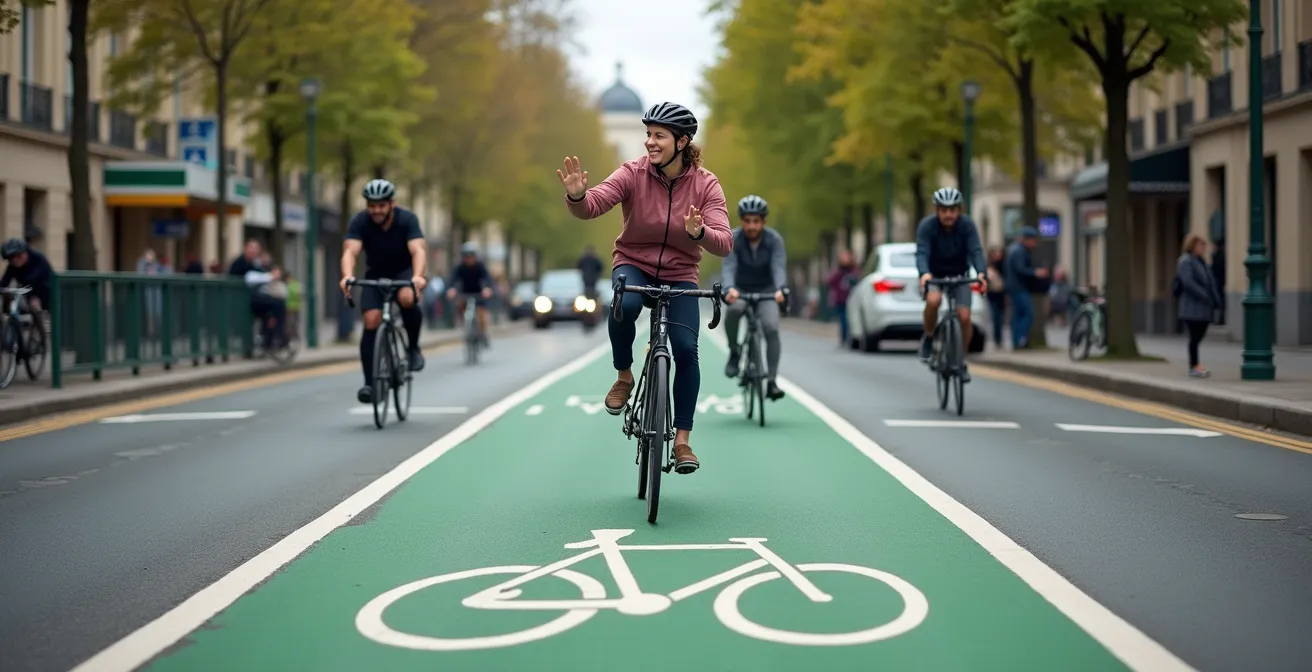
The most dramatic example of this is the transformation of the Rue de Rivoli and the quays along the Canal St-Martin, which are now largely reserved for bikes, buses, and taxis. These routes function as the main arteries of the city’s cycling network. The commitment to this shift is immense; as part of its plan, Paris will remove 72% of its on-street car parking spaces to make way for more bike lanes and green spaces. This infrastructure is designed for safety and efficiency, with physical separation from car traffic, clear markings, and cyclist-specific traffic signals.
Safely using these lanes involves a different skill set than on the shared quays. Here, the primary hazards are intersections, bus stops, and delivery vehicles momentarily blocking the lane. Always be vigilant at intersections, even with a green light. Use the green-painted ‘sas vélo’ bike boxes to position yourself ahead of cars at traffic lights for better visibility. Signal your turns clearly and be aware of buses pulling in and out of stops. By combining the scenic, slow-paced rides on the Seine with the efficient, fast-paced travel on the protected bike lanes, you can unlock the full potential of cycling in Paris.
Start applying these defensive cycling principles today. Whether you are navigating a shared ‘Zone de Rencontre’ on the quays or a protected bike lane on a grand boulevard, this proactive mindset will transform every ride in Paris into a safer, more enjoyable journey.
Frequently Asked Questions About Water Activities in Paris
Is a river license (permis fluvial) required for electric boats?
No, electric boats from Marin d’Eau Douce operate below the legal power threshold requiring a license. This makes them accessible to anyone, with a brief training session provided before you depart.
How does Canal de l’Ourcq compare to the Seine for boating?
The canal is much calmer with almost no commercial traffic, making it ideal for families and beginners. The Seine has heavy commercial and tourist boat traffic, requiring more experience to navigate.
What’s the recommended rental duration?
A two-hour rental is recommended. This allows for a comfortable round trip from the Bassin de la Villette to the Parc de la Villette and back, giving you plenty of time to enjoy the scenery without feeling rushed.