In summary:
- Choose your spot wisely: Canal Saint-Martin for a ‘bobo’ vibe, or Quai de la Tournelle for stunning views.
- Understand the rules: Alcohol is often banned on quays and in parks after 4 PM from May to October. Discretion is key.
- Shop smart: Prioritize supermarkets (Monoprix, Franprix) for budget wine and basics, but visit a *boulangerie* for the essential baguette.
- Master the essentials: A true apéro includes the trinity of wine, a fresh baguette, and shareable bites like saucisson and hard cheese (Comté).
- Leave no trace: Always pack out your trash to avoid a hefty fine (up to €135) and show respect for the city.
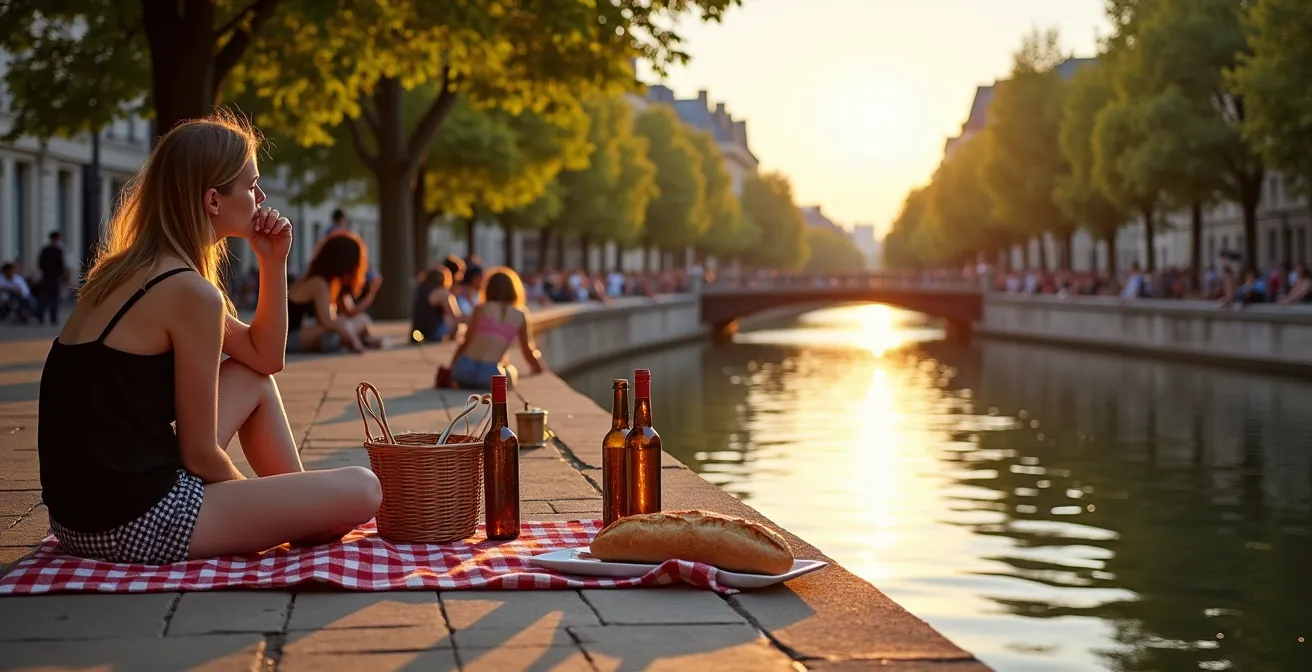
There’s a magical moment in Paris as the workday ends and the sun begins to dip, painting the Haussmannian buildings in gold. It’s the call of the *apéro*, an almost sacred social ritual. For students and young professionals, the dream is to partake not in an overpriced terrace, but like a true Parisian: with friends, a bottle of rosé, and a view of the water. Yet, the reality can be daunting. Where do you go? What are you actually allowed to do? And how do you pull it off without spending a fortune?
Many guides will give you the generic advice: “buy wine and cheese” and “go to the Seine.” But this overlooks the nuanced logistics that define an authentic experience. The true art of the quay-side apéro isn’t just about the food; it’s about mastering a set of unwritten rules, legal gray areas, and budget-friendly hacks. It’s knowing which patch of grass is permitted, where to find chilled wine at 7 PM, and understanding the subtle etiquette of sharing a saucisson.
This guide moves beyond the postcard clichés. We will decode the entire process, treating the apéro not as a simple picnic, but as a social event to be planned. We’ll focus on the practicalities: navigating the often-confusing local ordinances, shopping like a local on a deadline, and assembling the non-negotiable elements of a genuine French apéro. Forget the tourist traps; this is your blueprint for an unforgettable evening, Parisian-style, for less than 15 euros per person.
This article will walk you through every step, from choosing the perfect spot and understanding the specific alcohol laws to mastering the shopping run and the cleanup. Consider this your complete operational manual for the perfect, budget-friendly Parisian apéro.
Summary: Your Guide to a Budget Parisian Apéro on the Quays
- Canal or Seine: Where to Find a Spot That Isn’t Covered in Dust?
- Can You Drink Alcohol in Public Parks After 9 PM?
- Supermarket vs Épicerie Fine: Where to Buy Rosé at 7 PM?
- The Trash Rule: How to Avoid a Fine When Leaving Your Picnic Spot?
- Chips vs Saucisson: What Are the Non-Negotiable Elements of a French Apéro?
- Picnicking on the Canal: What Are the Alcohol Rules You Must Follow?
- Mozza & Co or Bring Your Own: How Much Does Food Cost on the Rives?
- Buttes-Chaumont vs Luxembourg: Which Park Allows You to Sit on the Grass?
Canal or Seine: Where to Find a Spot That Isn’t Covered in Dust?
The first decision in planning your apéro is the most crucial: the location. This choice sets the entire vibe for your evening. Paris offers two iconic waterfront experiences, the Seine and the Canal Saint-Martin, each with its own distinct personality. Your choice depends on whether you seek historical grandeur or a trendy, bohemian atmosphere. The key is to arrive early, especially on a sunny weekday, as the best spots are claimed well before 7 PM.
The banks of the Seine offer classic, breathtaking backdrops. For an unforgettable view, the Quai de la Tournelle in the 5th arrondissement provides a stunning panorama of Notre-Dame’s revival, with plenty of space to spread out a blanket. For a more intimate and romantic setting, the Square du Vert-Galant, a hidden gem at the tip of Île de la Cité, makes you feel like your feet are almost in the water, surrounded by panoramic views of Paris’s most famous bridges.

Conversely, the Canal Saint-Martin is the heart of ‘bobo’ (bourgeois-bohème) Paris. Its iron footbridges and tree-lined quays in the 10th and 11th arrondissements attract a younger, creative crowd. Further north, the Bassin de la Villette offers a more relaxed, family-friendly space where you can even play a game of *pétanque*. It’s less about the monumental views and more about soaking in the vibrant, local neighborhood energy.
Can You Drink Alcohol in Public Parks After 9 PM?
Navigating Paris’s public drinking laws is perhaps the most confusing part of planning an outdoor apéro. The short answer is, it’s complicated and highly dependent on location and time of year. Officially, alcohol is banned in all municipal parks at all times. State-owned gardens like the Jardin du Luxembourg and the Tuileries enforce a complete and strict ban on alcohol, with no exceptions.
For popular apéro spots, the rules are even more specific. On the Champ de Mars, the large park in front of the Eiffel Tower, alcohol is banned from 4 PM to 7 AM. However, the most stringent rules apply to the very places you’re most likely to go. From May through October, all alcohol consumption is banned from 4 PM to 7 AM along the quays of the Canal Saint-Martin and the Seine river in central Paris. This means that, technically, drinking a bottle of rosé by the water at 8 PM during the summer is illegal.
So how does anyone have an apéro? The reality on the ground is a “legal gray area” where enforcement varies. Police patrols are common, but they often prioritize public drunkenness and noise complaints over a quiet, well-behaved group sharing a bottle. The key is discretion. Avoid large, noisy gatherings, keep your bottles in a bag when not pouring, and use cups instead of drinking directly from the bottle.
| Location | Alcohol Rules | Enforcement Level | Alternative |
|---|---|---|---|
| Municipal Parks | Banned at all times | Variable | Licensed café terraces within parks |
| Luxembourg/Tuileries | Complete ban (State-owned) | Strict | Nearby bars on surrounding streets |
| Champ de Mars | Banned 4pm-7am | Regular patrols | Lunch picnics before 4pm |
| Canal Saint-Martin | Banned after 4pm (May-Oct) | Increasing enforcement | Quai de Valmy bars |
Supermarket vs Épicerie Fine: Where to Buy Rosé at 7 PM?
The 7 PM scramble for apéro supplies is a Parisian ritual in itself. Your location is chosen, your friends are on their way, and now you need to gather the goods. Your choice of shop depends on a trade-off between price, convenience, and quality. For a budget-friendly apéro, the large chain supermarkets are your best friends. Chains like Monoprix or Franprix are strategically located near major apéro spots and stay open until 9 or 10 PM. Here you can find a decent bottle of rosé for €5-10, along with all the basic snacks.
If you’ve forgotten to chill your wine, look for a Nicolas wine shop. This ubiquitous chain often has a selection of rosé and white wine “au frais” (chilled) for the same price as the supermarket. For a more authentic touch, stepping into a local *caviste* (independent wine merchant) can be rewarding. Don’t be intimidated; simply tell them you’re looking for “un bon petit rosé pour l’apéro, pas trop cher” (a nice little rosé for an apéro, not too expensive), and they’ll guide you to an excellent value pick.
For convenience, nothing beats the corner *épicerie de quartier*. These small, independent grocery stores are open late and are lifesavers for last-minute needs. Be aware that you’ll pay a premium for this convenience, with prices often being higher than in supermarkets. The ultimate pro move is a combined-arms assault: get your wine and bulk snacks at the supermarket, but make a stop at an artisan boulangerie for a baguette tradition and a *fromagerie* for a piece of cheese. This hybrid approach guarantees authenticity without breaking the bank.
The Trash Rule: How to Avoid a Fine When Leaving Your Picnic Spot?
The final, and arguably most important, part of the apéro ritual is the cleanup. This isn’t just about being a good citizen; it’s a matter of respecting a shared public space and avoiding a serious financial penalty. The city of Paris is increasingly strict about littering, and enforcement patrols are common in popular areas. Leaving your trash behind is a quick way to sour a perfect evening.
According to Paris enforcement policies, improper waste disposal can result in significant fines. While the maximum penalty can be severe, a typical infraction for leaving picnic waste will net you a fine of up to €135. This is an easily avoidable expense that could fund nearly ten more apéros. The unwritten rule among locals is simple: leave the space cleaner than you found it.
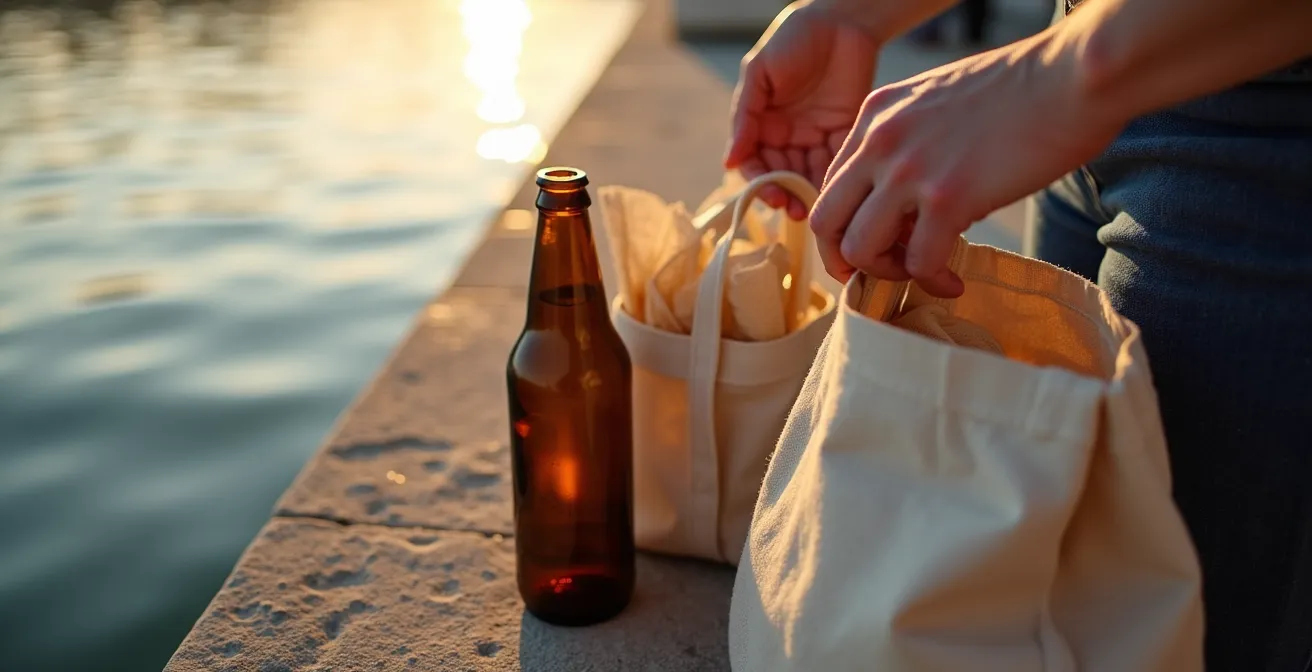
Being prepared is essential. Always pack at least two bags with you: one for general waste and another for recyclables like glass bottles and cans. What if the public bins are overflowing, a common sight on a warm evening? Never leave loose items or try to balance your bag on top of the pile. The correct etiquette is to tie your bag securely and place it neatly beside the bin. If there are no bins in sight, the rule is absolute: you must take all your trash with you and dispose of it at home or in another bin you find later. This “leave no trace” ethic is a core part of the social contract that makes these public gatherings possible.
Chips vs Saucisson: What Are the Non-Negotiable Elements of a French Apéro?
While a bottle of wine and a good spot are the foundation, a true French apéro is defined by its *amuse-bouches*—the small bites that stimulate the appetite and conversation. This is where you can elevate your gathering from a simple outdoor drink to an authentic cultural experience. While a bag of crisps is acceptable, it’s considered the bare minimum. To host a proper apéro, you need to embrace the holy trinity: something to spread, something to slice, and a good loaf of bread.
The cornerstone is charcuterie, France’s famous cured meats. A dry-cured sausage, or saucisson sec, is the quintessential choice. There is a key social ritual involved: never pre-slice the entire saucisson. You should cut a few starting pieces and then offer the knife to your friends to serve themselves. This act of sharing and self-service is central to the apéro’s communal spirit. Along with saucisson, a small container of *rillettes* (a savory meat spread) is another classic.
Cheese is the second pillar. For a practical quay-side setting, avoid soft, messy cheeses like Camembert or Brie. Instead, opt for hard cheeses that travel well and are easy to slice and share, such as Comté, Beaufort, or a dry goat cheese (*chèvre sec*). To complement the meat and cheese, include *tartinables* (spreads). A small jar of tapenade (olive spread) or even hummus adds a touch of sophistication and provides an option for vegetarian friends. All of this, of course, must be served with a fresh baguette tradition, torn by hand, never sliced with a knife.
Picnicking on the Canal: What Are the Alcohol Rules You Must Follow?
While we’ve touched on the general rules, it’s worth diving deeper into the specifics for the Canal Saint-Martin, as it’s a top destination with its own set of challenges. The popularity of the canal’s banks in the 10th and 11th arrondissements has led to increased regulation aimed at curbing noise and public disturbances. This means that enforcement here can be more frequent and less forgiving than in other, less crowded areas.
The primary rule to remember is the seasonal ban. The regulations specifically target the banks of the Canal Saint-Martin due to its popularity, with a strict decree banning all alcohol consumption from 4 PM to 7 AM between May and October. This is not a vague guideline; it’s a formal municipal order (*arrêté préfectoral*). During these hours in peak season, you are officially not allowed to drink there.
However, the on-the-ground reality often involves a degree of police tolerance, especially for those who are respectful and discreet. As one local guide notes, police patrolling the quays will often give a warning on their first pass if a group is behaving and doesn’t appear intoxicated. But if they return an hour later and find the same group still drinking, they are much more likely to confiscate the alcohol and issue fines. The key to navigating this is to minimize visibility. Pour your wine into neutral cups, keep the bottle in a tote bag, and avoid any rowdy behavior. The goal is to blend in with the relaxed, convivial atmosphere, not to stand out.
Mozza & Co or Bring Your Own: How Much Does Food Cost on the Rives?
The central promise of a quay-side apéro is a fantastic Parisian experience on a shoestring budget. But is it really cheaper than grabbing a quick bite from one of the many *péniches* (barge restaurants) or food trucks that line the Seine? A quick cost analysis shows that the “Bring Your Own” (BYO) strategy wins by a significant margin, provided you shop smart.
A typical meal from a food truck or a simple dish on a péniche will cost between €10 and €14 per person for a single item, like a sandwich or a small pizza. While convenient, this is essentially a quick, solo meal. In contrast, a well-planned supermarket run allows for a true, lingering apéro experience for much less. As a recent budget breakdown shows, you can easily stay within a €7 to €10 per person budget. This shareable feast typically includes a bottle of wine (around €5-8), a baguette (€1.30), a piece of cheese (€3-5), a saucisson (€4-6), and some chips or olives. When split between two or three people, the cost per person is remarkably low.
A popular “hybrid strategy” offers the best of both worlds: bring your own wine and basic snacks, but supplement them with one special item from a local artisan, like a high-quality cheese from a *fromagerie* or a delicious spread from a *traiteur*. This keeps the budget around €8-12 per person while adding an authentic, high-quality touch to your spread.
Your 15€ Apéro Blueprint: The Quay-Side Checklist
- Team Budgeting: Pool your cash (aim for €10-15 per person) to buy shareable items.
- The Supply Run: Hit a supermarket (Franprix/Monoprix) for wine, chips, and water. Stop at a *boulangerie* for a fresh baguette tradition.
- The Apéro Trinity: Ensure you have the three essentials: a bottle of rosé/white, a baguette, and at least two shareable items (e.g., saucisson, Comté cheese, tapenade).
- Essential Gear: Don’t forget a bottle opener, cups, a knife for the saucisson/cheese, and a bag for your trash.
- Final Cost Check: Before heading to the quay, do a quick tally. A bottle of wine (€6), a baguette (€1.30), a saucisson (€5), and a piece of cheese (€4) totals ~€16. Split between two, that’s just €8 each!
Key takeaways
- The best apéro spot depends on your desired vibe: the Seine for iconic views, the Canal Saint-Martin for a trendy, local scene.
- Discretion is paramount when it comes to alcohol, as consumption is officially banned on quays and in many parks after 4 PM in summer.
- A budget-friendly yet authentic apéro requires the “holy trinity”: wine, a fresh baguette, and shareable items like saucisson and hard cheese.
Buttes-Chaumont vs Luxembourg: Which Park Allows You to Sit on the Grass?
While the quays are the classic apéro setting, Paris’s beautiful parks offer a greener alternative. However, picnicking in a park comes with its own very French set of rules, the most perplexing of which is about the grass. In many of Paris’s most manicured gardens, the pristine lawns are for viewing only. If you hop a small fence to sit on the inviting grass, you’re likely to hear the shrill blow of a park employee’s whistle.
Before spreading your blanket, you must look for the all-important signs. A sign that reads “pelouse autorisée” means the grass is accessible and you are welcome to sit on it. Conversely, a sign saying “pelouse au repos” indicates the lawn is resting and temporarily off-limits. According to a guide on Parisian picnic rules, ignoring these signs is a common tourist mistake that locals know to avoid. In gardens like the Tuileries, there is no grass access at all; instead, you are meant to use the iconic green Fermob chairs scattered throughout.
So, where can you actually sit on the grass? Parks like Buttes-Chaumont and Parc Montsouris are known for their large, designated lawns that are open for picnics. The Champ de Mars also has open grass, but remember the strict 4 PM alcohol ban. The Jardin du Luxembourg is particularly tricky, as it features authorized and forbidden lawns side-by-side, so you must pay close attention to the signage. Choosing a park with accessible grass is the first step to a successful green-space apéro.