In summary:
- The Tuileries Garden is a strategic “decompression zone” to manage museum fatigue, not just a park.
- Focus on low-cost, high-energy activities like the trampolines and wooden boats.
- Use “parent hacks” for restrooms (the Carrousel du Louvre) and dealing with the infamous white dust.
- Adopt the “One Era per Hour” rule for short, themed museum visits to prevent burnout.
- Understand the unwritten etiquette of the green chairs to create a “parental basecamp.”
You know the moment. You’ve just survived the Louvre, the kids are a volatile mix of overstimulated and exhausted, and the stretch of gravel between you and Place de la Concorde feels like a mile-long tightrope. For many parents, the Tuileries Garden is a beautiful but intimidating space, a place where kid energy can either be a blessing or a curse. The usual advice—ride the carousel, find the playground—is fine, but it barely scratches the surface of what this historic garden can offer a family in need of a strategic reset.
The secret known to every Parisian parent is that the Tuileries isn’t a destination; it’s a tool. It’s a decompression zone, a free-range arena to burn off steam and prevent a full-blown meltdown. But using it effectively requires more than just pointing at a statue. It demands a few insider hacks, a bit of cultural know-how, and a strategy for turning a simple walk into a memorable adventure. Forget the generic tourist tips. This is about understanding the garden’s hidden rhythms and unwritten rules.
This guide will move beyond the obvious attractions to give you the practical, on-the-ground playbook. We’ll cover everything from the century-old boat rental system to the unspoken etiquette of the iconic green chairs. You’ll learn how to create a “time travel” itinerary within the garden itself and, most importantly, how to navigate this Parisian landmark with the confidence of a local, saving your money, your time, and your sanity.
Summary: A Parent’s Guide to Navigating the Tuileries
- The Wooden Boats: How Does the Rental System Work at the Grand Basin?
- The White Dust: Why You Should Never Wear Suede Shoes to the Tuileries?
- Tuileries Christmas Market: Is the Tartiflette Worth the Crowd?
- Hidden Fun: Where Are the Trampolines Located in the Garden?
- Restroom Strategy: Are the Tuileries Toilets Free or Paid?
- The “One Era per Hour” Rule: How to Prevent Museum Burnout in Children?
- The Green Chairs: Is It Rude to Hog Two Chairs for Your Feet?
- How to Create a “Time Travel” Itinerary for Kids in Paris Museums?
The Wooden Boats: How Does the Rental System Work at the Grand Basin?
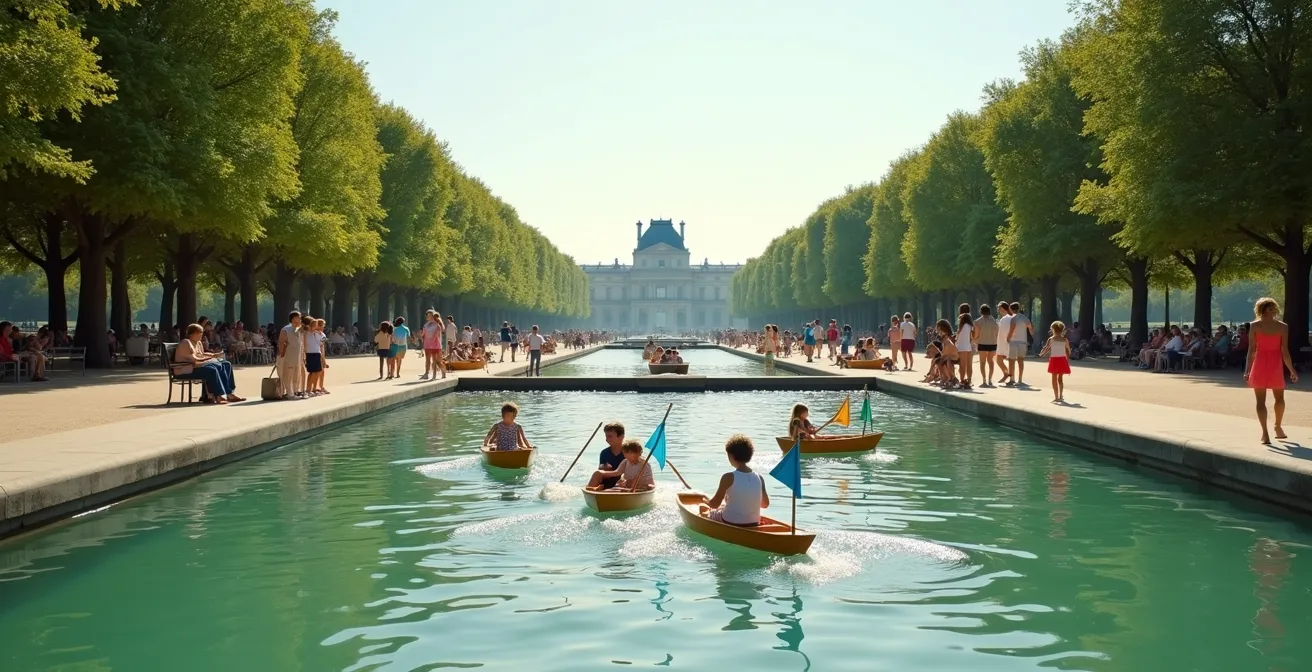
One of the most enchanting and authentically Parisian activities for children in the Tuileries is sailing the small wooden boats on the Grand Bassin Octogonal. This isn’t a modern tourist trap; it’s a tradition steeped in history. Since 1927, these hand-made boats have been a staple of childhood in Paris, and the system still operates with a charming, old-world trust. There’s no complex ticketing, no ID required—just a simple transaction that feels a world away from the Louvre’s bustling queues.
To partake, you’ll need to locate the small rental kiosk near the basin. It’s typically open on Wednesday afternoons and weekends, with extended hours during school holidays. The key thing to remember is to bring cash, as cards are rarely accepted. A rental session, which costs around €6 for 30 minutes, provides you with a boat and a long wooden stick, or ‘la perche’, used to launch your vessel and nudge it back to shore. Choosing a boat with a distinctive flag—be it a national flag or a pirate’s skull and crossbones—is a crucial part of the fun and helps your child spot their boat from across the pond.
The experience is as much about community as it is about sailing. You’ll often see parents and children working together, using their sticks to help untangle a multi-boat jam or give a stranded sailboat a helpful push. It’s a beautiful, low-tech way to spend an afternoon, embodying a trust-based spirit that is uniquely Parisian.
Your Action Plan: Renting a Wooden Boat
- Locate the rental kiosk near the Grand Bassin (typically open Wed 1pm-6pm, weekends 11am-6pm).
- Bring cash for the rental fee; do not rely on credit cards.
- Let your child choose a boat with a memorable flag for easy identification on the water.
- Take the provided wooden stick (‘la perche’) to guide and retrieve your boat.
- Embrace the spirit of it: help other parents untangle boat jams as part of the fun.
The White Dust: Why You Should Never Wear Suede Shoes to the Tuileries?
Every Parisian parent knows about the “dust tax.” The beautiful, wide pathways of the Tuileries are covered in a fine, white limestone gravel that is quintessentially Parisian. While it creates that iconic, crunchy sound underfoot and a lovely pale aesthetic, it also produces a pervasive white dust that clings to everything: shoes, stroller wheels, dark clothing, and little hands. Wearing your favorite suede shoes or black trousers is a rookie mistake you’ll only make once.
This isn’t just a minor inconvenience; it can dictate the rest of your day, especially if you plan on heading into a museum or a nice restaurant afterward. The fine powder is notoriously difficult to brush off completely. A seasoned parent, therefore, comes prepared. The most essential item in your bag should be a pack of ‘lingettes’ (wet wipes), which are far more effective at cleaning the dust off shoes and bags than a dry tissue. It’s also wise to wear closed-toe, easily washable shoes and perhaps opt for lighter-coloured clothing that won’t show the white stains as prominently.
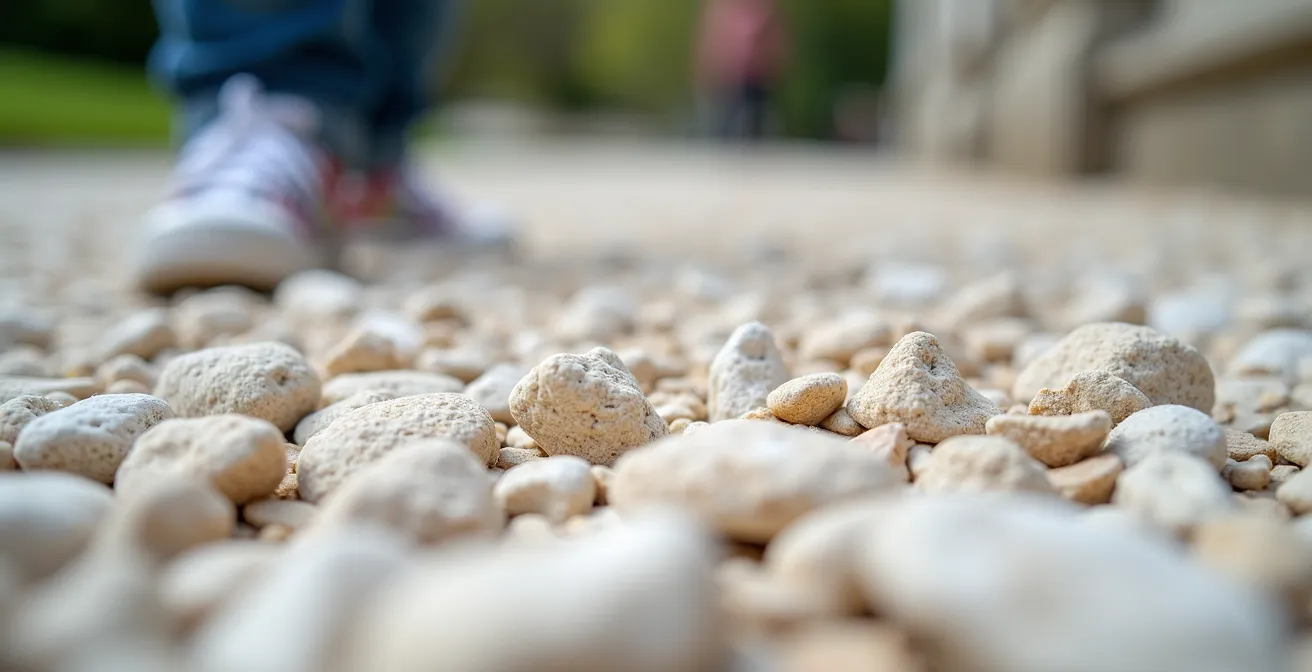
A smart strategy is to bring a dedicated plastic bag for particularly dusty items. Before entering the pristine halls of the Musée de l’Orangerie, for instance, you can give shoes a quick wipe-down and stash any dusty toys or blankets in the bag. A small bottle of water can also be a lifesaver for rinsing hands when you’re far from a restroom. Accepting the dust as part of the Tuileries experience is the first step; being prepared for it is the mark of a pro.
Tuileries Christmas Market: Is the Tartiflette Worth the Crowd?
During the festive season, a large portion of the Tuileries transforms into “La Magie de Noël,” a sprawling Christmas market complete with an ice rink, a Ferris wheel, and dozens of wooden chalets selling crafts and, most importantly, food. For a parent with hungry kids, the market can be a sensory overload and a potential budget-buster. The central question often becomes: what’s actually worth eating, and is it worth the price and the inevitable crowds?
The star of the show for many is the tartiflette, a hearty, bubbling dish of potatoes, reblochon cheese, lardons, and onions. At €12-15 a portion, it isn’t cheap, but it’s a genuinely filling meal that can easily be shared between a parent and a child, or even two kids, making its value proposition quite good. The same can be said for raclette, another cheesy delight served over potatoes. However, for a more budget-friendly option, you can never go wrong with a simple crêpe au sucre or au Nutella, which offers maximum joy for a minimal price. While the ‘vin chaud’ (mulled wine) is a classic, the real value for a family lies in the shareable, satisfying hot foods.
To make an informed choice, it helps to see how the classic market foods stack up against each other. This is where a little pre-planning can save you both money and decision fatigue. As a comparative guide to market fare shows, some items offer much better value for a family than others.
| Food Item | Market Price | Value Rating | Sharing Potential |
|---|---|---|---|
| Tartiflette | €12-15 | Good (filling meal) | Can share between 2 |
| Raclette | €10-12 | Good | Individual portion |
| Crêpe | €5-7 | Excellent (budget option) | Individual |
| Vin chaud | €4-5 | Fair | Individual |
| Churros | €4-6 | Good | Shareable bag |
Hidden Fun: Where Are the Trampolines Located in the Garden?
While the grand promenades and formal flowerbeds are the Tuileries’ main draw, its best-kept secret for parents is the cluster of in-ground trampolines. This isn’t your typical playground equipment; they are subtly integrated into the landscape, providing a fantastic outlet for boundless kid energy without disrupting the garden’s historic elegance. Finding them, however, can be a challenge if you don’t know where to look. They are a true “hidden in plain sight” attraction.
The trampolines are strategically positioned in a dedicated children’s zone, nestled in an area surrounded by palm trees. To locate them, head towards the Place de la Concorde end of the gardens. You’ll find them situated between the Terrasse des Feuillants (the elevated terrace running along the Rue de Rivoli) and the large octagonal basin. A helpful landmark is the nearby statue of Puss in Boots, a tribute to the famous fairy tale author Charles Perrault, whose work is synonymous with French childhood.
Designed for children aged two and up, these trampolines offer a fantastic and relatively inexpensive burst of fun, with current rates around €3 per session. The in-ground design is a key safety feature, eliminating the need for tall, unsightly nets and allowing for a more ‘laissez-faire’ style of supervision that is common in Parisian parks. It’s the perfect 15-minute activity to break up a long walk, rewarding kids for their patience after a museum visit and ensuring they are sufficiently tired out for a calm evening.
Restroom Strategy: Are the Tuileries Toilets Free or Paid?
It’s the question that strikes fear into the heart of any parent exploring a large, foreign city: “I need to go potty!” In the vast expanse of the Tuileries, a solid restroom strategy is not just helpful, it’s absolutely essential. The options range from free but unreliable to pricey but pristine, and knowing the pros and cons of each can prevent a frantic, desperate search.
Here is the ultimate breakdown of your toilet options, from a Parisian parent’s perspective:
- Option 1: The Paid ‘Point WC’. These are high-end public restrooms, often costing between €1.50 and €2.00. The major benefit is that they are exceptionally clean, always have toilet paper, and are reliably operational. This is your go-to for a guaranteed, stress-free experience.
- Option 2: The Free ‘Sanisettes’. These are the automated, self-cleaning public toilets run by the city. While the price (free) is unbeatable, their reliability is a gamble. They can be out of order, or you might face a queue. It’s a viable option if you’re not in a hurry and feel lucky.
- Option 3: The ‘Café Crème’ Hack. This is a classic Parisian move. Duck into any of the cafés along the nearby Rue de Rivoli, walk up to the counter (‘comptoir’), and order a single espresso for about €1.50. This small purchase grants you legitimate access to their (usually clean) restrooms. It’s often cheaper and faster than the official paid toilets.
- Option 4: The Carrousel du Louvre. This is the ultimate pro-tip. The underground shopping mall connecting the Louvre to the Tuileries has numerous free, clean, and well-maintained restrooms. It has direct access from the garden and is the best all-around option for reliability and cost.
- Option 5: The Museums. If you’re already visiting the Musée de l’Orangerie or the Louvre, their facilities are free with your entry ticket and are always very clean. Plan your restroom breaks to coincide with your museum time.
The “One Era per Hour” Rule: How to Prevent Museum Burnout in Children?
The proximity of the Tuileries to the Louvre creates a classic parenting dilemma: how to experience a world-class museum without it ending in tears? The answer is to abandon the idea of “seeing everything.” The most effective strategy is what I call the “One Era per Hour” rule. Instead of a marathon tour, you plan a short, focused “mission” to see one specific collection or time period. This turns an overwhelming museum into an exciting treasure hunt.
Case Study: The Pharaoh’s Hour at the Louvre
A perfect application of this rule is the “Pharaoh’s Hour.” Instead of entering through the main pyramid, use the less crowded Porte des Lions entrance, which provides direct access to the Egyptian antiquities. You then dedicate your entire visit—no more than 60-90 minutes—solely to this section. The mission is clear: find sarcophagi, see the Great Sphinx of Tanis, and discover hieroglyphics. By setting a clear theme and a firm time limit, you conquer a fascinating part of the museum and exit before anyone gets tired or bored. You leave on a high note, creating a positive memory of the museum rather than an exhausting one.
To make this even more effective, you can prime your children with a pre-museum scavenger hunt right in the Tuileries Garden itself. The garden is an open-air museum, filled with sculptures that can introduce concepts they’ll see inside. Before you even enter the Louvre or the Orangerie, challenge them with a quick game:
- Find ‘the woman lying down’ (one of the serene Maillol statues).
- Spot ‘the three ladies talking’ (another famous sculpture group).
- Count how many sculptures by Rodin you can identify.
- Look for mythological figures like Theseus battling the Minotaur.
- Try to locate the statue of Julius Caesar among the Roman figures.
This simple activity transforms passive sightseeing into an active game, gets them looking closely at art, and builds anticipation for the “real” museum, all while burning off that crucial physical energy.
The Green Chairs: Is It Rude to Hog Two Chairs for Your Feet?
The iconic green metal chairs scattered throughout the Tuileries are more than just public seating; they are a piece of French design heritage (the classic Fermob chair) and come with their own unspoken social code. For the uninitiated, navigating this etiquette can be confusing. Is it acceptable to grab an extra chair to put your feet up? The answer, like many things in Paris, is: it depends.
The unwritten rule among Parisians is that using a second chair for your feet is perfectly acceptable when the garden is not crowded. On a quiet weekday afternoon with plenty of empty chairs around, feel free to lean back and relax. However, the moment the area starts to get busy and people are actively looking for a place to sit, keeping that second chair becomes a ‘faux pas’. The courteous thing to do is to immediately free it up. It’s a simple code of spatial awareness and respect.
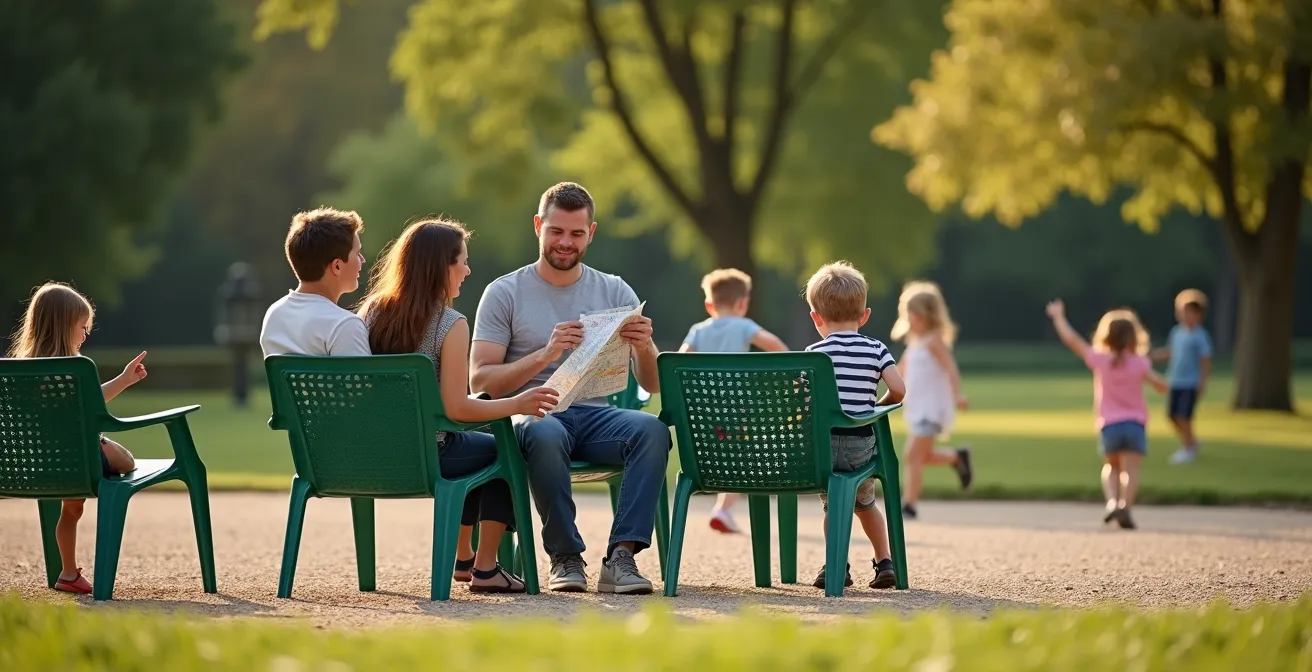
For parents, the chairs offer a more strategic function: creating a “Parental Basecamp.” By arranging three or four chairs in a semi-circle, you can create a defined family space. This little hub serves as a spot for snacks, a resting place for tired legs, and a clear visual anchor point while the kids run around within a set perimeter. This is considered a completely legitimate and smart use of the chairs. It respects the public nature of the space while providing a practical solution for managing a family, making your time in the garden infinitely more relaxing.
Key takeaways
- Frame the Tuileries as a “decompression zone” to manage post-museum energy, not just a park to visit.
- Prioritize low-cost, high-impact activities like the in-ground trampolines (€3) and the historic wooden boats (€6).
- Master the “Parental Basecamp” strategy using the green chairs and come prepared for the “dust tax” with wet wipes.
How to Create a “Time Travel” Itinerary for Kids in Paris Museums?
The ultimate hack for making Parisian history come alive for children is to realize that the Tuileries Garden itself is a timeline. The grand axis stretching from the Louvre to the Arc de Triomphe is a walk through centuries of French history, and you can create a simple, 30-minute “time travel” itinerary that is far more engaging than any history book. It requires no tickets, no queues, and allows for plenty of running around.
This approach connects the dots between the grand monuments, turning an abstract sense of history into a physical journey. Family tour operators consistently recommend limiting museum visits to 45 minutes to 2 hours maximum for this very reason; short, story-driven experiences are what stick. The Tuileries allows you to do this outdoors, for free.
Here is a simple “Royal Walk” you can do with your kids, starting from the Louvre side:
- Start at Arc de Triomphe du Carrousel (1808): Begin your journey here. This isn’t the famous Arc de Triomphe, but a smaller one built by Napoleon to celebrate his military victories. It’s the “newest” major landmark on your walk.
- Walk through the formal gardens (1664): As you move through the geometric paths, explain that this is how the garden looked when King Louis XIV’s court would promenade here. Imagine the elaborate dresses and wigs!
- Pass the site of the destroyed Tuileries Palace (1871): Point to the open space between the two arms of the Louvre. A huge royal palace stood here until it was burned down during a revolution. You are walking right through a ghost palace.
- Look toward Place de la Concorde (French Revolution): As you approach the great fountain and obelisk, explain that this square was where the guillotine was set up during the French Revolution. It’s a bit grisly, but kids are often fascinated by this dramatic part of history.
- End at the Louvre: Conclude your walk by looking back at the Louvre itself, explaining that it began as a medieval fortress, became a royal palace, and is now one of the world’s greatest museums.
This narrative transforms a simple walk into an adventure, giving context to the grandeur and making history a story they can physically move through.
So next time you’re in Paris, don’t just walk through the Tuileries—use it. Start with one small “time travel” walk or a single mission to find the trampolines. By applying these small, simple strategies, you can transform what could be a stressful corridor into the most relaxing and memorable part of your family’s day.