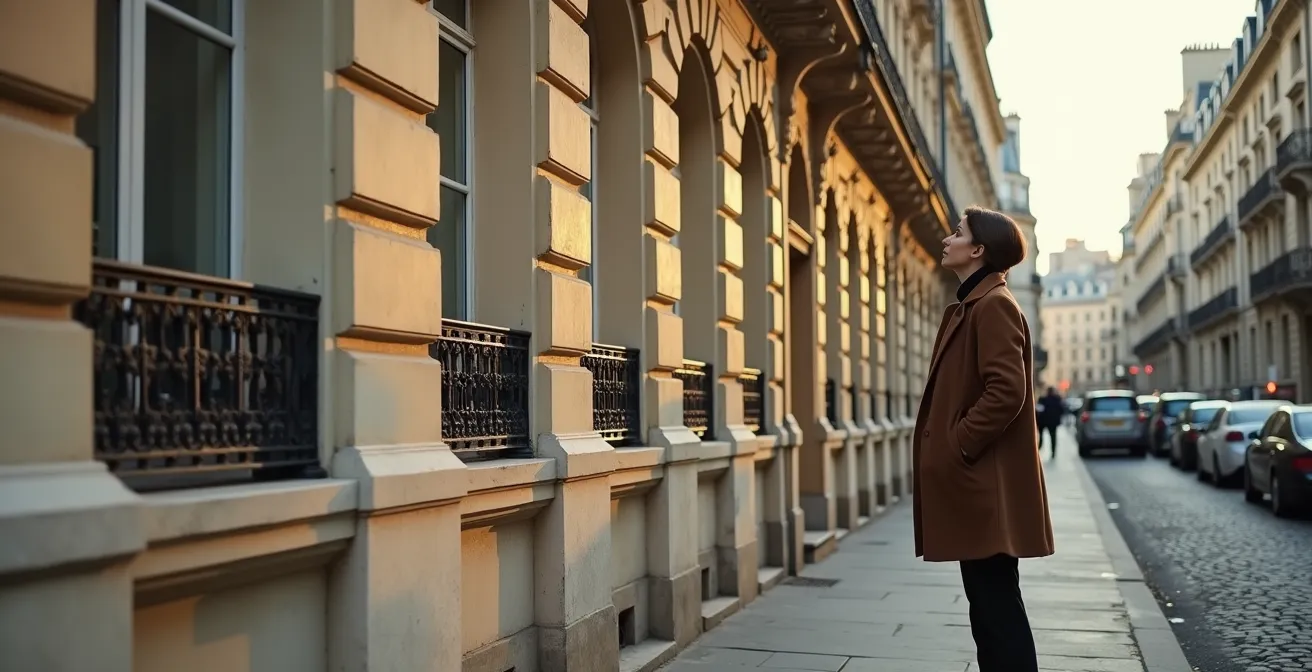
To truly read a Parisian facade, you must look past broad architectural styles and become a forensic detective of the wall itself.
- The most revealing clues are not grand designs, but “architectural scars” like bricked-up windows from old tax laws or bullet holes from historic battles.
- A building’s social hierarchy and age are encoded in its vertical structure, from the commercial ground floor to the servants’ quarters under the roof.
Recommendation: Instead of trying to name a style, learn to identify these specific material clues, as they tell a more precise and human story about any building you encounter.
Walking through Paris is like moving through a living museum, where every street corner offers a new architectural marvel. Most guides will tell you to identify the grand styles: the uniform elegance of Haussmann, the whimsical curves of Art Nouveau, or the geometric precision of Art Deco. But this approach only scratches the surface. It helps you categorize the famous landmarks but leaves you unable to decipher the story of the thousands of “ordinary” buildings that form the true fabric of the city.
The real secret to understanding Paris lies in shifting your perspective from art historian to architectural detective. The truth is not always in the grand design but in the flaws, the scars, and the seemingly insignificant details. A bricked-up window, a pattern of bullet holes, or a faded advertisement painted on a wall are not blemishes; they are forensic evidence. They are the words, sentences, and paragraphs of a language written in stone and mortar over centuries.
This guide abandons the traditional style-based approach. Instead, it will equip you with the observational tools to practice “façade forensics.” You will learn to spot specific, often-overlooked clues that reveal a building’s age, its economic history, and the social dramas that unfolded within its walls. By the end, you won’t just see buildings; you’ll read them.
This article breaks down the key forensic clues you can spot on any Parisian wall. The following table of contents will guide you through each piece of evidence, from decoding tax-dodging windows to finding the ghosts of old advertisements.
Contents: Decoding the Code of the Wall
- Blocked Windows: Why Do Some Buildings Have Fake Windows Painted On?
- Bullet Holes: Where to See Traces of the Liberation Fighting?
- The Open Door Trick: How to Glimpse Inside a Hallway Without Trespassing?
- The “Morts pour la France” Plaques: Who Were These People?
- Why the 2nd Floor Was Historically More Expensive Than the 5th?
- Le Corbusier in Paris: Is the Villa La Roche Worth the Trek to the 16th?
- The 3 Bloodiest Squares in Paris: How to Spot the Guillotine Markers?
- Ghost Signs: Where to Find Faded Painted Ads from the 1920s?
Blocked Windows: Why Do Some Buildings Have Fake Windows Painted On?
One of the most curious details you can spot on older Parisian buildings is the “blind” or blocked window. You might see a perfect stone window frame filled with bricks, or even more bizarrely, a flat wall with a trompe-l’œil window painted on it, complete with fake curtains and shadows. This wasn’t an aesthetic choice but a direct result of economic pressure. In 1798, France introduced a “door and window tax” to raise state revenue. The tax was calculated based on the number of openings in a property, making windows a luxury.
This policy, which was in effect for 128 years until 1926, led property owners to brick up existing windows to reduce their tax burden. The more elaborate painted fakes were an attempt to maintain the building’s external symmetry and grandeur without paying the price. These “tax windows” are therefore a reliable marker for a pre-1926 building, revealing a time when even light and air were subject to state levy. Spotting one is a classic first step in façade forensics.
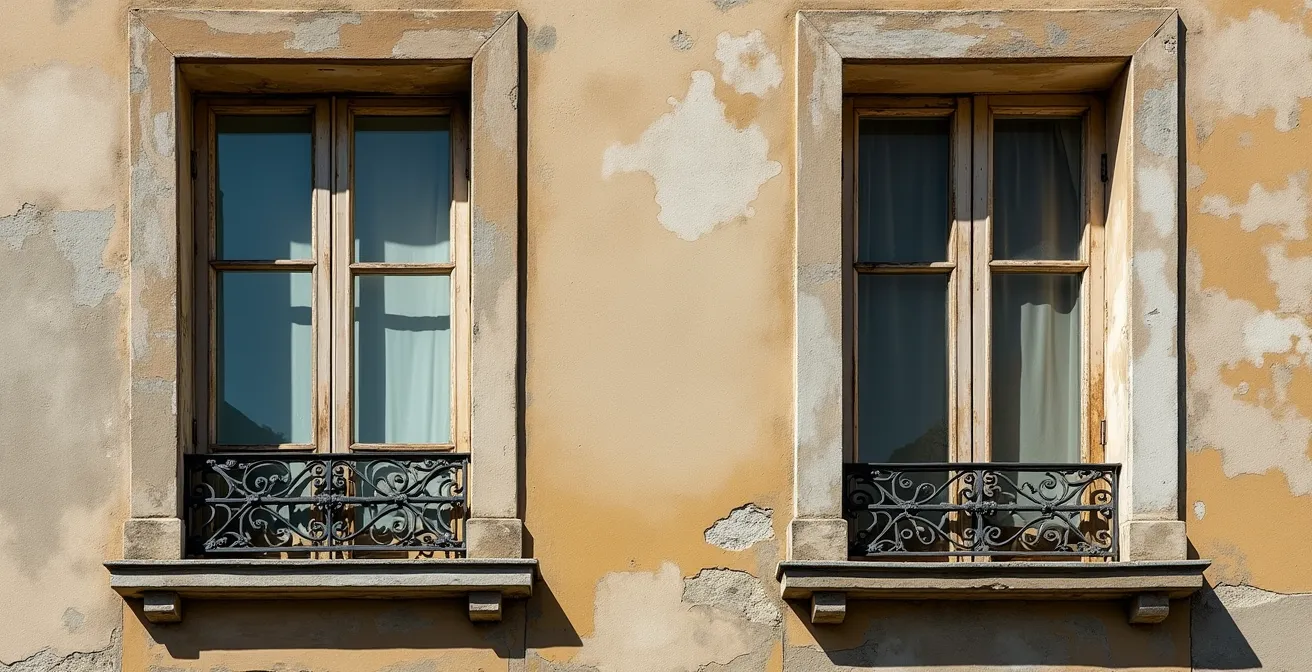
To find them, look for asymmetries in window patterns, especially on upper floors or less-visible courtyard walls where owners were more likely to cut costs. The texture of the infill material often differs slightly from the rest of the facade, a subtle clue for the observant walker. These phantom windows are a direct, physical record of a fiscal policy shaping architecture.
Bullet Holes: Where to See Traces of the Liberation Fighting?
While Haussmann’s 19th-century rebuild gave Paris its elegant avenues, the city’s walls also bear the violent scars of the 20th century. The most poignant of this architectural scar tissue are the pockmarks left by bullets and shrapnel, particularly from the fighting during the Liberation of Paris in August 1944. These are not random marks; they are historical records of specific skirmishes between the French Resistance (FFI), Allied forces, and the occupying German army.
A prime example can be found on the facade of the École des Mines, located at 60 Boulevard Saint-Michel. Here, you can observe distinct clusters of impacts around the main entrance. This pattern is not accidental; it tells the story of a defensive position established by German forces, which drew concentrated fire from the advancing Resistance fighters. By examining the density and location of the holes, you can almost map out the firefight that took place on that very spot.
Not all combat damage is the same, and an architectural detective can learn to differentiate them. This is confirmed by a comparative analysis of combat damage visible on historical buildings.
| Damage Type | Visual Characteristics | Common Locations | Historical Period |
|---|---|---|---|
| Small Arms Fire | Small, round impacts 7-10mm diameter | Street-level walls, doorways | 1944 Liberation |
| Machine Gun Strafing | Linear patterns of impacts | Upper floors, rooflines | 1944 Liberation |
| Shrapnel Marks | Irregular, jagged scarring | Wide wall areas | 1871 Commune & 1944 |
| Cannon Damage | Large, deep craters | Fortified positions | 1871 Paris Commune |
These marks are often clustered around significant locations: police stations, government buildings, and major intersections that were strategic points during the uprising. The next time you walk past the Préfecture de Police on Île de la Cité or buildings near Place de la République, look closely at the street-level stonework. The silent testimony of these holes connects you directly to the chaos and courage of the city’s fight for freedom.
The Open Door Trick: How to Glimpse Inside a Hallway Without Trespassing?
The Parisian facade is a master of public presentation, but it is also a barrier, hiding the semi-private world of its courtyards and grand hallways. For the curious walker, the “Porte Cochère” (carriage door) is a tantalizing mystery. While trespassing is out of the question, a patient and respectful observer can use the “open door trick” to catch a glimpse of the architectural splendor within, revealing the first layer of the building’s social hierarchy.
The key is timing and observation. These doors are most likely to be propped open during moments of daily activity. The most opportune moments include:
- Weekday Mornings (9-11 AM): Residents leaving for work and the “va-et-vient” (coming and going) of daily life often leave doors ajar.
- Cleaning Days: Cleaning staff often prop doors open, typically on Tuesday or Thursday mornings, to air out hallways and facilitate their work.
- Delivery Hours: The passage of mail carriers and delivery personnel provides frequent, brief opportunities to see inside.
- Journées du Patrimoine: During the annual Heritage Days in September, many private buildings and courtyards are officially open to the public, offering a legal and welcome chance to explore.
When you do get a glimpse, you are seeing the first clue to the building’s internal structure. The grandeur of the entrance hall was not for everyone. As architectural historian Claude Mignot notes in his book “Paris 100 Façades Remarquables”:
The grand entrance hall only serves the noble one, immediately signaling the vertical social hierarchy of the classic Haussmannian building.
– Claude Mignot, Paris 100 Façades Remarquables
The opulence of the hallway—marble floors, ornate mouldings, a grand staircase—was a direct message about the status of the residents of the “étage noble” (noble floor), a topic we will dissect further.
The “Morts pour la France” Plaques: Who Were These People?
Affixed to the facades of schools, apartment buildings, and offices all over Paris are small marble plaques. They bear a name, a date, and the solemn inscription: “Mort pour la France” (Died for France). These are not generic memorials; they mark the exact spot where an individual lived or was killed while fighting for their country, most often during the Resistance in World War II. They transform an anonymous wall into a site of personal sacrifice and bring the macro-history of the war down to a human level.
The title “Mort pour la France” is a legal status granted by the French state to service members and civilians killed in conflict. Since its creation, over 1.4 million French citizens have been granted this status, a testament to the immense cost of the nation’s 20th-century conflicts. Each plaque you see is one of those stories.
Case Study: The Student Resistance Fighter
At 44 Boulevard Saint-Michel, on the wall of the Lycée Saint-Louis, a plaque commemorates Guy Môquet. He was not a soldier, but a 17-year-old Communist student and resistance member, arrested and executed by German forces in 1941. His final letter to his family, written just hours before his death, has become one of the most powerful and heartbreaking documents of the French Resistance, a symbol of youthful sacrifice that is still read in French schools today. The plaque marks his home, forever connecting this building to his story.
These plaques are a critical part of the code of the wall. They tell you not just about the building, but about the people who inhabited it. They reveal that a simple apartment building was the home of a resistance network leader, a quiet school was the alma mater of young heroes, or an ordinary street corner was the site of a final, fatal act of defiance. Reading them is an act of remembrance and a profound way to connect with the city’s more recent, and often painful, past.
Why the 2nd Floor Was Historically More Expensive Than the 5th?
If you look at a classic Haussmannian building, you’ll notice that the balconies on the second floor are often the most ornate and prominent. This is not just a stylistic flourish; it is a direct expression of the building’s rigid social hierarchy. Before the widespread adoption of the elevator, a building’s desirability was inversely proportional to its height. The lower you lived, the higher your social status. This created a system of vertical stratigraphy, where each floor corresponded to a different social class.
Under Baron Haussmann’s strict 19th-century building codes, residential streets were regulated to create a uniform cityscape. Buildings were often constructed to a maximum height, and as a study on Parisian architecture notes, they had to be between 12 and 20 meters high with no more than six levels. This standardized canvas became the stage for a clear vertical social theatre.
The arrangement was logical and pragmatic. The ground floor housed shops and the concierge, while the “entresol” or mezzanine above it was often used for storage or business offices. The true prize was the second floor, the “étage noble.” This was the home of the wealthiest family, boasting the highest ceilings, largest rooms, and the most elaborate balconies for seeing and being seen. As you moved up, status and ceiling height decreased.
| Floor Level | Typical Residents | Ceiling Height | Features |
|---|---|---|---|
| Ground Floor | Shops/Concierge | 3-4m | Commercial spaces, storage |
| 1st Floor (Entresol) | Offices/Storage | 2.5m | Low ceilings, utilitarian |
| 2nd Floor (Étage Noble) | Wealthy Bourgeoisie | 3.5-4m | Ornate balconies, large windows |
| 3rd-4th Floors | Middle Class | 2.7-3m | Modest balconies |
| 5th Floor | Lower Middle Class | 2.5m | Smaller rooms |
| 6th Floor (Chambres de Bonne) | Servants | 2-2.3m | Tiny rooms, separate staircase |
The very top floor, with its tiny garret windows, contained the “chambres de bonne”—small, spartan rooms for the servants, who had to climb six or seven flights of stairs via a separate, unadorned service staircase. The invention of the elevator in the late 19th and early 20th centuries completely inverted this hierarchy, making the top-floor penthouses with their views and light the most desirable properties. But the architectural DNA of the old order remains clearly visible on nearly every Haussmannian facade.
Le Corbusier in Paris: Is the Villa La Roche Worth the Trek to the 16th?
After immersing yourself in the 19th-century code of Parisian walls, a trip to the quiet, leafy 16th arrondissement to see the Villa La Roche feels like a journey to another planet. Built between 1923 and 1925, this house is one of the most important works by the revolutionary architect Le Corbusier. The question for any architectural tourist is: is it worth the detour? The answer is an emphatic yes, because it doesn’t just represent a new style; it represents a complete and violent break with every rule we’ve just learned.
The Villa La Roche is a masterpiece of the Purist style and one of the first and finest examples of what would become the International Style. Its importance is hard to overstate. According to a guide for architects visiting Paris, a review in ArchDaily stated that “the house single handedly transformed Le Corbusier’s career as well as the principles of the International Style, becoming one of the most important architectural precedents in history”. To appreciate it, you must see it as a direct rebuttal to the heavy, earthbound, and socially stratified Haussmannian block. It is here that Le Corbusier perfectly articulated his “Five Points of a New Architecture.”
Understanding these five points is the key to appreciating why the Villa La Roche is so radical. It is not just a building; it’s a manifesto written in concrete and glass.
Checklist: Spotting Le Corbusier’s 5 Points at Villa La Roche
- Pilotis: Notice how the main volume of the house is lifted off the ground by reinforced concrete stilts, creating a sense of lightness and freeing the ground for a garden and driveway.
- Free Façade: Observe that the exterior walls are not load-bearing. This allows the facade to be a thin skin of smooth, white-rendered walls and glass.
- Open Floor Plan: While you can’t see this from the outside, know that the internal columns—not walls—support the structure, allowing for fluid, open interior spaces.
- Ribbon Windows: Look for the long, horizontal strips of windows that cut across the facade, allowing for uninterrupted views and flooding the interior with light, a stark contrast to the vertical punched windows of old Paris.
- Roof Garden: See how the flat roof is reclaimed as outdoor living space, a functional garden that replaces the green space occupied by the building.
The 3 Bloodiest Squares in Paris: How to Spot the Guillotine Markers?
The forensic reading of Paris is not limited to its building facades. The very ground beneath your feet holds some of the city’s darkest histories, particularly from the French Revolution. During the Reign of Terror (1793-1794), public squares were transformed into open-air execution sites. While today they are bustling with traffic and tourists, a knowledgeable observer can still stand on the exact spots where thousands met their end, even though official markers are deliberately absent.
The three most notorious execution sites were Place de la Révolution (now Place de la Concorde), Place du Trône-Renversé (now Place de la Nation), and Place de la Bastille. The most famous of these is undoubtedly Place de la Concorde. Today, it is defined by the magnificent Luxor Obelisk, but during the Revolution, its centerpiece was the guillotine. Over 1,200 people were executed here, including King Louis XVI and Queen Marie Antoinette. To find the spot, stand west of the Obelisk, looking towards the entrance of the Tuileries Garden. This is where the scaffold stood, offering its victims a final, chilling view of the palace they once ruled.
Finding these historical “hotspots” requires a bit of research and imagination, as the city has consciously chosen not to memorialize these specific locations with prominent markers. Your detective work involves looking for absences and understanding the historical geography of the squares. Here are some key locations to investigate:
- Place de la Concorde: Stand just west of the Obelisk. This was the main stage for the Reign of Terror’s most high-profile executions.
- Place de la Nation: This was the site of the second major guillotine, used during the “Great Terror” in the summer of 1794. More people were executed here in a shorter time than anywhere else.
- Place de la Bastille: While more famous for the storming of the prison, a guillotine also operated here for a short period. The July Column at its center commemorates victims of a later revolution (1830), not the Terror.
By standing on these sites, you connect with the raw, violent energy that reshaped France. The absence of a plaque or monument is, in itself, a powerful statement, forcing you to use your historical knowledge to see the ghosts that still haunt these grand public spaces.
Key Takeaways
- True facade reading goes beyond identifying styles; it involves forensic analysis of specific material clues.
- A building’s design is a direct record of historical pressures, from tax policies (blocked windows) to social hierarchies (floor levels).
- The most profound stories are often the most personal, revealed by details like bullet holes or memorial plaques for individuals.
Ghost Signs: Where to Find Faded Painted Ads from the 1920s?
As you wander through Paris, especially in older, less-renovated neighborhoods, train your eyes to look up at the large, windowless gable walls (‘murs pignons’). Here, you may find the faint outlines of another era: ghost signs. These are hand-painted advertisements from the late 19th and early 20th centuries, their colors slowly surrendering to time and weather. These visual echoes are more than just quaint relics; they are a direct portal into the commercial and social life of pre-war Paris.
Before the age of the billboard, these painted walls were prime advertising real estate. They hawked everything from aperitifs and clothing to chocolate and coal. A famous example is the iconic “Chocolat Menier,” whose distinctive yellow-on-blue lettering once adorned walls across the country, representing one of France’s first great industrial brands. Spotting one of these ads is like finding a page from a vintage newspaper printed directly onto the city itself. They reveal what people were buying, the brands they trusted, and the graphic design sensibilities of the time.
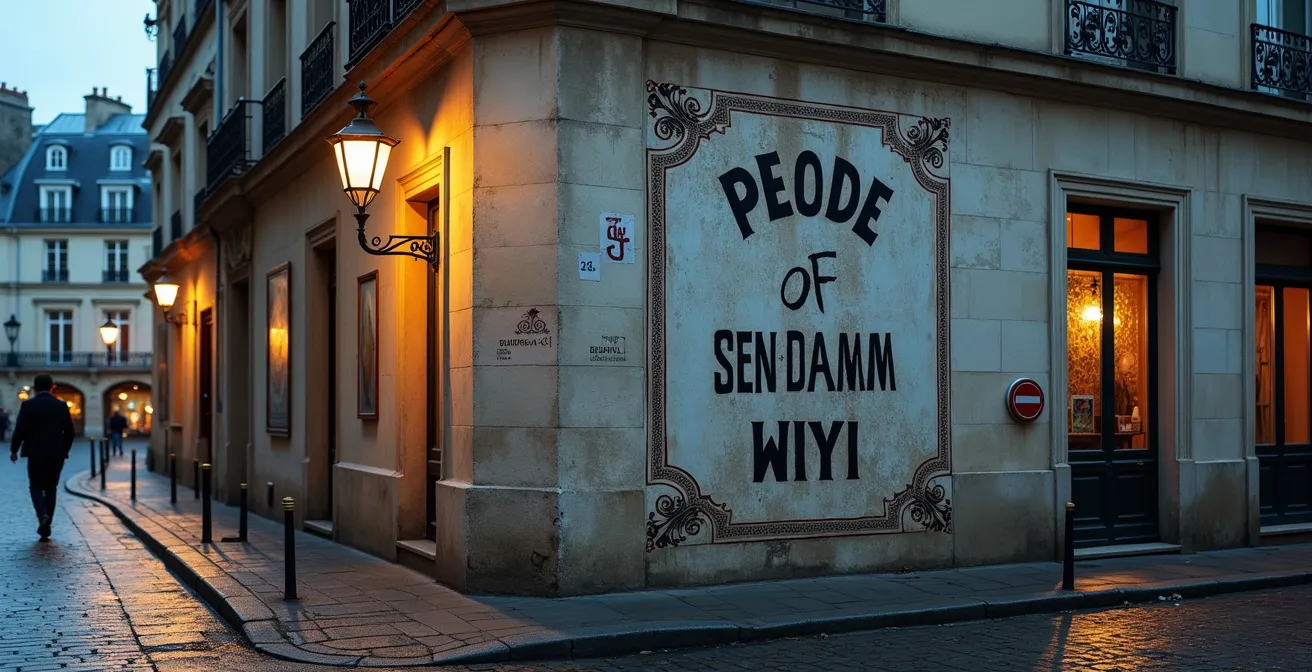
Ghost sign hunting is a rewarding detective game. While they can be found all over, some neighborhoods are particularly rich hunting grounds:
- Belleville and Ménilmontant: These traditionally working-class quarters have many preserved signs from local businesses.
- The Canal Saint-Martin area: Look for ads related to industrial businesses that once thrived along the waterway.
- Rue des Prouvaires (near Les Halles): This area sometimes reveals layered advertisements, where the fading of one sign reveals an even older one beneath it.
These signs are a fragile, disappearing part of the urban landscape. Each one that remains is an accidental survivor, a ghost of the city’s bustling commercial past, whispering stories of a world that has long since vanished.