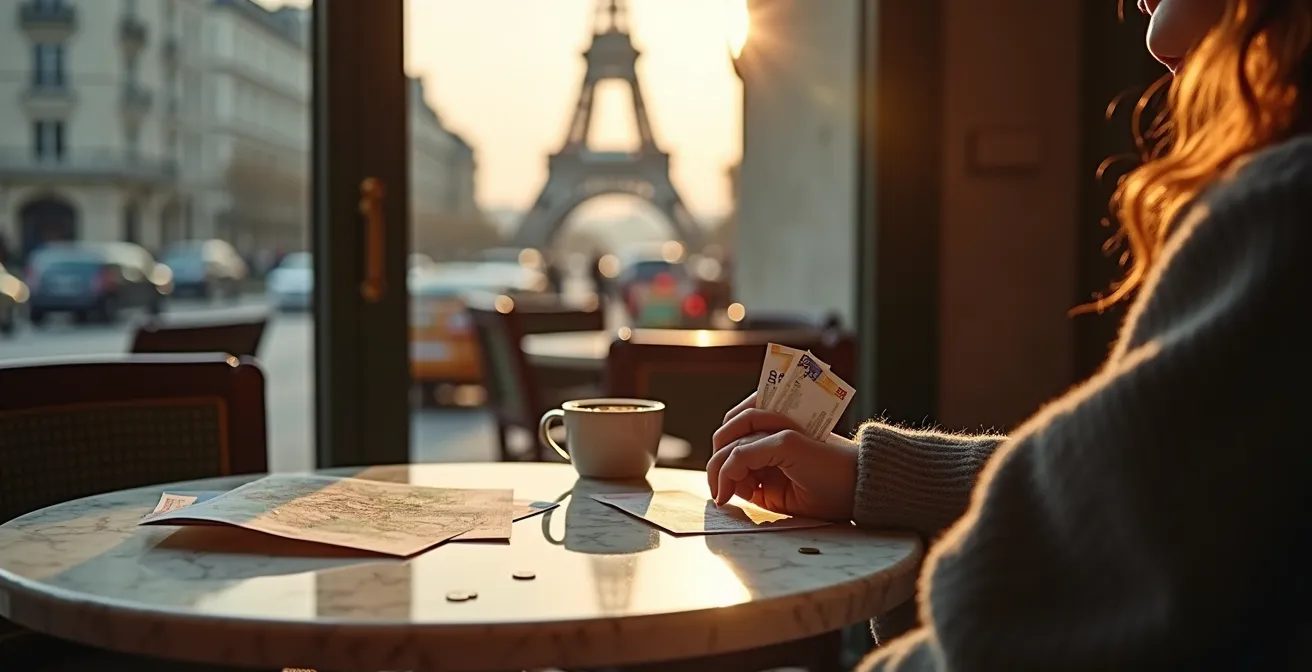
For the best value view in Paris, the real competition isn’t between the Eiffel Tower and Montparnasse Tower, but between paid icons and free, less-crowded alternatives.
- The value of a viewpoint is determined not just by its height, but by its “photographic ROI” and the level of “crowd friction.”
- Free or low-cost options like Galeries Lafayette and the Panthéon often provide superior value by minimizing queues and cost.
Recommendation: Prioritize viewpoints that offer a unique perspective and a low “experiential overhead” (time, cost, stress) to maximize your travel investment.
For decades, the pragmatic traveler visiting Paris has faced a classic dilemma: ascend the iconic Eiffel Tower for the experience, or choose the Montparnasse Tower for a superior panoramic view that includes the Iron Lady herself? This debate often revolves around a simple trade-off between iconic status and photographic composition. Standard advice suggests the Eiffel Tower is a must-do for first-timers, while Montparnasse is the connoisseur’s choice for skyline photography.
However, from a purely analytical standpoint, this binary choice is a false dichotomy. For a traveler focused on value, the question shouldn’t be limited to just two towers. A comprehensive analysis requires building a “viewpoint portfolio,” evaluating a wider range of options across the city against critical metrics. These include not only ticket price and view quality but also crowd density, queue times, photographic potential, and what can be termed “experiential overhead”—the non-monetary costs of stress and time.
This analysis moves beyond the simple “which is better” question to answer a more practical one: where can you get the highest return on your investment of time and money for a stunning view of Paris? We will deconstruct the city’s most famous viewpoints, from free rooftops to historic domes, to provide a data-driven framework for making the optimal choice. This guide will assess each option’s unique value proposition, allowing you to select the panorama that best aligns with your travel strategy.
This article provides a detailed analysis of Paris’s key viewpoints to help you decide. Explore the sections below to compare your options and find the perfect panorama for your trip.
Table of contents: An Analytical Guide to Parisian Panoramas
- Galeries Lafayette Rooftop: How to Enjoy the View Without Buying an Overpriced Drink?
- Golden Hour: When Exactly to Be at the Arc de Triomphe for the Perfect Sunset Alignment?
- Why the Pantheon Dome View Is the Least Crowded Panorama in Paris?
- Fog and Rain: Is It Worth Going Up the Eiffel Tower When Visibility Is Low?
- Les Ombres vs Ciel de Paris: Which Panoramic Restaurant Has Better Food?
- Why Climbing the Dome at 9 AM Is Crucial for a Clear View?
- Parc de Belleville: Why This View Rivals Montmartre Without the Tourists?
- Batobus or Bateaux-Mouches: Which River Cruise Suits Your Travel Style?
Galeries Lafayette Rooftop: How to Enjoy the View Without Buying an Overpriced Drink?
The Galeries Lafayette Haussmann offers one of the city’s most compelling viewpoints, primarily because its access is entirely free of charge. This immediately gives it an infinite “Value-Per-View” index from a cost perspective, a critical factor for any pragmatic traveler. The rooftop provides a stunning, direct line of sight to the Opéra Garnier and a classic Parisian skyline that includes the Eiffel Tower. The key to maximizing this value is to avoid the “experiential overhead” of unnecessary costs and crowds. The main challenge is not a ticket price, but navigating the department store and finding a good spot during peak hours.
Strategic timing is essential. The terrace is open to the public during store hours, and according to the official Galeries Lafayette website, this generally runs from 10am to 8pm daily. Arriving right at the 10 AM opening allows you to beat the tourist rush and enjoy a serene, almost private viewing experience. Another effective strategy is to visit during the typical Parisian lunch break (around 12:30 PM to 2:00 PM), when both locals and many tourists are dining elsewhere, temporarily reducing the rooftop’s population. While seasonal installations like pop-up bars and restaurants exist, participation is not mandatory to enjoy the view. You can simply walk past them to the public viewing areas.
Accessing the rooftop efficiently involves using the escalators located near the in-store café or taking the stairs from the 7th floor. This avoids the main elevator queues, further reducing your time investment. By employing a clear strategy, the Galeries Lafayette rooftop becomes a zero-cost, high-reward observation point that ranks exceptionally high in any value-based analysis of Parisian views.
Action Plan: Securing the Galeries Lafayette View
- Time Your Arrival: Arrive at 10 AM sharp as the store opens to be among the first on the terrace.
- Choose Your Route: Use the escalators or stairs from the 7th floor to bypass the main lifts and crowds.
- Monitor Conditions: Check the weather forecast beforehand, as the terrace may close during periods of bad weather.
- Leverage Lunchtime: Plan your visit between 12:30 PM and 2:00 PM when crowd levels often dip.
- Ignore the Extras: Walk past the seasonal rooftop bars and cafes directly to the free public viewing areas to enjoy the panorama without any pressure to purchase.
Golden Hour: When Exactly to Be at the Arc de Triomphe for the Perfect Sunset Alignment?
The view from the Arc de Triomphe offers a unique and powerful perspective that differs significantly from tower-based viewpoints. Its value lies not in sheer altitude, but in its unparalleled architectural symmetry. From its summit, you are positioned at the heart of the Axe Historique, looking down the Champs-Élysées towards the Place de la Concorde and the Louvre, with La Défense in the opposite direction. The photographic ROI here is exceptionally high, especially during golden hour, when the sun sets directly down the avenue on specific dates in May and August, creating a spectacular alignment.
To capture this perfect moment, precise timing is non-negotiable. “Golden hour” is the period shortly after sunrise or before sunset, but for the Arc de Triomphe alignment, you must target the exact sunset time. This requires planning weeks or even months in advance to align your visit with the solar phenomenon. Arriving at least 60-90 minutes before the scheduled sunset is critical. This buffer accounts for security checks, ticket lines (if not pre-booked), and the climb of 284 steps to the top. There is an elevator, but it does not go all the way and priority is given to those with mobility issues, so assuming you will climb is the most practical approach.
Once on the terrace, securing a prime, unobstructed spot on the Champs-Élysées side is the next objective. This space is limited and highly coveted by photographers. Being early ensures you can set up without jostling for position. The payoff is a geometrically perfect photograph where the sun’s rays and the long shadows of the trees create leading lines that converge on the horizon, an image that no other Parisian viewpoint can replicate.
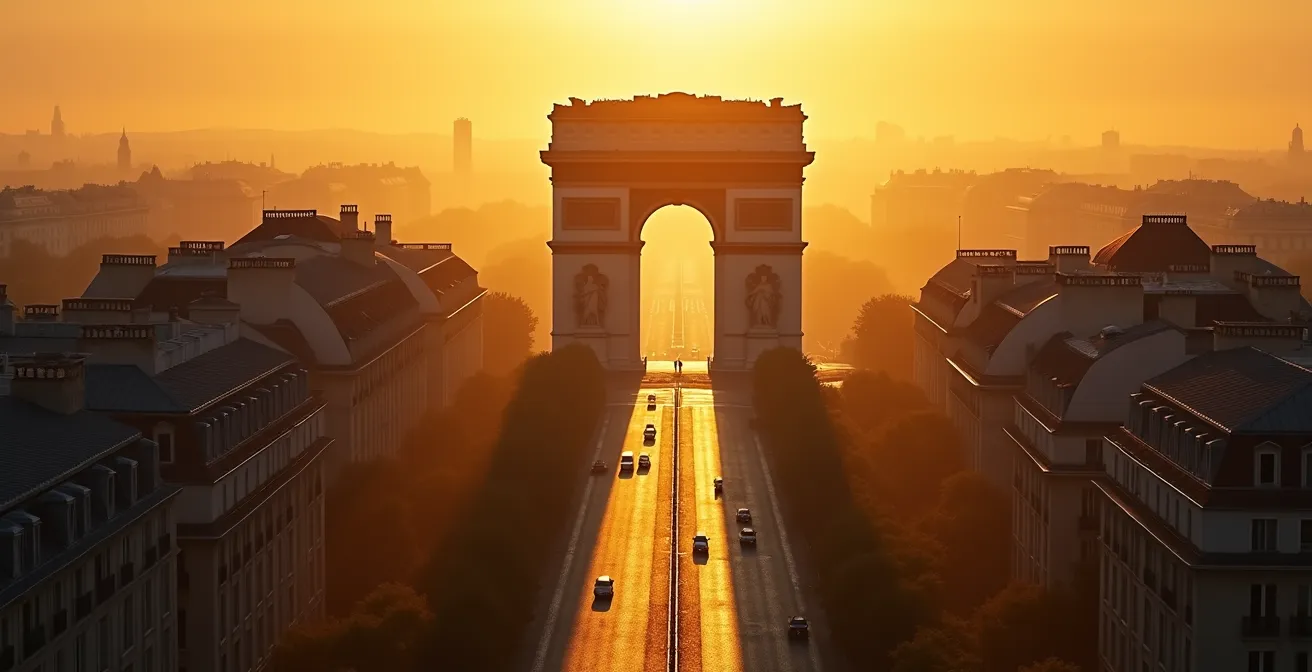
As this image demonstrates, the true value of the Arc de Triomphe is its ability to frame the urban landscape with historical and geometric precision. The experience is less about seeing everything and more about seeing a specific, perfect composition. While beautiful at any time, its value peaks for those who plan meticulously for the golden hour alignment, transforming a great view into an unforgettable photographic event.
Why the Pantheon Dome View Is the Least Crowded Panorama in Paris?
In the search for high-value viewpoints, the Panthéon’s dome is a standout performer, largely because it remains one of Paris’s best-kept secrets. While thousands visit the crypt below to pay respects to France’s national heroes, comparatively few are aware of, or choose to ascend, the dome. This results in significantly lower crowd friction compared to the Eiffel Tower or even the Arc de Triomphe, offering a more tranquil and personal viewing experience.
Several factors contribute to its under-the-radar status. First, access is seasonal and requires a separate ticket. As travel expert Džangir notes in the World in Paris guide:
Few visitors know that from April to October it is possible to climb up to the Pantheon’s cupola for one of the best views in Paris.
– Džangir, World in Paris guide
This limited-time access already filters out a large number of potential visitors. Furthermore, the ascent is only possible via a guided tour that takes you through the upper galleries before climbing the final stairs. Most critically, there is a small surcharge for this privilege. This €2 additional fee for dome access, while minor, acts as a significant deterrent for many tourists who are either on a tight budget or unaware of the option, making it a perfect example of a small barrier creating a premium experience for those willing to take the extra step.
The reward for navigating these minor hurdles is substantial. The 360-degree view from the colonnade is breathtaking, offering an intimate perspective of the Latin Quarter, the Luxembourg Gardens, and a perfectly framed view of the Eiffel Tower, often with much of the 5th arrondissement’s architecture in the foreground. For the pragmatic traveler, the Panthéon offers an almost ideal balance: a world-class view with minimal queues and crowds, all for a marginal additional cost. It is a prime example of how a little-known option can deliver outsized value.
Fog and Rain: Is It Worth Going Up the Eiffel Tower When Visibility Is Low?
A critical factor in the value equation of any viewpoint is weather dependency. The Eiffel Tower experience is profoundly diminished by fog, rain, or low-hanging clouds. Being on an open-air, windswept platform hundreds of meters in the air with zero visibility is a poor return on a significant ticket investment. In these conditions, the pragmatic choice is to pivot to a viewpoint that offers an indoor alternative, and this is where the Montparnasse Tower demonstrates its superior all-weather value proposition.
Unlike the Eiffel Tower, where the primary attraction is the outdoor deck, the Montparnasse Tower was designed with inclement weather in mind. Its 56th floor is a fully enclosed, climate-controlled observatory. Floor-to-ceiling windows provide a panoramic view that remains impressive even on overcast days, as you are often below the cloud base. More importantly, it offers supplementary indoor activities, ensuring that the visit is never a wasted effort, regardless of the visibility outside.
Case Study: Montparnasse Tower’s All-Weather Advantage
The Montparnasse Tower, located in the 15th Arrondissement, leverages its infrastructure to provide a weather-proof experience. The journey to the 56th floor via one of Europe’s fastest elevators is an attraction in itself. Upon arrival, the observatory is not just a viewing platform but an interactive space. As highlighted by tour providers like Civitatis, the indoor area features multimedia exhibitions, including interactive touch screens and virtual reality kiosks. These elements provide engaging content about the city’s landmarks, offering value and entertainment even when the panoramic view is completely obscured by fog. This makes a ticket to Montparnasse a much lower-risk investment than an Eiffel Tower ticket on a day with an uncertain forecast.
This inherent flexibility is a major asset. While the Montparnasse Tower also has an open-air rooftop terrace on the 59th floor, the robust indoor offering on the 56th floor acts as a valuable insurance policy. For the traveler analyzing risk versus reward, the Eiffel Tower is a high-risk, high-reward bet on clear skies. Montparnasse, conversely, is a safer, more reliable investment that guarantees a worthwhile experience, making it the clear winner from a value-for-money perspective when the weather is anything less than perfect.
Les Ombres vs Ciel de Paris: Which Panoramic Restaurant Has Better Food?
For travelers looking to combine a panoramic view with a dining experience, the choice of restaurant is as important as the view itself. Two of the most famous options are Les Ombres, located on the rooftop of the Musée du Quai Branly with a direct view of the Eiffel Tower, and Le Ciel de Paris, situated on the 56th floor of the Montparnasse Tower. While Les Ombres offers an unparalleled, close-up perspective of the Iron Lady, Le Ciel de Paris competes on a different axis: sheer altitude and a sweeping city-wide panorama.
From a purely geographical standpoint, Le Ciel de Paris has a distinct advantage. It is located significantly higher than its counterparts, including the Eiffel Tower’s own fine dining establishment. According to Chef Christophe Marchais, “The restaurant is located almost 50 meters above its Eiffel Tower counterpart – Le Jules Verne – and offers the unforgettable experience of dining with the City of Light at your feet.” This elevation provides a god-like perspective over the entire city, transforming the Parisian landscape into a glittering map. Food-wise, both restaurants offer high-end contemporary French cuisine, with reviews for both being generally strong but often noting that you pay a premium for the location. The decision often comes down to the type of view you prioritize.
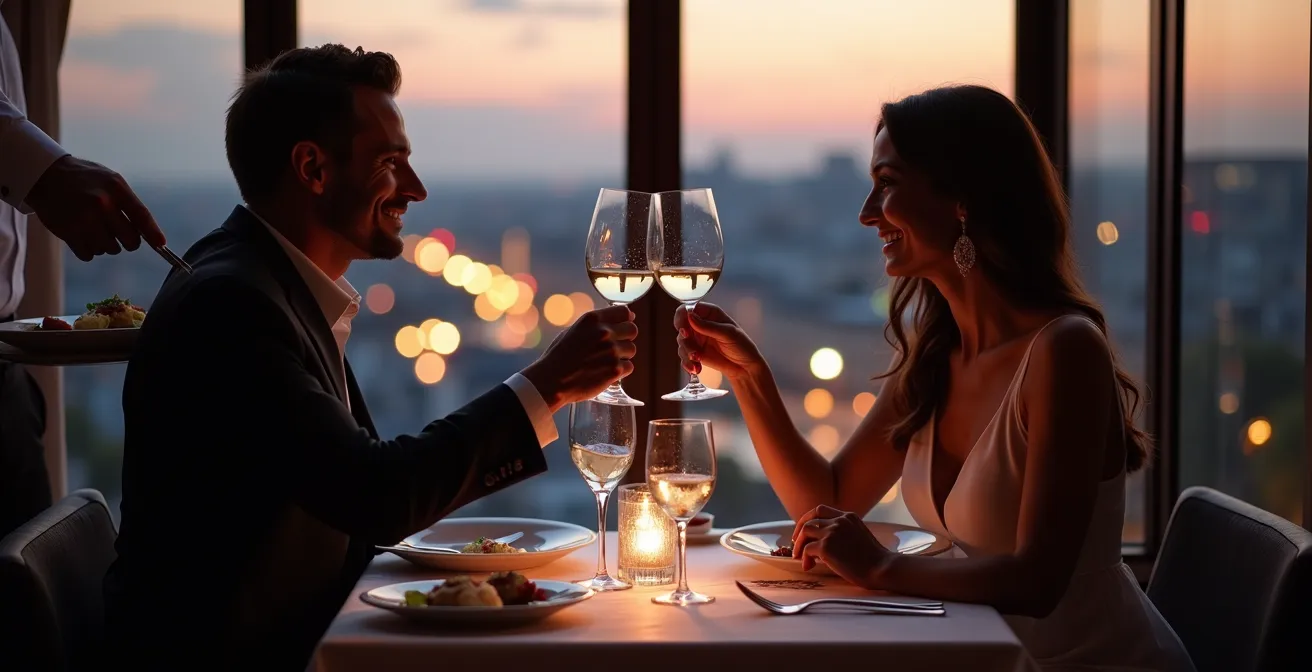
The experience at a panoramic restaurant is about ambiance as much as it is about food. Les Ombres provides a dramatic, intimate, and focused view of a single icon. In contrast, Le Ciel de Paris offers a vast, breathtaking, and impersonal vista of the entire metropolis. The culinary quality at both is designed to be high, but the choice between them is less a gastronomic one and more a decision about visual philosophy: do you want to look *at* the icon, or look out *from* above everything, with the icon as just one part of a larger tapestry?
Why Climbing the Dome at 9 AM Is Crucial for a Clear View?
While the Sacré-Cœur Basilica in Montmartre is famous for the free view from its front steps, the superior panorama is found at the top of its dome. For a small fee, visitors can climb nearly 300 stairs to access a 360-degree viewing platform that offers one of the highest natural perspectives over Paris. However, the quality of this experience is heavily dependent on timing. An early morning climb, specifically around 9 AM, is the optimal strategy for several analytical reasons.
First, arriving early allows you to avoid the tour groups and crowds that begin to flood Montmartre from 10 AM onwards. This significantly reduces crowd friction both during the narrow spiral staircase climb and on the viewing platform itself, allowing for an unhurried and unobstructed experience. Second, the morning light is ideal for photography. With the sun rising in the east, it will be behind you as you look out over the city towards the west and south, illuminating the Parisian skyline, including landmarks like the Eiffel Tower and Montparnasse Tower, without the harsh glare or backlighting that can occur later in the day.
The climb itself is part of the experience. The entrance to the dome is located on the western (left) side of the basilica’s exterior. The ascent is strenuous but rewarding, offering glimpses of the basilica’s architecture along the way. At the top, you are rewarded with a view that is both expansive and detailed. The relative quiet of the early morning enhances the magic of the panorama. As noted by travel guides, the area is particularly special at this time; you can capture the classic photo of the basilica with the carousel from the park below before the crowds arrive, and then enjoy a peaceful breakfast at one of Montmartre’s many cafés, completing a perfect morning itinerary.
Parc de Belleville: Why This View Rivals Montmartre Without the Tourists?
For the traveler whose value metrics are heavily weighted towards authenticity and tranquility, the Parc de Belleville in the 20th arrondissement presents a compelling alternative to the more famous hills of Paris. While Montmartre offers a classic, romanticized view, it comes at the cost of extreme crowds. Parc de Belleville provides a panorama of comparable scope and beauty but with a fraction of the tourists, making its “serenity-per-visit” value extremely high.
The park is situated on one of the city’s highest hills, offering a sweeping vista that includes the Eiffel Tower and other key landmarks. Its distance from the central tourist circuit means it retains a genuine local character. It’s a place where Parisians come to relax, walk their dogs, and enjoy their city. This provides an experience of authentic Parisian life that is impossible to find at the crowded summit of Montmartre. As The Girl On The Move travel guide puts it:
Parc de Belleville in the 20th Arrondissement has an incredible vantage point above the city. You can see many of the key landmarks in the distance and find peace and tranquility in this busy city.
– The Girl On The Move, Paris Travel Guide
The view from Belleville is arguably more “real.” It is less of a postcard and more of a living tapestry. You see not just the monuments but the sprawling city, its diverse architecture, and its patterns of life. The park’s terraced design, with its waterfalls and lush greenery, also makes the experience more pleasant and varied than simply standing on a crowded plaza. Reaching the top viewpoint can involve a journey via escalators, elevators, or a simple walk up the hill, integrating you into the fabric of a vibrant, multicultural neighborhood far from the souvenir shops of Montmartre.
For the pragmatic traveler, Parc de Belleville is a zero-cost, low-stress, high-reward option. It trades the iconic status of Montmartre for a more peaceful, authentic, and arguably more insightful perspective on Paris as a whole. It is the definitive choice for those looking to escape the crowds and see the city as its residents do.
Key takeaways
- The “best” view is subjective; the “best value” view is measurable, based on cost, crowds, and unique photographic potential.
- Free viewpoints like Galeries Lafayette and Parc de Belleville offer a high return on investment by eliminating ticket costs and reducing crowd-related stress.
- All-weather viability is a critical factor; indoor observatories like Montparnasse Tower offer a lower-risk investment than open-air platforms on uncertain days.
Batobus or Bateaux-Mouches: Which River Cruise Suits Your Travel Style?
A final category in our viewpoint portfolio analysis is the “mobile viewpoint” offered by Seine river cruises. These cruises provide a unique, ground-level perspective of Paris’s most famous landmarks, framed by the river and its historic bridges. The two primary models for this experience are the traditional sightseeing cruise, typified by Bateaux-Mouches, and the hop-on, hop-off water taxi service, Batobus. The choice between them depends entirely on your travel style and objectives.
The Bateaux-Mouches and similar services offer a closed-loop, relaxing tour. You embark, complete a circuit of the key sights with audio commentary, and disembark at the same point. This is ideal for travelers who want a passive, leisurely experience focused on sightseeing without the stress of navigation. It’s a contained event. In contrast, Batobus operates as a form of public transport. A day pass allows you to board and alight at multiple stops along the Seine, integrating the river journey into your broader sightseeing itinerary. This is the efficient, pragmatic choice for tourists aiming to visit several riverside attractions like the Louvre, Notre Dame, and the Eiffel Tower in a single day.
The following table breaks down the core differences, with data sourced from travel analyses showing that current pricing for basic river cruise options starts around €15.
| Feature | Batobus | Bateaux-Mouches |
|---|---|---|
| Type | Hop-on, hop-off water taxi | Closed-loop sightseeing cruise |
| Best for | Efficient tourists visiting multiple sites | Relaxing experience with commentary |
| Flexibility | Multiple stops along Seine | Fixed route, no stops |
| Price (from) | €19 day pass | €15 single cruise |
| Metro pass valid | No | No |
From a value-for-money perspective, Batobus offers greater utility for the active tourist, serving as both transport and a scenic experience. Bateaux-Mouches offers better value for those seeking pure relaxation and a condensed, guided tour. The decision hinges on whether you view the cruise as a means of transit or as the destination itself.
Ultimately, the most logical decision for a pragmatic traveler is not to blindly choose the most famous tower, but to build a diversified viewpoint portfolio. By combining a high-value free option like the Galeries Lafayette rooftop with a unique, low-crowd paid experience like the Panthéon’s dome, you can capture the best of Paris without the high costs and friction of the city’s most popular attractions. Start by mapping these viewpoints against your itinerary to build the most efficient and rewarding sightseeing plan.