In summary:
- Prioritize official transport like Noctilien buses or G7 taxis over rideshares for late-night returns, leveraging their built-in security features.
- Plan your sightseeing around the city’s new energy-saving illumination schedule, with most monuments dimming by 11 PM or 11:45 PM for the Eiffel Tower.
- For the best value and view, choose the Montparnasse Tower observation deck to see a complete panorama that includes the Eiffel Tower itself, with fewer crowds.
- Avoid dining traps near monuments by walking 5-10 minutes into local neighbourhoods like the 2nd arrondissement or South Pigalle (SoPi) for authentic, fairly priced brasseries.
- Experience a crowd-free walk along the Seine on the quays of Île Saint-Louis or near Pont de Grenelle after 11 PM, when the tourist boats have docked.
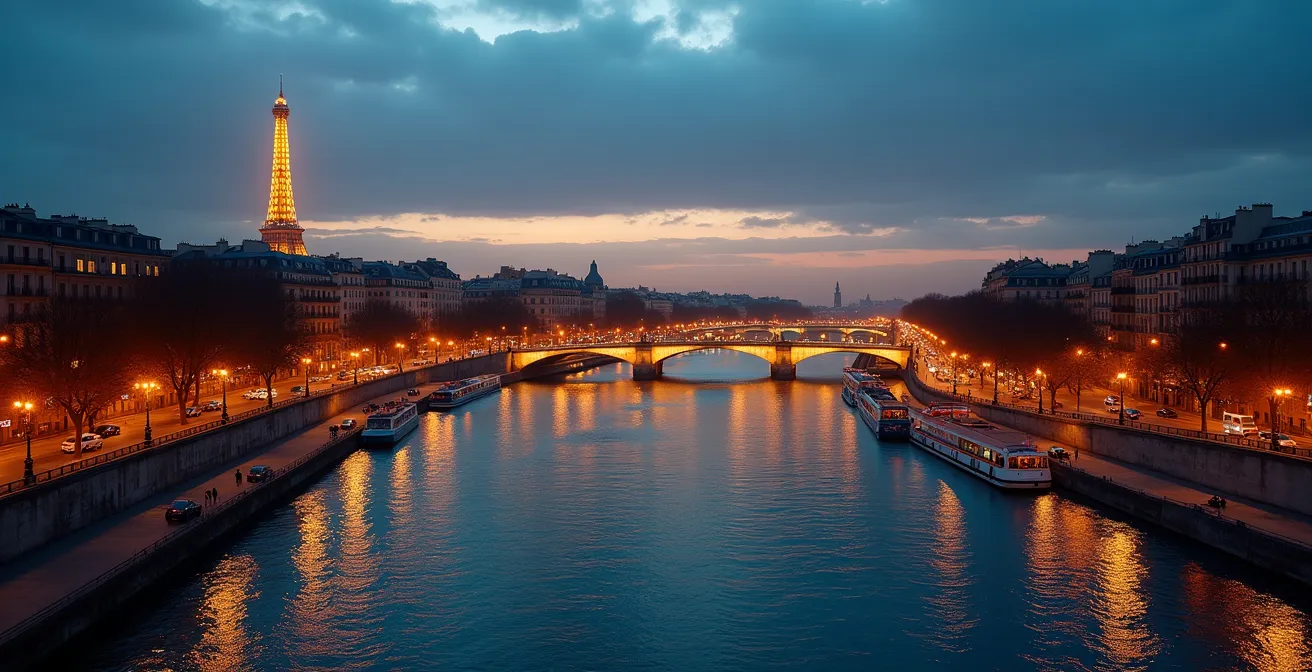
A frequent question I receive from guests as the city’s energy shifts from day to night is, “How can we truly experience Paris after 10 PM without the stress?” Many guides offer generic advice: be aware, stick to the light. While true, this advice misses the heart of the matter. Paris at night is not a monolith to be feared; it is a complex system with its own operational rhythm. Understanding this rhythm—the pulse of its late-night transport, the schedule of its illuminations, the social currents of its neighbourhoods—is the key to unlocking a truly magical and secure experience.
The common approach is to either retreat to the hotel early or venture out with a sense of apprehension. But what if the secret wasn’t just caution, but confidence born from insider knowledge? This guide is not about where you can’t go; it is about how you can go, elegantly and safely. It’s about empowering you to make concierge-level decisions, transforming logistical challenges into seamless parts of your Parisian story. We will move beyond the platitudes to give you the specific, actionable intelligence needed to navigate the City of Lights long after the sun has set.
This article provides a detailed roadmap for your nocturnal explorations. We will dissect transport options, pinpoint the most breathtaking views, demystify monument lighting schedules, and guide you to authentic late-night experiences, ensuring your Parisian nights are as memorable as your days.
Summary: Paris After 10 PM: A Concierge’s Guide to Exploring the City of Lights Safely and Efficiently
- Noctilien vs Uber: What Is the Safest Option to Return to Your Hotel at 2 AM?
- Which Bridge Offers the Best Light Show View of the Eiffel Tower in Winter?
- Why Some Monuments Turn Off Their Lights Earlier Than Expected This Year?
- The Late-Night Dining Trap Near Major Monuments That Costs 50€ for a Salad
- How to Organize a Private Night Walk Along the Seine Without Encountering Crowds?
- Pigalle at Night: Which Streets Are Trendy and Which Are Sleazy?
- Day vs Night Cruise: Why the 9 PM Slot Is Superior for Romance?
- Montparnasse Tower vs Eiffel Tower: Which Deck Offers the Best Value for Money?
Noctilien vs Uber: What Is the Safest Option to Return to Your Hotel at 2 AM?
Navigating your return journey in the small hours is a primary concern for the discerning traveler. While rideshare apps like Uber offer convenience, the official transport network provides a surprisingly robust and secure alternative. The choice between them hinges on understanding their distinct safety features. While Paris has made significant strides in security, with recent security data showing a 12% decrease in tourist-targeted crimes, a structured approach to late-night travel remains paramount.
The Noctilien night bus network is specifically designed for this purpose, operating from 12:30 AM to 5:30 AM. It’s more than just a bus; it’s a system with integrated security. Key lines are equipped with video surveillance connected to security centers, and major hubs like Châtelet or Gare Saint-Lazare are staffed. For added peace of mind, you can even request the attendant to wake you at your stop on certain lines. This structured environment offers a different kind of safety compared to the app-based features of Uber, such as GPS tracking and driver verification.
For a direct comparison, consider the following options for your late-night return.
| Transport Option | Safety Features | Cost | Availability |
|---|---|---|---|
| Noctilien Night Bus | Video surveillance, security center connection, staff at major stations | €1.50 per ticket | 12:30 AM – 5:30 AM |
| Uber/Rideshare | GPS tracking, driver verification, in-app emergency button | €15-30 average | 24/7 |
| G7 Taxi | Licensed drivers, regulated fares, official taxi status | €20-35 regulated fare | 24/7 |
Ultimately, for solo travelers or those prioritizing structural security, the Noctilien offers a reliable and remarkably cost-effective option. For door-to-door service, a licensed G7 taxi is often a more secure and regulated choice than a standard rideshare, removing the variables of surge pricing and driver availability. Choosing the right transport is the first step in mastering the city’s operational rhythm.
Which Bridge Offers the Best Light Show View of the Eiffel Tower in Winter?
Capturing the perfect, unobstructed view of the Eiffel Tower’s sparkling display is a quintessential Parisian goal. While many bridges offer a glimpse, one stands out for its superior composition, especially during the crisp nights of winter: the Pont Alexandre III. Its elegance is not merely aesthetic; it is functional, providing the ideal photographic framework. The secret lies in its specific location and architecture.
Professional photographers favor the elevated position along Cours-la-Reine, the high quay adjacent to the bridge. As an in-depth tour of Paris by night explains, this vantage point offers clear sightlines over the river traffic and is somewhat sheltered from the wind. The bridge’s single-span steel arch means no pillars obstruct the view, and its ornate, Belle Époque lampposts serve as magnificent foreground elements, framing the distant, glittering tower.
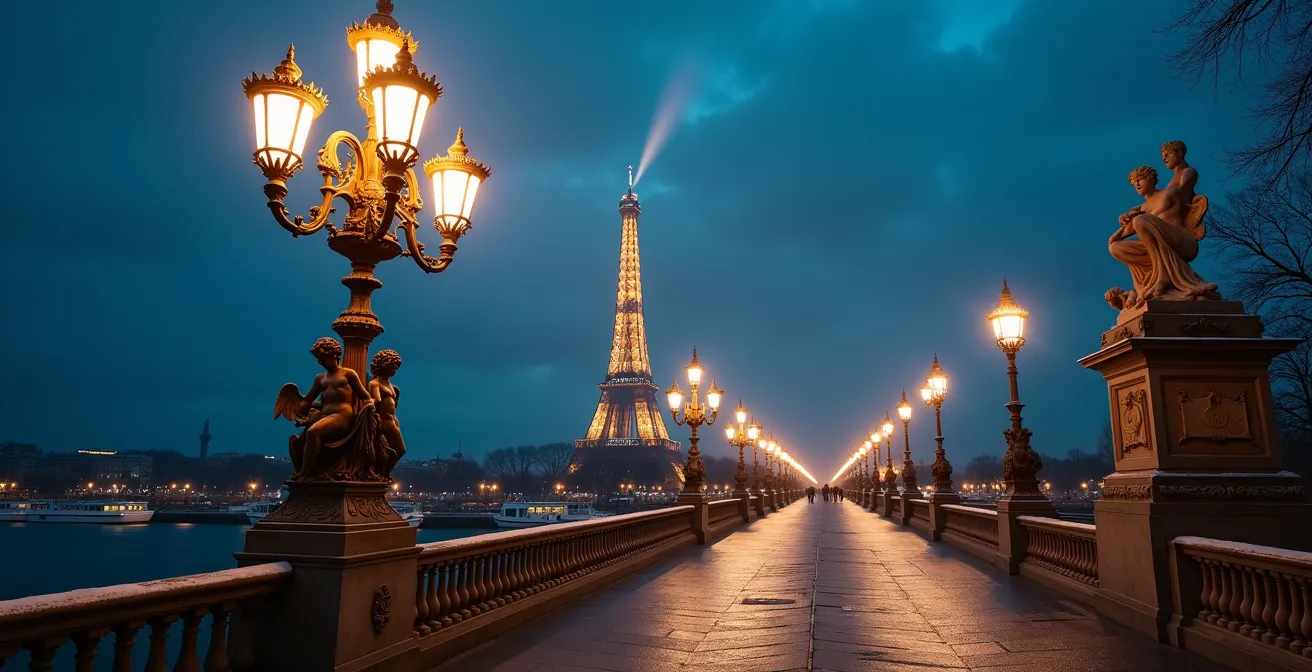
As you can see, the composition created from this spot is unparalleled. The golden cherub statues and intricate details of the bridge create a sense of depth and grandeur that other, more spartan bridges like Pont de l’Alma or Pont d’Iéna simply cannot match. It’s this combination of an unobstructed view and rich architectural foreground that makes Pont Alexandre III the concierge’s choice for a truly spectacular and memorable light show experience.
Why Some Monuments Turn Off Their Lights Earlier Than Expected This Year?
A common point of confusion for night-time explorers is arriving at a monument only to find it unexpectedly dark. This is not a random occurrence but a result of a city-wide policy adjustment. In line with France’s broader energy conservation efforts (the plan de sobriété énergétique), Paris has revised its illumination schedule for its most famous landmarks. Understanding this new operational rhythm is crucial for planning your evening itinerary.
The most significant change is the standardized switch-off time. The current energy conservation measures dictate that the decorative lighting for most major municipal monuments now goes dark at 11 PM. This is a notable shift from previous years when they often remained lit until 1 AM or later. The Eiffel Tower, being privately managed, has its own schedule: its golden illumination and the final five-minute sparkle now end at 11:45 PM. It’s a small but vital detail that can make or break a planned viewing.
To avoid disappointment, it is wise to consult this updated schedule:
- Eiffel Tower: Sparkling show ends and all lights are turned off at 11:45 PM.
- Louvre Pyramid: Illumination is switched off at 11 PM.
- Notre-Dame Facade: Lighting is extinguished at 11 PM.
- Arc de Triomphe: Lighting is significantly reduced after midnight.
Always remember to check the official Mairie de Paris website for special event exceptions, such as the Nuit Blanche, when lighting schedules can be extended. By factoring in these earlier times, you can ensure your nocturnal sightseeing is perfectly timed and brilliantly illuminated.
The Late-Night Dining Trap Near Major Monuments That Costs 50€ for a Salad
After a late-night visit to the Louvre or a stroll by the illuminated Notre-Dame, the temptation to slip into the first brightly lit restaurant is strong. Permit me to offer a piece of advice: this is often a costly mistake. The immediate vicinity of major tourist sites is rife with “tourist traps” where mediocre quality and exorbitant prices are the specials of the day. A 50€ salad is not an exaggeration in these establishments; it’s a cautionary tale.
The key to finding authentic, fairly priced late-night dining is a simple ten-minute walk. By moving away from the direct glow of the monuments, you enter the realm of genuine Parisian brasseries where locals dine. For instance, instead of eating on Rue de Rivoli opposite the Louvre, walk towards the 2nd arrondissement or the revitalized Les Halles area. Here, you’ll find classic institutions like Au Pied de Cochon, which has been serving patrons 24/7 for decades with unwavering quality. The contrast is stark: authentic spots have French-only menus and a local buzz, while traps lure you in with aggressive street touts (rabatteurs) and menus in five languages.
To arm yourself against these culinary pitfalls, it’s essential to recognize the warning signs. The following checklist will help you distinguish a neighborhood gem from a tourist trap.
Your Checklist for Avoiding Tourist Trap Restaurants
- Assess the Menu: Are menus displayed in more than 5 languages with glossy food photos? This is a major red flag indicating a focus on tourists, not quality.
- Observe the Entrance: Are there “rabatteurs” (street touts) aggressively trying to lure you inside? Authentic restaurants don’t need to solicit passersby.
- Analyze the Offer: Be wary of suspiciously low “prix fixe” menus that may hide surcharges for basic items or drinks. Always check the fine print.
- Check the Clientele: Glance inside. Is the restaurant filled with locals speaking French, or is it exclusively tourists consulting maps? The former is a sign of authenticity.
- Plan Your Escape Route: Instead of dining in the immediate shadow of a monument, commit to walking 5-10 minutes away into a residential or business area for far better options and value.
Most authentic restaurants stop serving food around 10:30 PM, but many brasseries continue service later. By applying these simple rules, you exchange a high-priced disappointment for a memorable and genuine Parisian dining experience.
How to Organize a Private Night Walk Along the Seine Without Encountering Crowds?
A romantic, tranquil walk along the Seine at night is an iconic Parisian dream. The reality, however, can often be a jostle with crowds on the main thoroughfares. The secret to achieving that peaceful, seemingly private experience lies in two factors: timing and location. It’s about understanding the neighborhood currents and the operational rhythm of the river itself.
The first rule is to begin your walk after 11 PM. This is the crucial hour when the last of the large tourist cruise boats, the Bateaux-Mouches, complete their final tours and dock for the night. Their departure signals a significant drop in foot traffic along the most popular stretches of the riverbanks. The noise and crowds dissipate, leaving the quays to the moon and the soft glow of the city’s streetlights.
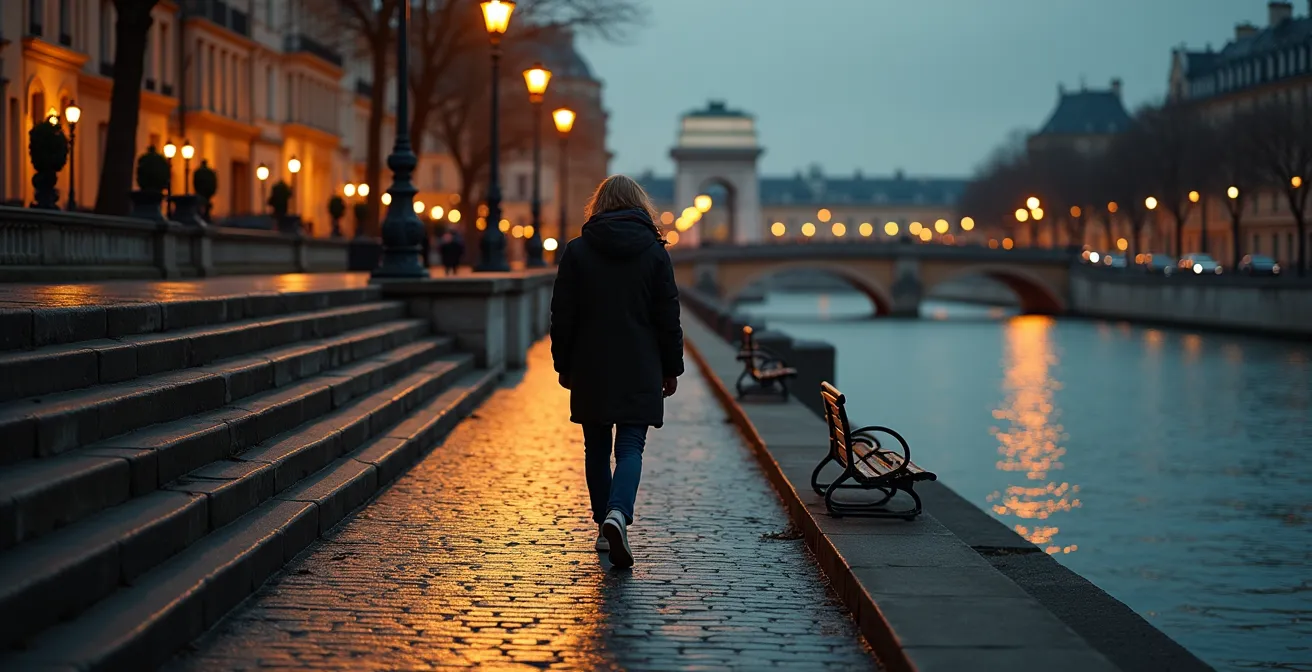
The second rule is to choose your location wisely. Instead of the bustling quays near the Eiffel Tower or Notre-Dame, opt for the quieter, more intimate sections. The stone quays surrounding Île Saint-Louis offer a historic, village-like atmosphere with stunning views back towards the city. Alternatively, the western stretch of the river near Pont de Grenelle, with its view of Paris’s own Statue of Liberty, is often deserted late at night. The upper, well-lit walkways provide a sense of security, while the river police (brigade fluviale) maintain a discreet presence on the water, ensuring a safe environment for your stroll.
Pigalle at Night: Which Streets Are Trendy and Which Are Sleazy?
Pigalle has a dual identity that can be confusing for the uninitiated. The area around Boulevard de Clichy, home to the Moulin Rouge, still retains the grit of its historic red-light district reputation. However, just a few streets away, a vibrant, gentrified neighborhood known as “SoPi” (South Pigalle) thrives with a completely different energy. Navigating these shifting neighborhood currents is key to a sophisticated night out.
As one guide notes, the area has seen a dramatic transformation.
Modern Pigalle has undergone significant gentrification, particularly South Pigalle affectionately called ‘SoPi’ by locals
– Radical Storage Travel Guide, Paris Safety Guide 2025
This gentrification has created a stark contrast. The main boulevard is for tourists and spectacle; the side streets of SoPi are for Parisians and style. Trendy cocktail bars with creative menus and speakeasy aesthetics cluster on streets like Rue Frochot and Rue Henry Monnier. The celebrated Rue des Martyrs, a food-lover’s paradise by day, maintains a hip and safe atmosphere at night with its wine bars and local bistros.
This table provides a clear guide to the area’s distinct zones:
| Area | Character | Safety Rating | What to Expect |
|---|---|---|---|
| Boulevard de Clichy | Historic red-light/tourist trap | 6/10 before midnight | Moulin Rouge crowds, street solicitors, tourist-oriented venues |
| South Pigalle (SoPi) | Gentrified/trendy | 8/10 | Cocktail bars, neo-bistros, local clientele |
| Rue des Martyrs | Hip local scene | 9/10 | Artisan shops, wine bars, safe late night |
| North of Clichy | Caution advised | 4/10 after midnight | Less policing, adult venues, avoid late night |
The concierge’s rule of thumb is simple: enjoy the spectacle of the Moulin Rouge on Boulevard de Clichy, but then immediately retreat south into SoPi for your drinks and dining. Ignore any street solicitors and seek out the establishments with local clientele to experience the truly fashionable side of Pigalle.
Day vs Night Cruise: Why the 9 PM Slot Is Superior for Romance?
A cruise on the Seine is a classic Parisian experience, but the timing of that cruise can dramatically alter its character. While a daytime trip offers clear views of architecture, a night cruise is steeped in romance. Among all the evening slots, the 9 PM departure stands out as unequivocally superior, particularly for couples. This is because it perfectly captures the magical “blue hour” transition.
Starting your cruise at 9 PM allows you to witness the city’s transformation. You begin in the soft, ethereal light of twilight, seeing monuments with the last vestiges of natural daylight, and end in the full, dramatic splendor of night-time illumination. This timing is also strategically synchronized with the Eiffel Tower’s light show. Your boat will pass the iconic landmark precisely as it begins to sparkle at both 9 PM and 10 PM, offering two opportunities for that perfect, glittering view from the water. The immense popularity and high quality of these evening cruises are reflected in how travelers rate them; evening cruise ratings demonstrate a satisfaction of 4.4 out of 5 stars across thousands of reviews.
Furthermore, many cruise lines, such as Bateaux Parisiens, offer their premier dinner cruise options at this hour. You can enhance the experience with VIP seating and a bottle of champagne, turning the sightseeing journey into a full-fledged romantic event. The combination of the “blue hour,” the synchronized sparkle of the tower, and the availability of premium services makes the 9 PM slot the most strategic choice for an unforgettable and romantic evening on the Seine.
Key Takeaways
- Mastering Paris at night is less about avoiding danger and more about understanding the city’s predictable systems, from transport to lighting.
- The best experiences—views, dining, walks—are often found by moving just slightly away from the main tourist-heavy centers.
- Making informed, strategic choices, such as selecting the Montparnasse Tower for its view or the 9 PM cruise for its light, elevates a standard trip into a curated, memorable event.
Montparnasse Tower vs Eiffel Tower: Which Deck Offers the Best Value for Money?
For a panoramic view of Paris by night, the Eiffel Tower is the default choice for many. However, the discerning traveler should seriously consider its less glamorous but arguably superior rival: the Montparnasse Tower. While it may lack the iconic status, it offers a better overall experience and, crucially, a better view for one simple reason. This is best captured by a witty Parisian saying.
The view from the top of the Montparnasse Tower is the most beautiful in Paris because it’s the only place from which you can’t see the Montparnasse Tower.
– Popular Parisian saying, Paris Tourism Commentary
This joke holds a profound truth: a panorama of Paris is incomplete without its most famous landmark. From the Montparnasse Tower, you get a breathtaking, unobstructed view of the entire city, with the glittering Eiffel Tower as its magnificent centerpiece. The value proposition extends beyond just the view. Wait times are significantly shorter, often minutes compared to the 1-2 hour queues common at the Eiffel Tower. The 56th-floor observation deck is fully enclosed and climate-controlled, with an open-air terrace on the roof, offering comfort in any weather—a stark contrast to the often windy and cold open-air decks of the Eiffel Tower.
This direct comparison highlights the practical advantages:
| Feature | Montparnasse Tower | Eiffel Tower |
|---|---|---|
| View Quality | Includes Eiffel Tower in panorama | City view without the tower itself |
| Wait Times | Significantly shorter | Often 1-2 hours |
| Comfort | Enclosed with open-air terrace | Mostly open-air, cold/windy |
| Transport Access | Major metro hub Montparnasse-Bienvenüe | Multiple metro lines but crowded |
| Late Night Options | Nearby brasseries open late | Limited dining nearby after 10 PM |
For value, comfort, and the quality of the panoramic photo you’ll bring home, the Montparnasse Tower is the clear concierge’s choice. It delivers the superior product, even if it doesn’t have the same brand recognition.
Now that you are equipped with the logistics for a safe and efficient evening, the final step is to embrace the mindset of a prepared explorer. Your magical night in Paris awaits, built on a foundation of smart, informed decisions.